

The riskiest moment in the entire sale isn't the transaction. It's the forty-five minutes a staff member spends inside a stranger's living room with a tray of loose diamonds and a signed invoice that says nothing about what happens if a stone goes missing while the dog knocks over a coffee table.
White-glove delivery and in-home viewing have quietly become expectations at the top tier of jewelry buyers. They don't want to drive to the store for a $90k anniversary band selection. They want you to come to them. That's fine — it converts beautifully — but most stores set it up by improvising, and the gaps only show up after something goes wrong.
This is a tight operational playbook for the parts nobody writes down: who you agree to visit, how the escort runs, what evidence you capture at handoff, and the exact waiver and insurer-notification steps that protect you when a high-value piece leaves the building.
Start with vetting, because not every address is worth the visit
The instinct is to treat every white-glove request as a VIP opportunity. It isn't. A good portion of in-home viewing requests for high-value jewelry come from people who either can't actually transact at that level or, occasionally, are setting up something you don't want to walk into.
Vetting happens before anyone schedules a van. What works is a short structured intake that your sales associate fills out while the customer is still engaged and talking — not a form emailed later that never comes back.
Customer vetting fields to capture before approving an in-home visit:
-
Full legal name and the name the appointment is booked under (flag mismatches)
-
Verified phone number — call it back once, don't just text
-
Residential address plus confirmation they own or lease it (a quick "how long have you been at this place?" tells you a lot)
-
Prior purchase history or relationship with the store
-
Estimated budget and the specific pieces requested
-
Payment method confirmed in advance (wire, card on file, financing pre-approval)
-
Who else will be present during the viewing
-
Secondary ID verification at the door (driver's license photo matched to booking name)
-
Ground-floor vs. upper-floor, gated community, building access notes
-
Any red-flag notes from the associate's gut read
That last field matters more than people admit. A typical problem profile looks like this: a buyer who insists on evenings only, won't confirm a long-term address, and keeps steering the conversation toward "bringing the most expensive pieces so I can see options." None of those individually kills the appointment. All three together should trigger a manager review before you commit inventory.
For buyers who found you online, vetting is even more important because you have no in-person read to go on. A lot of the trust groundwork for those customers actually starts on your site — the same trust signals that keep high-value online buyers from bouncing are what make a legitimate high-net-worth buyer comfortable requesting a visit in the first place.
Where to draw the line
Set a hard floor. White-glove visits cost real money once you factor in two staff members, transit insurance riders, and the opportunity cost of pulling a senior associate off the floor. A single in-home viewing with two people and a security escort can run somewhere in the $250–$500 range in loaded labor and insurance before anyone sells anything.
When in-home viewing makes sense:
-
Established clients with purchase history above a threshold you set
-
Confirmed budget that clears your minimum (many stores land around $25k–$50k)
-
Bridal or estate buyers where the emotional context genuinely benefits from a home setting
When it's a bad idea:
-
First-time contact with no verifiable history and an evening-only, address-vague profile
-
Requests that start with "bring everything expensive"
-
Locations your security protocol can't adequately cover (remote, no cell signal, no safe transit route)
You're allowed to decline. A polite "we'd love to host you in our private viewing room instead" filters out a surprising number of problems. Much of the pre-visit discipline here overlaps with your in-store high-value appointment capture and prep process — the home visit is just that same rigor extended past your front door.
The escort SOP: two people, one chain of custody, zero improvisation
Once a visit is approved, the delivery and escort procedure needs to be boring and repeatable. The failures almost always come from a single person going solo "just this once" or from nobody logging when the merchandise physically changed hands.
Never miss a sale or shipment again.
Jewlyly helps you manage orders, track inventory, and engage customers seamlessly.
- Real-time inventory tracking
- Automated customer notifications
- Sales and order analytics
No credit card required
Here's the core sequence for every visit:
-
Pre-load manifest. Two staff count and photograph every piece leaving the store against a signed manifest. Each item logged by SKU, with a timestamp and both signatures.
-
Transit assignment. Never one person. One carries/handles, one drives and observes. For pieces above a certain value, a licensed security escort rides along.
-
Confirmed arrival check-in. The transit team texts a check-in to a manager the moment they arrive. A missed check-in triggers a call within a set window.
-
Door-side ID verification. Match the photo ID to the booking name before merchandise enters the home. No match, no viewing.
-
Controlled presentation. One associate presents, one maintains line-of-sight on the full tray at all times. Nothing gets handed around freely. Pieces are tried on one at a time and returned to the tray before the next comes out.
-
Close-out count. Before leaving, both staff recount the manifest against physical inventory, in front of the customer. This is the single most important step and the one most often skipped when everyone's tired and the sale just closed.
-
Return check-in and reconciliation. Merchandise re-logged at the store, manifest reconciled, any sold items moved to the transaction record immediately.
The non-negotiable rule inside all of this: the tray is never unattended and never fully out of one person's sight. The most common in-home loss isn't dramatic theft — it's a piece that slips under a cushion or gets set down on a side table during an emotional moment and nobody notices until the count is already off and three days have passed.
Keep a laminated close-out count sheet and have both staff sign it in front of the customer every time.
Below is a visual summary of the escort workflow.
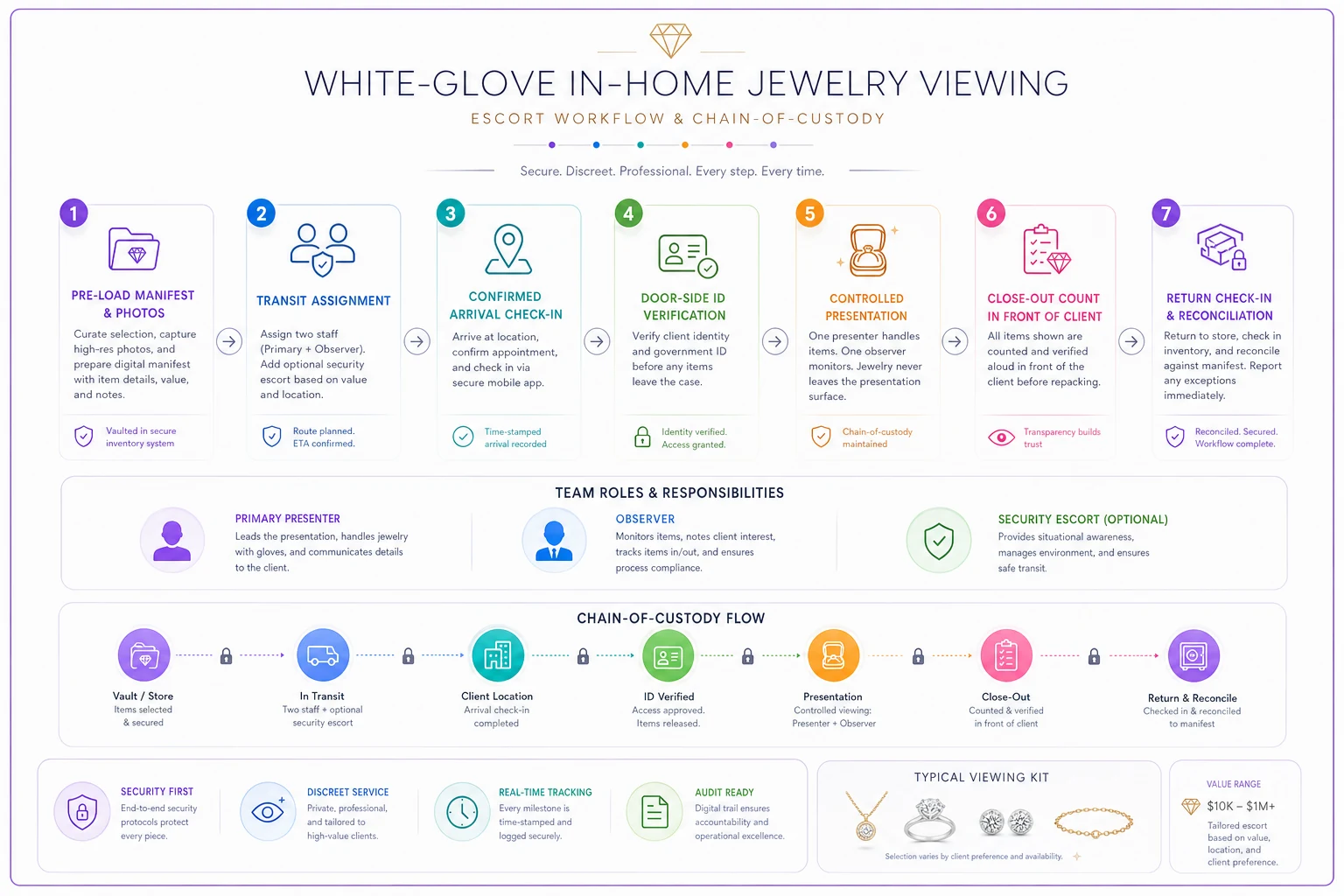
A lot of stores already run a secure shipping and transit playbook for high-value orders; think of the in-home escort as the same chain-of-custody logic, except the "carrier" is your own staff and the delivery point is someone's kitchen table.
Proof-of-delivery evidence: capture it like you'll need it in a dispute
Assume every white-glove visit might end in a dispute, and document accordingly. The cost of over-documenting is a few extra minutes. The cost of under-documenting is a claim you can't substantiate or a "that's not the ring I agreed to buy" argument you can't win.
Proof-of-delivery evidence checklist:
-
Timestamped photo of each piece at store departure (the pre-load manifest shots)
-
Signed delivery manifest listing every SKU present at the viewing
-
Photo of the customer's ID matched to the booking name (where legally permitted — check your state rules)
-
Signed receipt of any item sold, with item description, SKU, and price
-
A signed "items returned" confirmation for everything that went back
-
Timestamped close-out count photos showing full tray intact at departure
-
Any written acknowledgment of the liability waiver (covered next)
-
Transit team check-in/check-out log
| Evidence gap | What goes wrong without it | What the evidence proves |
|---|---|---|
| No departure photos | Can't prove the piece ever left intact | Condition and presence at handoff |
| No signed return count | Customer later claims an item was "left behind" | Full tray accounted for on exit |
| No ID match on record | Fraudulent buyer disputes the transaction | Identity of the person who received goods |
| No waiver acknowledgment | Store liable for in-home accidents | Customer accepted terms of the visit |
| No transit log | Insurer questions chain of custody on a claim | Unbroken custody from store to home and back |
Evidence captured at the moment of handoff is worth ten times the same information reconstructed later from memory. A signed return count takes ninety seconds and ends most "missing item" disputes before they start.
Liability waivers and sample language
The in-home environment introduces risks the store never signed up for. Someone's hardwood floor gets scratched by a display case. A ring is dropped and chipped during try-on. A guest at the home handles a piece without permission. Without a waiver, you're exposed on all of it.
Keep the waiver short and plain. A wall of legalese gets skimmed and resented. Have your own attorney review and localize this — treat the language below as a starting template, not legal advice:
> In-Home Viewing Acknowledgment > I, [Customer Name], have requested a private in-home viewing of jewelry from [Store Name] at the address and date listed above. I understand that: > > 1. All merchandise remains the exclusive property of [Store Name] until a sale is completed and payment is received in full. > 2. I am responsible for the safekeeping of any piece I personally handle during the viewing, and for any damage caused by me or by other persons present at my invitation. > 3. [Store Name] staff will conduct an item count at the start and end of the viewing. My signature below confirms that all items were accounted for at the conclusion of the visit. > 4. [Store Name] and its staff are not responsible for incidental damage to the premises arising from the normal conduct of the viewing, except in cases of staff negligence. > 5. I confirm the identity information provided matches my valid government-issued ID. > > Customer signature: Date: > Staff witness: Date:
Clause #3 — the item-count acknowledgment — is the one that saves you most often. It converts a vague accusation into a signed statement confirming everything was present when staff left.
Who should not skip the waiver: anyone running estate buys in homes, anyone doing consignment-style viewings, and any store letting a solo associate handle a visit (which, again, you shouldn't be doing in the first place).
Insurer notification: do it before the visit, not after a loss
This is where most stores get burned. Their jewelers block policy or in-store coverage quietly excludes off-premises exposure, or requires advance notification for any piece above a stated value leaving the premises. They find this out the day they file a claim.
Insurer notification steps for white-glove visits:
-
Confirm your policy's off-premises terms in writing — what's covered, the per-piece and per-trip limits, and any notification requirement.
-
Establish the notification threshold with your broker. Many policies require advance notice for off-premises values above a set figure.
-
Notify before high-value visits that cross that threshold — destination, estimated value, date, and transit method.
-
Confirm escort requirements. Some policies mandate a licensed security escort above certain values; skipping it can void coverage.
-
Keep proof of notification attached to that visit's record alongside the manifest and evidence package.
-
File promptly and completely if anything goes wrong — your departure photos, manifest, and transit log are exactly what the adjuster will ask for.
Worth noting: your proof-of-delivery evidence and your insurer notification are the same documentation serving two purposes. Build the record once, and it covers both the dispute and the claim.
A real scenario
A single-location store running roughly 15–20 in-home visits per quarter — bridal and estate clients — had no formal process in place. One evening visit ended with a tray coming back one pair of earrings short, around $8k at cost. The associate was certain they'd packed it; the customer was certain they hadn't touched it. No close-out count, no departure photos, no signed return form. The store ate the loss, and the insurer pushed back hard on the claim because there was no chain-of-custody record to reference.
They rebuilt the process: two-person rule, pre-load photos, a laminated close-out count sheet signed in front of the customer, and a one-line waiver. Over the following months, the disputes effectively stopped. More interesting, conversion on those visits held steady — the added structure didn't cool off the experience. Clients read the count and signature as professionalism, not suspicion.
The takeaway isn't the saved earrings. Every piece of documentation they added cost a couple of extra minutes per visit, and it closed the exact gap that had already cost them $8k once.
Keeping the whole thing coordinated
The hard part of white-glove delivery jewelry operations isn't any single step — it's that the vetting form, the manifest, the evidence photos, the waiver, and the insurer notification all live in different places and depend on a busy associate remembering to complete each one under pressure. That's where most of the breakdowns happen: not from bad intent, but from a skipped step on a long day.
An AI-powered operational platform that ties the appointment record to a required vetting checklist, prevents merchandise from being marked "out" until a pre-load count is completed, and holds the signed waiver and return count against that same record removes the "I forgot to do the close-out form" failure entirely. The value isn't the software for its own sake — it's that the risky steps stop being optional. When the system won't let you close a visit without a reconciled count, the count happens every time.
Set the process up properly once, and in-home viewing becomes one of your highest-converting, lowest-drama offerings — instead of the thing you quietly worry about every time a van leaves the parking lot.
Ready to elevate your jewelry store operations?
Join 500+ jewelers using Jewlyly to increase efficiency, reduce errors, and grow revenue.