

Most jewelers already know they should show certificates, appraisals, and lab reports online. The problem isn't whether to show evidence. It's what to show, where to show it, and how much to reveal before a buyer either trusts you enough to check out — or gets nervous and bounces.
That middle layer is where a lot of stores quietly lose money. They either dump a full GIA report as a downloadable PDF (with the report number sitting in plain text for anyone to clone onto a knockoff listing), or they hide everything behind "contact us for details," which kills the sale for a first-time online buyer spending $4,000 on a ring they can't hold.
The stores that get this right treat evidence like a system, not a bunch of file uploads. They decide, deliberately, which fragment of proof shows up on the listing, which shows up in the cart, and which only appears after purchase. They tokenize sensitive documents so the report is verifiable but not copyable. And they actually measure whether any of it moves conversion — or just makes the page look more credible.
That's what this piece is about: jewelry e-commerce trust signals as a governed process. Progressive disclosure, redaction patterns, structured data for certificates, and a real measurement plan tied to conversion and chargebacks.
Why "show everything" and "show nothing" both cost you
There's a reason evidence governance is messy in jewelry specifically. Your inventory is high-value, often one-of-a-kind, and heavily documented — lab grading reports, independent appraisals, provenance paperwork, hallmark photos. Every one of those documents contains information that's useful to a buyer but also useful to a fraudster or a competitor.
A full GIA or IGI report shows the report number. That number is checkable on the lab's public database. Great for trust — until someone screenshots your listing, lifts the number, and pairs it with a cubic zirconia on a marketplace. Now the real report is validating a fake stone, and the confused buyer's first call is to you.
On the other end, the "email us for the certificate" approach leaks buyers at the worst moment. Someone emotionally ready to buy an engagement ring at 11pm doesn't want to wait until morning for a PDF. They want reassurance now, and if they don't get it, they open three more tabs.
What tends to hold across high-ticket catalogs is that the win isn't more evidence or less evidence — it's staged evidence. You reveal proof in layers that match where the buyer is in the decision and how much exposure the store can tolerate.
Progressive disclosure: what to show where
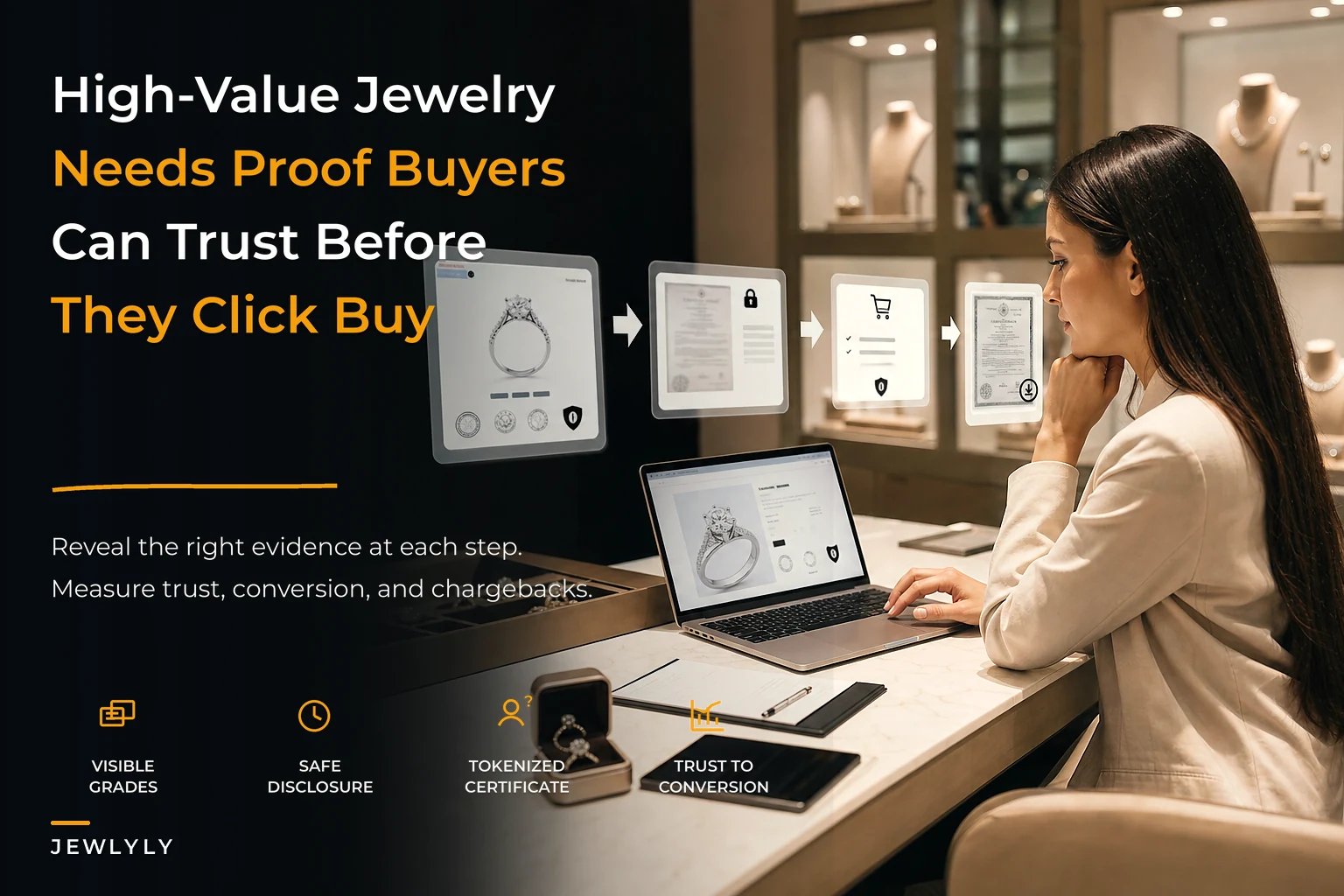
Think of your product page and checkout flow as having distinct zones. Each zone gets a different slice of the evidence. The further a buyer moves toward paying, the more verifiable and specific the proof becomes.
Never miss a sale or shipment again.
Jewlyly helps you manage orders, track inventory, and engage customers seamlessly.
- Real-time inventory tracking
- Automated customer notifications
- Sales and order analytics
No credit card required
| Stage | What buyer sees | What stays hidden | Why |
|---|---|---|---|
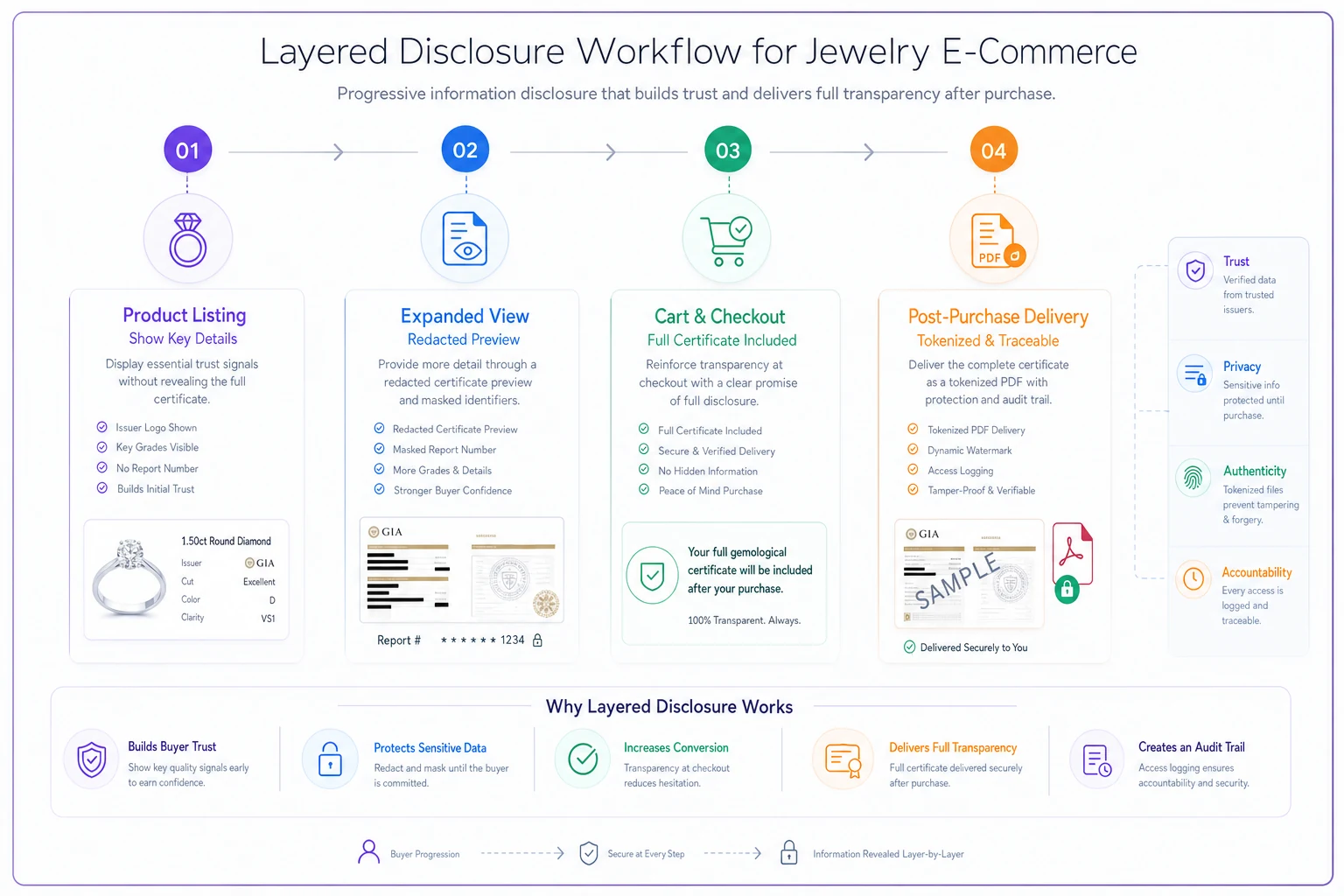
| Listing / product page | Certificate type + issuer logo, key grades (carat, color, clarity, cut), a watermarked thumbnail of the report | Full report number, appraiser signature, high-res scan | Establishes credibility, gives nothing copyable |
| Expanded "view details" | Redacted report preview, structured spec table, hallmark close-ups | Report number (partial mask), owner/provenance details | Buyer inspecting seriously; still no clonable data |
| Cart / checkout | "Full certificate included, verifiable on issuer database after purchase" statement, warranty + return terms | Actual document | Reassurance without exposure |
| Post-purchase (verified buyer) | Full tokenized PDF, unmasked report number, verification link | — | Buyer is now identified and paid; exposure risk drops sharply |
The report number is the single most sensitive field on a lab report, and it's the one most stores leak by default. Mask it everywhere pre-purchase. The grades themselves can be shown freely — grades alone can't authenticate a fake because they aren't tied to a checkable record.
A second pattern worth stealing: on the listing, show the issuer's logo, not a screenshot of the certificate. A GIA or AGS logo carries trust weight on its own, and it doesn't hand a fraudster anything to copy. Save the actual document imagery for the redacted preview one click deeper.
Mask report numbers everywhere pre-purchase to reduce fraud risk while keeping grades visible.
Here's a simple visualization of that layered disclosure workflow.
This layering only works if your product data is clean underneath it. If grades, issuer info, and report references live in structured fields rather than scattered across description text, you can drive disclosure rules automatically instead of hand-building every page. That structure is exactly what a solid jewelry product-data model for structured attributes and feeds gives you — the disclosure logic reads from the fields, so a ring's certificate type or masked report number renders correctly without someone remembering to do it manually.
Redaction and tokenized PDF patterns
"Redaction" in most stores means someone drew a black box over a report number in a screenshot. That's not really redaction — the text is often still selectable underneath, and even flattened images get re-typed by anyone motivated enough. If you're going to publish document evidence at all, do it properly.
Two patterns matter here, and they serve different purposes.
1. True redaction for pre-purchase previews. When you show a report preview on the expanded product view, sensitive fields should be removed from the file, not covered. That means regenerating the PDF or image with the report number, appraiser signature, and any owner/provenance line stripped or replaced with XXXX. Flatten it to a rasterized image so there's no underlying text layer to lift. Add a diagonal watermark along the lines of "PREVIEW — VERIFY AFTER PURCHASE."
2. Tokenized full documents for verified buyers. After purchase, the buyer needs the real thing — but you still don't want it floating around as a plain downloadable file that gets shared, indexed, or reused. Tokenized delivery handles this:
-
Generate a unique, expiring access link tied to the order and buyer.
-
Watermark the delivered PDF with the buyer's name and order number (so a leaked copy traces back to a source).
-
Log every access — who opened it, when, from where.
Here's a practical redaction ruleset to apply before any document touches a public page:
-
Always remove pre-purchase report/certificate number, appraiser or grader signature, unique laser inscription IDs, prior owner names, insurance policy references, internal SKU or cost notes.
-
Always keep issuer name and logo, grade values (4Cs, metal purity, carat weight), issue date (month/year only), document type.
-
Mask, don't delete, on the expanded view report number shown as
2••••••357so the buyer knows it exists and is real, without the full string being usable. -
Never publish as a live text layer any full-resolution scan. Rasterize and watermark, always.
The connective tissue here is your document backend. If your certificates aren't named, tagged, and stored consistently, redaction becomes a manual scramble every time a new listing goes up. The naming and storage discipline in a proper certificate and appraisal workflow for jewelers is what makes automated redaction and tokenized delivery possible at all — you can't tokenize what you can't reliably locate.
And the preview imagery needs the same care you'd give a product shot. A blurry, badly cropped certificate scan reads as suspicious, not reassuring. The same product photography discipline that prevents claims and lost sales applies to document previews — consistent crops, legible grades, clean watermarking.
Structured data for certificate metadata
Buyers aren't the only audience for your evidence. Search engines are reading your product pages too, and structured data lets you surface certificate metadata in a way that reinforces credibility and can influence how listings appear in results.
The mistake most stores make is burying certificate info in prose — "This stunning diamond comes with a GIA certificate…" — where it's invisible to structured parsing. Express it as machine-readable metadata alongside your Product schema instead.
{ "@type": "Product", "name": "1.24ct Round Brilliant Diamond Ring", "brand": "Your Store", "additionalProperty": [ { "@type": "PropertyValue", "name": "Certificate Issuer", "value": "GIA" }, { "@type": "PropertyValue", "name": "Certificate Type", "value": "Diamond Grading Report" }, { "@type": "PropertyValue", "name": "Carat Weight", "value": "1.24" }, { "@type": "PropertyValue", "name": "Color Grade", "value": "F" }, { "@type": "PropertyValue", "name": "Clarity Grade", "value": "VS1" }, { "@type": "PropertyValue", "name": "Cut Grade", "value": "Excellent" } ] }
Notice what's not in there: the report number. Same governance rule applies to structured data as to the visible page — don't expose the checkable identifier pre-purchase. You can mark that the report exists, name the issuer, and list the grades, but the unique number stays out of public markup.
The payoff is subtle but real. Structured grade data helps your listing show richer results, and it keeps certificate facts consistent everywhere they appear — the page, the feed, shopping surfaces. Buyers get nervous when the carat weight in the title doesn't match the number in the description. When everything reads from the same structured fields, those mismatches stop happening.
Sample disclosure templates
Concrete language moves faster than theory. Here are disclosure snippets you can adapt for each zone.
> Independently graded by GIA. Full grading report included with purchase and verifiable directly on GIA's database. Report number provided upon completion of your order for security.
> Preview of the accompanying grading report shown below. Sensitive identifiers are masked to protect against fraudulent reuse. The complete, verifiable report is delivered securely after purchase.
> Your purchase includes the original certificate and independent appraisal. Both are delivered as secured, watermarked documents within [X hours] of your order, with a direct link to verify authenticity on the issuer's official database.
> Attached is your grading report and appraisal, watermarked to your order for your protection. You can verify the report number directly at [issuer verification URL]. Please keep these documents for insurance purposes.
That last one does double duty — it delivers proof and nudges the buyer toward insuring the piece, which reduces "it was never worth what I paid" disputes down the line.
The measurement plan: does any of this actually work?
Trust signals get added on gut instinct and rarely get measured properly. That's a mistake, because some of them genuinely help conversion and some do nothing — and a few can actually hurt by cluttering the page or introducing friction. You need to know which is which.
Run this as a structured A/B program, not a one-off "we added badges and sales went up" assumption.
The core KPIs to track:
-
Add-to-cart rate — early signal that evidence is building enough confidence to engage.
-
Checkout conversion rate — the real money metric.
-
Time-to-purchase for high-value items — trust signals often shorten the deliberation window.
-
Return rate — better evidence should reduce "not as described" returns.
-
Chargeback rate — the one most stores forget, and arguably the most important for high-ticket.
-
Dispute win rate — when a chargeback happens, do your logged, tokenized documents help you win it?
Here's a numbered process for running it cleanly:
-
Pick one variable per test. Don't add redacted previews, structured data, and a new badge all at once. Test the redacted certificate preview alone first.
-
Segment by price band. Trust signals behave very differently on a $180 pair of studs versus a $6,000 engagement ring. Run tests within a band, not across your whole catalog.
-
Set a minimum sample. High-ticket traffic is thin, so give it real time — often 4–8 weeks per test rather than a few days.
-
Track chargebacks on a lag. A chargeback can land 30–90 days after purchase. Don't declare a winner on conversion before the chargeback window matures.
-
Log the document access data. Tie it back — did buyers who opened their tokenized certificate charge back less often?
-
Kill or keep based on combined effect. A change that lifts conversion 4% but raises chargebacks isn't a win.
A worked measurement dashboard
| Metric | Control | Variant | Read |
|---|---|---|---|
| Add-to-cart rate | 6.2% | 7.4% | Variant building more confidence |
| Checkout conversion | 2.1% | 2.6% | Meaningful lift on high-ticket |
| Avg. time-to-purchase | ~9 days | ~6 days | Evidence shortening deliberation |
| Return rate | 4.8% | 3.9% | Fewer "not as described" |
| Chargeback rate (90-day) | 1.3% | 0.8% | Fewer disputes — strong signal |
| Dispute win rate | 41% | 63% | Logged/tokenized docs winning cases |
The chargeback and dispute-win rows are where governed evidence quietly pays for itself. On a $5,000 order, one avoided chargeback can outweigh a whole month of marginal conversion tweaks.
A real scenario
A specialty bridal jeweler doing most of its high-ticket business online was running somewhere around 30–40 diamond ring orders a month, averaging close to $4,500 per order. They were posting full lab reports as open PDFs — report numbers fully visible — because they figured more proof was always better.
Two problems stacked up. First, they got flagged when a report number tied to one of their stones showed up validating a knockoff on a marketplace, which triggered a messy customer complaint that wasn't even their sale. Second, their chargeback rate on online rings was sitting just over 1.5%, and they were losing more disputes than they won because they couldn't prove which buyer received which document.
They rebuilt the flow: masked report numbers everywhere pre-purchase, rasterized watermarked previews on the detail view, and tokenized buyer-watermarked PDFs delivered only after payment with full access logging.
Over the following few months, the copied-report incidents stopped entirely. Chargebacks on online rings drifted down toward the 0.8–0.9% range, and their dispute win rate roughly doubled because they could now hand the payment processor a timestamped record of exactly what the buyer received and when they opened it. Conversion also ticked up modestly — the redacted previews reassured buyers who'd previously bailed to "think about it."
Nothing about that outcome required exotic technology. It required treating evidence as something you govern rather than something you upload.
When this level of governance makes sense — and when it doesn't
When it's worth the effort:
-
Average order value is meaningfully above a few hundred dollars.
-
You sell one-of-a-kind or certified pieces where document reuse is a real fraud vector.
-
You're seeing chargebacks or "not as described" disputes on higher-ticket items.
-
You sell to first-time online buyers who can't inspect in person.
When it's overkill:
-
Low-value, high-volume fashion jewelry where nobody's cloning a $40 chain's paperwork.
-
Pieces that don't carry independent certificates at all — there's nothing to redact.
-
A store doing almost all its business in person, where documents are handed over at the counter.
Who should hold off: if your product data and certificate storage are still a mess — files named IMG_4471.pdf scattered across a shared drive — fix that foundation first. Layered disclosure and tokenized delivery both depend on being able to find and read the right document reliably. Build the plumbing before the fixtures.
Pulling it together
The stores that win online with high-value pieces aren't the ones showing the most paperwork. They're the ones showing the right fragment of proof at the right moment, protecting the identifiers that matter, and actually checking whether their trust signals move both conversion and chargebacks.
Governed evidence is a coordination problem across three systems that usually don't talk to each other: your product data, your document storage, and your checkout analytics. When those three are aligned — grades in structured fields, certificates named and tokenizable, disclosure logic reading from both — the trust signals mostly run themselves, and you spend your time on the pieces, not the plumbing.
Start with one price band, one test, and the report number. Mask it, measure it, and let the chargeback numbers tell you the truth over the next quarter.
Ready to elevate your jewelry store operations?
Join 500+ jewelers using Jewlyly to increase efficiency, reduce errors, and grow revenue.