



Most jewelers don't realize they have a product-data problem until a channel starts rejecting listings, or a rich snippet that used to show price and availability suddenly disappears from Google. By then the mess is usually months deep — inconsistent metal fields, carat weights typed three different ways, cut descriptions living in a free-text box someone filled out years ago.
The frustrating part is that none of this shows up in daily operations. Your POS still rings sales. Your website still loads. Everything looks fine until you try to push a clean product feed to Google Shopping, a marketplace, or a paid channel — and the whole thing chokes on data you never standardized.
A real jewelry product data model isn't a spreadsheet of attributes. It's the connective tissue between your POS, your website, your ad channels, and your insurance-ready appraisal records. When it's built right, a single product entry flows outward cleanly to every surface. When it's built wrong, every channel becomes its own manual re-entry job — and that's where the errors, the double-work, and the lost snippets pile up.
This is the piece most jewelers skip. So here's how the whole thing actually connects, where it breaks as you grow, and what a governed system looks like in practice.
Why attribute chaos is the default state for jewelers
Jewelry has a nastier data problem than almost any other retail category. A t-shirt has size and color. A ring has metal, metal purity, carat weight, stone type, stone shape, cut grade, clarity, color grade, certificate number, ring size, setting style, and often a serial or lot number — and half of those fields interact with each other.
The chaos usually starts innocently. One person enters "14k YG," another types "14K Yellow Gold," a third writes "Gold (14 karat)." All three mean the same thing. Your POS treats them as three different values. Now try filtering inventory by metal, or building a feed rule that maps metal to a channel-required field. You can't — because the data isn't structured, it's just text that happens to look organized.
-
Free-text where there should be controlled values. Cut, clarity, and metal purity get typed by hand instead of selected from a fixed list.
-
Overloaded fields. The "description" box holds carat weight, certificate number, and setting details all mashed together because there was nowhere else to put them.
-
No distinction between operational and marketing attributes. The serial number a jeweler needs for insurance and the "sparkling brilliant-cut diamond" copy a channel wants get treated as the same kind of data.
This is exactly why a disciplined naming and structure layer matters so much upstream. If you've already read about why a purpose-built SKU schema unlocks faster reorders and accurate POS search, think of the attribute taxonomy as the layer sitting on top of the SKU — the SKU identifies the item, the attributes describe it in a machine-readable way.
The two-layer attribute taxonomy: operational vs. presentation
The single biggest fix is splitting your attributes into two clear layers. Most jewelers dump everything into one flat structure and then wonder why their feeds are inconsistent.
Never miss a sale or shipment again.
Jewlyly helps you manage orders, track inventory, and engage customers seamlessly.
- Real-time inventory tracking
- Automated customer notifications
- Sales and order analytics
No credit card required
Operational attributes are for your systems. They're precise, controlled, and never meant to be pretty. Presentation attributes are derived from the operational ones and formatted for customers and channels.
Here's how that split looks in practice:
| Attribute | Operational value (controlled) | Presentation value (derived) | Used by |
|---|---|---|---|
| Metal | AU14KYELLOW | 14K Yellow Gold | POS, feed, appraisal |
| Carat (center stone) | 1.05 (numeric) | 1.05 ct | Website, Google feed |
| Cut grade | EXCELLENT | Excellent Cut | Website, marketplace |
| Stone shape | ROUND_BRILLIANT | Round Brilliant | Website, ad copy |
| Certificate | GIA-2185940173 | GIA Certified | Website, insurance record |
| Serial | INT-SR-004821 | (not shown publicly) | Inventory, security, warranty |
The part most people miss: your operational values should be codes, not display text. AU14KYELLOW is ugly on purpose. It can't be misspelled, it can't drift, and it maps cleanly to whatever each channel calls that metal. The display version — "14K Yellow Gold" — gets generated from the code, not typed by a human every time.
Once the operational layer is controlled, presentation becomes automatic. You stop editing the same product across four places and start editing it once at the source.
The serial and certificate exception
Serial and certificate numbers deserve special handling. They're operational anchors — they tie a physical item to its appraisal, warranty, and insurance record — but they should almost never appear in a public feed. Broadcasting a certificate number publicly invites listing scrapers and, occasionally, fraud where a certificate gets paired with a different (usually inferior) stone. Keep these in the operational layer, mapped to a trust-signal presentation value like GIA Certified rather than the raw number.
What schema.org actually needs from a jeweler
Once your attributes are structured, marking up products with schema.org is straightforward — and it's what keeps your rich snippets (price, availability, ratings) showing in search.
A clean Product markup for a single ring might carry:
-
name— built from your presentation attributes -
sku— your internal SKU -
brand— designer or house brand -
offerswithprice,priceCurrency, andavailability -
additionalPropertyentries usingPropertyValuefor jewelry-specific attributes
That last one is the part jewelers underuse. The additionalProperty array is where metal, carat, cut, and shape live in a structured way. A simplified example:
{ "@type": "Product", "name": "14K Yellow Gold 1.05ct Round Brilliant Diamond Ring", "sku": "RNG-YG14-104", "brand": { "@type": "Brand", "name": "House Collection" }, "offers": { "@type": "Offer", "price": "4295.00", "priceCurrency": "USD", "availability": "https://schema.org/InStock" }, "additionalProperty": [ { "@type": "PropertyValue", "name": "Metal", "value": "14K Yellow Gold" }, { "@type": "PropertyValue", "name": "Carat Weight", "value": "1.05 ct" }, { "@type": "PropertyValue", "name": "Cut", "value": "Excellent" }, { "@type": "PropertyValue", "name": "Stone Shape", "value": "Round Brilliant" } ] }
Every value in there came straight from the presentation layer of the taxonomy. Nothing was hand-typed for the markup. That's the whole point — when your data model is clean, schema generation is a mapping job, not a writing job.
The common mistake is generating schema separately from your actual product data. Someone writes the markup once, the product gets updated later, and now the structured data contradicts the visible price. Google notices when your page price and your marked-up price disagree, and that's a fast way to lose the rich result.
What breaks at scale
At 200 SKUs, a jeweler can brute-force clean data. Someone careful enters everything and it mostly holds together. The cracks appear somewhere around 800 to a few thousand active listings, or the moment you add a second sales channel.
A typical pattern: a store runs fine on its own website. Then it adds Google Shopping, then a marketplace, then a paid social catalog. Each channel wants slightly different field names, different accepted values, different required fields. Metal on one channel is a free field; on another it's a controlled enum. Without a central data model, each channel gets its own hand-maintained export — and those exports drift apart within weeks.
-
Channel parity breaks. The price on your site updates after a metal swing, but the marketplace feed still shows last month's price for two weeks.
-
Silent feed rejections. A channel quietly disapproves a chunk of listings because carat weight is blank on older items, and nobody notices until traffic drops.
-
Snippet loss cascades. One malformed
Offerblock in a template affects every product using that template. -
Photo–data mismatch. The listing says "Round Brilliant" but the image is the pear-shaped version, usually because filenames and attributes were never linked. This ties directly into disciplined image handling — the kind covered in the jewelry product photography SOP with filename and export rules.
The theme across all of these: they're invisible until something downstream fails. Nobody gets an alert saying "your data model is inconsistent." You find out when sales dip or a channel account gets flagged.
A feed hygiene checklist that actually catches problems
Feed hygiene isn't a one-time cleanup — it's a recurring check. Run this before any major feed push and on a regular cadence afterward:
-
[ ] Every active product has a non-null value for all channel-required fields (metal, carat, price, availability, image URL)
-
[ ] All controlled fields use values from the approved list — no free-text creeping in
-
[ ] Carat weights are numeric and formatted consistently (1.05, not "just over 1ct")
-
[ ] Prices in the feed match live POS/website prices within your acceptable lag
-
[ ] Certificate and serial numbers are excluded from public feed fields
-
[ ] Every product image URL resolves and matches the item's actual attributes
-
[ ] No duplicate SKUs or GTINs across the feed
-
[ ] Availability status reflects real inventory (nothing marked in-stock that's on hold or sold)
-
[ ] Schema markup values match the visible page values for price and availability
-
[ ] Currency and measurement units are explicit and consistent
The item people skip most consistently is the price-parity check. It feels redundant — "of course the prices match." They often don't, especially right after a metal repricing event, when the site updates instantly but a scheduled feed hasn't refreshed yet.
Building governance so the model stays clean
A clean data model degrades the moment multiple people can edit it without rules. Governance is what keeps entropy out. Here's a workable order of operations:
-
Lock your controlled vocabularies. Define the exact accepted values for metal, purity, cut, clarity, and shape. Put them in a shared reference nobody can freely edit.
-
Make entry forms enforce the vocabulary. If metal is a dropdown fed by that reference list, misspellings become impossible. This one change eliminates most drift.
-
Assign attribute ownership. Decide who owns operational attributes (usually inventory or back office) versus who owns presentation copy (usually marketing). Without clear ownership, everyone edits everything and nothing stays consistent.
-
Set a validation gate before publish. No product goes live or enters a feed until it passes the hygiene checks above. Failing items go to a queue, not to the channel.
-
Run automated feed validation on a schedule. A nightly or pre-push job that flags null required fields, out-of-vocabulary values, and price mismatches catches problems before channels do.
-
Log rejections and root-cause them. When a channel disapproves listings, record why. Patterns emerge fast — usually one field, one data-entry habit, one broken template.
Make entry forms enforce the vocabulary.
This diagram shows the governance workflow.
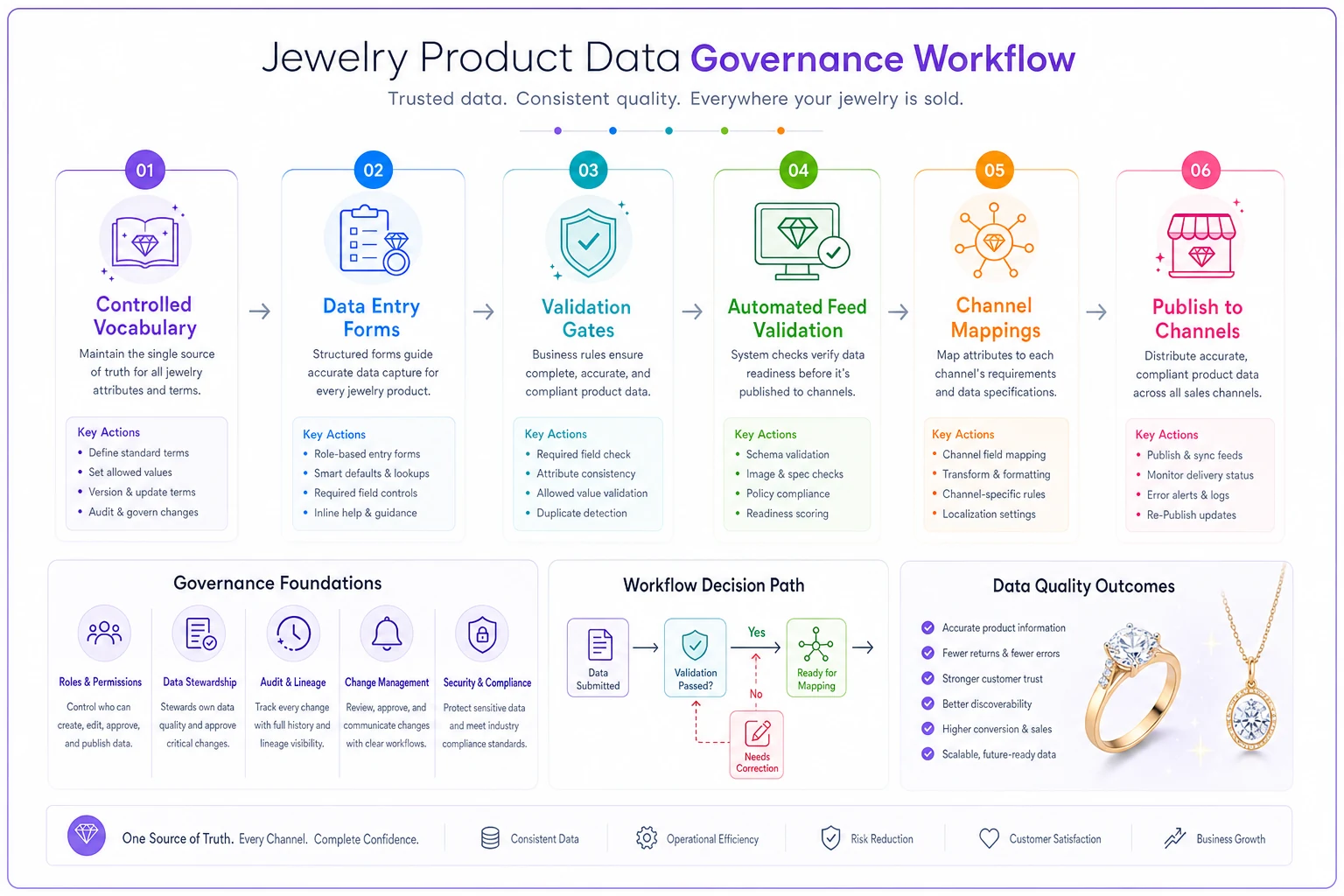
This is where a genuine workflow-and-product-data platform earns its keep. Instead of maintaining separate exports per channel, you maintain one governed product record and let the system map, validate, and push it outward — with validation rules enforced automatically rather than relying on someone being careful at 6pm on a Friday. The value isn't automation for its own sake; it's that the checks run every single time, unconditionally.
Worked QA rules to preserve rich snippets and channel parity
Governance sets the rules; QA verifies them. A few concrete rules worth encoding:
-
Price-drift rule Flag any product where the feed price differs from the live price beyond a set threshold. Auto-hold from feed until reconciled.
-
Required-field rule Any active product missing metal, carat (where applicable), price, availability, or image gets pulled from the feed automatically and queued for correction.
-
Vocabulary rule Any value outside the approved list triggers a rejection at entry, not at publish.
-
Snippet-integrity rule Weekly, sample a set of live URLs and confirm the rendered schema price and availability match the page. Any mismatch is a priority fix — it threatens the rich result directly.
-
Image-attribute match rule Flag products whose image filename metadata doesn't align with the stone shape or metal recorded in the data model.
The mistake is treating QA as a big quarterly audit. These rules should run continuously and fail loudly, so a broken template gets caught the day it breaks — not after two weeks of degraded listings.
A real scenario
A mid-sized independent jeweler carrying roughly 1,400 active online SKUs across a website and two external channels kept losing rich snippets on chunks of their diamond inventory. Traffic to those product pages was soft, and they couldn't isolate the cause.
The root cause turned out to be mundane: carat weight was stored as free text on about a third of older listings — things like "1ct," "1.00," "just over 1 carat." The schema markup pulled that field directly, so a meaningful slice of products had malformed structured data. Google was quietly ignoring the markup on those pages.
The fix wasn't glamorous. They converted carat to a numeric controlled field, backfilled the messy entries, and added a validation gate so nothing could publish with a non-numeric carat value. Within a few weeks, snippets returned on the corrected products, and the disapproval rate on one channel dropped from around 12–15% down to low single digits. No new marketing spend — just a data model that stopped lying to the channels.
When this level of structure is worth it — and when it isn't
When it makes sense: You're selling on more than one channel, you carry more than a few hundred SKUs, or your inventory changes value with metal prices. Any one of those three, and a governed data model pays for itself in avoided re-entry and preserved rankings.
When it's overkill: A single-location shop with 150 pieces sold only in-store and on one simple site doesn't need enterprise-grade governance. A well-organized set of controlled fields is plenty. Don't build a validation pipeline for a catalog you can eyeball.
Who should hold off: If your SKU foundation isn't clean yet, fix that first. Layering attribute governance on top of an inconsistent SKU structure just formalizes the mess. Get identity right, then get description right.
Bringing it together
Product-data problems feel slippery because they never announce themselves. Nothing crashes. The register still works. But the gap between "looks fine" and "actually structured" is exactly where jewelers lose snippets, lose channel parity, and lose hours re-entering the same ring across four systems.
A real jewelry product data model turns your catalog into a single source of truth that flows outward cleanly — one governed record, controlled vocabularies, a clear split between operational and presentation attributes, and validation that runs whether or not anyone remembers to check. Build that foundation, and schema markup, feed hygiene, and channel parity stop being separate recurring chores and start being byproducts of getting the data right once.
Product-data problems feel slippery because they never announce themselves. Nothing crashes. The register still works. But the gap between "looks fine" and "actually structured" is exactly where jewelers lose snippets, lose channel parity, and lose hours re-entering the same ring across four systems.
Ready to elevate your jewelry store operations?
Join 500+ jewelers using Jewlyly to increase efficiency, reduce errors, and grow revenue.