


The difference between declared value and actual insurance coverage just cost a Miami jeweler $47,000 on a single lost shipment. They declared the full value—$52,000 for a custom platinum anniversary set—but missed the fine print about FedEx's maximum liability for jewelry shipments. The carrier paid out exactly $5,000, their standard limit for "high-value items" without specialized coverage.
This happens more than jewelers realize. Carriers have category-specific limits buried in their service agreements. UPS caps jewelry at $1,000 without additional coverage. FedEx varies between $1,000 and $5,000 depending on service level. USPS Registered Mail offers up to $50,000 but requires specific packaging protocols that most stores don't follow correctly.
Why standard shipping protocols fail for jewelry
Most retail shipping advice assumes you're moving replaceable inventory. Ship it, track it, file a claim if something goes wrong. Jewelry doesn't work that way. You're shipping irreplaceable custom pieces, items on memo, customer repairs, and estate consignments—each of those categories needs different insurance structures, packaging standards, and chain-of-custody documentation.
The operational complexity multiplies when you factor in customer expectations. A lost engagement ring isn't just an insurance claim—it's a wedding crisis. A damaged repair isn't just a refund—it's a family heirloom potentially destroyed. Your shipping protocols need to account for both financial protection and relationship preservation.
Too many jewelers learn these distinctions through expensive mistakes. One store in Phoenix had been shipping repairs back to customers using standard FedEx Ground with declared value coverage. Worked fine for two years. Then three packages went missing in one month—$31,000 in repairs. The declared value coverage paid out, but only after 90 days of claims processing. Meanwhile, they had to remake two custom pieces at their own expense just to keep customers from walking.
Building your carrier selection matrix
Your carrier choice should change based on value, distance, and item type. Here's the decision framework that actually works:
Never miss a sale or shipment again.
Jewlyly helps you manage orders, track inventory, and engage customers seamlessly.
- Real-time inventory tracking
- Automated customer notifications
- Sales and order analytics
No credit card required
Under $5,000 domestic:
-
UPS Ground with declared value plus third-party insurance
-
FedEx Ground for business addresses only
-
USPS Priority Mail Express for residential (better delivery success rate)
$5,000 to $25,000 domestic:
-
FedEx Express with full third-party insurance
-
UPS Next Day Air with signature required
-
Never use ground services at this value tier
Over $25,000 domestic:
-
Registered Mail for maximum security (though slower)
-
Specialized jewelry shippers like Malca-Amit or ParcelPro
-
Armed courier for local high-value deliveries
International shipments:
-
Always use specialized jewelry logistics companies
-
Standard carriers create customs nightmares at these values
-
Third-party insurance often excludes international coverage
The matrix shifts for specific situations too. Repairs going back to known customers can tolerate lower-security options than new sales to first-time buyers. Shipments to businesses in secure buildings need different protocols than residential deliveries to apartments.
Stores that create clear value-based routing rules tend to see shipping problems drop by roughly half. Not because expensive shipping is inherently safer, but because consistent protocols eliminate the guesswork that leads to mistakes.
Declared value versus third-party insurance
Declared value isn't insurance. Carriers will fight you on this distinction when you need it most. Declared value only covers the carrier's liability—what they're willing to admit they owe you if they lose your package. It doesn't cover mysterious disappearance, customer claims of non-receipt, damage from "improper packaging," or about fifteen other exclusions buried in the fine print.
Real insurance—typically through third-party providers like Jewelers Mutual or ParcelPro—covers actual replacement cost regardless of carrier liability. Premiums generally run between 0.6% and 1.2% of value, depending on your volume and claims history.
Use declared value only when:
-
Shipping value under $1,000
-
Sending to established business customers
-
Moving inventory between your own locations
-
Third-party insurance isn't available for that carrier/service
Always use third-party insurance when:
-
Value exceeds $2,500
-
Shipping to residential addresses
-
Sending custom or one-of-a-kind pieces
-
Customer has any history of disputes
-
International shipments
Document your insurance decision for every shipment. When claims arise—and they will—you need to show consistent application of reasonable protocols. One store learned this the hard way when their insurance company denied a claim because they "selectively" insured shipments, which apparently suggested they knew certain shipments were higher risk.
Packaging standards that prevent disputes
Your packaging is evidence. When carriers deny claims for "insufficient packaging," they're not really debating whether the item arrived damaged—they're arguing you didn't follow their documented packaging requirements for the declared value. That's a different fight, and one you'll lose without documentation.
For jewelry shipments over $5,000:
Inner packaging:
-
Individual felt or foam slots for each piece
-
No metal-to-metal contact possible
-
Anti-tarnish strips for silver items
-
Moisture barriers for pearl or organic materials
Box construction:
-
New corrugated boxes only (reused boxes void coverage)
-
Minimum 2 inches of padding on all sides
-
Box-in-box method for values over $10,000
-
Tamper-evident tape on all seams
Documentation placement:
-
Invoice in packing slip pouch outside
-
Pictures of packaging process for values over $15,000
-
Insurance documents in separate sealed envelope
-
Return paperwork pre-filled when applicable
Take photos of packaging with timestamps and link them to the shipment ID to speed up claims.
The photo documentation requirement catches most jewelers off guard. Carriers can request proof of proper packaging for any claim over $5,000. Without photos, you're relying on their inspection of damaged packaging—which rarely goes your way.
A jeweler in Denver started photographing every packaging step for shipments over $10,000. Seemed excessive at first. Then UPS denied a $23,000 claim for "insufficient packaging." The photos showed perfect compliance with UPS guidelines. Claim approved in 48 hours instead of the usual 90-day fight.
Chain of custody and signature requirements
Signature requirements seem simple until you're dealing with refused deliveries, signature forgeries, and packages left with "authorized neighbors." The jewelry industry needs stricter protocols than standard signature confirmation provides.
For shipments over $2,500:
-
Adult signature with ID verification
Not just any signature—the recipient must show government ID matching the delivery address. Costs extra but eliminates most receipt disputes.
-
Restricted delivery
Only the named recipient can sign. No neighbors, no building managers, no family members unless explicitly authorized.
-
Hold for pickup options
For ultra-high-value items, require customer pickup at the carrier facility. More inconvenient, but it eliminates porch theft and signature fraud entirely.
-
Photographic delivery confirmation
Some carriers now offer photo proof of delivery. Require this for residential deliveries over $5,000.
Chain of custody extends beyond delivery. Document who packed the item, who created the label, who handed it to the carrier. When a $40,000 necklace went missing from a Houston store, their internal chain-of-custody log proved the carrier took possession. Without that documentation, insurance would have started by investigating internal theft.
RMA workflows for repairs and returns
Returns and repairs need completely different workflows than outbound sales. You're dealing with items you don't own, pre-existing damage conditions, and customer-provided descriptions that rarely match reality.
Start with intake documentation:
-
Detailed condition reports
Photo every angle, note every existing flaw, get customer signature on the condition assessment. One missing scratch notation can void your insurance coverage.
-
Specific repair authorization
List exactly what you're fixing. "Clean and tighten" isn't specific enough when the customer later claims you were supposed to replace missing stones.
-
Value agreement
Get written agreement on item value before shipping. Customer says grandmother's ring is worth $50,000, insurance appraisal says $12,000—that needs to be resolved before the piece leaves your store.
-
Return shipping preferences
Customer's choice of carrier, insurance level, and signature requirements. If they decline your recommended coverage, document that decision in writing.
For the actual RMA shipping process, package repairs separately from new merchandise. Insurance companies treat them differently, and mixed shipments complicate claims. One disputed item can delay payment on the entire shipment.
Create repair-specific shipping accounts so you can track loss ratios and negotiate better insurance rates for lower-risk repair shipments versus new sales. Build automated notification sequences so customers know when their repair ships, when it's out for delivery, and when it's confirmed delivered—that alone tends to cut "where's my repair?" calls significantly.
Also worth implementing: a short quarantine period for returned items. Don't ship anything back immediately after repair. Hold it 24-48 hours in case the customer remembers additional work they wanted done. Saves round-trip shipping costs and reduces unnecessary handling.
Operational software and shipment tracking
The complexity of shipping high-value jewelry creates natural breaking points in manual systems. Tracking insurance decisions, packaging photos, chain-of-custody logs, carrier performance across different value tiers—it gets overwhelming quickly without proper operational structure.
AI-powered operational software helps jewelers build consistency where manual processes fail. Instead of relying on staff to remember different insurance thresholds for each carrier, the system prompts the correct coverage based on value and destination. Instead of manually logging packaging photos, it creates timestamped records linked to each shipment automatically.
The more useful benefit is pattern recognition over time. When the same address has multiple delivery failures, the system flags it for pickup-only delivery. When a specific carrier route shows higher loss rates, you're alerted before another shipment goes missing. These patterns are invisible in spreadsheets but obvious in properly structured operational data.
Some jewelers resist systematizing their shipping operations because their volume doesn't seem to justify the investment. One denied insurance claim changes that math fast. The question isn't whether you can afford to systematize—it's whether you can keep absorbing the cost of not doing it.
Carrier relationships and volume negotiations
Your carrier relationships determine your options when problems arise. The jeweler with 50 monthly shipments gets different treatment than the one with 500. But volume alone doesn't drive better outcomes—relationship structure does.
Consolidate shipments with fewer carriers rather than spreading across many. Better to be a meaningful customer to two carriers than invisible to five. That concentration gives you real leverage when service recovery matters.
Establish escalation contacts before you need them. Get direct numbers for your account manager and their supervisor. When a $30,000 shipment goes missing, you can't afford to wait in callback queues.
Track carrier performance metrics monthly:
| Metric | Why It Matters |
|---|---|
| Delivery success rate by value tier | Identifies weak spots in your routing decisions |
| Claims processing time | Measures how responsive carriers are when things go wrong |
| Damage rates by service type | Reveals which service levels carry more physical risk |
| Signature capture accuracy | Catches gaps in proof-of-delivery before disputes arise |
Present this data during quarterly business reviews. Carriers respond to data-driven feedback better than complaints. One jeweler documented that FedEx had roughly 3x higher damage rates on their Express Saver service versus Priority Overnight. FedEx couldn't explain the discrepancy but offered to upgrade all shipments to Priority at no additional cost.
Volume thresholds that tend to matter:
-
100+ monthly shipments
Dedicated account manager
-
250+ monthly
Custom insurance rates
-
500+ monthly
Waived accessory fees
-
1,000+ monthly
On-site pickup included
Even smaller jewelers can access better rates through jewelry industry shipping aggregators. Groups like Jewelers Mutual or IJO negotiate collective rates that beat what most individual accounts can get on their own.
The hidden costs of shipping problems
Lost revenue from missing shipments is obvious. The less obvious part is the cascading operational cost that follows.
Staff time on claims processing averages somewhere between four and six hours per incident. Between carrier forms, insurance documentation, and customer communication, one lost shipment can consume most of a working day. Multiply that across a few incidents a year and it's a meaningful labor drain.
Relationship damage extends beyond the affected customer. They tell people. One bad shipping experience can quietly erode years of marketing investment in a customer segment.
Remake costs for custom pieces often exceed insurance recovery too. Insurance covers material cost and basic labor—it doesn't cover design time, customer consultations, or rush fees when you're trying to remake something before a deadline.
Inventory carrying costs also increase when you start holding extra stock to cover shipping delays. That trapped capital could be invested in new designs or marketing instead.
The solution isn't just better insurance or more expensive shipping. It's building systematic protocols that prevent problems, document everything, and resolve issues quickly when they do arise. The jewelers who handle shipping well don't eliminate all problems—they build operations that absorb problems without disrupting everything else.
Building your shipping standard operating procedures
Your shipping SOPs should be detailed enough that a temporary employee could handle a $50,000 shipment correctly. Document every decision point, every form required, every verification step.
Start with role definitions. Who's authorized to approve shipping methods? Who handles insurance documentation? Who communicates with customers about delays? Clear ownership prevents the "I thought someone else handled that" problems that show up constantly in shipping operations.
Create value-based checklists that can't be skipped. Over $10,000? Photo documentation required. Over $25,000? Manager approval required. Over $50,000? Evaluate armed courier. These thresholds should trigger automatic holds in your system.
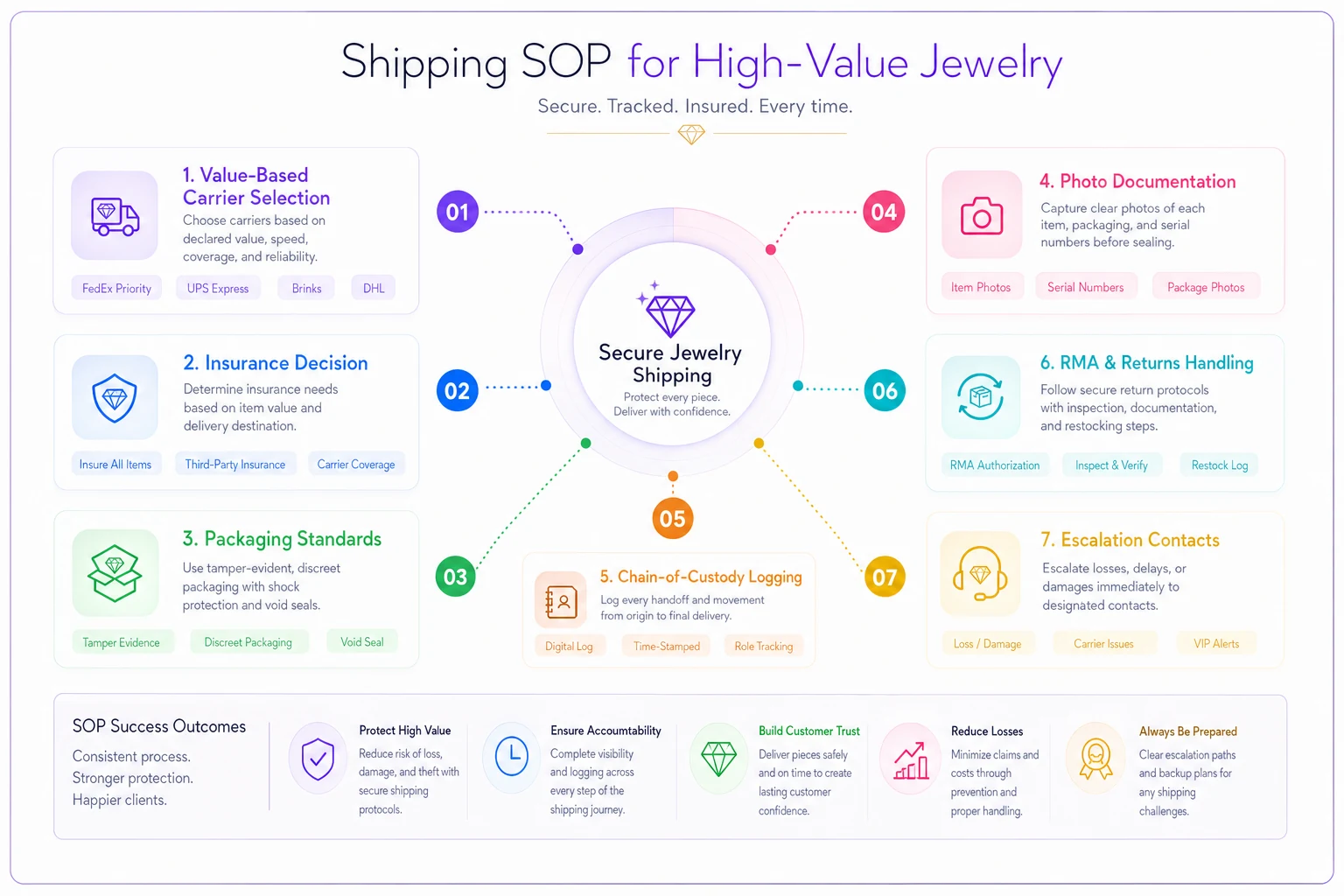
A quick visual helps teams follow the SOP when handling high-value shipments.
Build feedback loops into your processes. Every shipping problem should generate a process improvement discussion—not blame, but analysis. What change prevents this specific problem from happening again?
The stores that handle high-value shipping well share a few common traits. They document everything. They build redundancy into critical steps. They invest in carrier and insurance relationships before they need them. And they treat shipping as a core operational competency, not an afterthought.
Your shipping operation directly impacts customer trust. Every successful delivery builds confidence. Every problem erodes it. In a business where trust drives initial purchases, repeat business, and referrals, how you ship matters more than most jewelers give it credit for.
Conclusion
Shipping high-value jewelry isn't just logistics. It's a core part of how you protect your inventory, your margins, and your customer relationships.
The stores that handle it well don't rely on carrier promises or luck. They build systematic approaches to carrier selection, insurance decisions, packaging standards, and documentation. They know exactly when declared value is sufficient and when third-party insurance is non-negotiable. They maintain chain-of-custody records, track carrier performance, and adjust routing when the data suggests they should.
Start with the fundamentals: build your carrier selection matrix based on value and destination, document your insurance criteria, standardize your packaging, and get photo documentation into your workflow. Those foundational elements prevent most shipping problems before they start.
Then layer in the advanced protocols—chain-of-custody tracking, RMA-specific workflows, carrier performance monitoring, and systematic escalation procedures—so you can recover quickly when something does go wrong.
The investment in proper shipping operations tends to pay for itself with the first prevented loss. But the longer-term value is customer confidence. When people trust you to deliver their most precious items safely, they come back, they refer others, and they stay.
Ready to elevate your jewelry store operations?
Join 500+ jewelers using Jewlyly to increase efficiency, reduce errors, and grow revenue.