

Most jewelers treat appointments like glorified walk-ins. They book a time slot, maybe jot down a name, and wing it when the customer arrives. Then they wonder why their $15,000 engagement ring appointments ghost them or their estate jewelry consultations turn into tire-kicking sessions.
The difference between a jewelry appointment that converts at 70% versus one that converts at 20% isn't the salesperson's charm or the lighting in your private viewing room. It's the operational framework running underneath—the capture fields you collect beforehand, the demo sequence you follow during, and the structured follow-up that happens after.
Running appointment-based selling without proper operational structure is like trying to set diamonds without a loupe. You might get lucky sometimes, but you're missing details that determine the outcome.
Why jewelry appointments fail operationally (not because of salesmanship)
The typical high-value jewelry appointment goes something like this: someone calls or emails asking to see engagement rings. Your team books them for Saturday at 2pm. Maybe they grab a phone number. The appointment arrives, you show them whatever seems appropriate based on their reactions, quote some prices, and hope they buy. When they leave to "think about it," you follow up once or twice before giving up.
This approach treats a $10,000+ purchase decision like someone buying a watch battery. No wonder conversion rates hover around 25-30% for most independent jewelers.
The operational gaps become obvious when you map out what actually happens:
Pre-appointment: You know nothing about budget, timeline, preferences, or decision-making dynamics. You're preparing blind.
During appointment: Without a structured demo flow, you're reacting instead of guiding. You show pieces randomly based on facial expressions rather than following a proven sequence.
Post-appointment: Your follow-up is generic because you didn't capture specific objections, preferences, or next steps during the meeting.
Each missing operational element compounds the next. Skip pre-appointment discovery and you waste 20 minutes during the appointment figuring out basics. Miss capturing specific objections and your follow-up emails might as well be spam.
Pre-appointment capture fields that actually predict conversion
What separates professional appointment selling from hoping someone buys is structured information capture before they walk through your door.
Never miss a sale or shipment again.
Jewlyly helps you manage orders, track inventory, and engage customers seamlessly.
- Real-time inventory tracking
- Automated customer notifications
- Sales and order analytics
No credit card required
Timeline and occasion
-
Specific date needed by
-
Type of occasion (proposal, anniversary, self-purchase)
-
Hard deadline vs flexible timeline
Budget framework
-
Comfortable range (not maximum)
-
Financing interest (yes/no/maybe)
-
Previous jewelry purchases (price points)
Style preferences
-
Photos of pieces they like (3-5 examples)
-
Metal preferences
-
Stone preferences
-
Ring size or wrist size if applicable
Decision dynamics
-
Shopping alone or with someone
-
Who else influences the decision
-
Other jewelers they're visiting
Appointment goals
-
Education only
-
Ready to purchase
-
Narrowing options
-
Custom design consultation
Most jewelers resist asking these questions upfront, worried about seeming pushy. But customers spending $5,000+ actually expect this level of preparation. They want you to be ready for them.
One pattern that shows up consistently: stores that capture at least 6 pre-appointment data points convert at roughly 45-55%. Stores capturing fewer than 3 data points convert around 20-25%. The correlation is too strong to ignore.
Build these capture fields directly into your booking system and make them mandatory—incomplete forms should trigger a reschedule.
Build these capture fields directly into your booking system. Whether someone books online, by phone, or in-person, these fields should be mandatory. Train your team that incomplete forms mean rescheduling the appointment.
The in-room demo checklist that transforms browsers into buyers
Walking into a high-value appointment without a demo checklist is operational malpractice. Yet most jewelers rely entirely on reading the room and adjusting on the fly.
Structure doesn't kill spontaneity—it creates space for genuine connection by removing friction you shouldn't be dealing with mid-appointment.
Your demo sequence should follow this progression:
Opening verification (3 minutes)
-
Confirm pre-appointment details
-
Verify timeline hasn't changed
-
Check if decision dynamics shifted
-
Set appointment duration expectations
Education before showing (5-7 minutes)
-
Explain your quality standards
-
Cover certification basics relevant to their purchase
-
Discuss your customization capabilities
-
Set context for pricing
This education phase is where most jewelers fail operationally. They rush straight to showing pieces, missing the chance to establish expertise and build value perception before price enters the conversation.
Structured showing sequence (20-30 minutes)
-
Safe choice within stated budget
-
Slight stretch above budget (15-20% higher)
-
Aspirational piece (40-50% above budget)
Document their reaction to each—specific likes, specific dislikes, questions asked, comparison points mentioned. Then narrow to two pieces based on feedback. This is where your demo checklist becomes critical:
Comparison demonstration
-
Side-by-side under different lighting
-
Magnification comparison
-
On-hand/neck/ear viewing
-
Photo/video with their phone
Technical verification
-
Certification review together
-
Quality markers explanation
-
Warranty and service coverage
-
Customization options if applicable
Closing sequence (10 minutes)
Never end with "what do you think?" Instead, follow this structured close:
-
Review their favorite elements from pieces shown
-
Confirm timeline and budget alignment
-
Present specific next steps (not vague "think about it")
-
Schedule follow-up before they leave
Document everything in your appointment notes immediately after—which pieces they loved, which they dismissed, specific phrases they used, concerns raised. This becomes your follow-up roadmap.
Use this visual to keep your team aligned on the appointment flow.
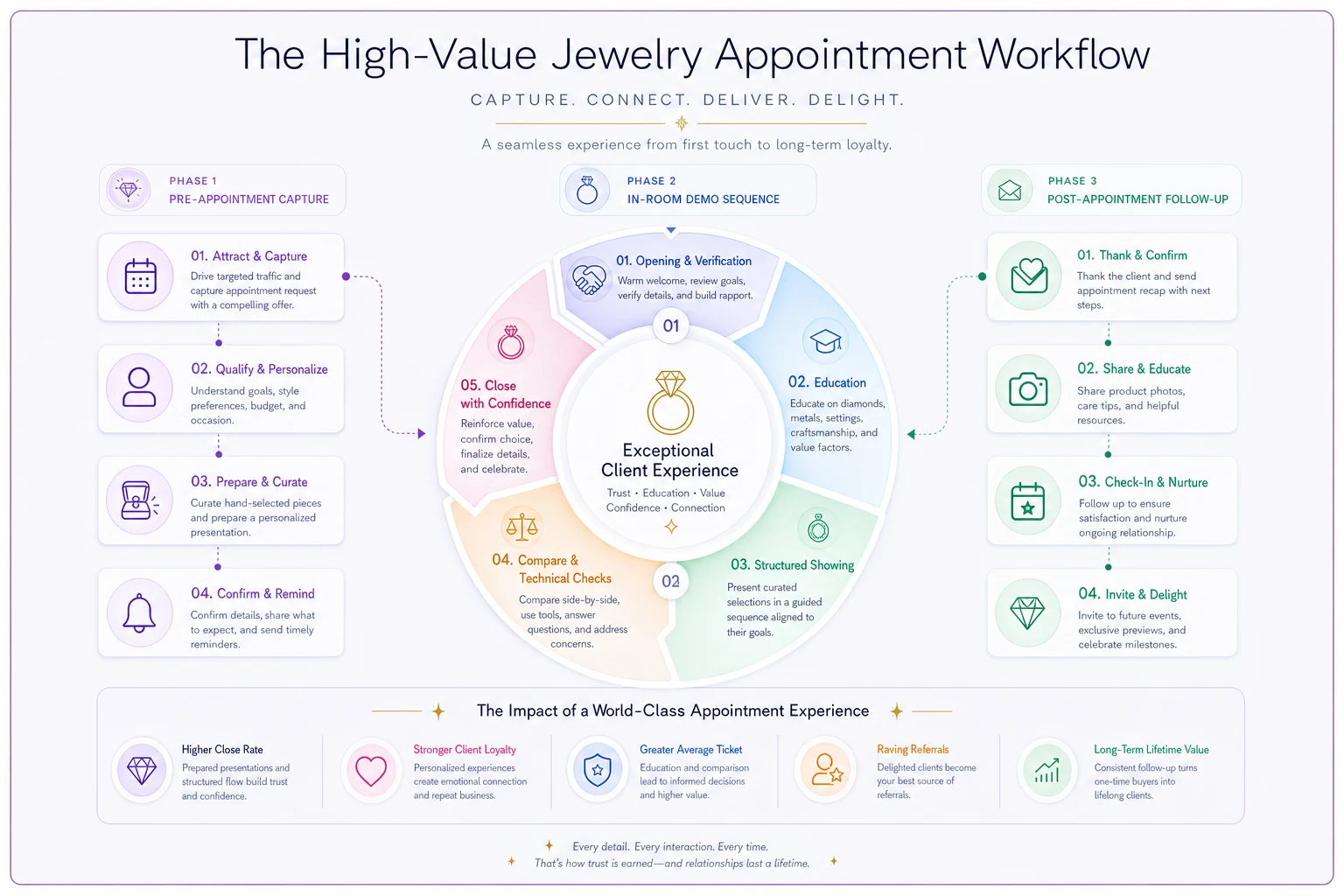
Keep the workflow handy on tablets or behind the counter as your appointment backbone.
Security and inspection protocols during high-value showings
Showing $50,000 in jewelry to strangers requires strict security protocols. But heavy-handed security kills sales. You need invisible structure.
Pre-showing verification
-
ID capture (driver's license photo)
-
Two-person rule for appointments over $25,000
-
Preset piece limits (maximum 5 out at once)
-
Locked staging area for selected items
During showing protocols
-
One piece in hand at a time
-
Soft count between transitions
-
Mirror positioning for visibility
-
Door positioning for staff
Post-showing inspection
This is where expensive mistakes happen. Someone walks out with an $8,000 tennis bracelet because your team got comfortable.
-
Count pieces against your show log
-
Verify each piece matches its tag
-
Check for damage or switching
-
Return to cases in client's presence
-
Sign off on the inspection
Build this into your operational software as a mandatory checkpoint. No appointment closes without inspection sign-off from two team members.
Pricing presentation templates that prevent negotiation fatigue
How you present pricing determines whether you'll spend 45 minutes negotiating or 5 minutes confirming. Most jewelers make pricing a verbal discussion, which invites haggling.
Create structured pricing sheets that include:
The piece basics
-
Item code and description
-
Certification details
-
Warranty coverage
-
Service package included
Pricing structure
-
Retail price
-
Current promotion if applicable
-
Financing options with monthly payments
-
Trade-in value if applicable
Value reinforcers
-
Comparable pieces at competitors
-
Resale value indicators
-
Included services value
-
Lifetime service savings
Print these during the appointment, not before. This prevents clients from fixating on price before experiencing the piece.
For custom orders, your pricing template should break down:
-
Design fee
-
Materials cost
-
Labor estimate
-
Timeline with milestones
-
Deposit structure
-
Change order implications
Always present three pricing options when possible—cash price, financed price, and layaway price. This shifts the conversation from "whether" to "how" to buy.
Post-appointment follow-up sequences that actually close sales
The appointment ends when they buy, not when they leave. Most jewelers send one or two follow-ups then give up. Professional operations run structured sequences for 30-90 days.
Your follow-up sequence depends on what happened during the appointment:
Hot prospects (showed strong interest, needed to think)
Day 1: Thank you + appointment summary
-
Photos of pieces they liked
-
Answers to specific questions raised
-
Reconfirmation of timeline
Day 3: New information add
-
Related piece that arrived
-
Financing promotion started
-
Relevant customer story
Day 7: Soft check-in
-
Timeline reminder if applicable
-
Offer to hold favorite piece
-
Schedule second appointment
Day 14: Value add
-
Educational content relevant to their purchase
-
Certification guide
-
Styling suggestions
Day 21: Alternative options
-
Different pieces based on their feedback
-
Price point adjustments
-
Customization possibilities
Warm prospects (interested but no timeline)
Week 1: Light touch
-
Thank you and resource sharing
Month 1: Market update
-
New arrivals in their interest area
-
Price changes if relevant
-
Upcoming events
Month 2: Preference refresh
-
Check if preferences changed
-
Share similar client decisions
-
Soft appointment offer
Custom design prospects
Day 1: Design packet
-
Inspiration gathered during appointment
-
Timeline breakdown
-
Deposit requirements
-
Next steps clearly outlined
Day 3: Design slot availability
-
Specific dates for design consultation
-
What to bring/prepare
-
CAD timeline expectations
Week 2: Similar custom work
-
Photos of recent custom pieces
-
Customer testimonials
-
Price range validations
Track every follow-up in your operational system. Note what was sent, any response, and next action required. Without this documentation, you're just sending random emails hoping something sticks.
The hidden appointment conversion killers nobody tracks
Partner misalignment: When one person loves a piece but their partner seems hesitant, most jewelers focus on convincing the hesitant one. Wrong approach. Document both perspectives separately and follow up with content addressing each person's specific concerns.
Comparison shopping overload: Clients visiting five or more jewelers often can't remember who showed what. Create a detailed takeaway packet with photos, prices, and notes from your appointment. Become their reference point for comparing everyone else.
Assumption poisoning: Your team assumes someone can't afford the piece they love, so they redirect to cheaper options. Document what they actually gravitated toward, regardless of stated budget. Follow up with financing options for their true preference.
Timeline miscalculation: Someone says they need a ring in 6 months, your team assumes no urgency. But 6 months for custom work means starting now. Build timeline education into your follow-up sequence.
Beyond the obvious operational gaps, several less visible factors tank conversion rates.
Appointment capacity planning most jewelers ignore
Operational reality check: if you're booking 8 appointments on Saturday and converting 25%, you're not running appointments efficiently—you're running an expensive showroom.
Proper appointment selling means:
-
60-90 minute slots minimum
-
Maximum 4-5 appointments per consultant per day
-
30-minute reset between appointments
-
Protected appointment zones (no walk-in interruptions)
This seems like you're seeing fewer people, but the math works differently:
| Approach | Appointments | Conversion | Avg Sale | Revenue |
|---|---|---|---|---|
| Volume approach | 8 | 25% | $4,000 | $8,000 |
| Structured approach | 4 | 55% | $6,000 | $13,200 |
The structured approach yields more revenue with less operational chaos. Your team isn't burnt out, your serious buyers get proper attention, and your conversion metrics actually mean something.
For category planning, reserve your premium appointment slots for categories with the highest conversion potential—typically engagement rings and custom design consultations. Don't waste Saturday afternoon slots on watch battery customers who insisted on booking an "appointment."
Building appointment operations that scale
Small jewelry stores often assume appointment-based selling is for luxury boutiques with private showing rooms and champagne service. But structured appointments work especially well for smaller operations because they maximize each interaction.
The key is building repeatable operations, not relying on individual sales talent. When your appointment process runs on structured systems—capture fields, demo checklists, follow-up sequences—any competent team member can achieve decent conversion rates. You stop being hostage to one salesperson having a good day.
This is where operational software makes a real difference. Instead of tracking appointments in a paper book and hoping someone remembers to follow up, you need:
-
Automated capture forms sent with booking confirmations
-
Demo checklists accessible on tablets during appointments
-
Inspection sign-offs logged digitally
-
Follow-up sequences triggered automatically based on appointment outcomes
-
Conversion tracking by appointment type, consultant, and source
The best appointment operations feel high-touch and personal to the client while running on systematic workflows underneath. They don't know you're following a checklist—they just experience a smooth, professional consultation that addresses their specific needs.
Making appointment selling work in your jewelry store
Start with one appointment type—probably engagement rings, since they carry the highest average transaction value and customers already expect a consultative process. Build out your complete operational framework for just that one type: design your pre-appointment form, create your demo checklist, write your follow-up templates, set your capacity limits, and track your conversion metrics.
Run this for 30 days before expanding to other appointment types. You'll quickly see which operational elements drive conversion and which create friction.
Most importantly, stop treating appointments like calendar entries. They're operational workflows that begin the moment someone inquires and continue until they either buy or explicitly decline. Every touchpoint between those moments should be documented, structured, and optimized.
Stores consistently converting 50-60% of high-value appointments aren't lucky or exceptionally talented. They're operationally disciplined. They capture the right information upfront, follow proven demo sequences during appointments, and maintain structured follow-up until decisions are made.
When appointments run on proper operational rails—from initial capture fields through post-appointment sequences—conversion becomes predictable. You stop hoping people buy and start knowing your conversion percentage before the month even begins. Inventory planning becomes strategic, marketing investments trace back to actual revenue, and staff scheduling aligns with appointment capacity instead of random floor coverage.
Build the operational foundation and watch your monthly revenue stabilize at levels that random walk-in traffic could never support.
Ready to elevate your jewelry store operations?
Join 500+ jewelers using Jewlyly to increase efficiency, reduce errors, and grow revenue.