



You're looking at a $12,000 custom engagement ring order. Client puts down 30%, everyone's happy, design work begins. Three weeks later they want major changes. Two weeks after that, they go quiet. Another month passes—they resurface wanting different stones. Your bench jeweler has already started fabrication. The original timeline is shot. The deposit barely covers CAD work and initial materials.
This scenario destroys profit margins across custom jewelry, yet most stores still run the same basic deposit structure on every custom order regardless of complexity, client history, or project scope.
Why standard deposits fail custom jewelry operations
The core problem isn't the deposit percentage—it's treating all custom work the same. A $2,000 redesign of grandmother's ring needs completely different financial protection than a $25,000 bespoke necklace with sourced stones. Yet jewelry stores typically apply one deposit rule across everything.
When deposits don't match project risk, things unravel fast. Bench time gets hijacked by endless revisions. Design iterations eat into fabrication schedules. Clients disappear mid-project, leaving partially completed pieces. Payment disputes emerge at delivery because expectations shifted during the process. Your most skilled craftspeople burn hours on projects that might never complete.
The financial hit compounds quickly. One stalled $15,000 custom order can tie up bench capacity for weeks, blocking other profitable work. Material costs fluctuate during delays—that platinum you quoted three months ago now costs 15% more. Design time bleeds into unpaid territory as clients request "just one more small change."
Most damaging: your team starts avoiding custom work altogether, treating it as operational quicksand rather than a profit center.
Breaking down deposit structures by actual project risk
Clear patterns emerge across custom jewelry operations around which projects need stronger financial protection. The deposit percentage should directly correlate with three factors: design complexity, material volatility, and client commitment indicators.
Never miss a sale or shipment again.
Jewlyly helps you manage orders, track inventory, and engage customers seamlessly.
- Real-time inventory tracking
- Automated customer notifications
- Sales and order analytics
No credit card required
| Project Type | Deposit % | Key Risk Factors | Typical Timeline |
|---|---|---|---|
| Simple Modifications | 40-50% | Minimal design, quick turnaround | 1-2 weeks |
| Material Redesigns | 50-60% | Client materials, emotional decisions | 3-4 weeks |
| Original Designs | 60-70% | CAD time, revision cycles | 4-6 weeks |
| Complex Bespoke | 70-80% | Multiple craftspeople, special sourcing | 6-10 weeks |
| Luxury Commissions | 80-100% | Extreme materials, reputation risk | 10-16 weeks |
Simple modifications (resizing, adding stones to existing pieces, basic engravings): 40-50% deposit. Minimal design risk, quick turnaround. The main concern is material cost coverage and basic bench time.
Redesigns using client materials (inherited jewelry transformations, stone resets): 50-60% deposit. Higher percentage needed because you can't resell client materials if they walk away. Design time is moderate but revision risk runs higher—emotional attachment affects decision-making in ways that are hard to predict.
Original designs with standard materials (custom engagement rings with common stones, wedding bands): 60-70% deposit. Covers substantial design time, standard CAD work, and typical revision cycles. Material costs are predictable but bench time commitment is significant.
Complex bespoke pieces (elaborate necklaces, unusual stone combinations, artistic pieces): 70-80% deposit. Maximum protection needed for extensive design iterations, special material sourcing, and extended fabrication timelines. These projects often involve multiple craftspeople and specialized techniques.
High-risk luxury commissions (pieces over $30,000, extremely rare materials): 80-100% deposit or milestone-based payment structure. An abandoned luxury project can damage your entire quarter.
Building milestone payment structures that prevent scope creep
Single deposits create operational blind spots. A client pays 50% upfront, then feels entitled to unlimited revisions since they've "already paid." The solution is milestone-based payment structures that tie financial commitment to project progress.
-
Milestone 1 - Design Approval (25-30% of total)
Covers initial consultation, rough sketches, and CAD development. Payment triggers when client approves final CAD rendering. This prevents endless design iterations eating into profit.
-
Milestone 2 - Material Procurement (30-40% of total)
Due when stones and metals are ordered. Protects against material price fluctuations and ensures client commitment before major purchasing decisions. Include a 72-hour confirmation window after stone selection.
-
Milestone 3 - Production Start (25-30% of total)
Collected when the piece moves to bench for fabrication. Eliminates the risk of clients abandoning projects mid-production. Clearly communicate that changes after this point incur additional charges.
-
Milestone 4 - Completion (15-20% of total)
Final payment before delivery. Keeping this lower reduces pickup friction while ensuring most costs are covered regardless of collection timing.
The power of this structure: each milestone creates a natural pause for client confirmation, reducing disputes about unexpected outcomes. Clients psychologically commit at each stage rather than viewing the project as one large transaction they paid for up front.
Confirm all stone selections with a 72-hour written acknowledgment to lock pricing and prevent sourcing disputes.
Here's a quick visual of the milestone workflow.
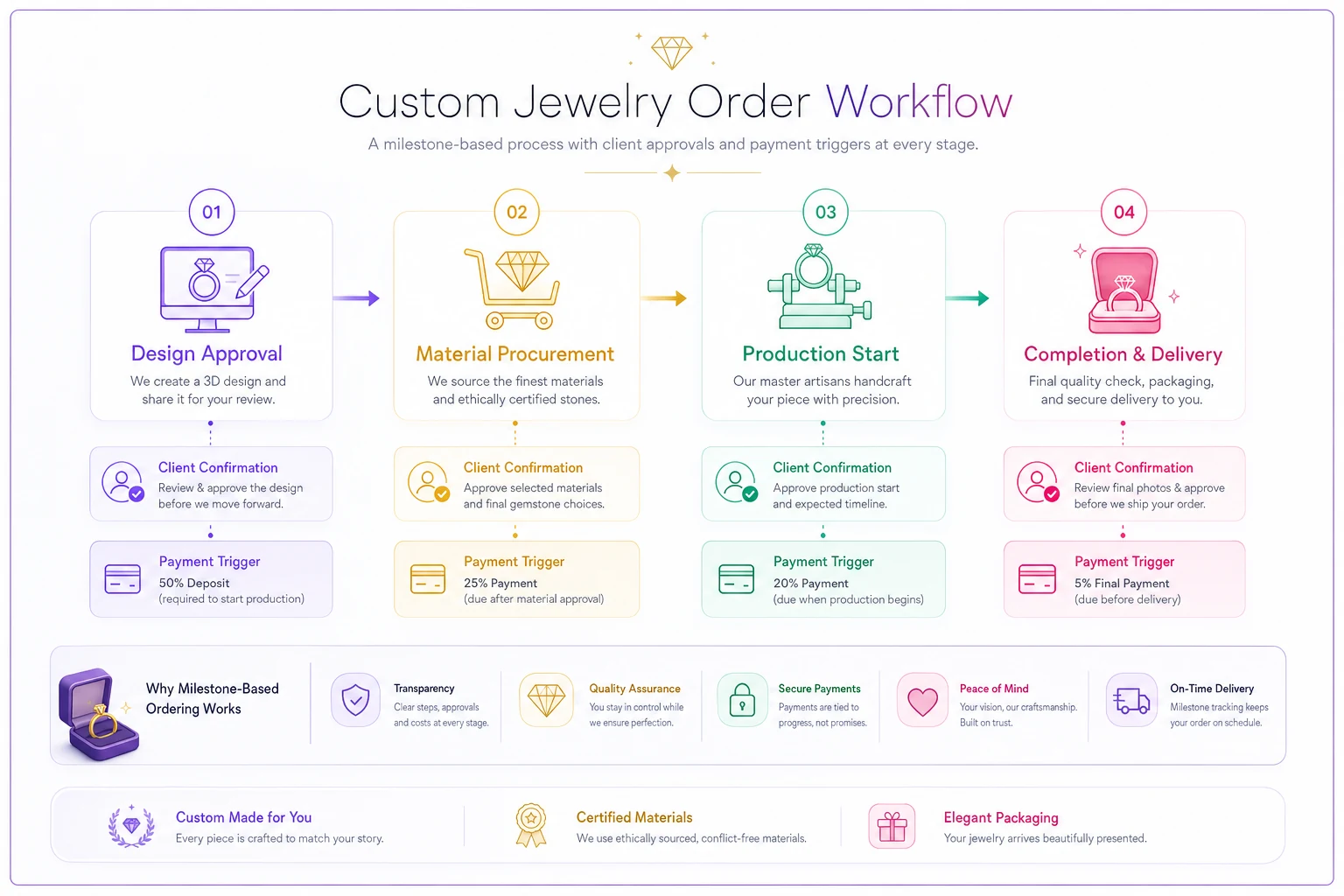
The visual helps teams and clients see where payments align with progress and where changes will impact timelines and costs.
Contract language that eliminates interpretation disputes
Vague contracts create expensive problems. "Reasonable revisions" means something different to you than to a client comparing every angle of their ring to Pinterest photos. Contracts need operational precision.
Start with revision limits: "Design phase includes up to three rounds of CAD modifications. Additional revisions billed at $125 per round." This single line prevents the most common custom order profit leak. Clients become much more thoughtful about changes when they understand the cost structure.
Timeline contingencies: "Production timeline begins after final design approval and receipt of Milestone 2 payment. Any client-requested changes after design approval will reset the timeline and may incur additional charges." This prevents clients from complaining about delays they caused.
Material price protection: "Quoted prices valid for 30 days. Projects delayed beyond this period subject to material cost adjustments based on current market rates." Precious metal volatility can destroy margins on delayed projects.
Abandonment terms: "Orders not completed within 90 days of initiation forfeit all deposits. Materials purchased for abandoned orders remain property of [store name]." This gives you legal coverage to recoup costs from stalled projects.
Change order documentation: "All modifications after design approval require written change order with associated costs and timeline impacts." Creates a paper trail that prevents disputes at delivery.
Quality expectations: "Custom pieces are handcrafted and may show subtle variations from CAD renderings. Minor differences in stone placement, metal texture, or finish are part of the artistic process." This heads off unrealistic perfection demands before they start.
Tracking fields that catch problems before they explode
Most jewelry stores track basic order info—client name, design details, due date. Operational success requires tracking data points that predict problems before they become disputes.
Communication frequency: Note every client interaction timestamp. When gaps exceed normal patterns for active custom orders—typically 5-7 days—reach out proactively. Silent clients often indicate brewing dissatisfaction or changing circumstances.
Revision count by phase: Track design revisions separately from production modifications. When design revisions exceed three, project profitability usually turns negative. Use this data to identify patterns and adjust future quotes.
Decision speed: Record how long clients take to approve each milestone. Slow decision-makers—over 72 hours per approval—correlate strongly with higher revision rates and payment disputes. Build longer timelines and higher deposits for these clients going forward.
Material source: Track whether stones and metals come from you or the client. Client-supplied materials create significantly more disputes due to quality concerns or sentimental value disagreements. Document condition extensively when accepting them.
Comparative reference tracking: Note any photos, drawings, or existing pieces clients reference. These become critical when managing expectation gaps. "Inspired by" has a way of becoming "exact copy of" in client memory.
Payment method patterns: Track how clients pay each milestone. Changes in payment method—credit to check, for example—often signal financial pressure that could affect project completion.
Escalation protocols that salvage profitable relationships
Problems in custom orders rarely explode suddenly. They build through ignored warning signs. Effective escalation protocols catch issues while they're still manageable.
Level 1 - Communication Delays (2 missed checkpoints): Send a friendly reminder with a specific action needed. "Hi Sarah, ready to review your CAD rendering whenever you have 10 minutes. Let me know if you'd prefer to adjust the timeline." Collaborative, not confrontational.
Level 2 - Revision Excess (approaching contract limits): Schedule a conversation before hitting hard limits. "We're on revision 2 of 3 included in your package. Want to make sure we nail this final round—should we talk through what isn't quite right yet?" This prevents surprise charges.
Level 3 - Payment Delays (5 days past milestone): Pause all work immediately. "Hi Michael, noticed we haven't received Milestone 2 payment. Work will resume as soon as payment clears. This may affect your October 15 target date." Clear cause and effect.
Level 4 - Scope Creep (significant design changes post-approval): Require a formal change order with new timeline and costs. "These modifications would essentially create a new design. Here's what that involves..." Present it as professional project management, not punishment.
Level 5 - Abandonment Risk (30 days no contact): Send a certified letter outlining abandonment terms from the contract. Keep a copy in the project file. This legal documentation protects against future claims while giving clients one final chance to re-engage.
Each escalation level should feel like natural project management rather than confrontation. Clients actually appreciate clear communication when it's framed as protecting their investment.
Technology integration for deposit and milestone management
Manual tracking of complex deposit structures creates operational chaos. One forgotten milestone payment or missed escalation trigger can cost thousands.
The complexity multiplies with volume. Ten custom orders means managing 40+ milestone dates, 30+ payment checkpoints, and dozens of client communication threads. Without proper systems, things fall through cracks constantly.
AI-powered operational software turns this chaos into predictable workflows. Automated milestone reminders eliminate the awkwardness of payment conversations. Triggered escalation protocols catch problems before they sour client relationships. Centralized project dashboards show immediately which orders are on track and which aren't.
The real value comes from pattern recognition over time. Good operational software can surface which client behaviors tend to predict problems—slow CAD approvals leading to payment disputes, excessive early revisions signaling unrealistic expectations, communication gaps that tend to precede abandonment. These patterns let you adjust deposits and terms proactively rather than reactively.
Payment processing integration removes friction at each milestone. Clients receive automated invoices with payment options exactly when due. No chasing checks or playing phone tag about credit card details. The system tracks payment timing and flags anomalies that might signal problems downstream.
Most importantly, proper software creates institutional memory. When a client returns two years later for another custom piece, you immediately see their previous decision speed, revision patterns, and payment history. That data drives smarter deposit structures and timeline estimates for repeat business.
Hidden profit leaks in custom jewelry deposits
Beyond the obvious deposit percentage question, several overlooked areas quietly drain profitability from custom orders.
CAD revision charging: Most stores include "reasonable" CAD changes without defining limits. Each revision typically costs $50-150 in designer time. Three extra rounds of changes on a $5,000 ring wipes out most of the margin. Bundle exactly two revision rounds, then charge hourly for anything beyond that.
Material holding costs: When clients delay decisions, you're sitting on thousands in allocated inventory. If platinum increases 10% during a two-month delay, that appreciation is lost profit. Build carrying cost language into contracts for delays beyond 30 days.
Bench scheduling gaps: A delayed custom order doesn't just affect that one piece—it creates scheduling chaos. Your setter planned for that job Tuesday and now has dead time. Build schedule disruption fees into delay penalties.
Reference piece recreation: Clients bring photos of $50,000 Harry Winston pieces wanting recreation at $5,000. The comparison disappointment almost guarantees disputes. Require substantial price premiums for exact recreation attempts, or decline entirely.
Stone sourcing time: "Can you find a stone that looks exactly like this?" leads to hours of unpaid sourcing work. Charge sourcing fees upfront, credited toward purchase only if the client proceeds with your stone selection.
Real operational scenario: fixing a broken custom order system
Consider a typical family jewelry store doing roughly $2.4M annually with about 40% from custom work. They're running flat 50% deposits across all custom orders, tracking everything in Excel, and dealing with constant disputes about timelines and expectations.
After implementing structured deposits by project type, their average deposit climbed to around 62%. More importantly, project abandonment dropped from roughly 12% to under 4%. The milestone payment structure improved cash flow too—instead of waiting 6-8 weeks for final payment, money flowed every 2-3 weeks through the project lifecycle.
The bigger win was bench utilization. With clearer escalation protocols, stalled projects got resolved quickly rather than lingering for months. Their master jeweler went from juggling 8-10 uncertain projects to focusing on 5-6 confirmed, progressing orders.
Client satisfaction actually went up despite higher deposits and stricter terms. Clear expectations and regular milestone checkpoints meant fewer surprises at delivery. Revision limits forced clients to think carefully about changes rather than treating the design phase as unlimited exploration.
Within six months, custom work profitability improved roughly 20% without raising prices—purely through better operational management and appropriate deposit structures.
Making the transition without losing current clients
Implementing new deposit structures on existing clientele requires some care. Sudden policy changes create resentment and lost business.
Start with new clients only. They have no expectation of old policies, making higher deposits and milestone structures feel normal. Use these initial projects to refine your processes and contract language. Document what works, what creates friction, what needs clarification.
For existing clients, introduce changes at natural breakpoints. When someone returns for their second custom piece, present the new structure as an improvement: "We've redesigned our custom process to ensure smoother projects and clearer communication. Here's how it works now." Frame it as professional evolution, not reactive policy changes.
Grandfather your best clients temporarily. If someone has commissioned multiple pieces without issues, offer them a choice: old structure with longer timelines, or new structure with priority scheduling. Most choose the new structure once they understand the benefits.
Train your entire team thoroughly. Mixed messages about deposits and policies create confusion and distrust. Everyone from sales associates to bench jewelers should understand why these structures exist and how they protect both store and client.
Be prepared for some pushback. A small percentage of clients will resist higher deposits or milestone payments—and that's actually useful information. These clients often become your most problematic projects. Better to identify them early than discover it mid-production.
The economics of saying no to bad custom orders
Not every custom order deserves acceptance. Some projects predictably lose money regardless of deposit structure.
Beware the committee design—multiple decision-makers who must approve every detail. These projects average far more revisions and significantly longer timelines. If you accept them, require 100% upfront payment or extremely rigid milestone structures.
Pinterest perfectionists who bring 50+ inspiration photos rarely end up satisfied. The mental image they've built is impossible to match in reality. Either charge substantial premiums for the inevitable revision cycles or politely decline.
Clients who immediately question your deposit requirements often become payment problems later. If someone battles over standard terms, they'll probably battle over everything else too.
Opportunity cost matters here. Every problematic custom order prevents you from taking profitable, straightforward projects. That difficult client haggling over every detail is blocking several smooth, profitable orders from established customers.
The right deposit and milestone structure does more than secure payment—it creates operational predictability. Clear financial commitments at each stage force genuine client engagement. Defined revision limits protect your design resources. Escalation protocols prevent small issues from becoming relationship-ending disputes.
Most jewelry stores treat deposits as necessary evils, apologetically requesting them while hoping clients don't object. That backwards approach creates the exact problems it should prevent. Strong deposit structures actually improve client relationships by establishing clear mutual commitments from the start.
The stores thriving with custom work get this: deposits and milestones are operational tools that protect both parties. They ensure projects complete successfully, profitably, and with satisfied clients who come back for future pieces.
Your custom jewelry deposit structure shouldn't be an afterthought or copied from a competitor down the street. It should reflect your operational reality, risk tolerance, and client base. Build it thoughtfully, implement it consistently, and custom work stops being an operational headache and starts being a reliable profit center.
Ready to elevate your jewelry store operations?
Join 500+ jewelers using Jewlyly to increase efficiency, reduce errors, and grow revenue.