

The weekend after a big bridal campaign, a store will book thirty-plus appointments across two days and then discover that on Saturday afternoon only one person on the floor is cleared to pull diamonds over a certain value from the safe. So the custom consult that was supposed to close a $14k engagement ring sits waiting while a manager finishes a repair intake in the back. The client gets a glass of water and a vague apology. That ring doesn't close that day.
That's not a staffing shortage. The store had five people scheduled. It's a staffing matrix problem — the right number of bodies, wrong distribution of authorizations and skills against the hours that actually mattered.
Most jewelry rosters are built on availability and gut instinct. Who can work Saturday, who hates opening, who's reliable. That works fine for a coffee shop. It falls apart the moment your floor involves six-figure trays, appointment-driven revenue, and security rules that say only certain people can touch certain things. The schedule has to encode capability and authorization, not just presence.
This is about building a jewelry staffing schedule that maps forecasted demand against who's actually cleared and competent to handle what — and doing it in a way that survives a no-show.
The three layers your roster is actually balancing
A normal retail schedule balances one thing: coverage. A jewelry showroom roster balances three, and they don't move together.
Layer one — forecasted appointment and walk-in demand. This is your hour-by-hour expected load. Bridal consults cluster on weekends and early evenings. Repair drop-offs cluster at open and lunch. Watch battery and quick-service traffic is steady but unpredictable. If you're not already forecasting appointment volume by hour, you're guessing.
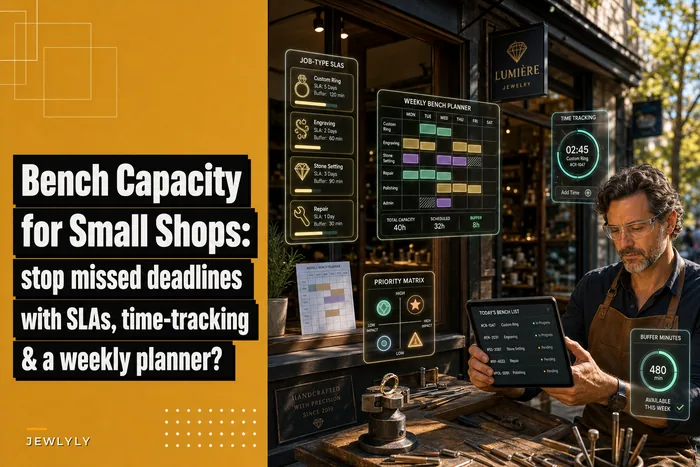
Layer two — bench and back-of-house capacity. Your jeweler at the bench, your intake person, whoever handles sizing and setting. These people often get pulled onto the floor during rushes, which quietly destroys your repair turnaround. We've written separately about bench capacity planning for small shops because this layer deserves its own SLA — but for rostering purposes, the key point is that bench hours and floor hours are not interchangeable, even when the same person can do both.
Layer three — security and handling authorizations. Who can open the safe. Who can pull high-value trays. Who can authorize a return over a threshold. Who can be alone on the floor with a client and a loose stone. These are rules, not preferences, and they're the layer almost nobody puts into the schedule.
The failure mode is always the same: the schedule gets built on layer one (enough people for the traffic), ignores layer three (enough authorized people for the traffic), and then layer two gets cannibalized to paper over the gap.
Why authorization gaps hide until they bite
On an average Tuesday, it doesn't matter. Three people on the floor, one is key-holder-cleared, demand is light, everything flows. The authorization matrix has slack.
Never miss a sale or shipment again.
Jewlyly helps you manage orders, track inventory, and engage customers seamlessly.
- Real-time inventory tracking
- Automated customer notifications
- Sales and order analytics
No credit card required
The problem is concentration. High-value handling events — the $14k ring pull, the estate piece appraisal, the large refund — don't spread evenly across your staffed hours. They pile onto exactly the busy windows where your authorized person is already occupied with something else.
A typical example: a store has four employees who can run the floor, but only two authorized to pull and present items above the high-value threshold. Both scheduled Saturday — looks fine on paper. But one is the shift lead handling opening reconciliation and vendor pickups, and the other is in a 90-minute custom appointment. For that window, the store has zero available high-value handlers for anyone walking in. That's not a rare collision. On a busy Saturday it's basically the default.
Role-based handling authorization only works if you schedule availability of the authorization, not just presence of the authorized person. Having a key-holder on the clock means nothing if they're structurally unavailable for two-hour stretches.
Building the authorization matrix first, then the roster
Most stores get this backwards: they build the roster, then check if security coverage happens to be okay. Flip it. Define the authorization requirements per hour, then staff to satisfy them.
Start with a simple capability grid. Every employee, every handling authorization, honest yes/no.
| Employee | Floor sales | High-value pull (>$10k) | Safe open/close | Returns > $2k | Bench/sizing | Appraisal intake |
|---|---|---|---|---|---|---|
| Dana (lead) | ✔ | ✔ | ✔ | ✔ | — | ✔ |
| Marcus | ✔ | ✔ | ✔ | ✔ | — | — |
| Priya | ✔ | — | — | — | ✔ | ✔ |
| Elena | ✔ | — | — | ✔ | — | — |
| Sam (bench) | — | — | ✔ | — | ✔ | — |
The grid immediately shows you something a headcount never will: high-value pull authorization lives entirely with Dana and Marcus. If both are off, unavailable, or buried, your store cannot present its most profitable inventory. Two points of failure for your highest-margin transactions.
Now set minimum coverage rules per operating hour. Something like:
-
At least two high-value-pull-authorized staff present during all weekend hours and weekday evenings
-
At least one safe-authorized person who is not the sole floor closer during any given hour
-
Never a single-staff floor window where that one person is both the only authorized handler and the only person watching the door
These rules go in before anyone's name gets dropped into a slot. The roster has to satisfy the matrix, not the other way around.
A weekly rostering process that encodes all three layers
Here's the build order that actually holds up week to week.
-
Pull next week's appointment forecast by hour. Confirmed appointments plus a walk-in estimate based on the same week last year and any active campaigns. Flag the high-value consults specifically — those are your authorization-demand hours.
-
Lay down your authorization minimums. Using the grid above, block in which hours require two high-value handlers, which require separate safe and floor coverage, and so on. This is your non-negotiable layer.
-
Protect bench hours before floor hours. Decide how many bench hours the week needs to hit your repair SLAs, and fence them off. Sam and Priya's bench time is not a reserve you raid during a floor rush — the moment it becomes one, your repair turnaround slips and you get the disputes that follow.
-
Fill floor coverage against the forecast. Now, and only now, staff to the hourly demand curve. This is the easy part once the constraints above are locked.
-
Build in one authorization backup per critical window. For every weekend high-value window, name a specific second person who can be pulled in or called if your primary handler gets tied up. Not "someone will cover" — a name.
-
Stress-test the Saturday no-show. Remove your most heavily authorized person from the roster on paper. Does the week still satisfy every authorization minimum? If removing Dana collapses your coverage, you have a cross-training problem, not a scheduling one.
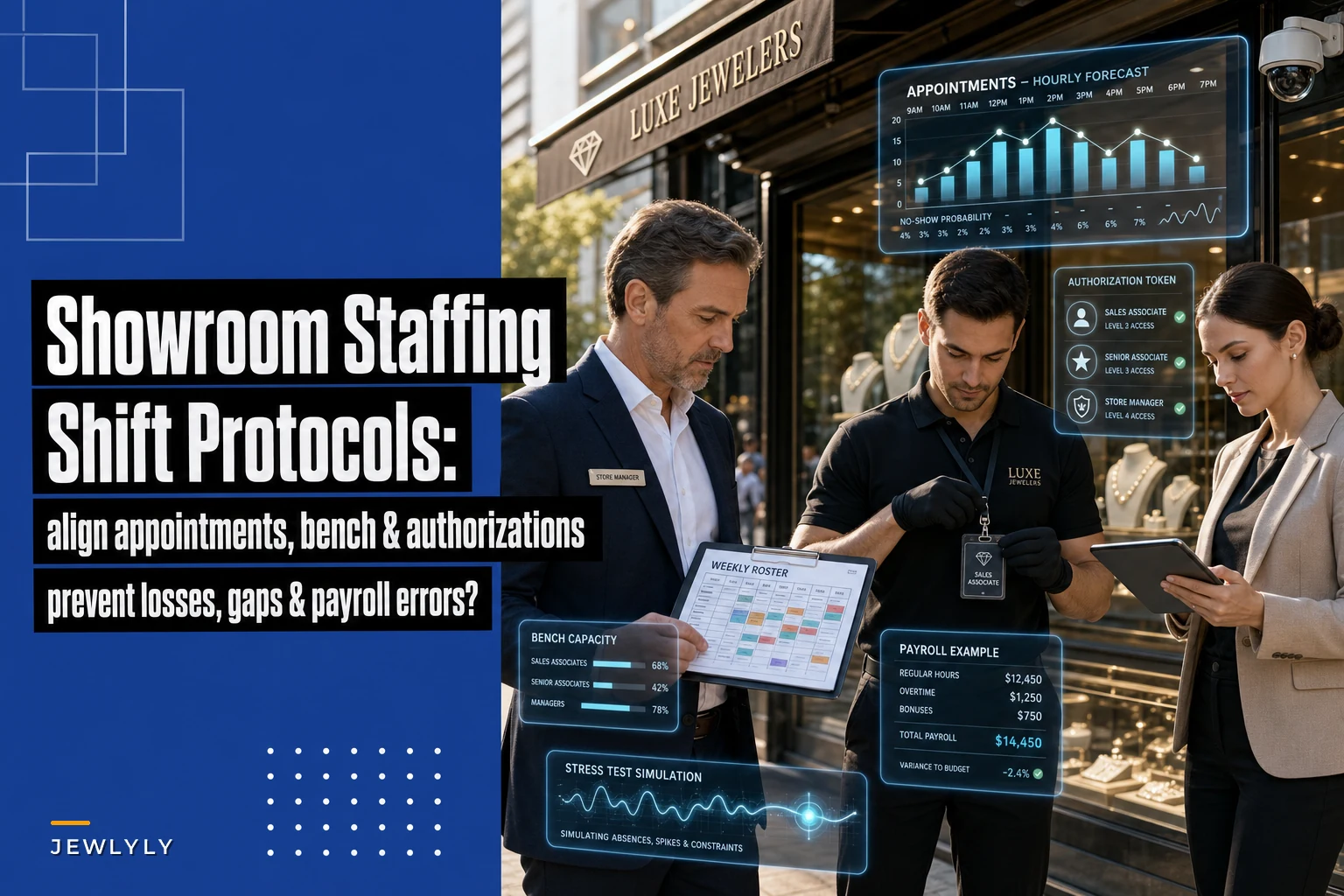
A visual of the weekly rostering workflow.
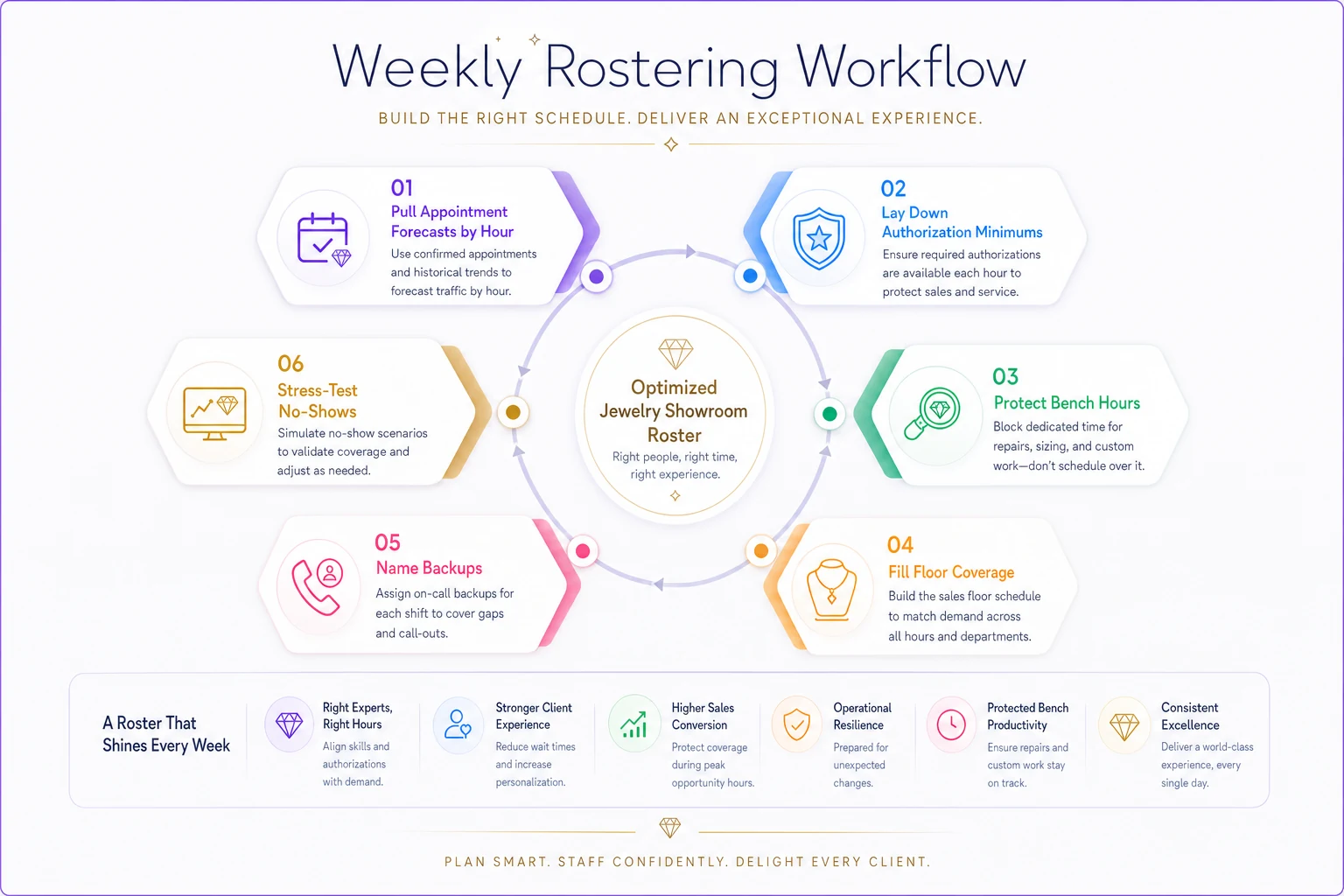
Step six is the one everybody skips and the one that saves the weekend.
The payroll side nobody models until it hurts
Authorization-aware scheduling has a payroll shape, and it's usually cheaper than the alternative — but only if you actually look.
The hidden cost of the old way is overstaffing to compensate for authorization concentration. If only two people can pull high-value, managers instinctively schedule both of them on most busy shifts "to be safe," which means you're paying your two most senior people to be on the floor constantly — including hours that don't need them.
Pro-tip: Cross-train one additional person on high-value handling to reduce overlapping senior hours and lower payroll insurance costs.
Run the rough math. Say your two high-value handlers each earn around $26–30/hour loaded, and you've been scheduling both for every weekend and every weekday evening out of habit. That's a lot of overlapping hours where you've got two senior people covering a window that genuinely needs one plus a backup on-call. Convert even 12–15 of those overlap hours to a cheaper cross-trained floor person backed by an on-call authorization, and you're looking at something like $150–200 a week in labor you've been spending to insure against a gap you could've closed with training.
The deeper fix is widening your authorization base. Cross-training one more person on high-value handling changes the entire math — suddenly you have three points of coverage instead of two, your senior people aren't chained to every busy shift, and your roster stops being a hostage situation. We dug into the training and loss-prevention side of this in the people-systems blueprint, and it connects directly here: who you authorize is a staffing-cost decision, not just a security one.
Reusable weekly rostering templates
Stop rebuilding from scratch every week. Most jewelry stores have maybe three or four recurring week-shapes, and you can template them.
Standard week. Normal appointment load, no campaign. Two high-value handlers across weekend and evening peaks, bench hours fully protected, one on-call backup named for Saturday.
Campaign/peak week. Bridal push, holiday run-up, or a promoted event. Authorization demand jumps because high-value consults cluster. This template adds a third authorized handler to weekend windows and pre-books a bench overflow plan so sizing doesn't back up behind the sales spike.
Thin week. Post-holiday, mid-January, dead summer Tuesdays. Fewer bodies, but the authorization floor does not drop — you still need safe coverage and a high-value handler even when traffic is light, because a single estate walk-in can still show up and you can't tell them to come back when someone's authorized.
A quick checklist to validate any week before you post it:
-
[ ] Every weekend/evening hour has ≥2 high-value handlers available (not just present)
-
[ ] No hour where the only authorized handler is also the only person watching the floor
-
[ ] Bench hours meet repair SLA targets and are fenced off
-
[ ] Every high-value window has a named backup
-
[ ] Removing your most-authorized person still satisfies all minimums
-
[ ] No single-staff window with an unauthorized employee alone
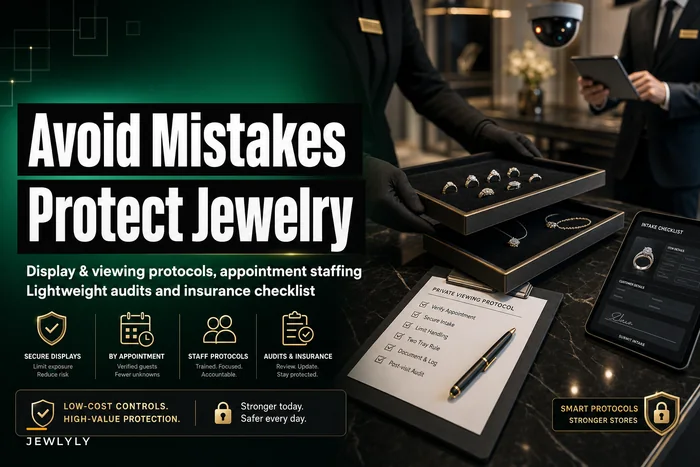
The thin-week trap is the sneaky one. Owners cut staff aggressively when traffic dies and accidentally schedule a single unauthorized person alone on the floor. That's both a sales miss and a security exposure — the exact kind of routine gap covered in low-cost store controls to protect high-value inventory. Light traffic does not mean light authorization requirements.
When this level of structure is overkill
If you're a one- or two-person shop where everyone is fully authorized and does everything, you don't need an authorization matrix — you are the matrix. The three-layer model matters once you have enough staff that authorizations become unevenly distributed, usually somewhere around four-plus employees with real seniority gaps.
It's also overkill if your average ticket is low enough that "high-value handling" isn't really a category for you. A store doing mostly silver, fashion, and sub-$1k pieces doesn't have the concentration risk that drives all of this. The whole framework exists because high-value handling is both rare and clustered. No clustering, no problem to solve.
Where it becomes essential: multi-staff stores with real bridal, estate, or high-end watch business, where a single busy-window authorization gap costs you a four- or five-figure sale and leaves inventory exposed. That's the profile this is built for.
A real scenario
A single-location store, seven employees, strong bridal and estate business, was running roughly 300–340 appointments a month with persistent Saturday bottlenecks. Only two staff could pull and present high-value pieces. The owner kept scheduling both every weekend and still watched consults stack up whenever one got tied in a long appointment.
They did two things. First, they built the capability grid and rebuilt the roster from the authorization layer down instead of from availability up. Second, they cross-trained a third person on high-value handling over about six weeks.
The immediate change was fewer stalled appointments — the "please wait while I find someone who can help you" moment that had been happening most Saturdays basically went away. On the labor side, they stopped double-scheduling both senior handlers for every peak and trimmed something like 10–12 overlap hours a week, which roughly offset the training time within a couple of months. Nothing dramatic on the P&L, but the weekend stopped being a scramble, and a handful of high-value consults that used to walk out started closing in the room.
The point isn't the numbers. The fix was structural. They didn't hire more people or work harder — they just stopped building the roster blind to the one layer that actually decides whether a busy Saturday converts or stalls. Schedule the authorization, not just the person, and most of these problems quietly disappear.
Ready to elevate your jewelry store operations?
Join 500+ jewelers using Jewlyly to increase efficiency, reduce errors, and grow revenue.