



Running a jewelry bench without capacity planning is like trying to fit twenty rings through a sizing mandrel at once. The metal doesn't care about your intentions—it has physical limits. Same with bench time. Yet most small jewelry shops track everything except the one metric that actually determines whether that anniversary band gets delivered on time: available bench hours.
The problem isn't dedication or skill. Your bench jeweler can be absolutely brilliant with a flex shaft and still get buried when three rush repairs, two custom settings, and a complex restoration all land on Tuesday morning. Without visibility into actual capacity versus committed work, you're essentially promising delivery dates based on hope rather than math.
Why bench capacity becomes invisible in jewelry operations
Small jewelry shops face a capacity challenge that other retail just doesn't deal with. When a clothing store runs low on inventory, they order more. When your bench jeweler has forty-three hours of work queued for a thirty-five hour week, you can't order more bench time. The constraint is absolute.
The invisibility happens gradually. It starts innocently enough—your jeweler handles whatever comes in, works late when needed, catches up on Saturdays. Works fine when you're doing maybe fifteen jobs a week. But as volume grows, that mental tracking system breaks down. Your bench jeweler knows they're behind but can't quantify it. You know customers are waiting longer but can't predict it. The whole operation runs on feel rather than data.
What makes this particularly painful is the mix of work types. A simple ring sizing takes forty minutes. Prong retipping might need ninety. A full restoration could eat six hours across multiple sessions. Without categorizing jobs and tracking actual time spent, you're trying to plan capacity using completely different units of measurement—like trying to calculate how many diamonds fit in a case by counting carats, points, and millimeters as the same unit.
The financial impact shows up in ways owners don't always connect. That master jeweler you're paying $28 an hour ends up doing $8-an-hour cleaning work because the schedule's so jumbled they grab whatever's urgent. Rush fees get waived constantly because delays were your fault, not the customer's. The bench becomes a bottleneck that chokes revenue even when demand is strong.
Three capacity myths that destroy bench productivity
Myth 1: "We'll know when we need another jeweler"
Never miss a sale or shipment again.
Jewlyly helps you manage orders, track inventory, and engage customers seamlessly.
- Real-time inventory tracking
- Automated customer notifications
- Sales and order analytics
No credit card required
This reactive hiring approach means you're always behind the curve. By the time delays become painful enough to justify another salary, you've already lost customers and pushed your bench jeweler past sustainable limits. The signal always comes too late.
The math is unforgiving. A competent bench jeweler costs roughly $55,000 to $65,000 fully loaded with benefits and taxes—$4,600 to $5,400 monthly whether they're swamped or sitting idle. No wonder owners wait until they're absolutely certain. But that certainty only comes after months of customer complaints and rushed work that creates comebacks.
Myth 2: "Our jeweler knows how long things take"
Individual expertise doesn't translate to systematic capacity planning. Your jeweler might know a sizing takes forty minutes, but they're not tracking that Tuesday's batch of six sizings actually took five hours because of interruptions, metal issues, and that one ring that needed a shank replacement.
This gap between estimated and actual time compounds invisibly. Each job runs slightly over, nobody captures the overage, and by month end you've lost dozens of productive hours to untracked inefficiency—while the schedule still assumes perfect execution times.
Myth 3: "Priority systems are too complex for a small shop"
The opposite kills productivity. When everything's urgent, nothing is. Your bench jeweler spends mental energy constantly reprioritizing instead of actually working, jumping between jobs based on who called most recently or which envelope looks oldest.
Without clear priority rules, bench time gets eaten up by decision-making. Should they finish the $3,000 custom setting or handle the walk-in sizing for a good customer? These micro-decisions take five to ten minutes each and happen dozens of times a week.
Building job-type SLAs that match bench reality
Service Level Agreements sound corporate, but for a jewelry bench, they're just documented promises about turnaround time. The key is making them specific to job types, not generic across all work.
Start with your five most common job types. For most shops, that's sizing (up or down), prong retipping, chain repair, clasp replacement, and stone setting. Pull your last three months of repair envelopes and categorize them. You'll likely find these five categories cover 70% or more of your bench volume.
For each type, establish three time metrics:
-
Quoted time
What you tell customers
-
Target bench time
Actual working minutes needed
-
Maximum bench time
When to investigate why it's taking longer
Here's what realistic SLAs look like for a small jewelry bench:
| Job Type | Customer Quote | Target Bench Time | Max Bench Time | Notes |
|---|---|---|---|---|
| Simple sizing (up to 2 sizes) | 5-7 days | 40 min | 60 min | Includes polish |
| Prong retipping (4 prongs) | 7-10 days | 90 min | 120 min | Plus inspection time |
| Chain repair (solder) | 3-5 days | 30 min | 45 min | Not including untangling |
| Clasp replacement | 5-7 days | 45 min | 70 min | Standard clasps only |
| Stone setting (single, under 1ct) | 7-10 days | 75 min | 100 min | Excludes custom settings |
Notice the customer quote is always in days while bench time is in minutes. That buffer accounts for queue time, inspection, customer communication, and the reality that jobs don't flow continuously through the bench.
The maximum bench time triggers a conversation. When a sizing consistently takes longer than sixty minutes, something's wrong—maybe your jeweler needs better tools, maybe certain ring styles should be quoted differently, or maybe interruptions are killing efficiency.
Time tracking that jewelers will actually use
Detailed timesheets are fantasy for bench jewelers. They're craftspeople, not accountants. The tracking system needs to be simple enough to use with dirty hands and without breaking concentration.
The most effective approach for small shops uses job envelopes with pre-printed time boxes. When the jeweler starts a job, they circle the start time (just the hour, not minutes). When they finish or pause, they circle the stop time. That's it. No apps, no computers, no detailed logs.
START: 8 | 9 | 10 | 11 | 12 | 1 | 2 | 3 | 4 | 5 STOP: 8 | 9 | 10 | 11 | 12 | 1 | 2 | 3 | 4 | 5 RESTART: 8 | 9 | 10 | 11 | 12 | 1 | 2 | 3 | 4 | 5 FINAL: 8 | 9 | 10 | 11 | 12 | 1 | 2 | 3 | 4 | 5
This gives you enough data to calculate actual time spent without requiring precision that disrupts workflow. If they started at 9 and stopped at 11, that's roughly two hours. Close enough for capacity planning.
Some jewelers prefer a simple tick system—one tick per fifteen-minute block spent on a job, four ticks to an hour. Works especially well for jobs that get touched multiple times throughout the day.
Make the envelope system visible to the jeweler by summarizing weekly minutes so they can see how small interruptions add up.
The crucial part: make tracking benefit the jeweler, not just management. Share the data back. Show them that those "quick" stone tightenings actually average thirty-five minutes once you factor in inspection and cleaning. This validates their experience and helps them give better estimates.
Creating a priority matrix that eliminates bench chaos
Priority shouldn't be whoever complained loudest or whatever envelope sits on top. A clear matrix removes emotion and politics from scheduling decisions.
The most effective approach for jewelry shops uses two factors: promise date and job value. Not customer value—job value. A $200 sizing for your best customer might actually deserve lower priority than a $3,000 custom setting for a new client, assuming equal promise dates.
Urgent + High Value: Custom pieces due this week, repairs over $500 approaching deadline
Urgent + Low Value: Simple repairs due soon, watch batteries for waiting customers
Not Urgent + High Value: Custom orders with comfortable deadlines, estate restoration work
Not Urgent + Low Value: Routine maintenance, engravings with flexible dates
The power comes from having pre-set rules about how to handle each quadrant:
-
Urgent + High Value always gets worked first each morning when focus is sharpest
-
Urgent + Low Value gets batched—all sizings together, all chain repairs together
-
Not Urgent + High Value fills the afternoon when interruptions are more likely
-
Not Urgent + Low Value only gets touched when other quadrants are clear
This matrix connects directly to bench capacity planning. If Urgent + High Value work consistently exceeds 40% of available bench time, you're heading for a crisis. Either too many rush jobs are being accepted or promise dates are too aggressive for current capacity.
Weekly bench capacity planner with real numbers
Forget complex software initially. A simple weekly planning sheet that takes ten minutes every Monday morning will transform your bench operations.
Here's a working example for a single-jeweler bench with thirty-five available hours:
Week of March 10-14
Available capacity: 35 hours (2,100 minutes)
Already committed from previous weeks:
-
3 custom settings at 90 min each = 270 min
-
2 restoration projects at 120 min each = 240 min
-
Carryover sizing batch (5 pieces) = 200 min
-
Total pre-committed
710 minutes
New jobs accepted this week:
-
Monday intake
4 sizings, 2 prong repairs = 340 min
-
Tuesday intake
1 custom setting, 3 chain repairs = 180 min
-
Wednesday intake
2 stone settings, 2 sizings = 230 min
-
Total new work
750 minutes
Capacity calculation:
-
Available
2,100 minutes
-
Committed
710 minutes
-
New work
750 minutes
-
Remaining capacity
640 minutes (roughly 10.5 hours)
That remaining capacity isn't really available—it's your buffer for complications, customer interactions, tool maintenance, and the inevitable rush job that walks in Thursday afternoon.
When remaining capacity drops below 20% of total weekly capacity (seven hours in this example), stop accepting new work for the week unless it's a true emergency. This prevents the cascade effect where accepting one more job on Wednesday means everything else slides into next week.
Here's a simple visual workflow of how the weekly planner feeds into daily decisions.
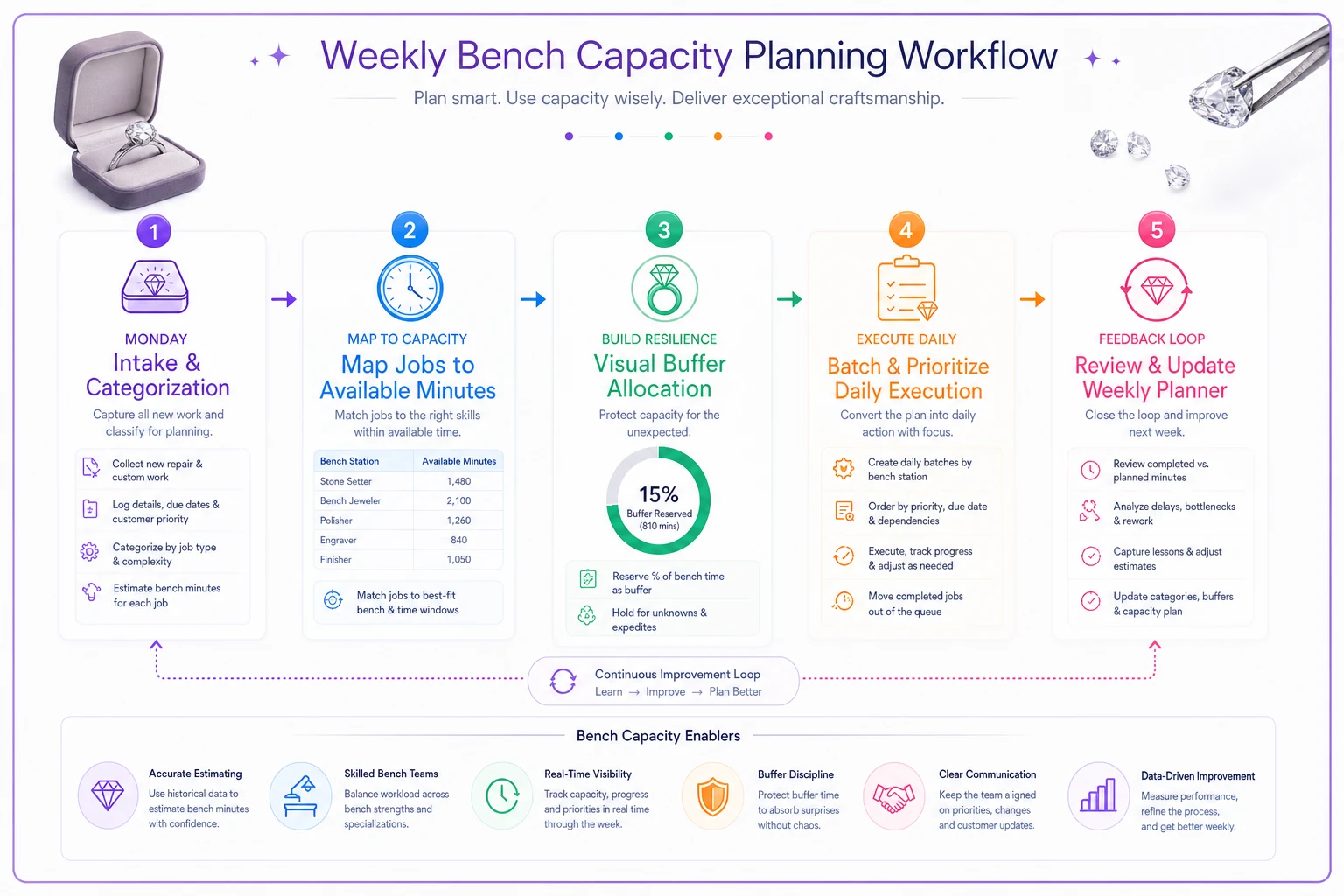
Use that visual to guide the Monday planning meeting and the quick nightly updates.
Handling rush jobs without destroying the schedule
Rush jobs are jewelry retail reality. Engagement rings need sizing before proposals. Anniversary gifts need repair before the big day. Completely refusing rush work isn't realistic for shops that depend on community reputation.
The solution isn't to avoid rush work—it's to price and plan for it intelligently. First, establish what genuinely qualifies as rush. "Customer wants it fast" isn't rush. "Proposal this Saturday" or "Anniversary tomorrow" might be.
Set rush capacity aside explicitly. If your bench has thirty-five hours weekly, reserve three to four hours for legitimate rush work. When no rush work appears, that time goes toward getting ahead on next week's jobs.
Rush pricing should be meaningful enough that customers self-select. A 50% upcharge barely covers the disruption. Consider 100% minimum, clearly posted. That sizing might take the same forty minutes, but shuffling everything else to accommodate it costs far more in coordination time and stressed workflows. Honest pricing for honest operational impact.
When capacity planning reveals you need help
The numbers don't lie. When your weekly planner consistently shows 120% or more capacity utilization, you're beyond optimization—you need more hands. But hiring another full-time jeweler might not make sense yet.
Consider intermediate steps first. Part-time bench help for specific tasks often works better than expected. Find someone who just does sizings and simple repairs. At $20-25 hourly for fifteen hours weekly, you're adding roughly 600 minutes of capacity for $300-375. That's often enough to keep the main jeweler focused on complex, profitable work.
Contract jewelers for overflow are another option. Build relationships with two or three independent jewelers who can handle the excess. Yes, margins shrink at contract rates, but it beats losing customers or burning out your primary jeweler.
Some shops successfully implement "bench days" where certain job types only get worked on specific days—Mondays and Thursdays for sizings, Tuesdays for repairs, Wednesday and Friday for custom work. Batching this way tends to squeeze 10-15% more capacity from the same hours.
Integrating capacity planning with customer communication
Visibility into bench capacity changes how you communicate with customers. Instead of vague promises about "probably next week," you can give realistic timeframes based on actual workload.
Train front-counter staff to check the capacity planner before quoting dates. If the bench shows 90% utilization, that "simple" sizing isn't getting done in three days regardless of how much the customer pleads. Better to set realistic expectations upfront than apologize later.
Share capacity reality with good customers. "Our bench is fully booked through Thursday, but I can guarantee Friday afternoon if that works." This transparency builds trust and often leads customers to self-select urgency levels. Many will say "next week is fine" once they understand the situation.
When customers genuinely need rush service, the capacity planner justifies the premium. "To fit this in tomorrow means reshuffling six other jobs—that's why we charge the rush fee." It's not arbitrary. It's operational reality.
The compound effect of systematic capacity planning
After three months of disciplined capacity planning, patterns emerge that weren't visible before. Maybe Tuesday intake consistently overwhelms the bench because Monday's newspaper ad drives traffic. Maybe certain job types always run over estimate. Maybe one of your sales staff consistently overpromises on timing.
These patterns let you adjust proactively. Shift marketing to spread intake more evenly. Revise estimates for consistently problematic job types. Retrain staff who create bench conflicts. Small adjustments compound into real efficiency gains over time.
The psychological effect on your bench jeweler matters too. When they know capacity is actively managed, stress drops. They're not personally responsible for disappointing customers when the math simply doesn't work. They can focus on quality rather than constantly juggling priorities.
One shop owner who ran this system for about six months told me their jeweler started suggesting process improvements unprompted. Once the chaos settled, there was mental space to actually think about better workflows. The jeweler recommended a new tool that cut sizing time by roughly 25%. That kind of contribution only happens when someone isn't drowning.
Making capacity planning stick in daily operations
The best system fails if nobody uses it consistently. For bench capacity planning to work, it needs to become as routine as opening the register.
Start with just one week. Track everything, even if the numbers seem off. Second week, refine time estimates based on reality. Third week, start using the data to make actual scheduling decisions. By week four, the old way of operating feels genuinely reckless.
The owner or manager needs to own this initially. Don't dump it on the bench jeweler who's already overwhelmed. Fifteen minutes every Monday morning to plan the week. Five minutes each evening to update actual versus planned. Friday afternoon, a quick review of what worked and what didn't.
Once the rhythm is there, gradually pull the bench jeweler into the planning process. Most start to appreciate having input on their week rather than just reacting to whatever lands on the bench. Some eventually start doing their own capacity planning once they see how much it reduces their stress.
When establishing repair workflows, capacity planning becomes the backbone that makes everything else work. And for shops handling custom orders with complex timelines, knowing actual bench capacity transforms how you structure milestone commitments.
From reactive to proactive bench management
Small jewelry shops don't need complex systems to make capacity planning work. A clear SLA structure, basic time tracking, a simple priority matrix, and a weekly planning habit are genuinely enough to transform how the bench runs.
The shift from reactive to proactive typically shows results within thirty days. Customer complaints about timing drop. Rush fees actually get collected because they're justified by real operational cost. The bench jeweler stops working unpaid overtime just to keep pace.
Most importantly, capacity planning gives you control over growth. When you know exactly how much work your bench can handle, you make better decisions about marketing, hiring, and which jobs to accept. The bench stops being a mysterious bottleneck and becomes a managed asset you can actually optimize.
The math is straightforward: if your single jeweler handles thirty-five hours of bench work weekly, that's roughly 140 hours monthly. At an average job value of $180 and forty-five minutes per job, that's around $4,200 in weekly bench revenue potential. Know your numbers, plan your capacity, and stop leaving money on the table because of poor workflow management.
Ready to elevate your jewelry store operations?
Join 500+ jewelers using Jewlyly to increase efficiency, reduce errors, and grow revenue.