


Three months ago, a jewelry store in Denver lost a $42,000 client over a botched sapphire resetting. Not because the bench jeweler made a mistake—the stone was actually set perfectly. The problem? Nobody documented the hairline fracture that was already there when the customer dropped off the ring.
When the customer picked up the piece and noticed the crack under their loupe at home, they went nuclear. No intake photos. No condition notes. No signed acknowledgment. Just a he-said-she-said disaster that ended with legal threats and reputation damage spreading through local Facebook groups.
This plays out constantly in jewelry repair operations. Not always at the $42k level—that's extreme. But the smaller bleeds add up fast: $800 refunds for "damaged" stones that arrived damaged, free re-platings because nobody tracked how many times that white gold ring had already been serviced, rush fees waived because someone forgot to call the customer about a two-week parts delay.
Most jewelry stores still run repairs like it's 1995. Paper tickets stuffed in envelopes. Sticky notes on repair bags. Memory-based tracking of who needs what and by when. Maybe you've upgraded to a basic POS that logs repairs, but it almost certainly doesn't handle the complexity jewelry actually demands—stone counts, metal testing results, before photos, plating history, outsourced vendor tracking, liability waivers for heirloom pieces.
Jewelry repair requires documentation density that most general repair shops never have to think about. A phone screen replacement has maybe three checkpoints. A vintage ring restoration might have twenty-seven.
Why jewelry repairs create more disputes than any other retail service
The core problem is information asymmetry combined with emotional value that multiplies everything.
When someone brings in their grandmother's engagement ring for resizing, they're not handing you a 2.8-gram 14k band with a .45ct I2 diamond. They're handing you their entire family history. Every existing inclusion becomes potential damage you caused. Every old wear mark turns into scratches from your incompetent staff.
Layer on the technical complexity: most customers have no idea that rhodium plating wears off naturally, that ultrasonic cleaning can loosen already-compromised settings, that certain stones can't survive a jewelry torch. They drop off a ring that "just needs sizing" not knowing their opal will crack under heat. Then they blame you when standard metalwork destroys their stone.
Traditional shops handle this with experience and verbal explanations. The problem is verbal explanations evaporate the moment a customer walks out the door. You need operational documentation that protects both your business and your customer relationships.
What usually happens instead: Sarah at the counter takes in a ring, scribbles some notes on a repair envelope, maybe mentions that emeralds are risky to clean. She tosses it in the safe for whenever Tom the bench jeweler gets to it. Tom finds issues Sarah didn't catch—loose prongs, worn galleries, thin shank spots. He fixes what he can, leaves notes for Sarah (sometimes), puts it in the pickup drawer. Customer comes back three weeks later when Sarah's off. Marcus hands them the ring. The customer notices something that was never documented. And now you're in dispute resolution mode.
The inspection framework that eliminates most disputes before they happen
The most critical moment in a jewelry repair isn't the actual repair—it's the intake inspection. This single interaction determines whether the transaction ends smoothly or becomes a nightmare dispute three weeks later.
Never miss a sale or shipment again.
Jewlyly helps you manage orders, track inventory, and engage customers seamlessly.
- Real-time inventory tracking
- Automated customer notifications
- Sales and order analytics
No credit card required
Here's the inspection framework that actually works:
-
Overall photos from six angles (top, bottom, all four sides)
-
Macro photos of any stones over 2mm
-
Detailed shots of existing damage, wear, or inclusions
-
Photos of hallmarks, engravings, and identifying marks
-
Stone count and description—not just "diamonds" but "7 round brilliants, approximately 2mm each"
-
Prong condition for every stone setting
-
Metal test results, especially for white metals that could be white gold, platinum, or silver
-
Band thickness measurements at three points
-
Any visible previous repairs, solder marks, or non-original components
Documentation alone doesn't prevent disputes, though. You need customer acknowledgment of existing conditions while they're still standing in front of you. Walk them through what you're seeing. "I'm noting that your emerald has some surface-reaching inclusions here and here—see these lines? These were present before we touched it, but emerald is brittle, so there's always risk they could extend during normal repair work."
The customer needs to sign off on more than just agreeing to the repair. They need to acknowledge specific risks and existing conditions. Your intake form should include checkboxes for:
-
Natural inclusions noted in colored stones
-
Existing chips or cracks documented
-
Understanding that plating wears off over time
-
Risk acknowledgment for heat-sensitive stones
-
Understanding that ultrasonic cleaning may reveal already-loose stones
-
Acknowledgment that metal testing may leave small marks
-
Agreement that exact color matching isn't guaranteed on repairs
Use consistent lighting and a fixed camera distance for intake photos so before/after comparisons are unambiguous.
Most shops skip this because it feels like overkill. Then they eat the cost when Mrs. Patterson swears her sapphire was flawless before you touched it.
Building repair SLAs that match operational reality
Service level agreements in jewelry repair are usually fiction. "Ready in 7-10 business days" means nothing when you're dealing with six different repair types that require completely different workflows.
Here's how timelines actually break down in functional operations:
| Repair Type | Estimated Timeline | Key Variables |
|---|---|---|
| Simple sizing (no stones) | 2–3 business days | Intake, bench work, polish/QC |
| Sizing with stones | 5–7 business days | Stone removal, resetting, security check |
| Stone replacement (standard cuts) | 7–14 business days | Stock availability; colored stones may need ordering |
| Prong repair / retipping | 3–5 business days | Complexity and number of prongs |
| Chain repair | 1–2 business days | Hollow chains may need replacement (7–10 days) |
| Custom work or restoration | 15–30 business days | Consultation, approvals, material sourcing |
The mistake most shops make is treating all repairs the same. Intake staff quotes "about a week" for everything, then wonders why customers get frustrated when a simple sizing takes ten days because it got buried under complex restoration work.
Build separate tracking queues for different repair types. Fast-track simple sizings and chain repairs—these clear your workspace and build customer confidence. Complex restorations go into a different workflow entirely, with different communication expectations from the start. Even just separating those two queues makes a noticeable difference in how chaotic the repair bench feels day-to-day.
Communication templates that prevent the "nobody told me" nightmare
The number one complaint in jewelry repair isn't poor craftsmanship—it's communication failures. "Nobody told me it would take three weeks." "Nobody mentioned the stone was already cracked." "Nobody called about the extra charges."
A consistent communication framework eliminates most of these disputes:
Intake confirmation (immediate): "We've received your [piece description] for [repair type]. Based on our initial inspection, we estimate completion by [date]. If we discover any issues requiring additional work or costs, we'll contact you before proceeding. Your repair ID is [number]."
Issue discovery (within 48 hours): "During detailed inspection of your [piece], we discovered [specific issue]. This isn't uncommon with [piece type/age]. To proceed with your original repair, we recommend [solution]. This would add approximately $[amount] and [X] days to your timeline. Please respond within 48 hours so we know how you'd like to proceed."
Delay notification (as soon as known): "Your [piece description] repair requires [specific part/stone/material] that's taking longer than expected to source. New estimated completion date is [date]. We apologize for the delay. If you need the piece returned unrepaired for an upcoming event, just let us know."
Ready for pickup: "Your [piece description] is ready for pickup. We're open [hours]. Please bring your receipt or ID. If you can't collect within 30 days, we'll move your item to long-term storage, which may incur fees."
Follow-up (3 days after pickup): "We hope you're happy with your recent repair. If you notice any issues with the work within the next 30 days, please bring your piece back for complimentary inspection and adjustment."
These aren't optional niceties. They're operational insurance. Every message creates a documentation trail showing you communicated proactively—which matters enormously if a dispute surfaces later.
The three-tier liability system that protects both parties
Jewelry repair liability isn't one-size-fits-all. A $200 silver chain repair carries completely different risks than a $20,000 antique restoration. You need tiered protocols that match actual risk levels.
Tier 1: Standard repairs under $1,000
-
Basic photo documentation
-
Standard liability waiver
-
Store insurance covers reasonable claims
-
No special handling requirements
Tier 2: Repairs $1,000–$5,000
-
Comprehensive photo documentation
-
Detailed condition report
-
Customer signs specific risk acknowledgments
-
May require a deposit for expensive materials
-
Consider suggesting customer insurance inspection
Tier 3: Repairs over $5,000 or irreplaceable pieces
-
Professional appraisal recommended before work begins
-
Video documentation of intake condition
-
Detailed written assessment of all risks
-
Customer insurance verification suggested
-
Work performed in stages with approval at each stage
-
May decline certain high-risk repairs entirely
The key point here is that liability protection isn't just about covering your business—it's about setting correct expectations before the work starts. When someone understands that their 100-year-old Art Deco ring might not survive a sizing, they can actually make an informed decision about whether to proceed.
Most shops treat every repair identically until something goes wrong. Build the tiered system before you need it.
Tracking the data that reveals your actual repair profitability
Most jewelry stores have no idea whether their repair department actually makes money. They track total repair revenue, maybe track bench jeweler hours, and assume the difference is profit. This completely misses the hidden costs eating margins.
Here's what you actually need to track:
-
Time investment by repair type
Not just bench time—total operational time. That "quick sizing" might take 20 minutes at the bench but 45 minutes of total staff time once you include intake, customer communication, invoicing, and pickup.
-
Redo and warranty rates
What percentage of repairs come back within 30 days? Industry average runs somewhere around 3–5%, but certain repair types can hit 10–15%. If your stone settings keep coming back loose, you're losing money even when the initial repair seemed profitable.
-
Material usage versus billing
Are you charging for every jump ring, every drop of solder, every rhodium plating solution refresh? Small materials add up to thousands annually when left untracked.
-
Dispute resolution costs
Track how much you spend—in refunds, free work, and staff time—resolving repair disputes. Most shops find this number is quietly larger than they expect until proper documentation systems are in place.
-
Outsourcing ratios
What percentage of repairs go to outside vendors? What's your markup? Are you making enough to justify the administrative overhead of managing those relationships?
-
Customer lifetime value impact
Does repair work lead to purchases? Track whether repair customers buy within 90 days. Good repair experiences often trigger significant purchases—but only if you're actually watching for the connection.
When shops run these numbers honestly for the first time, the pattern is usually the same: simple sizings barely break even after full operational cost, complex custom work has solid margins but ties up resources, and stone replacement is profitable only if materials are marked up properly.
Building stone-specific handling protocols that prevent catastrophes
Different stones require completely different handling, but most repair operations treat everything like it's a diamond. This is where expensive mistakes happen.
Emeralds can't go in ultrasonics—the oil treatments leach out and internal fractures can extend. Opals crack if they dry out or face rapid temperature changes. Tanzanite can shatter from thermal shock. Pearls dissolve in pickle solution. The list of stone-specific disasters waiting to happen is genuinely long.
A basic framework for stone handling:
| Category | Stones |
|---|---|
| Heat-sensitive (cannot torch with stones in place) | Opal, Emerald, Tanzanite, Pearl, Turquoise, Amber, Coral |
| Ultrasonic-sensitive | Emerald, Opal, Tanzanite, Pearls, heavily included stones, treated/filled stones |
| Chemical-sensitive | Pearls (no acids), Turquoise (porous), Opal (no harsh chemicals), Coral (organic) |
| Physically fragile | Tanzanite (extremely brittle), Emerald (brittle along inclusions), Opal (pressure), Kunzite (perfect cleavage) |
These protocols need to be physically posted at every workstation—not memorized, but posted where staff can verify before every single repair. One tanzanite disaster costs more than a year of successful repairs.
The software piece: when operational automation actually helps
Paper tickets and memory-based tracking might work when you're processing twenty repairs a month. Once you hit fifty, you need systems. Once you're managing a hundred, you need automation.
A rough picture of how a modernized repair workflow actually flows:
Customer intake (online or tablet) ↓ Photos + stone documentation uploaded to repair record ↓ Risk acknowledgments signed digitally ↓ Repair assigned to queue by type (simple / complex / outsourced) ↓ Automated confirmation sent to customer ↓ SLA timer starts → triggers delay alerts if exceeded ↓ Bench jeweler flags issues → notification sent for approval ↓ Repair completed → QC checkpoint ↓ Pickup notification sent → record closed ↓ Follow-up message sent 3 days post-pickup
Here's a simple visual of that workflow.
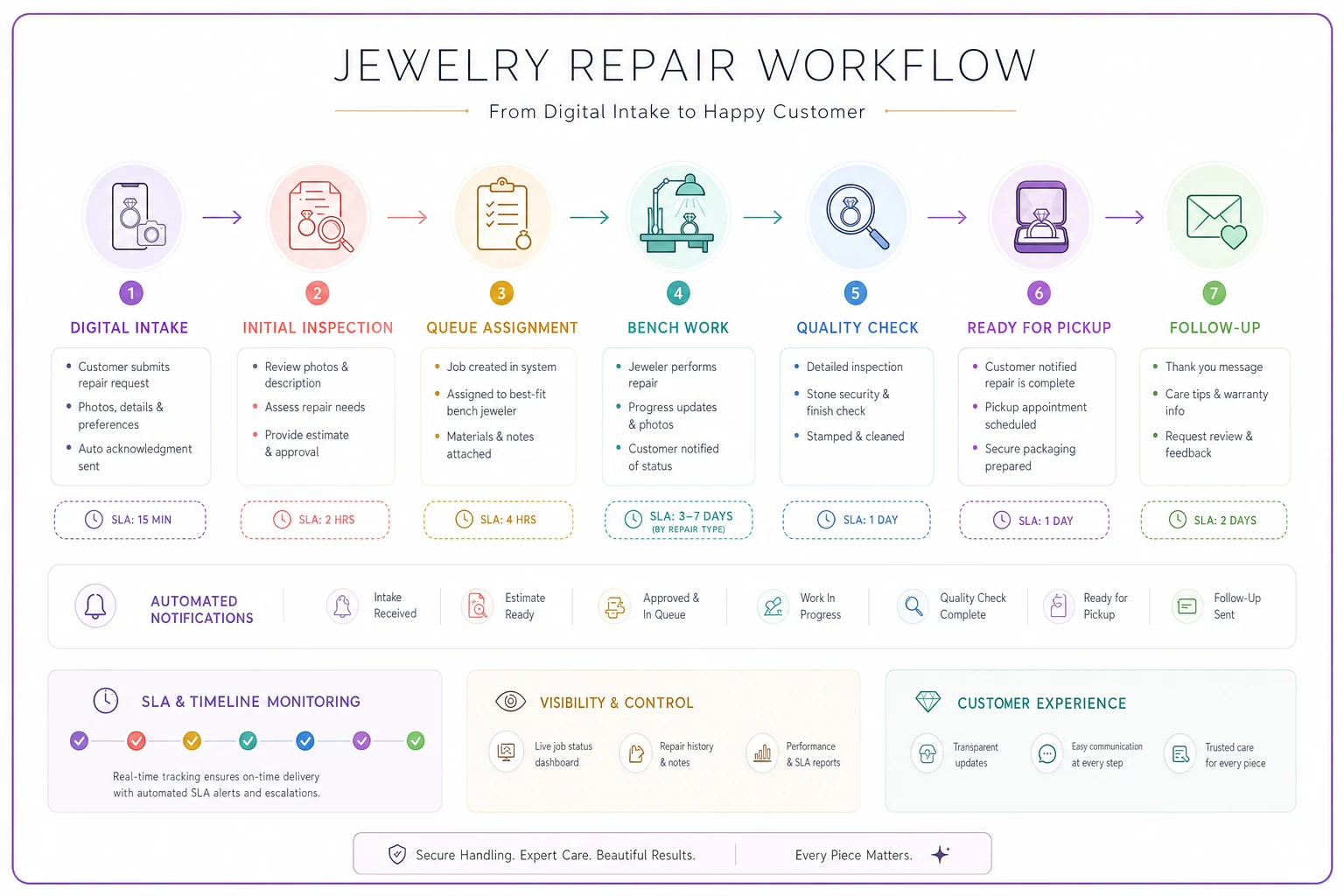
Modern repair tracking starts with digital intake. Customers fill out initial information online or on a tablet. Photos upload directly to their repair record. Stones get documented in a standardized format. Risk acknowledgments become required checkboxes before anything moves forward.
AI-powered operational platforms can now analyze intake photos to flag common issues before your bench jeweler even touches the piece. The emerald with surface-reaching inclusions gets flagged automatically. The "platinum" ring that's actually white gold triggers a metal testing reminder. The vintage piece with lead solder activates the safety protocol. Workflow automation handles the mundane but critical tasks: sending confirmation messages, triggering delay notifications when repairs exceed SLA targets, reminding customers about pickups, alerting staff when high-value pieces need special handling.
The real value comes from connecting repair operations to your broader business. When Mrs. Henderson drops off her ring for sizing, the system should know she bought it from you three years ago, flag that her anniversary is next month, and surface that information for your sales staff when she comes in to pick up. Not replacing human judgment—just making sure things don't slip through when you're juggling dozens of repairs at different stages.
Repairs as relationship builders, not just revenue
The most successful jewelry repair operations understand that repairs aren't just about fixing jewelry. They're trust-building exercises that determine whether customers come back for their next major purchase.
Every botched repair or dropped communication destroys thousands in future sales. Every smooth experience—where the customer feels heard and protected throughout—builds loyalty that compounds over years.
The operational framework outlined here—comprehensive intake documentation, tiered liability protocols, automated communication, proper stone handling—isn't about covering legal bases. It's about delivering repair experiences so smooth that customers naturally think of you when they're ready to upgrade the ring you just sized.
Most jewelry stores treat repairs as a necessary evil. A low-margin service they provide grudgingly. The smart ones recognize repairs as the gateway to customer relationships worth tens of thousands over time. But that only works when operations run smoothly enough that both staff and customers can actually enjoy the process.
The tools to transform repair operations from chaos to something manageable exist and are more accessible than most shop owners realize. The question is whether you implement them before the next dispute costs you a longtime customer, or after.
Ready to elevate your jewelry store operations?
Join 500+ jewelers using Jewlyly to increase efficiency, reduce errors, and grow revenue.