
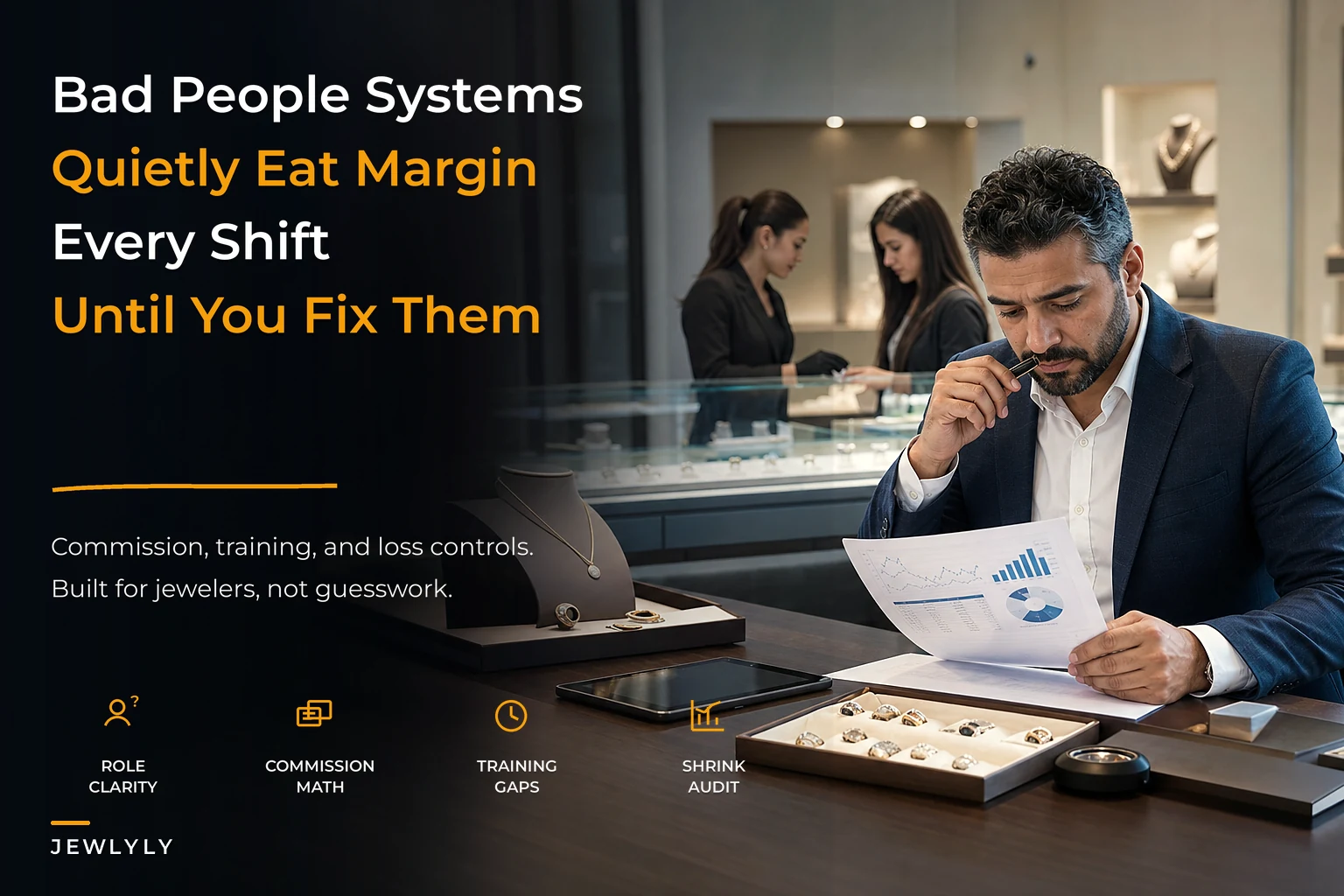

Most jewelry stores lose somewhere between 8 and 12% of potential margin through compensation structures that accidentally reward the wrong behaviors. Not because staff members want to game the system—they're usually just responding to incentives exactly how you'd expect them to.
The real problem runs deeper than commission percentages. It's the disconnect between how you pay people, what you train them on, and the actual operational risks they create or prevent every day on your floor. When these three systems don't align, you get predictable failures: associates pushing easy sales over profitable ones, experienced staff hoarding knowledge instead of developing newer hires, and everyone treating loss prevention like someone else's job.
Having built operational software for jewelry stores ranging from single locations doing $800k annually to small chains pushing $15 million across four stores, the pattern is hard to miss. Stores that treat commission, training, and loss prevention as separate problems always end up fighting the same cascading issues. Meanwhile, stores that connect these systems into one coherent people-operations framework consistently outperform on both margin and shrinkage.
Why traditional jewelry commission structures create operational chaos
The standard flat 3–5% commission on everything made sense when stores carried mostly finished pieces at predictable margins. Modern jewelry retail doesn't work that way. You've got fashion jewelry at 200% markup sitting next to designer consignment at 15% commission splits. Custom orders with 40-plus hours of bench time competing against grab-and-go silver. Estate pieces needing authentication next to branded watches with MAP pricing.
Yet most stores still run commission like it's 1995. Same percentage whether someone sells a $300 silver bracelet (five minutes, zero risk) or closes a $30,000 engagement ring (multiple appointments, insurance verification, special handling). The math stops working pretty quickly.
What actually happens: your best salespeople gravitate toward easy volume. They'd rather sell ten $500 pieces at 4% than spend three hours educating a nervous groom on a $15,000 ring that earns the same rate. Can you blame them? The compensation structure literally penalizes them for taking on complex, high-touch sales.
Newer associates avoid anything complicated. Estate jewelry? "Let me grab Sarah, she knows more about vintage pieces." Custom design consultation? "Tom handles our CAD requests." Luxury watch authentication? "That's really more of a manager thing." They're not being lazy—they're protecting themselves from mistakes that could cost them their job while earning the same commission rate as selling basic chains.
This creates a vicious cycle. Experienced staff get overwhelmed handling every complex transaction. New hires never develop advanced skills. Customers who need expertise learn to wait for specific people. The store's overall selling capacity shrinks to whatever your top two or three associates can handle.
The compounding damage of role-agnostic handling procedures
Walk into most jewelry stores and watch what happens when someone wants to see a $20,000 watch. The newest associate grabs the key, opens the case, hands it over. Same process as showing a $200 pair of earrings. No special protocol, no documentation, no senior oversight.
Never miss a sale or shipment again.
Jewlyly helps you manage orders, track inventory, and engage customers seamlessly.
- Real-time inventory tracking
- Automated customer notifications
- Sales and order analytics
No credit card required
This isn't recklessness—it's the absence of role-based operational structure. When every employee has the same responsibilities regardless of experience, you're running on luck. Sure, nothing bad has happened yet. But "yet" is doing a lot of heavy lifting in that sentence.
The real operational damage shows up in three ways:
Insurance claims become nightmares. When something goes missing, your carrier asks for documentation showing who handled the item, when, and under what protocols. If your answer is "whoever was closest to the case," that claim is going to be a problem. Carriers increasingly reject claims when stores can't demonstrate proper handling procedures tied to employee authorization levels.
Knowledge transfer breaks down completely. Without defined progression from basic to advanced responsibilities, there's no framework for skill development. New hires just exist. They sell what they can, avoid what they can't, and hopefully absorb knowledge through osmosis. Osmosis is a terrible training strategy.
Accountability becomes impossible. When everyone can theoretically do everything, no one owns anything. A damaged piece found during inventory? Could have been anyone. Authentication paperwork missing? Who knows who handled it last. The lack of role definition creates perfect conditions for both honest mistakes and intentional misconduct.
Building category-specific commission tiers that actually drive the right behavior
A functional commission plan starts with reality: different categories require different effort, carry different risk, and generate different margins. Paying the same rate across everything is like pricing all your inventory the same—simple, but wrong.
Tier 1: Fashion & Basic Jewelry (2–3% commission)
-
Sterling silver
-
Fashion brands
-
Basic gold chains/bracelets
-
Items under $1,000
-
No special handling required
-
Standard return policy applies
Tier 2: Mid-Range Fine Jewelry (4–5% commission)
-
Gold pieces $1,000–$5,000
-
Basic diamond jewelry
-
Standard luxury brands
-
Requires case keys
-
Standard authentication
Tier 3: High-Value Complex Sales (6–8% commission)
-
Items over $5,000
-
Custom design projects
-
Estate/vintage pieces
-
Certified diamonds
-
Requires consultation time
-
Special documentation needed
Tier 4: Specialty Categories (Variable structure)
-
Consignment
25% of store's commission
-
Repairs leading to sales
10% of repair + standard commission on add-ons
-
Custom CAD/design
Flat fee + commission on final sale
-
Appointments resulting in sales
Extra 1–2% for pre-booked consultations
The exact percentages matter less than the underlying principle: acknowledge operational complexity in your compensation. When you pay more for harder sales, associates develop skills to earn those higher rates. When you recognize special categories, people stop avoiding them.
Most stores miss the critical piece though—you need clear qualification criteria for each tier. Not just "expensive stuff pays more" but specific operational requirements. Can't sell from Tier 3 without completing luxury handling certification. Can't earn Tier 4 custom commissions without CAD software training. The commission structure becomes your skill development roadmap.
Onboarding modules that prevent expensive mistakes before they happen
New jewelry store employees typically get three days of "training"—here's the POS system, here are the case keys, don't steal anything. Then they're on the floor, learning by making mistakes that cost you money and reputation.
Real onboarding for jewelry retail needs structured progression through risk levels. Not because new employees are incompetent, but because jewelry-specific operational knowledge takes time to build. You wouldn't hand someone a bench torch on day one. Why hand them access to $50,000 in loose diamonds?
Week 1–2: Foundation Systems
-
POS basic operations (no voids/returns yet)
-
Basic security protocols
-
Customer interaction standards
-
Fashion jewelry only (under $500)
-
Shadow experienced staff for higher-value interactions
Week 3–4: Intermediate Skills
-
Case management procedures
-
Basic gemstone identification
-
Authentication paperwork
-
Mid-range jewelry ($500–$2,000)
-
Supervised high-value demonstrations
Month 2: Advanced Authorization
-
Void/return procedures
-
Custom order intake
-
Basic repair assessment
-
Items up to $5,000
-
Independent customer consultations
Month 3+: Specialization Paths
-
Choose focus area (luxury, custom, estate, etc.)
-
Complete category-specific training
-
Earn commission tier qualifications
-
Full selling authorization
Each module needs specific sign-offs. Not "yeah, I showed them the diamond tester" but documented proficiency. Simple checklists work fine: identify 10 gemstones correctly, process 5 authentication forms without errors, complete 3 supervised custom consultations.
The onboarding structure connects directly to your commission tiers. Want to earn Tier 3 rates? Complete the modules. This transforms training from a cost center into a clear advancement path. Associates can see exactly what they need to learn to earn more.
High-value handling checklists that everyone actually follows
Creating handling procedures is easy. Getting people to follow them consistently is where most jewelry stores fail. The problem isn't laziness—it's that most procedures feel like bureaucracy rather than protection.
Effective checklists need three characteristics: role-specific (not one-size-fits-all), value-tiered (more valuable = more steps), and audit-friendly (easy to verify compliance).
$5,000–$10,000 Item Showing
-
Two-person rule
associate + witness
-
Client ID verification (driver's license)
-
Show log entry
time, item, client name
-
Secure case immediately after showing
-
Digital photo of log page
-
Manager notification for items over $8,000
$10,000–$25,000 Item Showing
-
Everything from previous tier, plus
-
Manager pre-approval required
-
Client pre-screening (appointment scheduling system)
-
Security camera position check
-
Dedicated showing room only
-
Post-showing verification count
-
Insurance rider confirmation
$25,000+ Item Showing
-
Everything from previous tiers, plus
-
Owner/senior manager only
-
Background check on new clients
-
Two forms of ID required
-
Written showing agreement
-
Security present or on-call
-
Immediate case audit after showing
The critical piece: these aren't suggestions, they're requirements tied to authorization levels. A six-month employee cannot access the $25,000+ procedure because they don't have system permissions. The POS locks them out. The case requires a manager key. The insurance paperwork needs a senior signature.
Tie case keys and POS permissions directly to authorization levels to enforce the rules.
This removes the judgment call aspect. It's not about trust—it's consistent operational protection that doesn't rely on individual decision-making under pressure.
Audit cadences that catch problems before they become disasters
Most jewelry stores run "audits" that are really just counting exercises. Once a quarter, count everything, panic about discrepancies, make no systemic changes, repeat. This reactive approach guarantees you'll always be behind on both shrinkage and training gaps.
Effective audit programs use different cadences for different risk levels:
Daily Spot Audits (5 minutes)
-
Count 3 random high-value pieces
-
Verify yesterday's showing log entries
-
Check one authentication folder
-
Review previous day's voids/returns
-
Confirm safe contents match log
Weekly Systematic Review (30 minutes)
-
Full count of items over $10,000
-
Audit roughly 10% of mid-range inventory
-
Review all custom order paperwork
-
Check training module completions
-
Verify security protocol compliance
Monthly Deep Dive (around 2 hours)
-
Category rotation full count
-
Commission calculation audit
-
Handling procedure compliance check
-
Training progression review
-
Loss incident analysis
Quarterly Comprehensive (full day)
-
Complete physical inventory
-
Full reconciliation with POS
-
Insurance documentation review
-
Staff authorization audit
-
Process improvement planning
What makes audits actually work is immediate feedback. Spot audit finds a discrepancy? Stop everything, figure it out now. Weekly review shows handling violations? Retrain that afternoon. Don't let problems age into mysteries.
Connect audit findings directly to both training and compensation. Pattern of mistakes with a specific associate? Back to foundational modules. Consistent compliance over time? Fast-track to higher authorization levels. Audits should be about improvement, not punishment.
The multiplication effect of aligned systems
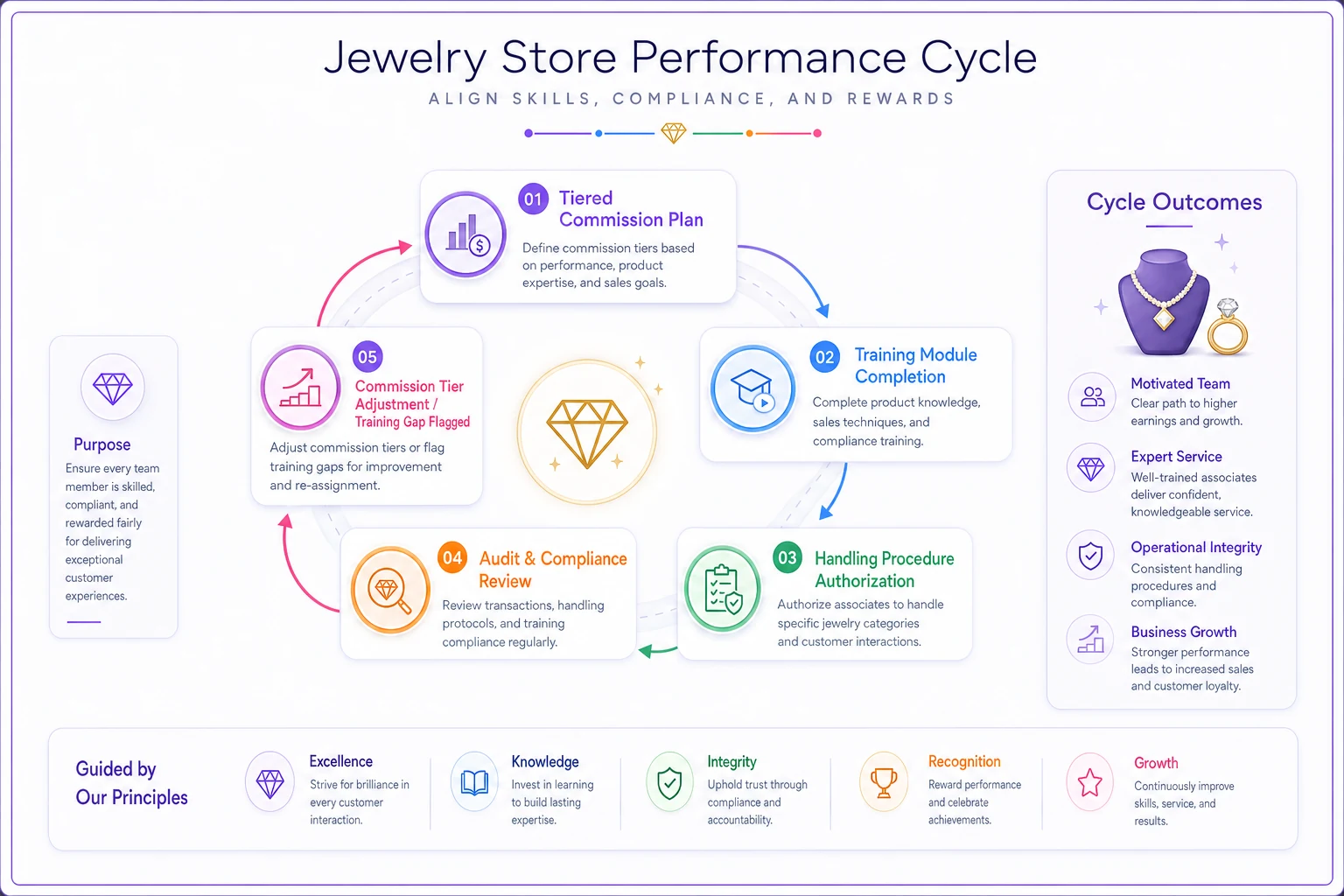
When commission structures, training modules, handling procedures, and audit cadences operate independently, you're essentially running four different companies that occasionally interact. When they align into one coherent system, each component starts strengthening the others.
A properly structured commission plan incentivizes associates to complete advanced training. Those modules include handling procedures as graduation requirements. The procedures create natural audit points. Audit results identify training gaps and flag commission adjustments. The circle completes and reinforces itself.
[Tiered Commission Plan] ↓ [Training Module Completion] ↓ [Handling Procedure Authorization] ↓ [Audit & Compliance Review] ↓ [Commission Tier Adjustment / Training Gap Flagged] ↓ [Back to Tiered Commission Plan]
A real example from a three-store operation in the Midwest: they shifted from flat 4% commission to tiered structure, required module completion for tier advancement, tied handling procedures to authorization levels, and implemented weekly spot audits. After about eight months, here's what changed:
| Metric | Before | After |
|---|---|---|
| Shrinkage rate | 1.8% | 0.6% |
| Average transaction value | Baseline | +22% |
| Staff turnover | Baseline | ~50% reduction |
| Annual insurance premiums | Baseline | -$11,000 |
The owner didn't suddenly get better employees. The existing team started operating within a system that made sense. Clear advancement paths, consistent procedures, predictable accountability.
Making it sustainable with smart automation
The gap between designing these systems and maintaining them daily is where most stores fall apart. It's not that the ideas are bad—it's that manually tracking commissions, training progress, handling compliance, and audit schedules becomes overwhelming fast. You end up with great procedures sitting in a binder nobody opens.
This is where operational software changes the equation. Not by replacing human judgment, but by automating the tracking, scheduling, and verification that keeps these systems alive. When commission calculations happen automatically based on category rules, when training modules track progress without extra paperwork, when handling checklists are built into the POS workflow, when audit schedules generate themselves—that's when good intentions become actual operations.
AI-powered platforms handle the administrative burden while your people focus on what actually matters: selling jewelry, developing skills, serving customers. The software doesn't make decisions. It just ensures the decisions you've already made get implemented consistently, every day.
Common objections and why they don't hold up
"My staff will revolt if I complicate commissions"—they won't. People resist arbitrary changes, not logical improvements. When associates see clear paths to earning more through skill development, most of them engage. The pushback usually comes from sudden changes without context, not from thoughtful structure.
"We're too small for all these procedures"—actually, small stores need them more. Larger operations can absorb occasional losses. One significant shrinkage event can seriously hurt a single-location store. Procedures aren't bureaucracy, they're protection that scales with your risk level.
"This sounds expensive to implement"—compared to what? One missing high-value piece? One insurance claim denial? One experienced associate walking out because they're tired of doing all the complex work for the same pay as everyone else? The investment in proper systems pays back quickly.
"My team is trustworthy"—good, and clear systems protect trustworthy people from false accusations. When procedures are documented and handling is logged, there's no ambiguity about who did what. Strong systems protect good people as much as they prevent misconduct.
Start with the highest-impact changes
You can't overhaul everything at once. Start where risk and opportunity are both highest:
-
Implement tiered commission on items over $5,000 first
-
Create basic handling procedures for your 20 highest-value pieces
-
Establish weekly spot audits on those same pieces
-
Build one training module specifically for high-value sales authorization
Run this for 60 days. Track the changes. Use the early wins to build momentum for expanding the system. Most stores see measurable improvement within the first month—fewer mistakes, more engaged associates, better documentation.
The goal isn't perfection on day one. It's creating a foundation where commission drives the right behavior, training prevents expensive mistakes, handling procedures protect everyone involved, and audits catch small problems before they compound into big ones.
Once these systems align and reinforce each other, your people operations stop being a constant source of stress and start functioning like a real competitive advantage. Associates know how to advance. Managers know what to monitor. Owners know their risk is managed. Everyone works within a structure that actually makes sense.
The stores struggling with margin pressure and shrinkage usually aren't dealing with bad people—they're dealing with bad systems. Fix the systems, align the incentives, clarify the procedures, and watch how quickly the same team starts operating at a completely different level.
Ready to elevate your jewelry store operations?
Join 500+ jewelers using Jewlyly to increase efficiency, reduce errors, and grow revenue.