

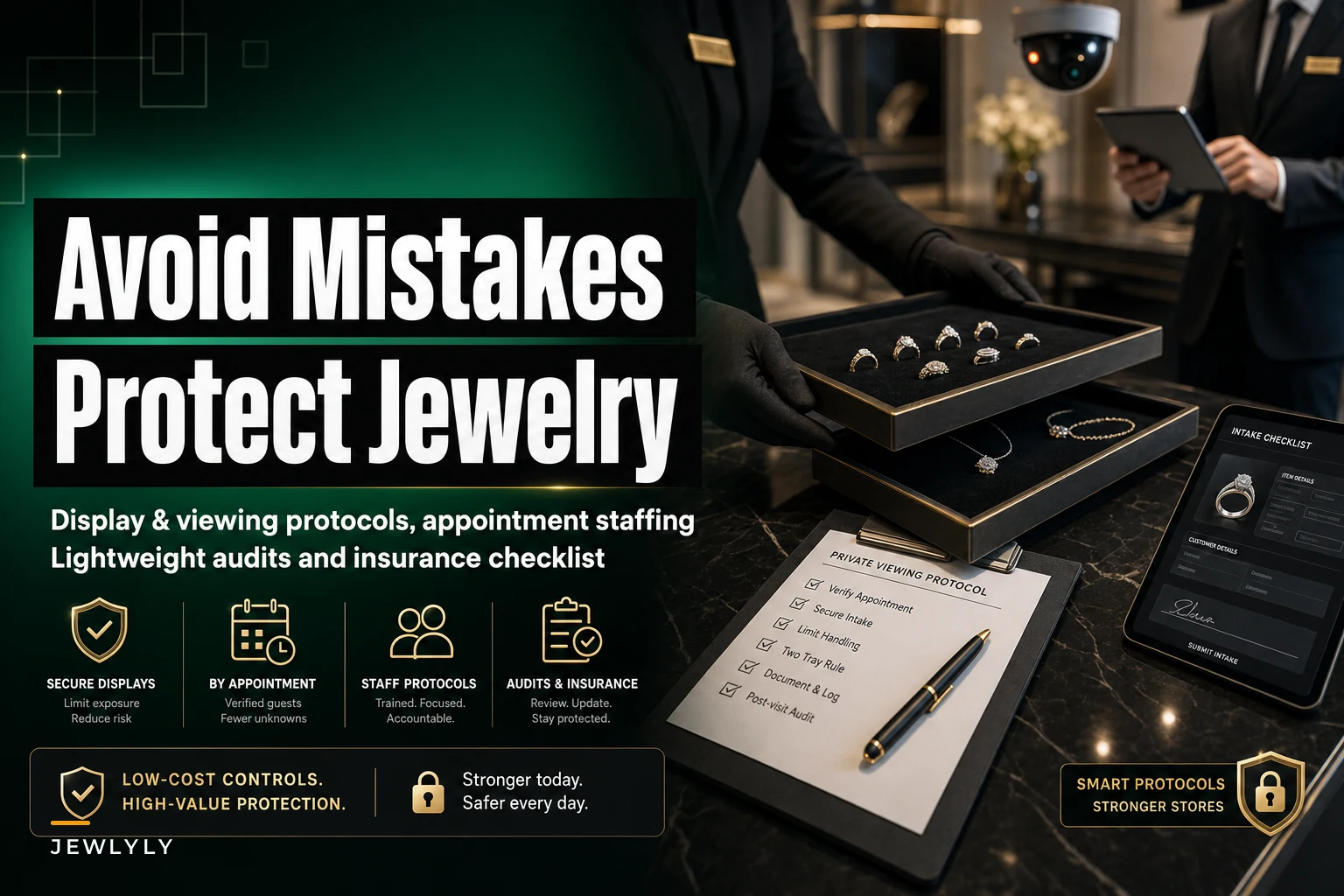

You know that feeling when you're closing up and realize someone moved the $8,000 engagement ring to a different case? Or when your part-timer mentions they showed three tennis bracelets to a customer "somewhere in the back" because the main floor was busy?
These aren't dramatic heist scenarios. They're the operational gaps that create real losses in jewelry stores every single day.
The pattern becomes pretty obvious once you've watched enough small jewelry shops try to build security protocols: the biggest vulnerabilities aren't in your safe or alarm system. They're hiding in plain sight during regular business hours, embedded in how your team handles merchandise, runs appointments, and documents high-value pieces.
Your jewelry store security checklist probably covers locks, cameras, and closing procedures. But operational security—the workflows that protect inventory during active selling hours—often gets overlooked because it feels less urgent than physical security measures.
Why traditional security thinking misses operational vulnerabilities
Most jewelers approach security backwards. They invest heavily in after-hours protection while leaving gaping holes in their daily operations.
Think about your typical Tuesday afternoon. Multiple customers browsing. Someone asking to see engagement rings. Another customer waiting for a repair pickup. Your experienced associate is on lunch, leaving your newest hire managing the floor alone.
-
Multiple high-value pieces out of secured cases
-
No standardized viewing protocols
-
Inconsistent documentation of what's being shown
-
Zero audit trail if something goes missing
The security industry loves selling expensive solutions—biometric safes, advanced camera systems, panic buttons. These matter, but they don't address the reality that most inventory discrepancies happen during operating hours, not during break-ins.
Small jewelry stores face a unique challenge. You need security protocols tight enough to protect $200,000 in inventory but flexible enough that a two-person team can actually follow them. The multi-location chains have 47-page security manuals and dedicated loss prevention staff. You have yourself, maybe a manager, and whatever procedures you can realistically maintain.
Display protocols that actually work with small teams
The jewelry industry standard says "only show one piece at a time." Whoever wrote that has never worked a real sales floor.
Never miss a sale or shipment again.
Jewlyly helps you manage orders, track inventory, and engage customers seamlessly.
- Real-time inventory tracking
- Automated customer notifications
- Sales and order analytics
No credit card required
What actually happens: a couple comes in looking at engagement rings. You pull three options in their price range. While they're discussing, another customer wants to see gold chains. You're the only one on the floor. Do you put everything back, lose the engagement sale momentum, and make everyone wait? Of course not.
Instead of fighting reality, build display protocols around how selling actually works.
The Two-Tray Maximum Rule
Never have more than two presentation trays active per associate. This isn't arbitrary—it matches what a single person can visually monitor while maintaining customer engagement.
Label trays with associate initials to keep accountability during busy shifts.
When you need to show a third item:
-
Return one tray to the case
-
Note which items remain out
-
Document the swap in your viewing log
Viewing Zones, Not Viewing Counters
Designate specific areas for showing different value tiers:
-
Zone A (closest to register) Items under $2,000
-
Zone B (main counter, camera coverage) $2,000 to $10,000
-
Zone C (private showing area) Over $10,000
The 15-Second Recovery Standard
Every piece shown must be recoverable within 15 seconds. That means:
-
No walking items to different rooms without documentation
-
No leaving pieces on counters while fetching something else
-
No "I'll put this back in a minute" delays
A shop in Dallas started tracking recovery times after losing a $4,500 ring that "was definitely on the corner display." They discovered their average recovery time was 3-4 minutes—plenty of time for confusion or opportunistic theft.
Appointment staffing that prevents single-point failures
High-value appointments create a specific vulnerability: one associate handling multiple expensive pieces while trying to build rapport and close a sale.
Your standard Saturday walk-in traffic might work fine with one person, but appointment viewing of estate jewelry or custom consultations need different staffing logic.
The Appointment Coverage Matrix
| Appointment Type | Value Range | Minimum Staff | Documentation Required |
|---|---|---|---|
| Standard viewing | Under $5k | 1 associate | Basic viewing log |
| High-value viewing | $5k-$15k | 1 associate + floater | Viewing log + photo inventory |
| Estate/collection viewing | Over $15k | 2 dedicated associates | Full documentation packet |
| Custom consultation | Any value | 1 associate + available backup | Design forms + deposit docs |
The "floater" role is crucial but often undefined. This person isn't actively selling—they're restocking, organizing nearby cases, staying available if needed. They provide surveillance without making customers uncomfortable.
Pre-Appointment Prep Protocols
-
Pull and photograph requested pieces
-
Create a temporary SKU list for the appointment
-
Assign primary and backup associates
-
Set viewing room with limited access points
This prep work seems excessive until something goes missing. Then you realize having photos and assignments from the start would've saved hours of investigation.
The lightweight audit cadence that catches problems early
Full inventory counts are nightmares that everyone avoids. By the time you do an annual count, discrepancies have compounded beyond investigation.
The Daily High-Value Touch
Every morning before opening:
-
Count pieces in your highest-value case
-
Verify your five most expensive items by SKU
-
Check that previous day's viewing log matches case contents
Weekly Category Rotation
-
Week 1
Engagement rings
-
Week 2
Watches
-
Week 3
Gold chains/bracelets
-
Week 4
Estate/consignment pieces
Document variances even if resolved. Pattern recognition matters—if gold chains consistently show minor discrepancies, you've identified either a process problem or something worse.
The Monthly Movement Report
Track which pieces move most frequently between cases, safes, and viewing areas. High-movement items carry higher loss risk.
One shop discovered their $2,000-$3,000 tennis bracelets were being moved an average of 17 times per month between cases. They created a dedicated "high-movement protocol" requiring photo documentation for any piece moved more than 10 times monthly. Shrinkage in that category dropped to zero.
Insurance documentation that actually protects you
Your insurance company loves documentation until you actually file a claim. Then suddenly your records aren't detailed enough, photos aren't clear enough, and that verbal appraisal doesn't count.
Build documentation assuming adversarial claim review.
The Three-Photo Standard
-
Full piece photo on neutral background
-
Close-up of identifying marks/stamps
-
Scale reference photo (with ruler or coin)
These aren't artistic shots. They're evidence. Set up a simple photo station with consistent lighting and background. Your phone camera is fine if lighting is decent.
The Insurance-Ready Checklist
-
- [ ] Original purchase invoice or supplier documentation
-
- [ ] Current appraisal (if over $5,000)
-
- [ ] Three-photo set
-
- [ ] POS entry with full description
-
- [ ] Location tracking log (which case/safe)
-
- [ ] Any repair/modification records
-
- [ ] Certificate copies (diamonds, gemstones)
Store digital copies in cloud storage, not just your POS system. When the insurance adjuster asks for documentation, you need access regardless of whether your store computer is functional.
The Quarterly Insurance Sync
-
Updated inventory summary by category
-
New acquisitions over $5,000
-
Photos of any new high-value pieces
-
Total inventory value confirmation
Most jewelers wait until renewal to update coverage. By then, you've been underinsured for months, or you can't remember exactly when you acquired certain pieces.
When lightweight controls reveal heavyweight problems
Sometimes your basic controls surface issues that require immediate escalation.
A jeweler in Phoenix noticed through daily spot-counts that a particular style of gold chain showed discrepancies three times in two weeks. Small variances—one piece off each time, but always the same style. The easy explanation was counting error.
Instead of dismissing it, they pulled security footage for those specific chains. They discovered a part-time employee had developed a method of removing them during busy periods when customers were blocking the camera angle.
Lightweight controls aren't just about catching mistakes. They're about surfacing patterns before they become major losses.
A shop in Portland started photographing pieces before customer appointments and noticed certain customers repeatedly scheduling appointments for items they'd "already seen last time" but needed to "show their spouse." The photos revealed they were requesting different items each visit—potentially casing inventory. They adjusted protocols for repeat appointment requests, requiring manager approval and limited piece access.
The coordination gaps that create vulnerabilities
The most dangerous moments in jewelry retail happen during handoffs: shift changes, lunch coverage, opening and closing transitions, multiple simultaneous customers.
These coordination points need explicit protocols, not assumed understanding.
Shift Handoff Documentation
-
Pieces currently out of cases
-
Appointments scheduled next 2 hours
-
Any special customer situations
-
Cases that need attention
-
Items in cleaning/repair areas
Takes 3 minutes to complete and eliminates the "I thought you put it back" scenarios that plague jewelry stores.
The Backup Protocol Matrix
If showing items under $2,000:
-
Can pause showing briefly
-
Must return items to case if leaving floor
-
Customer can wait in seating area
If showing items $2,000–$10,000:
-
Must call backup before stepping away
-
Complete viewing log entry
-
Transfer responsibility formally
If showing items over $10,000:
-
Cannot leave until backup arrives
-
Must complete documentation before transfer
-
Both associates verify piece count
These coordination points need explicit protocols, not assumed understanding.
Building operational security into daily workflows
The best security protocols become invisible—embedded so naturally into operations that following them requires no extra thought.
Instead of treating security as a separate layer added on top of operations, weave it directly into existing workflows. Every customer interaction, every piece movement, every appointment should have security built into its natural flow.
Here's a simple workflow diagram that captures how intake, viewing logs, photo documentation, two-tray rules, and staff roles connect.
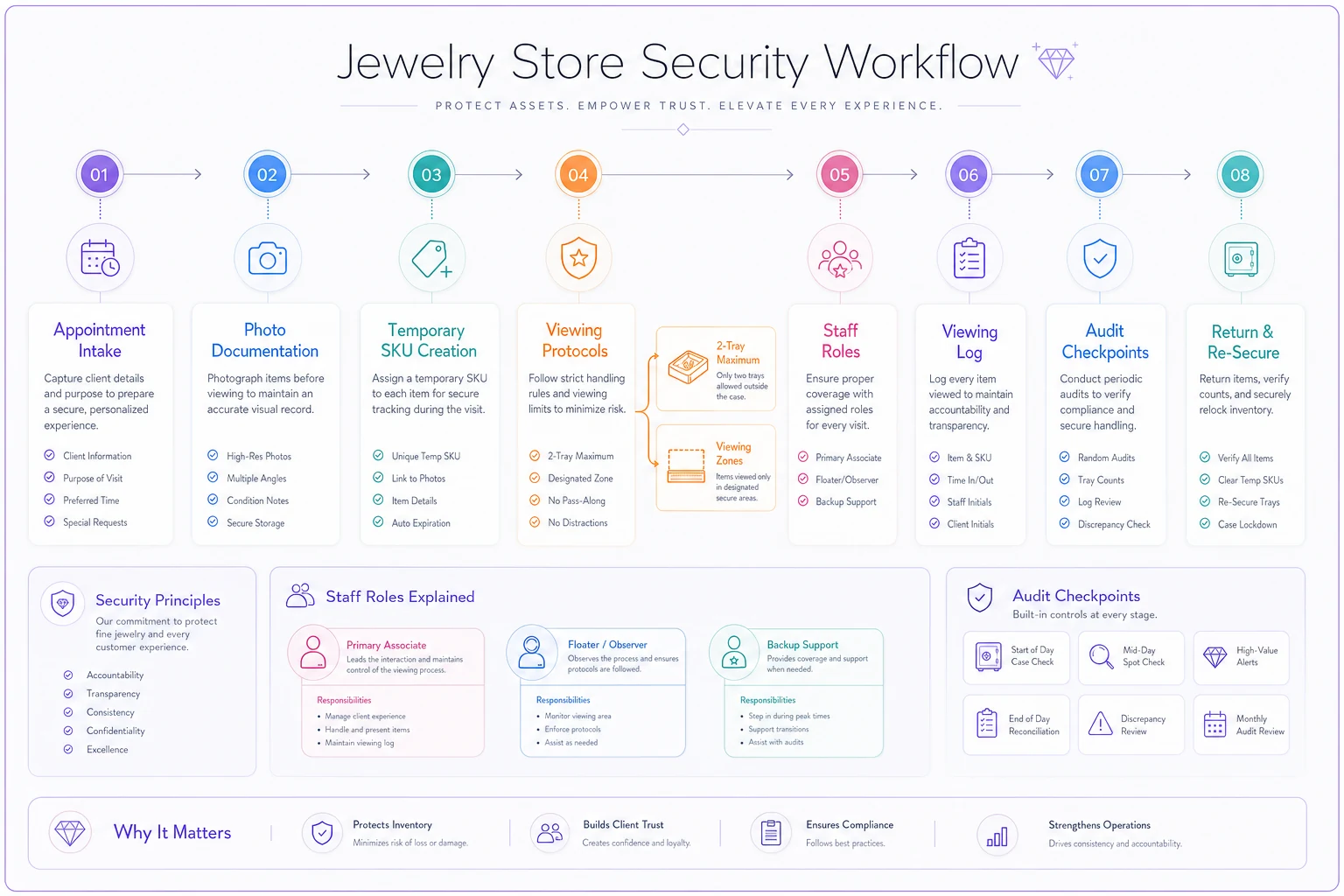
Your viewing log shouldn't be a separate book to fill out—it should be integrated into your appointment scheduling system. Your photo documentation shouldn't require a special process—it should happen automatically as part of intake.
This is where modern operational software starts to make a real difference. AI-powered platforms can automate security workflows that would otherwise rely entirely on human memory and discipline. Automatic photo prompts during intake, viewing logs that populate from appointment systems, audit schedules that generate based on inventory movement patterns—these tools turn security from a burden into a background process.
But even without sophisticated software, you can build security into workflows by making the secure method also the easiest method. If your team has to choose between a complex secure process and a simple insecure one, they'll pick simple every time.
The real cost of operational security gaps
A single significant loss typically costs more than years of prevention would have. Beyond the immediate inventory value:
-
Insurance deductibles ($5,000–$10,000 typically)
-
Premium increases (20–30% after claims)
-
Investigation time (40–60 hours of owner/manager time)
-
Team morale impact (lasting months)
-
Customer trust damage (unmeasurable but real)
One missing $15,000 piece can easily create $30,000 in total impact when you factor in all costs. Meanwhile, implementing these lightweight controls might require 30 minutes of daily team time—roughly $4,000 yearly in labor cost for most small jewelry stores.
The math is obvious, but implementation stays inconsistent because security feels like overhead rather than operations. Reframe it: these aren't security procedures, they're inventory excellence standards. You're not adding bureaucracy; you're building operational precision that happens to prevent losses.
Start with the highest-impact, lowest-effort protocols
Don't try implementing everything at once. Start with three foundational protocols that create immediate impact:
-
Morning High-Value Touch (10 minutes daily) - Count your top case - Verify five most expensive pieces - Review previous day's viewing log
-
Two-Tray Maximum (ongoing during sales) - Never exceed two active presentation trays - Document any exceptions - Return items immediately when switching
-
Three-Photo Standard (during intake) - Photograph every new piece over $1,000 - Use consistent setup - Store in cloud backup
These three protocols alone will catch the majority of potential issues while requiring minimal behavior change. Once they become routine—usually within two or three weeks—layer in additional protocols based on your specific vulnerabilities.
Consistency beats complexity. A simple jewelry store security checklist that gets followed daily is infinitely more valuable than an elaborate system that gets ignored when things get busy. Build operational security gradually, making each layer automatic before adding the next.
Your team might initially push back on these procedures as unnecessary overhead. But after catching that first discrepancy early—finding a miscounted piece within hours instead of months—they'll understand the value. Security protocols aren't about distrust; they're about creating clarity and confidence in your operations.
The goal isn't paranoia or perfection. It's building reasonable safeguards that protect your inventory without destroying your selling environment. Every jewelry store faces the same balance: security tight enough to prevent losses, flexible enough to maintain the personal, high-touch experience that sells jewelry.
Start tomorrow morning with that simple high-value count. Ten minutes of prevention beats months of investigation every single time.
Ready to elevate your jewelry store operations?
Join 500+ jewelers using Jewlyly to increase efficiency, reduce errors, and grow revenue.