

Here's a question that stops most jewelry owners cold: if a customer walked in today and asked you exactly who inside your store has looked at their diamond appraisal and GIA certificate in the last 90 days, could you produce that list?
Almost nobody can. And that's the real privacy gap in jewelry retail — not that someone will hack your cloud storage, but that your own certificate and appraisal files sit in a shared Dropbox folder, a shared email inbox, and three staff phones, with zero record of who touched what.
This isn't about paranoia. Certificates and appraisals are some of the most sensitive documents your store holds. An appraisal doesn't just say "nice ring." It says this specific person owns a $48,000 item, here's its description, here's where they live (if the doc has an address block), and here's what it's insured for. That bundle is gold for anyone planning a theft, and it's a genuine liability if it leaks. Yet most stores protect their safe far better than they protect the documents that describe what's in it.
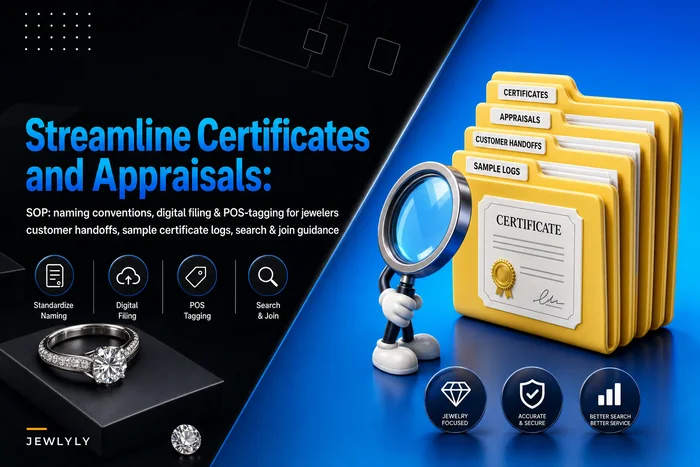
If you've already sorted out your naming and storage side — and if you haven't, start with certificate and appraisal workflows for jewelers — this piece is the next layer: who gets access, how long you keep things, how documents get delivered to customers and insurers, and what you do when something goes wrong.
The way this actually breaks
A typical leak is almost never dramatic.
A customer buys an engagement ring. The sales associate scans the GIA cert and the in-house appraisal, then emails both to the customer from the shared store inbox — the one four people have logged into. The customer forwards the appraisal to their insurer. Three weeks later, a different staff member helping with a resize searches that same inbox for "appraisal" to confirm the ring's details and finds not just that customer's docs but every appraisal ever emailed from that account.
Nothing was stolen. No alarm went off. But now every current and former employee with inbox access can pull the full appraisal history of your highest-value clients. One disgruntled departure and that data walks out the door, and you'd never know it happened.
The other common failure is the opposite — documents that are too locked down. The owner is the only person who can access the appraisal archive, so when a customer calls on a Saturday needing a copy for an insurance claim, nobody on the floor can help. The customer waits until Monday. That's a trust hit on a high-value relationship, and trust is the whole game in this category — worth keeping in mind alongside your broader trust signals for high-value buyers.
Both extremes come from the same root cause: no deliberate access design. Access just happened based on who set up the folder.
Retention: stop keeping everything forever
The instinct in jewelry is to keep every document indefinitely "just in case." That instinct is wrong, and it quietly increases your risk every year.
Never miss a sale or shipment again.
Jewlyly helps you manage orders, track inventory, and engage customers seamlessly.
- Real-time inventory tracking
- Automated customer notifications
- Sales and order analytics
No credit card required
Every appraisal you hold past its useful life is a document you now have to secure, could have to produce in a dispute, and could have leaked in a breach. The question isn't "could this ever be useful?" — almost anything could be. The question is "what's the actual operational and legal reason to keep this specific document, and for how long?"
A workable retention framework for certificate and appraisal data looks like this:
| Document type | Keep for | Reason | After retention |
|---|---|---|---|
| Lab certificate (GIA/IGI/etc.) for sold item | Life of warranty + 2 yrs | Warranty claims, resale verification | Archive (restricted) |
| In-house appraisal (customer copy) | 7 yrs | Insurance disputes, tax basis | Redact PII, then archive |
| Appraisal for item never purchased | 90 days | No ongoing relationship | Delete |
| Repair/service appraisal updates | Life of customer relationship | Aftercare history | Archive on account closure |
| Estate / consignment valuation docs | Per contract + 3 yrs | Legal and provenance | Return or destroy per agreement |
Note the second row. Keeping the appraisal for seven years doesn't mean keeping the customer's home address and phone number attached to it for seven years. Once the active relationship cools, you can strip the personal identifiers and keep the item description for your own records. The document stays useful; the liability drops sharply.
One pattern worth flagging: stores almost always under-manage the "item never purchased" category. Someone comes in, you appraise a piece they're thinking of insuring or selling, they leave, and that document sits in your system indefinitely with no business reason attached to it. Those are pure liability. Set a 90-day auto-review and be done with it.
Build a real RBAC matrix (not "everyone's an admin")
Role-based access control sounds like enterprise IT jargon, but for a jewelry store it just means: define roles, then grant document access by role, not by person.
The mistake almost every store makes is granting access by individual as people get hired, which means permissions only ever accumulate. Nobody ever gets access removed, so over three years your part-time weekend associate somehow has the same reach into appraisal archives as your store manager.
Here's a starting matrix you can adapt. Four roles, and what each should actually be able to do with certificate and appraisal data:
| Capability | Sales Associate | Store Manager | Bench / Service | Owner / Admin |
|---|---|---|---|---|
| View cert for item currently being sold/serviced | Yes | Yes | Yes (service only) | Yes |
| View full appraisal (with valuation) | Masked value | Yes | No | Yes |
| View customer PII on appraisal | No | Yes | No | Yes |
| Search entire appraisal archive | No | Limited | No | Yes |
| Email/deliver docs to customer | Via template only | Yes | No | Yes |
| Delete or edit stored docs | No | No | No | Yes |
| Export bulk document sets | No | No | No | Yes |
Mask valuation fields for non-manager roles whenever possible.
The important column is "Sales Associate." They can see the certificate for the item in front of them, but the valuation is masked and they can't browse the archive. That's the single highest-leverage control you can add. A floor associate can do their entire job — confirm stones, describe items, help a customer — without ever being able to pull up "every $30k+ appraisal we've ever written." It also removes the temptation and, frankly, the suspicion. If a high-value item goes missing, you've dramatically shrunk the list of people who had the information to target it.
Most modern POS and operational platforms built for jewelry let you set permissions at this granular level, and masking valuation fields by role is often a simple toggle rather than a custom build. If your current system forces you into "staff vs admin" with nothing in between, that's a real limitation worth raising when you reassess tools.
Tokenized and redacted delivery: how documents should leave your store
When you send an appraisal or certificate to a customer or insurer today, you're probably attaching the full PDF to an email. That file now lives in their inbox, your sent folder, possibly their forwarded chain, and anywhere it gets downloaded. You've permanently lost control of it.
Two better delivery patterns:
-
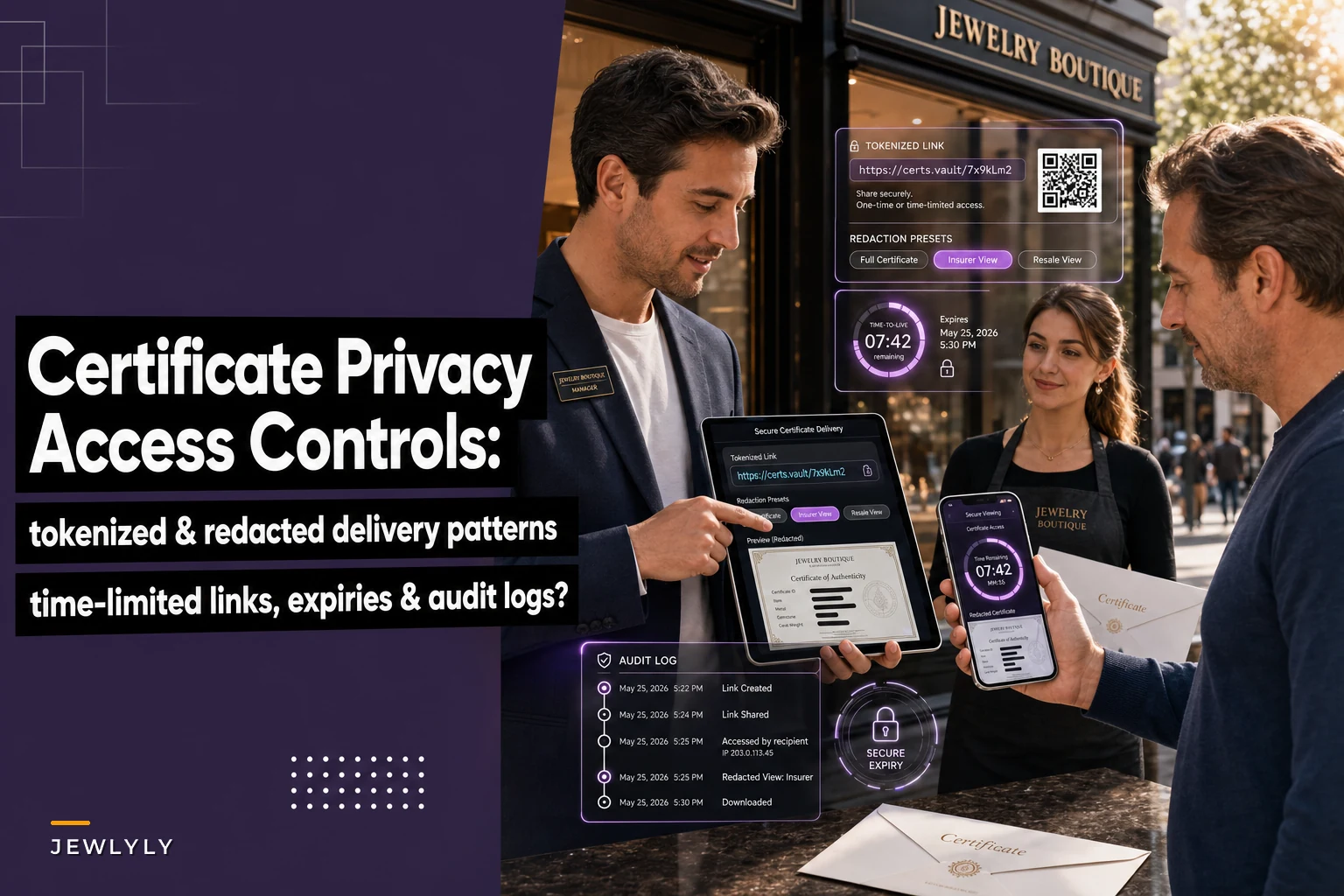
Tokenized links instead of attachments. Rather than attaching the PDF, you send a secure link that expires. The document stays on your system; the recipient views or downloads it within a set window. When the link expires, the exposure ends. If a customer's email is later compromised, an old expired link is worthless. This is standard practice in a lot of document software now, and it changes delivery from "permanent copy floating around the internet" to "controlled, time-limited access."
-
Redacted delivery for specific purposes. Not every recipient needs the full document. A quick redaction logic:
-
To the customer full appraisal, full detail — it's their property.
-
To an insurer for a new policy item description, valuation, cert number. They usually don't need your internal cost notes or staff annotations.
-
To a third party (resale platform, another jeweler) cert and item description, but strip the original owner's PII entirely unless the customer has explicitly authorized it.
A quick workflow diagram:
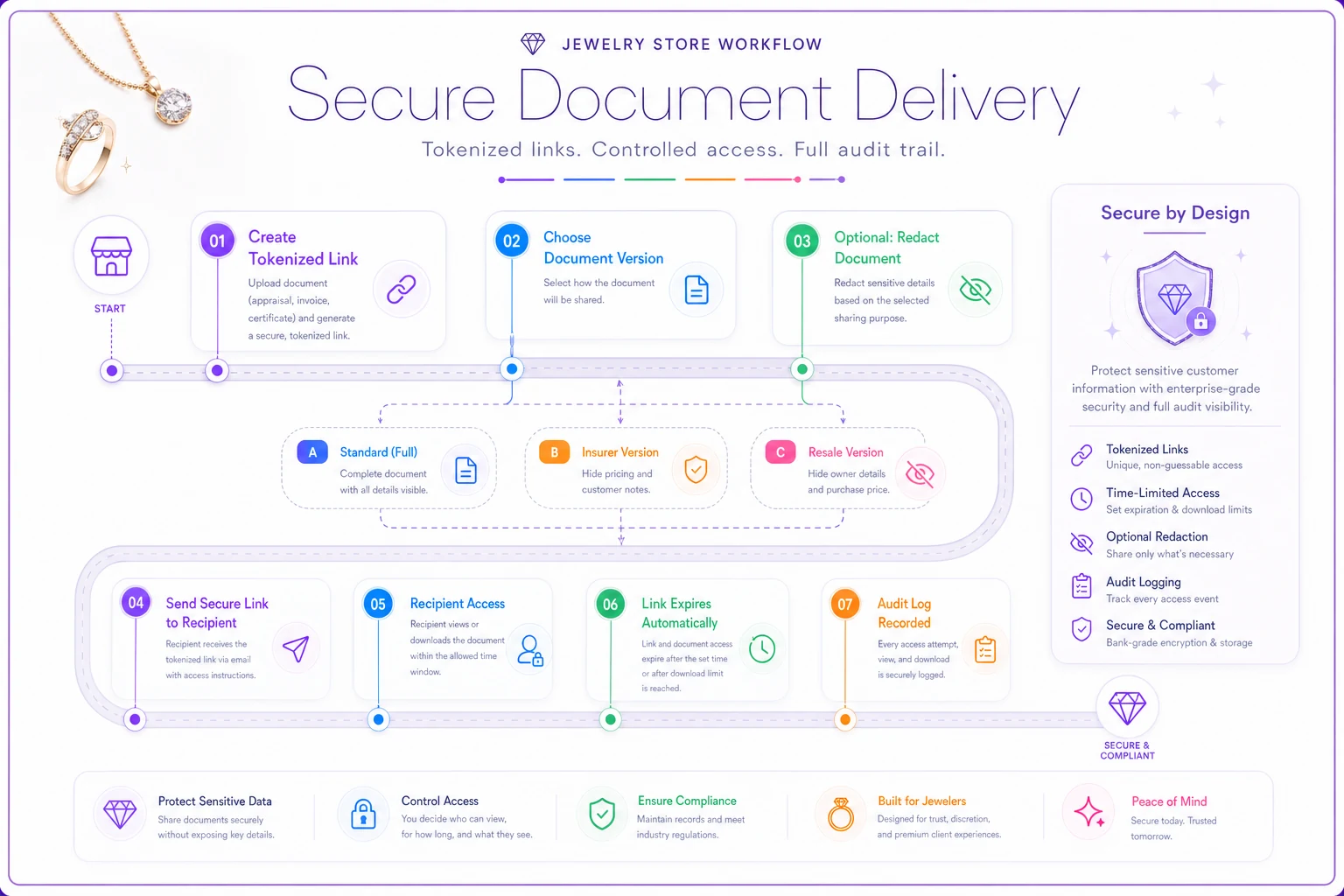
The pattern that gets stores in trouble is sending the same full-detail document to everyone because it's the file they already have. A redacted "insurer version" and "resale version" generated automatically from the master document removes the judgment call from a busy associate's hands.
Audit logging: the layer that makes everything else real
You can have a clean RBAC matrix and solid retention rules, but without logging you have no way to verify any of it is working — and no way to answer that opening question about who actually saw a given appraisal.
An audit log for certificate and appraisal data should capture, at minimum, for every document event:
-
Who (specific user, not a shared login — this is why shared inboxes are poison)
-
What document
-
What action (viewed, downloaded, emailed, edited, deleted)
-
When
-
How delivered (if sent — tokenized link vs attachment, to which recipient)
The single most important enabler here is killing shared logins. A log that says "store@yourjewelry.com viewed 47 appraisals" tells you nothing. A log that says "Marcus viewed these three, Dana downloaded that one" is the difference between an audit trail and a decoration.
A real example of why this matters: a two-location store had a recurring problem where high-value clients occasionally got marketing outreach from a competing jeweler suspiciously soon after visiting. No proof of anything, just a bad pattern. After moving everyone to individual logins and turning on document access logging, the picture got clear within about six weeks — one associate was pulling appraisal archives at odd hours well outside any active sale. Nothing was provable before; now it was obvious. The associate was let go, the outreach pattern stopped, and the store finally had the ability to see its own exposure. The fix cost them almost nothing beyond the time to configure permissions.
A 7-step incident response checklist for a certificate or appraisal leak
When you suspect documents have been exposed — a lost laptop, a compromised email, a staff member who left under bad terms — you need a sequence you can run without improvising. Walk it in order:
-
Contain first. Revoke the suspected user's access and expire any active tokenized links tied to the affected documents. Don't investigate before you contain.
-
Pull the audit log for the affected documents and time window. Identify exactly which customers' appraisals and certs were accessed or delivered.
-
Scope the data. For each exposed document, note what it reveals — item value, PII, insurance details. A cert number leaking is very different from a full appraisal with a home address.
-
Assess legal/regulatory obligations. Depending on your state and the PII involved, you may have notification duties. This ties directly into your broader obligations — your tax and regulatory compliance groundwork should already name who you call here.
-
Notify affected customers honestly and specifically. Tell them what was exposed and what you're doing. For high-value clients especially, a straight answer protects the relationship better than silence.
-
Alert insurers if security-relevant. If an appraisal describing a $50k item in someone's home leaked, that's a theft-risk conversation, not just a privacy one.
-
Document and close the gap. Record the incident, root cause, and the specific control change that prevents a repeat. A leak you fix the process around is tuition. A leak you repeat is negligence.
Print this. Tape it inside the office door. In an actual incident nobody thinks clearly, and a checklist is what keeps you from skipping containment and going straight to panic.
When tight controls are overkill — and when they're not
A single-location store with two employees and a few dozen high-value appraisals a year does not need a fourteen-role permission system. If you and your spouse run the shop, the whole RBAC matrix collapses into "us," and that's fine. For you, the priorities are simpler: kill the shared inbox, set retention on documents for items nobody bought, and use expiring links when you send appraisals out.
Where this all becomes genuinely important:
-
Multiple locations or 5+ staff touching documents — the point where "I just know who did what" stops being true.
-
High turnover roles like seasonal sales help, where accumulated access is a real risk.
-
Any store handling estate or consignment valuations, where you're holding other people's property documents under contract.
-
Stores that have had even one near-miss — a suspicious outreach pattern, a missing high-value item, a messy employee exit.
Who should not build this out aggressively: a brand-new store still figuring out its basic workflows. Lock down the shared login and set simple retention first. Layer on granular roles and redacted delivery once you actually have the volume and staff to justify them. Over-engineering access control on day one just creates friction that staff route around, which is worse than no system at all.
The mindset shift
The real change here isn't technical. It's moving from treating certificates and appraisals as files you store to treating them as access you grant.
Most stores are excellent at the first question and have never seriously asked the second. The uncomfortable part is that the second question is the one that actually protects your customers — and protects you the day something goes wrong. You don't need enterprise software to start. You need individual logins, a retention rule for documents tied to items nobody bought, expiring links instead of attachments, and a one-page incident checklist. Those four things alone put you ahead of nearly every independent jeweler in the country on certificate privacy.
Most stores are excellent at the first question and have never seriously asked the second. The uncomfortable part is that the second question is the one that actually protects your customers — and protects you the day something goes wrong. You don't need enterprise software to start. You need individual logins, a retention rule for documents tied to items nobody bought, expiring links instead of attachments, and a one-page incident checklist. Those four things alone put you ahead of nearly every independent jeweler in the country on certificate privacy.
Ready to elevate your jewelry store operations?
Join 500+ jewelers using Jewlyly to increase efficiency, reduce errors, and grow revenue.