



Most jewelers don't have a tax knowledge problem. They have a documentation problem.
The store owner usually knows, in a general way, that cash sales over a certain amount trigger a filing, that some vendors get 1099s, that selling to an international buyer changes how sales tax works. That knowledge lives in their head. It does not live in a folder. It does not live in a template your part-time associate can follow on a Saturday when you're at a trade show. And it definitely doesn't survive a CPA asking, in March, "hey, can you send me the backup for that $14,000 gold bar buy in August?"
That gap — between knowing the rule and having the evidence — is where compliance actually breaks. Not because someone did something illegal, but because nobody built a system to capture proof at the moment the transaction happened. This article is about closing that gap: translating jewelry tax compliance obligations into intake templates, month-end evidence folders, audit-ready file structures, and the specific questions you should be handing your CPA before they ask.
Why compliance breaks even when nobody is doing anything wrong
A jeweler is fully honest, files everything, pays what they owe. But when a question comes up — from an auditor, an insurance adjuster, a CPA doing year-end — the answer requires reconstructing a transaction from six months ago using a POS export, a shoebox of receipts, and memory.
Reconstruction is the enemy. Every hour spent rebuilding "what happened" proves the underlying system didn't capture it the first time. And it gets exponentially harder as volume grows.
-
Cash is normal here. Watch buyers, estate liquidations, older customers who just prefer it. Cash triggers the Form 8300 rules (payments over $10,000 received in a trade or business), and it triggers them in ways people forget — like two related payments inside 24 hours, or installments that cross the threshold over a 12-month window.
-
Precious-metal buys blur the line between inventory and a reportable transaction. Buying scrap gold from the public, selling bullion, dealing certain reportable metal quantities — these carry their own paper trails that ordinary retail POS wasn't built to track.
-
High-value items create 1099 and vendor-reporting complexity. Consignors, independent benchwork, appraisers, refiners — a lot of the money leaving your business goes to people who should be getting a 1099, and the W-9 to support it was never collected.
-
International sales feel like a win and quietly create exposure. A tourist buys a $22,000 piece and has it shipped home. Now you're in export documentation, sales-tax exemption evidence, and sometimes customs paperwork territory.
None of these are exotic. They're Tuesday. The problem is that the moment to capture the evidence — the ID, the W-9, the shipping doc, the cash breakdown — is at the counter, and the counter is the least documentation-friendly place in the whole operation.
The core idea: capture at intake, not at audit
The single most useful shift is moving your compliance evidence collection to the front of the transaction instead of the back. If the right fields are required before a sale closes, you never reconstruct anything.
Never miss a sale or shipment again.
Jewlyly helps you manage orders, track inventory, and engage customers seamlessly.
- Real-time inventory tracking
- Automated customer notifications
- Sales and order analytics
No credit card required
-
Intake record templates — captured in the moment, per transaction.
-
Month-end evidence folders — assembled monthly, tied to your reconciliation.
-
Audit-ready file structure — the permanent home where everything lands and stays findable for years.
Get layer one right and the other two mostly build themselves. This is closely tied to how you close your books each month; a lot of what belongs in your evidence folder is the same backup you'd already be pulling if you ran a disciplined month-end reconciliation.
A quick visual of the intake -> month-end -> audit-ready flow helps teams understand who does what and when.
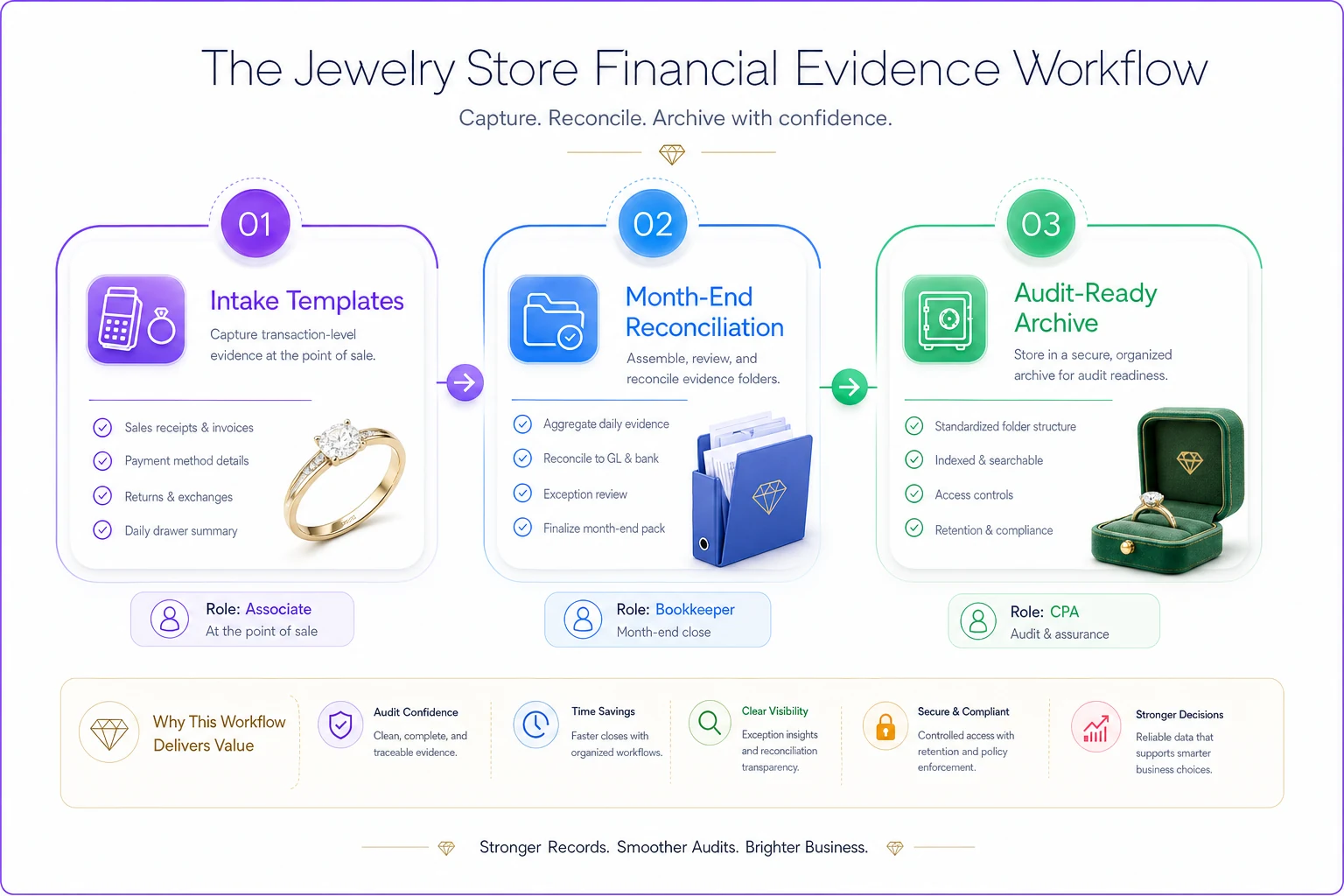
This ties the capture to your close so the evidence is a byproduct, not a separate project.
Intake record templates: what to capture, by transaction type
Different transactions carry different obligations, so you don't need one giant form — you need a small set of triggered templates. The key design principle: the template fires based on transaction attributes, not on the associate remembering to grab it.
Template A — Cash-heavy or large payments (8300 territory)
-
Trigger this whenever cash plus cash-equivalents on a single sale (or from a single buyer within a rolling window) approaches the $10,000 line. Fields:
-
Buyer legal name, address, and TIN/SSN (with a copy of a valid photo ID)
-
Amount received, broken down by payment form (cash, cashier's check, money order)
-
Date(s) received and whether related to any prior payment from the same buyer
-
Item(s) and reference to the sale record
-
A flag
"aggregate check needed — related payments within 12 months?"
The mistake people make: treating 8300 as a single-transaction rule. It's not. Structured or installment payments that add up matter, and the person at the counter almost never knows what that customer paid last month. That's why the aggregate flag has to be built into the system, not left to memory.
Template B — Buying precious metal from the public
-
Trigger on any scrap-gold, estate-metal, or bullion purchase. Fields
-
Seller ID and contact info (many states require holding-period and reporting rules for secondhand precious-metal purchases)
-
Metal type, weight, tested purity, spot reference at time of purchase
-
Amount paid and payment method
-
Photos of the item as received
-
Hold-period start date if your jurisdiction requires one
Template C — International / export sales
-
Trigger when the ship-to is outside your tax jurisdiction or the buyer is a non-resident. Fields:
-
Exemption basis (export, resale, out-of-state ship-to) with supporting doc
-
Shipping carrier, tracking, and proof of export/delivery abroad
-
Any customs or commercial-invoice references
-
A note on whether you collected or exempted sales tax and why
Template D — Vendor/payee setup (1099 groundwork)
This one isn't at the sales counter — it's at the moment you first pay anyone who isn't a corporate supplier. Collect the W-9 before the first payment goes out, not in January.
| Transaction type | Primary obligation | Must-capture evidence | When it's captured |
|---|---|---|---|
| Large cash sale | Form 8300 | Buyer ID, TIN, payment breakdown, aggregation check | At the counter |
| Buying metal from public | State secondhand/precious-metal rules | Seller ID, weight/purity, photos, hold date | At intake |
| International sale | Sales-tax exemption + export proof | Exemption basis, shipping/export docs | At sale + at ship |
| Payments to consignors/benchworkers/refiners | 1099 reporting | W-9, payment log, classification | Before first payment |
| Appraisal-linked sales | Valuation support | Signed appraisal, cert reference | At sale |
The appraisal row connects to something most stores already half-do. If your certificate and appraisal records are named and tagged consistently — the approach laid out in these certificate and appraisal workflows — then the valuation evidence for a high-value sale is already sitting somewhere findable instead of buried in a random email thread.
The month-end evidence folder
Intake gives you clean records per transaction. Month-end is where you prove the month is complete — that nothing that should have triggered a template got missed.
A workable month-end evidence folder for a jeweler contains:
-
A cash-receipts log with every payment over a set threshold flagged, and a note on which ones did or didn't cross 8300
-
A precious-metal purchase register with weights, spot references, and seller IDs
-
The vendor-payment list for the month with 1099 status marked per payee
-
All international/export sales with their exemption evidence attached
-
Sales-tax summary by jurisdiction, matched to what the POS collected
-
A short exceptions memo
anything unusual, anything flagged for the CPA
The operational habit that separates stores that sail through audits from stores that panic: the person doing month-end reconciliation is the same checkpoint that verifies compliance evidence exists. You're already tying out cash, cards, and inventory movement. Add a few compliance checks to that same close and the evidence folder becomes a byproduct, not a separate project.
A simple month-end process:
-
Pull the POS report of all transactions above your review threshold.
-
Match each flagged transaction to its intake template. Missing template = investigate now, while people still remember.
-
Reconcile cash receipts and confirm every 8300-relevant event was filed (8300 is generally due within 15 days of receipt, so this should be near real-time — month-end is the safety net, not the trigger).
-
Confirm every new payee this month has a W-9 on file.
-
Verify export/exemption docs are attached for each international sale.
-
Write the one-paragraph exceptions memo and drop the whole folder into its dated location.
The process isn't complicated. The hard part is doing it consistently when the month gets busy.
Audit-ready file structure
If your files aren't findable in under a minute, they might as well not exist. The structure below is boring on purpose — boring is what survives staff turnover.
/Compliance/ /2026/ /01-January/ /8300-filings/ /metal-purchases/ /international-sales/ /vendor-W9s/ /sales-tax/ month-end-evidence.pdf /02-February/ ... /Vendors/ /W9-master/ /1099-issued/ /Policies/ intake-template-A-cash.pdf intake-template-B-metal.pdf ...
Use a sortable date prefix like
YYYY-MM-DDin filenames so folders stay chronologically discoverable.
Consistent naming. A file called 2026-01-148300JSmith_14200.pdf tells you everything before you open it. scan0032.pdf tells you nothing.
One home per document, referenced everywhere else. Don't duplicate. If a signed appraisal supports both an insurance record and a tax record, it lives in one place and both records point to it.
The CPA / vendor question checklist
The best time to align with your CPA is before year-end, and jewelry-specific questions get skipped constantly because generalist accountants don't deal with metal thresholds on a regular basis. Hand them this:
-
How do you want 8300 filings tracked and reported to you — and do we have any aggregation exposure from repeat cash buyers?
-
Which of my payees actually need 1099s? (Consignors, independent bench jewelers, appraisers, refiners — walk through each category.)
-
For precious-metal purchases from the public, what state-level reporting or holding rules apply to me specifically?
-
On international sales, what documentation do you need to defend a sales-tax exemption if audited?
-
How should I treat scrap-metal and refiner transactions — inventory, cost of goods, reportable, or something else?
-
What's the retention period you want for each evidence category, and in what format?
-
Are there any use-tax obligations on items I pull from inventory for repairs, gifts, or personal use?
Most of these questions map directly back to an intake template. When the CPA says "I need X to defend this," that's a field you add to the template so the answer is automatic next time.
A real scenario
A single-location jeweler doing roughly $2.4M a year had clean books but a messy paper trail. Their bookkeeper spent close to two full days every quarter reconstructing backup for large cash sales and consignor payments — pulling POS exports, chasing down IDs that were sometimes never collected, emailing consignors for tax info in December.
The year they got a routine state notice about a precious-metal purchase, it took nearly a week to assemble evidence for a handful of transactions, and two of them had no seller ID at all.
They rebuilt around triggered intake templates and a dated month-end evidence folder tied to their existing close. Reconstruction work dropped from roughly two days a quarter to well under an hour, because the evidence was already assembled month by month. The bigger win was quieter: when a payment or metal buy hit the threshold, the associate couldn't complete the sale without the required fields, so the "never collected it" problem basically went away. No dramatic revenue story — just a real reduction in risk and a lot of Sunday-afternoon panic that never happened.
Where operational software fits (and where it doesn't)
You can run all of this on shared drives and disciplined habits, and plenty of small shops do. The reason a workflow platform helps is narrow and specific: it can force the template to fire based on transaction attributes, so compliance capture doesn't depend on memory. A system that flags a sale crossing the cash threshold, blocks close-out until buyer ID is attached, auto-collects a W-9 before a new payee's first payment, and drops finished records into the correct dated folder — that removes the single biggest failure point, which is the person at the counter forgetting.
AI-assisted checks add one more layer: scanning the month's transactions for patterns a person might miss — repeat cash buyers approaching aggregation limits, payees who've crossed the 1099 reporting floor, international sales missing export proof — and surfacing them during your close instead of during an audit. It's not doing the accounting. It's making sure nothing that should have triggered a rule slipped through unflagged.
But the tooling only matters if the underlying design is right. Software that captures the wrong fields just gives you organized garbage.
When this level of structure makes sense — and when it's overkill
Build the full system when: you regularly take large cash payments, buy metal from the public, pay consignors or independent benchworkers, or make international sales. If two or more of those are routine, the reconstruction cost alone justifies it.
Keep it lighter when: you're a small shop, almost entirely card-based retail, no public metal buying, no consignment, no export. In that case you mostly need clean sales-tax handling and a simple vendor W-9 habit — don't build folders for events that never happen.
Who should not do this alone: anyone unsure whether their cash volume or metal-buying triggers state or federal reporting. That's a conversation to have with a CPA first, then translate their answers into templates. Building the system before you know your obligations just means you'll systematize the wrong thing.
The takeaway
Tax and regulatory compliance in a jewelry business isn't really about knowing more rules. It's about converting the rules you already know into fields, folders, and checkpoints that operate whether or not you're thinking about them that day.
Capture at intake so you never reconstruct. Assemble evidence at month-end so nothing goes missing. Structure files so anyone can find proof in a minute. Get your CPA's specific requirements before year-end so every answer they'll ever ask for is already a field on a form.
Do that, and audits stop being events you dread and become a folder you hand over.
Ready to elevate your jewelry store operations?
Join 500+ jewelers using Jewlyly to increase efficiency, reduce errors, and grow revenue.