


Your bridal customer picks a setting on March 2nd for an April 18th wedding. Your usual center-stone supplier quotes 12 business days. You build the custom timeline around that. On day 14, you get an email: the GIA cert is delayed, the stone's stuck in transit, expect another 8–10 days. Now you're scrambling to find a comparable 1.2ct F VS1 at the same price point — except every backup vendor is quoting a premium because it's a rush, and your margin on that ring just dropped from 48% to 31%.
That's the real cost of vendor lead time jewelry volatility. Not the delay itself — the cascade it triggers. Rush premiums, blown deposits, angry customers, and forecast math that quietly rots because your reorder points were built on lead times that no longer reflect reality.
This is about building the operational guardrails so a single supplier slip doesn't eat your margin or your weekend.
Why precious-stone and metal lead times behave differently
Most retail inventory advice assumes relatively stable lead times. Jewelry breaks that assumption in specific ways, and understanding the why changes how you build your buffers.
Certification is a hidden bottleneck. A loose diamond isn't done when it's cut — it's done when the lab finishes grading. GIA and other labs have their own queue volatility, especially after major trade shows. Your vendor can ship fast and still be stuck because the paper isn't done.
Metal and stone move on separate clocks. Your casting house might turn a mounting in 7 days while your melee supplier is backed up 3 weeks. If you treat "the order" as one lead time, you'll miss which leg is actually failing.
Price and availability are coupled. When gold spikes or a particular color grade gets tight, lead times stretch and prices climb at the same time. That double-hit is what turns a timing problem into a margin problem.
A typical pattern looks like this: a store tracks "average lead time" as a single number — say, 11 days — and sets custom-order promise dates off it. But that 11 is an average hiding a distribution that runs from 6 days to 26. Promises get made against the average, and roughly one order in five blows past it.
Build vendor-tier SLAs with real floors, not vague promises
The fix starts with written expectations per vendor, tiered by how critical and how reliable they are. A verbal "usually a couple weeks" isn't an SLA — it's a hope.
Never miss a sale or shipment again.
Jewlyly helps you manage orders, track inventory, and engage customers seamlessly.
- Real-time inventory tracking
- Automated customer notifications
- Sales and order analytics
No credit card required
Tier your vendors into three buckets:
| Tier | Who belongs here | SLA floor you negotiate | What you track |
|---|---|---|---|
| A — Core | Primary center-stone and casting suppliers you rely on weekly | Committed max lead time + late-penalty or rush-credit | On-time %, variance days, cert-delay frequency |
| B — Secondary | Reliable but occasional-use suppliers | Quoted lead time with 48-hr confirmation requirement | On-time %, quote accuracy |
| C — Spot | One-off or specialty sourcing | No SLA; priced for the risk | Nothing ongoing — evaluate per order |
For Tier A, the number that matters isn't average lead time — it's the 95th percentile. If 95% of orders arrive within 18 days, that's your planning floor, not the 11-day average. You promise customers off the 18, not the 11. You'll feel like you're padding. You're not. You're pricing in reality.
Your SLA document per Tier A vendor should pin down:
-
Committed maximum lead time by order type (loose stone, mounting, finished piece, repair-parts)
-
Who covers the cert delay — them or you
-
Notification requirement
how many hours before a known slip they must tell you
-
Rush-credit or discount if they miss the committed max
-
Substitution rights
can they swap to an equivalent grade without your sign-off? (Answer should be no.)
If you've already built formal vendor evaluation, this plugs directly into it. The same data that feeds your vendor scorecards and procurement SOPs should feed your SLA floors — on-time percentage and variance days are the raw material for both.
The contingency sourcing decision tree
When a slip happens, the worst thing you can do is improvise under pressure. That's how you overpay for a rush backup or promise the customer something you can't deliver twice. Decide the branches before you're in the moment.
When a Tier-A vendor confirms a slip, your first question should always be about calendar math — not vendor relationships, not who's to blame. Work through this sequence in order and don't skip steps.
-
Is there slack in the customer's deadline? If the promised date still clears with the new ETA, log the variance and move on. Don't burn money solving a problem the calendar absorbs.
-
If no slack — is a comparable stone available from a Tier-B vendor at ≤10% premium? If yes, place the backup and cancel the delayed order (check your cancellation terms first). The 10% premium is usually cheaper than a blown wedding date or refunded deposit.
-
If the premium exceeds 10% — can you upgrade the spec instead? Sometimes a slightly larger or higher-color stone is in stock locally at your dealer when the exact spec isn't. Offer the customer the upgrade at your cost difference, not full retail. You eat a little margin, keep the date, and often the customer remembers the save.
-
If no comparable stone exists at any reasonable price — trigger the customer conversation early. Not on the deadline. The moment you know. A two-week heads-up with options reads as competence. A two-day scramble reads as a failure.
The threshold numbers (10%, "comparable") should be written down and consistent, so whoever's covering the floor makes the same call you would. The mistake most stores make is leaving this to in-the-moment judgment — and judgment under deadline pressure consistently overpays.
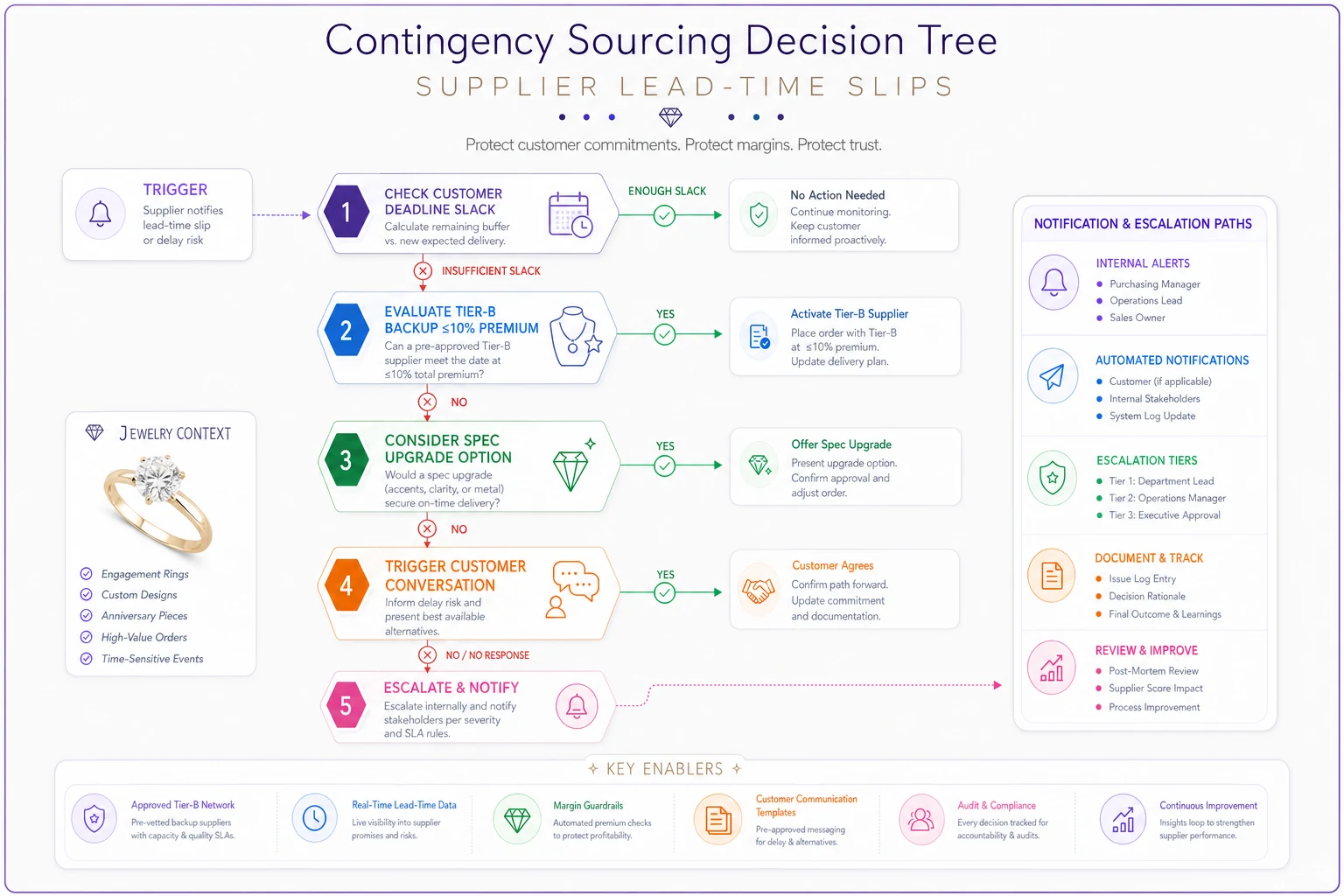
Use the decision tree as a checklist during the call so the person covering the floor runs the same sequence every time.
When contingency sourcing is a bad idea
Don't reflexively source a backup for every slip. If the customer has genuine date flexibility, chasing a rush replacement just adds cost and complexity for no real benefit. And for low-margin fashion pieces, the rush premium can wipe out the entire profit — sometimes the right call is to refund the deposit cleanly and move on rather than complete a sale at a loss.
Customer-notification sequences that hold deposits
The communication gap is where goodwill dies. Customers don't rage about delays nearly as much as they rage about finding out late, or hearing nothing and having to chase you.
Build a tiered notification sequence tied to how far the slip pushes the deadline:
-
Minor slip (still inside promised date) No proactive message needed. Log it. Don't create anxiety over a problem that isn't one.
-
Moderate slip (pushes 1–5 days past promise) Proactive call or text within 24 hours of confirming. Lead with the new date and one concrete option. "Your setting's on track, but the center stone's cert got delayed at the lab. New ready date is the 22nd instead of the 18th. If that's tight for you, I've got a comparable stone I can bring in to hold your original date — want me to?"
-
Major slip (threatens the event or pushes 6+ days) Same-day personal call, never text-first. Present the contingency options you already worked out in the decision tree. Follow up in writing with the agreed plan.
The sequencing matters because over-communicating minor slips trains customers to distrust your dates. Under-communicating major ones loses the relationship. Match the message intensity to the actual deadline risk.
One operational detail that prevents disputes: every notification should restate the deposit terms and what the customer agreed to. If you've got milestone-based deposits on custom work, the delay conversation is also the moment to confirm which milestone you're at and that nothing's changed on the money side.
Fixing the forecast math that lead-time volatility quietly breaks
This is the part most stores miss entirely. Reorder points are built from lead time. If your lead times are volatile and you're planning off averages, your safety stock is structurally too low — you're just absorbing the stockouts without connecting them to the cause.
Reorder point = (average daily demand × average lead time) + safety stock, where safety stock scales with how much your lead time varies, not just how long it is.
A supplier with an 11-day average and tight consistency (9–13 days) needs far less buffer than a supplier with the same 11-day average but a 6–26 day spread. Same average, wildly different safety-stock requirement. Stores that treat them identically chronically stock out on the volatile one.
Track variance days per vendor and let the volatile suppliers earn bigger buffers automatically.
If you're already running seasonal reorder logic, this is a parameter adjustment, not a rebuild — your existing demand forecasting and reorder automation just needs the lead-time distribution fed in alongside demand, rather than a single lead-time constant. Track variance days per vendor and let the volatile suppliers earn bigger buffers automatically.
Worked example: the margin cost of getting this wrong
It helps to walk through the actual money on a single blown lead time, because the abstract "protect margin" framing hides how fast it adds up.
The setup: Custom engagement ring. Center stone cost $4,200. Mounting and labor $1,100. Retail $10,200. Expected margin ~48% (~$4,900).
What happens without guardrails: The primary stone vendor slips 9 days past the 12-day quote, and you find out on day 13. The wedding is in 16 days with no slack left. You source a comparable stone from a backup vendor under rush — $4,200 becomes $4,850, roughly a 15% rush premium. Add $150 in expedited secure shipping to make the date. Margin drops from ~$4,900 to ~$4,100, an $800 hit on one order.
What happens with the guardrails: You promised off the 95th-percentile lead time (18 days), not the 12-day quote. The vendor's 48-hour slip-notification requirement means you hear about the delay on day 3, not day 13. Your decision tree says the deadline still has slack against the padded promise, so you wait. No rush premium. No expedited shipping. Margin lands at ~$4,900 as planned.
Across a store doing 60–80 custom orders a year, if one in six used to trigger a scramble, you were quietly bleeding somewhere in the range of $4k–$7k annually in rush premiums and expedited shipping alone — before counting refunded deposits and lost referrals from the ones you couldn't save.
A quick checklist to put this in place
Start here.
-
Pull 6–12 months of order history per Tier-A vendor and calculate the 95th-percentile lead time, not the average
-
Rewrite custom-order promise dates off the 95th percentile
-
Negotiate written SLA floors with core vendors, including slip-notification windows and no-substitution-without-signoff
-
Document your contingency sourcing decision tree with real thresholds (the 10% premium cutoff, "comparable" spec rules)
-
Build the tiered customer-notification sequence and tie message intensity to deadline risk
-
Feed lead-time variance into your reorder points so volatile vendors get bigger safety-stock buffers
-
Track cert-delay frequency separately from shipping delay — they need different fixes
Most stores can get the first three done in an afternoon with nothing more than order history and a spreadsheet.
Real scenario
A two-location independent jeweler with a solid custom and bridal business was missing promise dates on roughly one in five custom orders. Every miss meant either a rush-sourced replacement at a 12–18% premium or an uncomfortable call that sometimes ended in a refunded deposit.
They made three changes: promise dates moved to the 95th-percentile lead time, their two core stone vendors signed SLAs with 48-hour slip notifications, and reorder points got reweighted for lead-time variance. Nothing exotic.
Within a few months the scramble rate dropped from about one-in-five to closer to one-in-fifteen. Rush premiums fell off noticeably, and the few delays that did happen got communicated early enough that customers stayed calm. The owner's rough estimate was somewhere around $5k–$6k a year back in margin, plus a lot fewer stressful weekends.
Worth noting: the same discipline pays off anywhere lead-time variance stacks up, including internal moves between your own locations — tight multi-location transfer controls are just lead-time management for inventory you already own.
The core shift
Lead-time volatility isn't something you eliminate — stones and certs and metal markets will always run on their own clocks. What you control is whether a single supplier slip cascades into a margin hit and a lost customer, or bumps against a buffer you already built and barely registers.
The stores that handle this well aren't the ones with perfect vendors. They're the ones who planned off reality — the 95th percentile, not the optimistic quote — and decided their contingency moves before the pressure hit. Build the floors once, and the next delayed cert becomes a logged variance instead of a ruined weekend.
The stores that handle this well aren't the ones with perfect vendors. They're the ones who planned off reality — the 95th percentile, not the optimistic quote — and decided their contingency moves before the pressure hit. Build the floors once, and the next delayed cert becomes a logged variance instead of a ruined weekend.
Ready to elevate your jewelry store operations?
Join 500+ jewelers using Jewlyly to increase efficiency, reduce errors, and grow revenue.