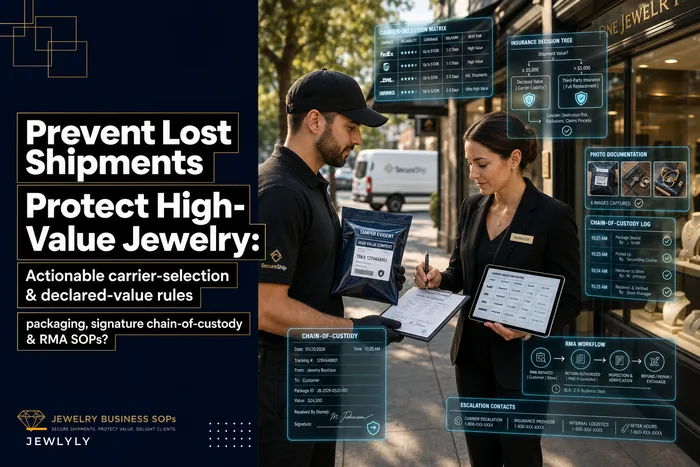


Moving a $14,000 diamond band from your uptown store to your mall location sounds simple until it isn't. The piece leaves in a courier pouch, arrives two days later, and somewhere in that gap it stops being tracked in any real way. The uptown store already marked it "transferred out." The mall store hasn't scanned it in yet because the box is sitting behind the counter unopened. For those two days it exists nowhere — and that gap is where jewelry cross-store transfers quietly go wrong, and where most of the actual losses and insurance headaches start.
It's a narrow problem, but a costly one. Below is how the failure actually plays out, and the specific controls — transfer request rules, transit insurance thresholds, temporary SKU holds, a receiving inspection checklist, and reconciliation templates — that close it.
The transfer gap nobody watches
The transfer itself is usually well-intentioned. A sales associate at Store B has a client who wants a specific pendant that's only in Store A's case. Someone calls, someone agrees, the piece gets sent over. The problem is that the request lives in a text message or a phone call, and the moment the piece physically leaves, the system loses visibility.
A typical scenario: Store A decrements the item from their inventory the second it's handed to the courier. Store B doesn't add it until someone finds time to inspect and scan the incoming box. In between, the piece is "in transit" — but no system field actually says that. So if a manager runs an inventory report on Tuesday, that pendant shows as gone from A and not-yet-arrived at B. It's invisible. Invisible high-value stock is exactly what internal shrink and "honest mistakes" feed on.
The second failure mode is worse: the item never gets marked as leaving at all. Store A sends it, forgets to log it, and three weeks later during a count someone notices the pendant is missing from the case. Now you're doing forensic work — pulling texts, asking who worked that shift, calling Store B to ask if they ever got it. Sometimes the answer is "yes, we sold it two weeks ago and just never told you." That's not theft. That's a broken workflow producing chaos that looks like theft.
Start with a real transfer request — not a phone call
The fix begins before anything moves. A transfer request should be a structured record, not a conversation. At minimum it needs:
Never miss a sale or shipment again.
Jewlyly helps you manage orders, track inventory, and engage customers seamlessly.
- Real-time inventory tracking
- Automated customer notifications
- Sales and order analytics
No credit card required
-
Requesting store and requesting associate
-
Source store and the specific SKU (not "the emerald ring" — the actual SKU)
-
Declared value at cost and at retail
-
Reason (client hold, restock, repair routing, display rebalancing)
-
Requested-by date
-
Approval status and who approved it
The reason field matters more than people expect. Transfers requested for a specific client hold behave completely differently from transfers requested to rebalance the case. A client-hold transfer has a deadline and a named customer attached to it. A rebalancing transfer can wait. When you don't distinguish them, urgent transfers get stuck behind casual ones, and the client waiting on that pendant hears "it's on its way" for four days.
One operational note: require approval for anything above a value threshold — say, $5,000 retail. Below that, an associate can initiate freely. Above it, a manager signs off. This single rule cuts down significantly on the "someone just sent it" situations that create untracked gaps in the first place.
Transit insurance thresholds: decide the routing before you pack
Not every transfer deserves the same handling, and treating them all the same is expensive in both directions — you either over-insure cheap pieces or under-protect the ones that actually matter. A simple tiered table tied to declared value tends to work well. The value decides the carrier, the insurance, and whether the piece can travel in a given method at all.
| Declared retail value | Transit method | Insurance requirement | Approval level |
|---|---|---|---|
| Under $2,500 | Insured courier or trusted staff hand-carry | Standard carrier coverage | Associate |
| $2,500 – $10,000 | Insured overnight, signature required | Named jewelers block / declared value | Manager |
| $10,000 – $50,000 | Specialized jewelry carrier, tracked | Full declared-value transit rider | Manager + owner notice |
| Over $50,000 | Specialized carrier only, split shipments considered | Confirmed rider before pickup | Owner sign-off |
The threshold that trips most stores up is the mid-tier. A $7,000 ring gets tossed into a regular overnight envelope because it "felt fine," and it technically arrives — until the one time it doesn't, and the coverage caps out at $1,000. If your carrier and insurance choice is driven automatically by the declared value on the transfer request, that judgment call disappears. Nobody has to remember the rule; the rule is attached to the number.
This connects directly to how you handle high-value movement overall. If you haven't set up the broader coverage logic yet, the shipping playbook for high-value jewelry orders covers insurance declarations and carrier selection in more depth — the transfer thresholds here should mirror whatever coverage rules you've already established for outbound customer shipments.
The temporary SKU hold — the piece that fixes the invisible gap
This is the most important control, and the one almost nobody implements: a temporary in-transit status for the SKU.
The moment a transfer is approved and the piece is packed, the SKU should move into an "in-transit" state — not "sold," not "removed," not "at Store B." In-transit is its own status. While a piece sits in that state:
-
It cannot be sold at either location
-
It shows on inventory reports as a distinct, accounted-for line
-
It has a timer attached to the expected arrival date
-
It's tied to the transfer request ID, the courier, and the insurance tier
The invisible gap only exists because most POS setups have no state between "here" and "there." You either own it or you don't. The in-transit hold gives the item a place to live while it's moving — which means a Tuesday inventory report shows it exactly where it is: on the road, worth $14,000, expected Thursday, insured under the correct rider.
The timer is what turns this into an early-warning system. If a piece is supposed to arrive Thursday and it's still sitting in-transit on Monday, someone gets flagged. In practice, this usually catches problems before they become claims — the package that got misrouted, the box that arrived and never got scanned, the transfer that was "sent" but actually never left a drawer. Without the timer, you find out three weeks later during a count.
This connects to the wider counting discipline. Transfers are just one movement type in a piece's life, and if your overall inventory tracking is loose, transfer controls alone won't save you. The jewelry inventory lifecycle approach covers how each status transition should be logged — the in-transit hold slots into that lifecycle as a specific, auditable state.
Receiving inspection: the checklist that protects both stores
When the box arrives at Store B, the receiving process is where accountability transfers. Do it sloppily and you inherit problems that started somewhere else. The receiving associate should never just scan the SKU and move on — the inspection is what confirms the piece that arrived is the piece that was sent, in the condition it was sent.
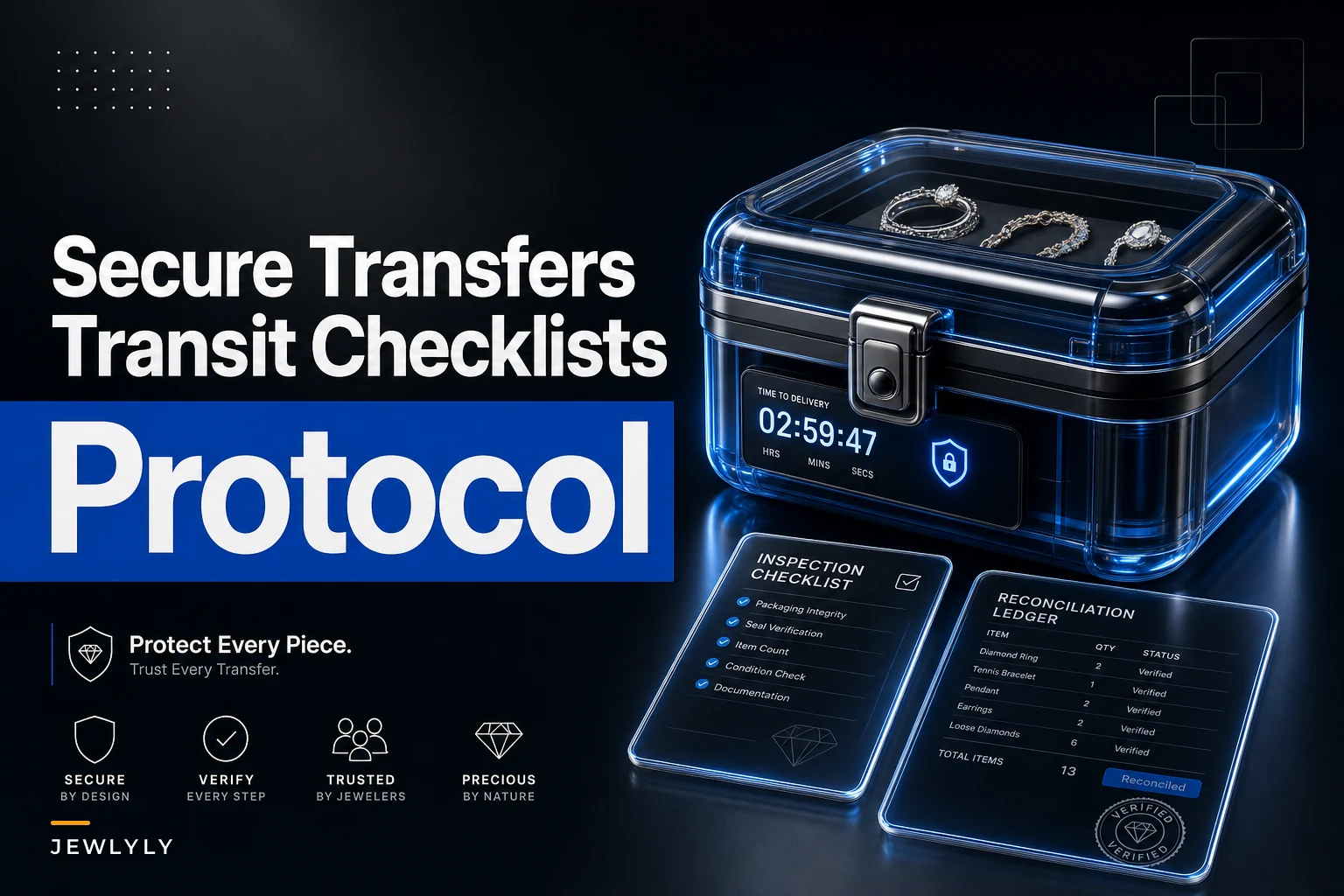
Run through this before anything gets marked received:
-
Match the SKU on the tag to the transfer request ID
-
Confirm the piece matches the description and photo on the request
-
Check for damage — loose stones, bent prongs, clasp issues, scratches not noted at origin
-
Verify weight for loose stones or anything sold by carat
-
Confirm certificate/appraisal paperwork traveled with the piece if applicable
-
Photograph the received item and its packaging condition
-
Note discrepancies immediately, before marking received
The photo step is the one people skip and later regret. If a ring shows up with a chipped stone, you need to know whether that happened in transit or whether it left Store A that way. A timestamped photo at receiving, matched against the origin photo, settles the question in seconds instead of turning into a two-store argument. Same logic you'd apply to returns — condition documentation at the moment of hand-off is what prevents disputes later.
Only after the checklist passes does the SKU move out of in-transit and into Store B's active inventory. That's the moment ownership officially transfers, and it should be tied to a named person. Not "received by Store B" — received by a specific associate who ran the checklist.
Automatic reconciliation: matching what left against what arrived
At any point, you should be able to run a report that answers one question: does every piece that left match a piece that arrived, and is anything still in-transit longer than it should be?
The reconciliation template needs three buckets:
-
Completed transfers — left Store A, passed receiving at Store B, statuses match, values match. No attention needed.
-
Open in-transit — approved and shipped, not yet received, still inside the expected arrival window. Normal, but watched.
-
Exceptions — anything that breaks the pattern
in-transit past its timer, received-without-a-matching-send, sent-without-a-matching-receive, or value mismatches between origin and destination records.
That third bucket is the entire point. A clean reconciliation isn't the one with zero transfers — it's the one where the exception list is empty. When a piece shows "received at B" but Store A never logged it leaving, that's worth investigating today, not next month.
Here's a workflow view of how the whole thing runs end to end:
Request → associate submits structured transfer with SKU and declared value → Approval routes by value threshold → Insurance tier auto-assigned from declared value → SKU flips to in-transit, removed from sellable stock at both stores, timer starts → Piece ships via the tier-appropriate carrier → Receiving checklist runs at destination, photos captured → SKU flips to active at Store B, ownership assigned to named associate → Reconciliation matches the send against the receive and clears the transfer, or flags an exception.
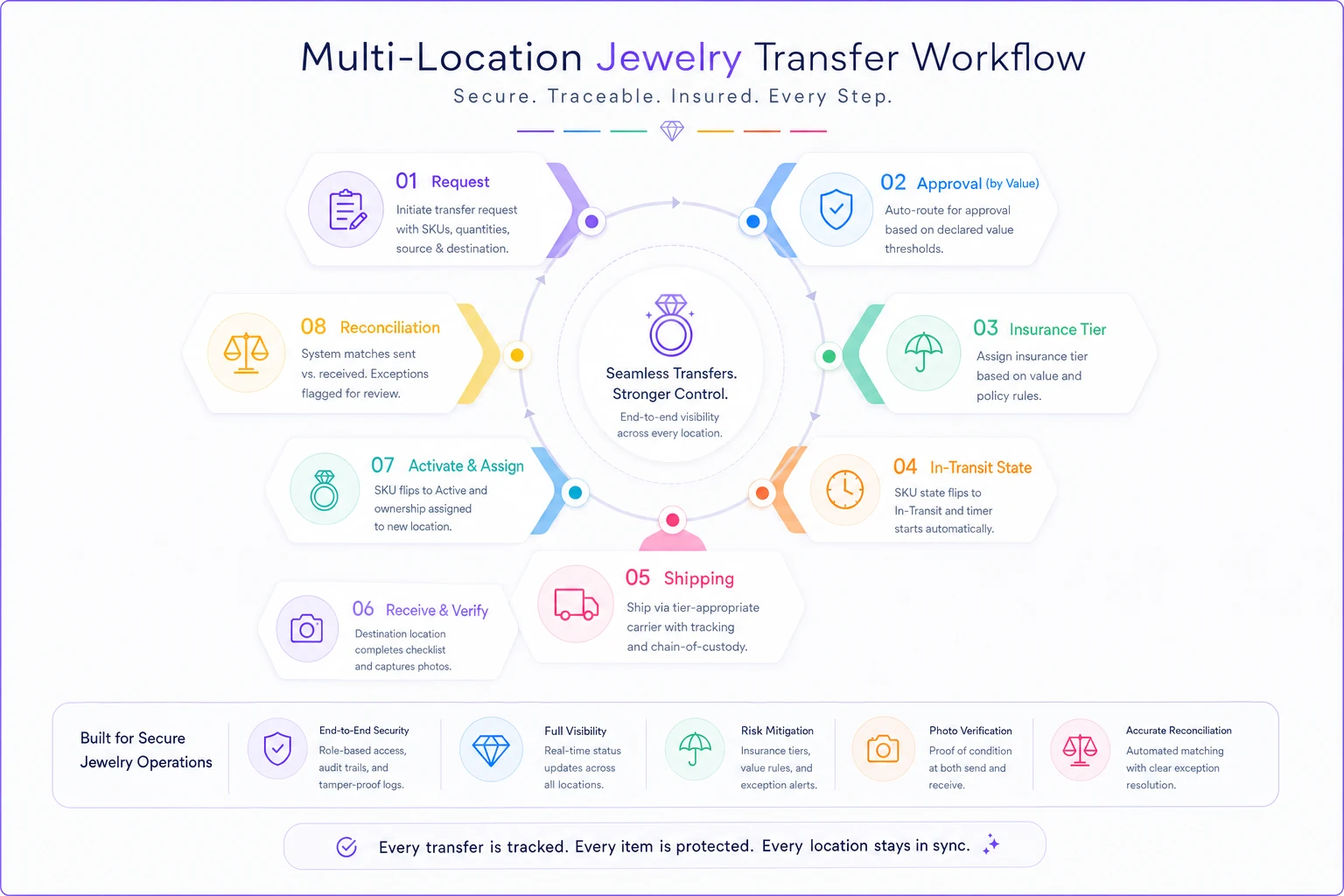
Every step produces a record. That's what makes the reconciliation possible — you're not reconstructing what happened, you're reading statuses that were logged as they occurred.
A real scenario
A two-location jeweler doing bridal and estate pieces was running transfers entirely by phone and handwritten pouch slips. They moved somewhere around 40–60 pieces a month between stores, mostly for client holds and case rebalancing. Year-end counts kept surfacing two or three pieces they couldn't cleanly account for — not necessarily stolen, just genuinely unclear whether they were at the other store, sold, or lost in transit. Untangling each one ate hours of manager time and, in one case, produced an insurance claim they couldn't fully substantiate because they had no origin photo.
They moved to structured transfer requests with a mandatory in-transit hold and a receiving checklist with photos. The change wasn't dramatic day-to-day — associates still packed pouches — but the reconciliation report became something a manager could clear in about fifteen minutes each week instead of a quarterly forensic project. The "unaccounted at count" problem essentially went away, and the one damaged-in-transit dispute they did have was resolved quickly because the origin and receiving photos told the whole story.
When this level of control makes sense — and when it's overkill
When it's worth it: You run two or more locations, you regularly move pieces above a few thousand dollars, or you've had even one "where did this go" incident. The moment high-value stock crosses between stores without a status to live in, you need this.
When it's overkill: A single-location store moving nothing but an occasional repair to an off-site bench doesn't need a full transfer-request system. A simple logged hand-off covers it. Don't build multi-store transfer infrastructure for a problem you don't have.
Who should not skip the in-transit hold specifically: Anyone whose inventory reports currently can't tell them where a moving piece is right now. If your only two states are "here" and "not here," you have the gap — and the gap is where the losses hide.
The controls above aren't about distrust or bureaucracy. They're about giving every piece a place to exist while it's between two locations. The pieces that fall through the cracks are almost always the ones that were moving at the time. Close the gap between "left" and "arrived," and the mysterious count discrepancies, the underinsured shipments, and the two-store arguments mostly stop on their own.
Ready to elevate your jewelry store operations?
Join 500+ jewelers using Jewlyly to increase efficiency, reduce errors, and grow revenue.