



Most jewelry stores lose somewhere between $8,000 and $35,000 a year to inventory problems they can't even pinpoint. Not theft. Operational failures. Missing pieces during repairs. Consignment items that vanish between display rotations. Stones that disappear during resizing. Losses that happen slowly, piece by piece, until your annual inventory reveals the damage.
The jewelry inventory lifecycle isn't just about counting items. It's about understanding how each piece moves through your operation, where handoffs fail, and which transitions create the most risk. The solution isn't better counting—it's building a system that makes miscounts impossible.
The hidden complexity of jewelry movement
Jewelry inventory moves differently than other retail. A single engagement ring might transition through twelve different states before sale: receiving, authentication, pricing, display case A, customer viewing, back to safe, display case B, sizing consultation, bench work, quality check, gift wrap staging, and finally sale. Each transition creates risk.
The problem compounds because jewelry stores run multiple parallel inventory streams simultaneously. New stock arrives while repairs cycle through the bench. Consignment pieces rotate between cases. Custom orders move between design, production, and completion. Estate purchases need authentication and refurbishment. Each stream has different documentation needs, different risk profiles, and different failure points.
What makes this harder is that jewelry stores typically run lean. Maybe three or four people handling all of these movements. The same person who receives shipments also manages repairs and rotates displays. When workflows overlap and handoffs aren't clearly defined, pieces start disappearing.
Consider a typical Thursday at a four-person store. Morning shipment arrives with 22 pieces. Two repairs come back from your outside bench. A customer drops off three items for cleaning. Someone pulls four rings for an afternoon appointment. Another employee rotates the window display. By 3pm, you've had 47 individual inventory movements across eight different workflow types. Without structured handoffs and verification points, something will go wrong.
The real damage happens gradually. You might not notice that tanzanite ring is missing for weeks. A customer's repair sits in the wrong drawer for a month. A consignment piece gets logged incorrectly and you can't prove ownership when the consigner asks. These aren't dramatic failures—they're death by a thousand cuts.
Stage 1: Procurement to receiving—where accuracy begins
Your inventory lifecycle starts before items even arrive. The procurement-to-receiving handoff sets the tone for everything downstream. Most stores treat receiving as a simple check-in process, but this is where foundational data problems start.
Never miss a sale or shipment again.
Jewlyly helps you manage orders, track inventory, and engage customers seamlessly.
- Real-time inventory tracking
- Automated customer notifications
- Sales and order analytics
No credit card required
The procurement stage needs to capture:
-
Purchase order details with exact specifications
-
Expected delivery windows
-
Authentication requirements by category
-
Insurance documentation needs
-
Payment terms and dating
-
Return windows and conditions
When these details aren't locked down during procurement, receiving becomes guesswork. Your staff opens a shipment and tries to match vague descriptions to physical pieces. "14k yellow gold ring with diamonds" could describe 30% of your inventory.
The receiving workflow should force verification at multiple levels. Physical count against packing slip. Packing slip against purchase order. Actual specifications against ordered specifications. Weight verification for precious metals. Authentication checks for high-value stones. Photo documentation before anything moves to the sales floor.
Here's what typically breaks: stores skip steps when they're busy. A Friday afternoon shipment arrives during rush hour. Instead of running the full receiving protocol, someone does a quick count and promises to "finish logging it later." That's when discrepancies start. The vendor says they sent 15 pieces, you counted 14 quickly, but maybe there were actually 16—and now you'll never know.
Required data fields for receiving:
-
Timestamp of receipt
-
Employee who received
-
Vendor invoice number
-
PO number reference
-
Individual piece count
-
Category classification
-
Metal type and weight
-
Stone details (type, count, total carat weight)
-
Wholesale cost
-
Planned retail price
-
Location assignment
-
Photos from three angles
Use photos from three angles to speed verification and reduce disputes.
The receiving stage also needs clear escalation paths. What happens when counts don't match? Who approves receiving discrepancies? How quickly must they be reported to vendors? These aren't just policies—they need to be built into your workflow.
Stage 2: Display management and the rotation trap
Once inventory passes receiving, it enters the display ecosystem—the most chaotic part of the jewelry inventory lifecycle. Pieces move between cases, safes, windows, and back rooms based on sales patterns, seasons, and gut feelings. Without systematic tracking, this is where most inventory quietly disappears.
Display rotation seems simple until you actually map the movements. A diamond tennis bracelet might start in the safe, move to case 3 for the weekend, shift to the window for a promotion, return to the safe during slow season, go to case 1 for holiday traffic, then back to the safe for inventory count. Six movements, probably handled by four different employees over three months. If any transfer wasn't logged, you've lost the chain of custody.
The challenge multiplies with multi-case operations. A typical jewelry store runs 8–12 display cases plus window displays. Each case might hold 40–80 pieces. You're managing somewhere around 600 items in active display rotation. Add seasonal swaps, and you're looking at 200-plus movement transactions monthly just for display management.
Smart operations create display zones with specific transfer protocols:
High-Security Zone (safe to locked cases only)
-
Two-person verification for any movement
-
Photo log of items leaving safe
-
Written log with timestamps
-
Maximum 3 pieces moved simultaneously
Standard Display Zone (between regular cases)
-
Single person can move with logging
-
Batch movements allowed
-
End-of-day reconciliation required
-
Weekly spot audits
Feature Display Zone (windows and feature cases)
-
Requires manager approval
-
Full documentation with photos
-
Limited rotation schedule
-
Insurance notification for high-value pieces
Your display data needs to track more than just location. Each movement should capture:
-
Previous location
-
New location
-
Reason for movement
-
Employee making change
-
Timestamp
-
Next scheduled review date
-
Sales performance in previous location
This isn't just about security—it's about learning what sells where. That sapphire collection might sit dead in case 2 but move quickly in case 7. Without movement history, you're guessing at placement decisions.
Stage 3: The repair and consignment maze
Repairs and consignments create parallel inventory streams that constantly intersect with your regular stock. This is where most jewelry stores lose complete visibility. A piece leaves for repair and essentially exits your tracking until it returns—if it returns correctly.
The repair workflow has multiple failure points. Customer drops off a piece. Front desk logs it, maybe. Piece goes to bench queue. Bench pulls it for work. Piece might go to an outside vendor. Returns from vendor. Sits in completion queue. Quality check. Customer notification. Pickup staging. Each transition risks misplacement or miscommunication.
Real scenario: a customer drops off her grandmother's ring for sizing. Front desk is swamped, writes a quick note, puts the ring in a repair envelope. The bench can't read the handwriting, sizes it wrong. Ring comes back, sits in the "completed" drawer. Customer calls after two weeks. Nobody can find it. Eventually discovered in the "problem repairs" box because whoever checked it noticed the sizing looked off. Customer is furious. Reputation damaged. Maybe legal action threatened.
Consignment adds another layer. You're managing inventory you don't own, with specific terms, rotation requirements, and settlement schedules. Consignment pieces need parallel tracking:
-
Owner information
-
Consignment agreement terms
-
Commission structure
-
Minimum price
-
Markdown schedule
-
Settlement timeline
-
Display requirements
-
Return conditions
Most stores handle consignments informally—handshake agreement, piece goes in the case, hopefully someone remembers to pay the consigner when it sells. That casual approach creates real liability. When an $8,000 estate necklace sells and you can't prove the consignment terms, you're dealing with a legal problem.
The repair and consignment workflow needs hard stops:
-
No repair accepted without complete intake form
-
No bench work starts without ticket verification
-
No outside vendor shipment without documentation
-
No consignment accepted without signed agreement
-
No consignment displayed without system entry
-
No settlement without a documentation trail
KPIs for repair and consignment:
-
Average repair turnaround time
-
Repairs completed on schedule
-
Outside vendor return rate
-
Consignment days to sale
-
Consignment settlement accuracy
-
Repair dispute rate
-
Items in "unknown status"
The repair and consignment workflows should minimize ambiguity and ensure traceability at every handoff.
Stage 4: The sale process and post-sale tracking
The sale looks like the end of your jewelry inventory lifecycle, but it's actually a critical transition point that affects everything upstream. How you handle sales determines your reorder patterns, identifies shrinkage, and validates your entire tracking system.
Most stores treat sales as simple deductions from inventory. Item sells, comes out of system, done. But the sale process reveals whether your upstream tracking actually worked. If you can't locate the exact piece that supposedly sold, if specifications don't match what the system shows, if the location history doesn't add up—those are symptoms of systemic tracking failures, not isolated mistakes.
The sale workflow needs multiple verification points:
-
Physical piece matches system description
-
Location history makes sense
-
Pricing aligns with current structure
-
All modifications are documented
-
Final sale price captured accurately
-
Removal from all display logs
-
Update to reorder triggers
Post-sale tracking often gets ignored, but it provides useful intelligence. The customer who bought the emerald ring—did they come back for matching earrings? The couple who purchased wedding bands—did they return for anniversary gifts? Without post-sale tracking, you're missing patterns that could drive smarter inventory decisions.
Data architecture that actually works
The jewelry inventory lifecycle needs specific data fields that general retail systems miss entirely. Your SKU can't just be "RING-GOLD-7"—it needs to capture metal purity, stone details, design family, vendor, and more. Not complexity for its own sake. Enough detail to prevent expensive mistakes.
Core data requirements by stage:
| Stage | Critical Fields | Update Frequency | Verification Method |
|---|---|---|---|
| Procurement | Vendor ID, PO number, specifications, cost, terms | Once at order | PO to invoice match |
| Receiving | Actual specs, weight, photos, location, discrepancies | Once at receipt | Physical to document |
| Display | Current location, movement history, duration | Every movement | Daily spot checks |
| Repair/Consignment | Owner ID, terms, status, estimated completion | Status changes | Weekly reviews |
| Sale | Final price, customer ID, sales associate, warranties | At transaction | End-of-day reconciliation |
Your data structure also needs to handle edge cases. Split sets where earrings sell separately. Repairs that become sales. Consignments that convert to inventory purchases. Custom orders that pull from existing inventory components. These aren't rare exceptions—they happen weekly in most stores.
Building workflows that eliminate handoff failures
The jewelry inventory lifecycle breaks at handoffs. Receiving to display. Display to repair. Repair to customer. Each handoff needs explicit protocols that don't rely on memory or goodwill.
Start with physical handoff points. Create designated zones for each inventory state:
-
New receipts staging
-
Authentication queue
-
Display ready
-
Repair intake
-
Bench queue
-
Vendor shipments
-
Customer pickup
-
Problem items
Each zone needs clear ownership. Who's responsible for moving items from receiving to display-ready? Who validates repairs before customer pickup? Without ownership, items sit in limbo between stages.
Digital handoffs matter equally. When someone updates inventory location in your system, does it trigger verification? Can employees override logistics without approval? Your software workflows should enforce the same discipline as your physical protocols.
Time-based escalations help too. Items sitting in any transition zone over 24 hours should trigger an alert. Repairs approaching deadlines need daily visibility. Consignments near settlement dates require proactive review. This isn't micromanagement—it's pattern interruption before small problems turn into bigger ones.
The following diagram illustrates how a piece flows through the lifecycle from procurement to post-sale, with verification points at each stage transition:
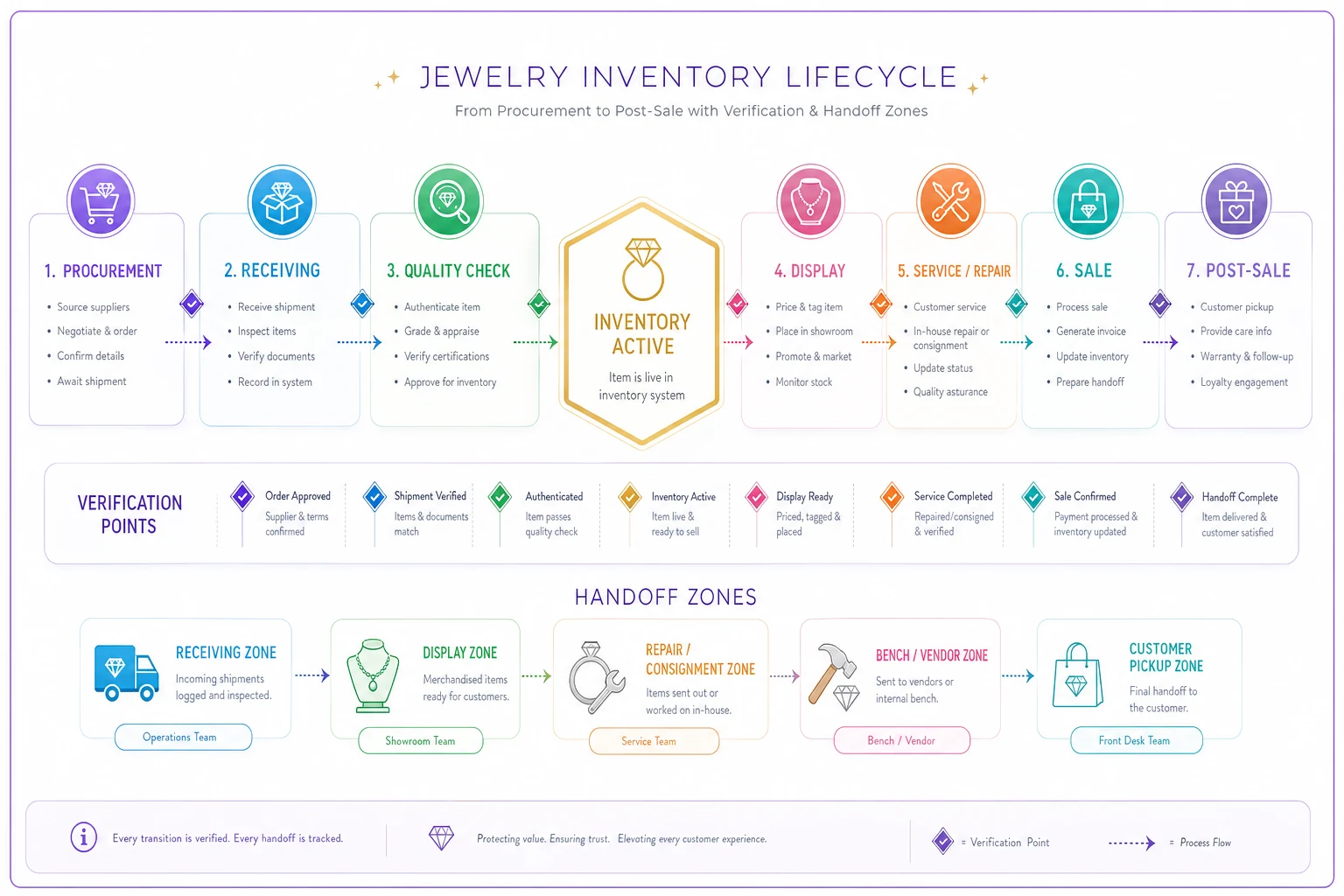
Mapping this flow visually tends to surface gaps that aren't obvious from a written policy document alone.
The compound effect of small failures
What actually kills jewelry inventory accuracy isn't one big mistake—it's tiny failures that seem insignificant individually but destroy visibility over time. Someone forgets to log one display movement. Another person miscounts by one piece. Someone puts a repair in the wrong envelope. Individually, these seem like minor mistakes. Together, they create systematic blindness.
A store doing $2 million annually might process around 10,000 individual inventory movements. If your accuracy rate is 99%—which sounds great—you still have roughly 100 movements recorded incorrectly. Those errors don't distribute evenly. They cluster around busy periods, new employees, and complex items. By year-end, you could have 20 high-value pieces that are completely untraceable.
The solution isn't demanding perfection from your team. It's building systems that make errors visible immediately rather than months later during annual inventory. Daily reconciliations, exception reports, and systematic reviews catch problems early.
Your KPIs should track both accuracy and velocity:
-
Movements logged same day
target 100%
-
Daily reconciliation completion
target 95%
-
Items in "unknown" status
target fewer than 5 pieces
-
Average time in transition zones
target under 24 hours
-
Verification override rate
target below 2%
-
System-to-physical match rate
target above 98%
When metrics slip, you need investigation triggers. Three days of missed reconciliations means management review. A jump in override rates means training gaps. Items stuck in transition zones means a workflow breakdown somewhere. The numbers tell you where to look—but someone still has to look.
Technology's role in inventory lifecycle management
Manual tracking of the jewelry inventory lifecycle is essentially impossible at scale. Even a small store with 500 active pieces can't maintain accuracy with paper logs and memory alone. This is where AI-powered operational software changes what's actually achievable.
Modern platforms can automate routine verification while flagging anomalies that deserve attention. Automatic alerts when items sit too long in transition. Pattern recognition when certain employees have higher error rates. Predictive warnings when repair deadlines approach. The technology doesn't replace judgment—it makes it easier to spot problems before they compound.
But generic retail systems don't understand jewelry operations. They can't handle split sets, multi-stone specifications, or consignment terms. They treat repairs like returns and custom orders like regular sales. That fundamental mismatch creates workarounds, and workarounds destroy data integrity over time.
Purpose-built jewelry operations software changes the equation. When your system understands that a ring going in for sizing hasn't left inventory, that consignment pieces need different margin calculations, that custom orders pull from multiple inventory sources—your workflows actually make sense in the digital environment. AI automation can reduce the manual logging burden further: image recognition to verify pieces match specifications, predictive analytics to suggest reorder points based on sales velocity. The technology handles repetitive validation while your team focuses on customer service and the decisions that actually require judgment.
Making the lifecycle work in your operation
Every jewelry store needs to adapt these principles to their specific situation. A high-end boutique with 200 pieces has different needs than a mall store with 2,000. But the fundamental framework stays the same: clear stages, defined handoffs, comprehensive tracking, and systematic verification.
Start with your highest-risk transitions. For most stores, that's the repair workflow. Map every step from customer handoff to pickup. Identify where pieces go missing. Build verification points that catch errors immediately. Once repairs run smoothly, tackle display rotations. Then consignments. Build your system incrementally rather than trying to fix everything at once.
Your team needs to understand why these protocols matter. "Because management said so" doesn't motivate careful tracking. But sharing the real cost of a lost repair—customer relationship damage, potential legal exposure, staff hours spent searching—creates genuine buy-in. Make accuracy everyone's responsibility, not just the manager's problem.
The jewelry inventory lifecycle is never truly "done." As your business evolves, so do your inventory challenges. New vendor relationships, expanded repair services, additional locations—each change requires workflow adjustments. Build quarterly review cycles into your operation to catch what's breaking before it becomes a significant problem.
Stores that master their inventory lifecycle don't just reduce shrinkage. They move faster because they trust their data. They scale more easily because their systems are proven. And they can focus on what actually matters: sourcing great pieces, building customer relationships, and growing the business—instead of spending hours hunting for missing inventory or reconciling mysterious discrepancies.
That's the real value of a properly managed jewelry inventory lifecycle. Not just counting items, but understanding how inventory flows through your business, where value gets created or destroyed, and how to build systems that make success repeatable.
Ready to elevate your jewelry store operations?
Join 500+ jewelers using Jewlyly to increase efficiency, reduce errors, and grow revenue.