
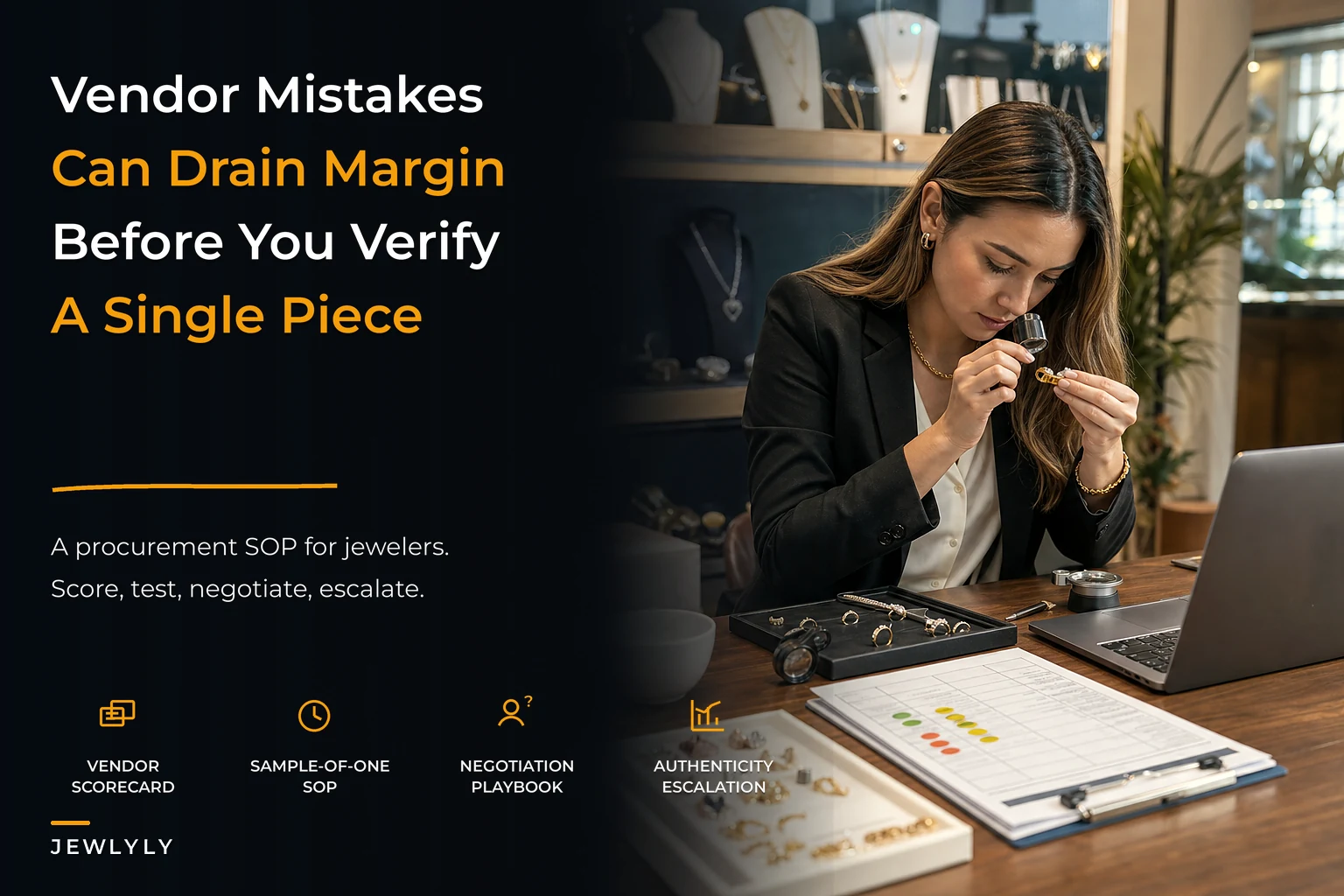

Running a jewelry store means you're essentially managing two businesses at once: retail operations and high-stakes procurement. While most retailers worry about markup and delivery times, jewelers deal with authenticity verification, metal market volatility, and vendors who know exactly how desperate you are during engagement season.
The average independent jewelry store works with somewhere between 12 and 18 vendors regularly, yet most track vendor performance on sticky notes or in the owner's head. That works fine at $30k in monthly orders. It falls apart completely once you're pushing $80k and suddenly realize your "reliable" diamond supplier has been quietly stretching lead times while your consignment vendor keeps sending pieces with incomplete paperwork.
Why vendor management breaks down in jewelry retail
Most jewelers start vendor relationships the same way. You meet suppliers at trade shows, inherit them from previous owners, or get introduced through industry connections. These relationships feel personal—almost friendly—until you realize friendship doesn't prevent a vendor from shipping treated stones without disclosure or changing payment terms mid-contract.
The procurement challenges unique to jewelry create operational complexity that standard retail vendor scorecards just can't handle. You're not just tracking cost and delivery. You're managing:
Authentication chains that affect insurance claims years down the road. When a customer brings back a piece for appraisal three years after purchase and discovers the center stone has undisclosed treatment, that vendor relationship has already cost you more than any discount they ever offered.
Consignment inventory that ties up display space without guaranteed turnover. Some vendors push high-ticket pieces that look impressive but sit for months, while denying you access to faster-moving items that actually generate cash flow.
Metal content variations that affect your entire pricing structure. A vendor claiming 14k gold that consistently tests at 13.8k might seem like a minor issue until you calculate the margin impact across hundreds of pieces.
Repair and custom work partnerships where one delayed CAD file can blow up a wedding timeline. These vendors often know they're hard to replace for certain skills, and that dynamic shows up in every negotiation.
The hidden costs of poor jewelry vendor strategy
A jewelry store in Phoenix discovered their "premium" watch supplier had been shipping grey market pieces for roughly two years. They only found out when a customer tried to register a $12,000 Rolex for warranty service. The authentication issue cost them the sale, the customer relationship, and their authorized dealer application with three other luxury brands.
Never miss a sale or shipment again.
Jewlyly helps you manage orders, track inventory, and engage customers seamlessly.
- Real-time inventory tracking
- Automated customer notifications
- Sales and order analytics
No credit card required
This happens because jewelry procurement differs from standard retail in ways that aren't always obvious:
Trust erosion happens slowly. A vendor might ship 50 perfect orders, then one problematic piece. You assume it's an anomaly. By the time you recognize the pattern, you've already sold dozens of potentially problematic items.
Vendor leverage increases over time. As you become known for carrying certain brands or styles, switching vendors means disappointing established customers. Vendors know this and adjust terms accordingly.
Documentation gaps compound. Missing one certificate might seem manageable. Missing certificates across multiple vendors means you can't verify anything when problems arise, leaving you liable for issues you didn't create.
Building vendor scorecards that actually track what matters
Generic vendor scorecards track on-time delivery and invoice accuracy. For jewelers, those metrics matter far less than authenticity verification rates and consignment sell-through. Here's what an effective jewelry vendor scorecard actually measures:
| Metric Category | What to Track | Weight | Red Flag Threshold |
|---|---|---|---|
| Authentication | % orders with complete certs | 25% | Below 95% |
| Quality Variance | Failed inspections per 100 items | 20% | Above 3% |
| Financial Terms | Days payment vs. industry standard | 15% | 15+ days worse |
| Inventory Turn | Consignment sell-through at 90 days | 15% | Below 40% |
| Margin Reliability | Actual margin vs. quoted | 10% | 5% variance |
| Response Time | Hours to quote requests | 10% | Over 48 hours |
| Problem Resolution | Days to resolve issues | 5% | Over 7 days |
Track these monthly, not quarterly. Jewelry vendor relationships can deteriorate quickly, especially when metal prices swing or vendors face their own cash flow pressure.
The scorecard should feed directly into your procurement decisions. A vendor scoring below 70% needs immediate attention—either renegotiation or replacement. Vendors consistently above 85% deserve preferred terms and first access to special buys.
Sample evaluation SOP for single-piece purchases
Buying individual high-value pieces requires a different approach than regular inventory orders. Whether it's an estate piece, a collector trade-in, or a unique designer item, how you evaluate it determines both immediate profitability and long-term reputation risk.
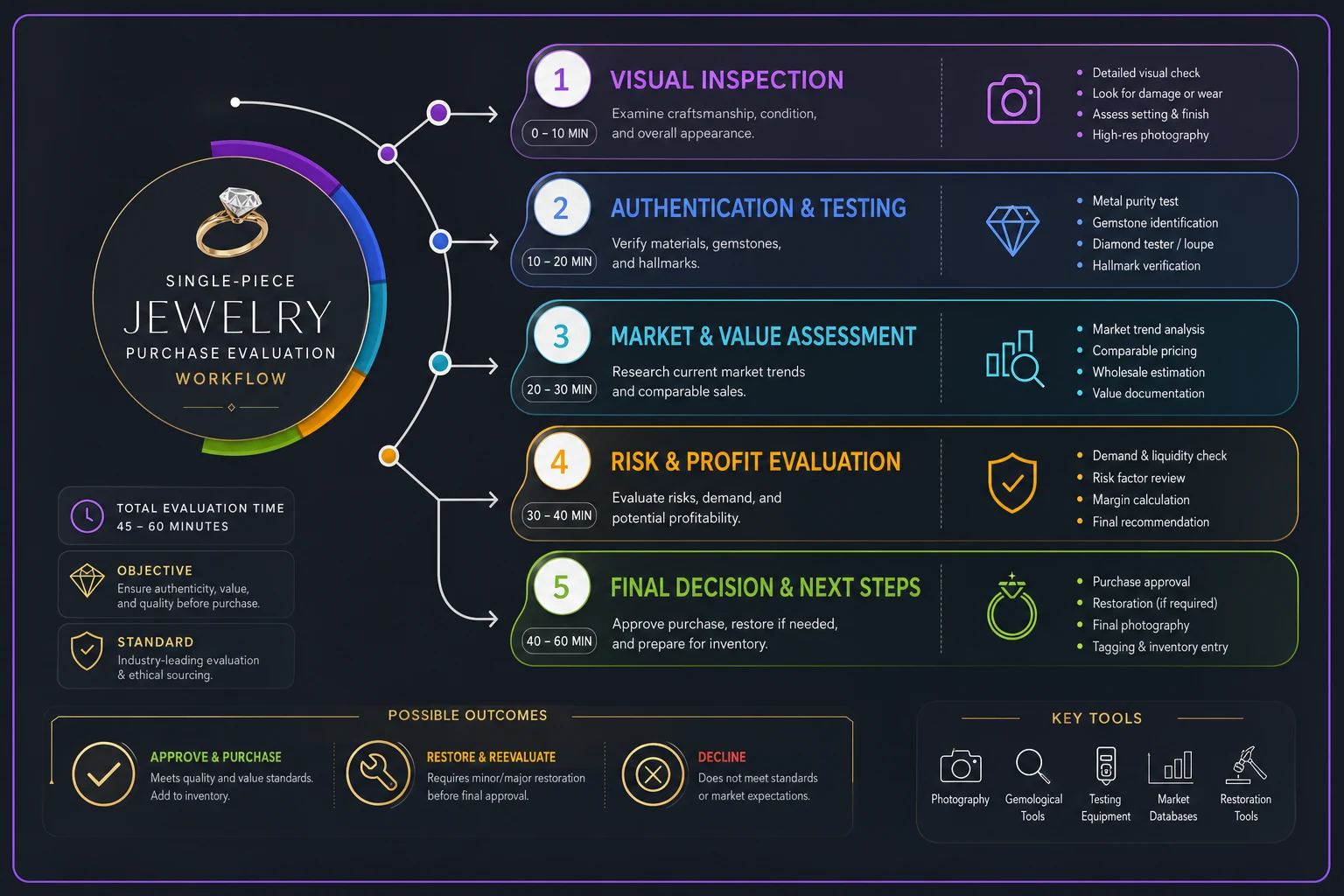
Here's the evaluation process that actually holds up in practice:
-
Initial inspection checkpoint (10 minutes) - Photograph all sides under consistent lighting - Note any visible markings, stamps, signatures - Check basic construction quality - Document weight and dimensions
-
Authentication verification (30-45 minutes) - Test metal content at three points minimum - Examine stones under 10x magnification - UV test for treatments or synthetics - Cross-reference any designer signatures against known examples
-
Market position assessment (20 minutes) - Search current retail prices for comparable pieces - Check recent auction results - Review your own sales history for similar items - Calculate maximum profitable purchase price
-
Risk evaluation (15 minutes) - Consider authentication challenges - Estimate holding period based on your client base - Factor in any necessary restoration costs - Account for certification expenses if needed
-
Make or pass decision - If margin potential exceeds 55%, proceed - If authentication has any doubt, pass - If holding period exceeds 180 days, reduce offer by 20%
This flow shows the evaluation steps in sequence.
Document every evaluation, even pieces you pass on. Over time this builds a reference library for future purchases and helps you spot when vendors are repeatedly sending problematic inventory.
The negotiation playbook that keeps small shops competitive
Small jewelry stores often assume they have no leverage against established vendors. That's only true if you negotiate like every other small store—focusing solely on price and payment terms.
Effective vendor strategy means understanding what suppliers actually need from smaller accounts. They need consistent orders, even if smaller. They need feedback on what sells in your market. They need showcase accounts in geographic areas where they're trying to expand.
Document your marketing reach and engagement rates before you sit down to negotiate.
Start negotiations by establishing your value beyond order volume:
Geographic advantage. If you're the only quality jeweler in a 30-mile radius, vendors need you to maintain market presence. A vendor might accept lower margins to keep competitors out of your area.
Category depth. Vendors prefer retailers who commit to full collections rather than cherry-picking bestsellers. Offering to carry complete lines—even at lower quantities—creates real negotiation leverage.
Marketing participation. Small stores that actively promote vendors through social media and events provide value that larger stores often won't. Document your marketing reach and engagement rates before you sit down to negotiate.
Payment reliability. Larger stores might order more, but they often pay slower. If you pay within terms consistently, that's worth 2-3% better pricing to vendors managing their own cash flow.
The actual negotiation should follow this sequence:
First, establish performance metrics from your scorecard. Show the vendor how they rank against others in specific categories. This shifts the conversation from general complaints to specific, trackable improvements.
Second, propose a performance-based agreement. Instead of fighting for blanket discounts, suggest pricing tiers based on quality metrics. A vendor maintaining 98% authentication completion might earn preferred status and better terms.
Third, always negotiate beyond price. Better return windows, consignment ratios, and exclusive access to new collections often matter more than a 2% cost reduction. A vendor who gives you 120-day returns on slow movers has effectively given you free financing.
Fourth, document everything in writing. Jewelry vendor relationships last years, and the sales rep who made promises might be gone next season. Written agreements prevent "misunderstandings" when personnel changes happen.
Authenticity escalation workflows that prevent disasters
Despite best efforts, authentication issues will come up. The difference between stores that weather these situations and ones that get badly burned usually comes down to how fast they identify and act on warning signs before customers are affected.
Build an escalation workflow that triggers automatically when something looks off:
Level 1: Initial suspicion (Handle internally) Any piece that fails initial inspection or shows inconsistencies gets quarantined immediately. Don't wait for confirmation—remove it from the sales floor and flag any similar pieces from the same vendor or batch.
Level 2: Verification needed (Engage vendor) Contact the vendor within 24 hours with specific concerns and documentation. Request additional authentication or explanation. Give them 72 hours to respond with proof or resolution. Meanwhile, review all recent purchases from this vendor.
Level 3: Confirmed issue (Protect business) If authentication problems confirm, immediately audit all inventory from that vendor. Contact any customers who purchased similar pieces for voluntary inspection. Document everything for potential insurance or legal action.
Level 4: Systemic problem (Strategic response) Multiple authentication issues require stopping all orders, demanding a full audit of past shipments, and potentially ending the vendor relationship. This also triggers reviews of your other vendors in similar categories.
Each escalation level needs clear ownership and timelines. The person discovering the issue might not be the one managing vendor relationships, but they need to know exactly who to notify and how fast.
Turning vendor data into strategic advantage
Collecting vendor performance data means nothing if it doesn't drive better decisions. Stores that actually benefit from scorecards use them to find patterns that affect broader operational strategy.
For instance, tracking authentication completeness across all vendors might reveal that estate jewelry suppliers consistently provide better documentation than contemporary wholesalers. That insight could shift your category-level assortment planning toward vintage pieces where you have a competitive edge through superior authentication.
Monitoring consignment sell-through rates might show that certain vendors' pieces move faster during specific seasons. Instead of accepting year-round consignment terms, you could negotiate seasonal arrangements that improve cash flow during peak periods.
The data also helps during vendor transitions. When replacing an underperforming supplier, historical scorecards show exactly which metrics matter most for that category. If your previous pearl vendor failed on consistent grading, you know what to prioritize when evaluating replacements.
Integration with inventory and SKU systems
Your vendor scorecard system needs to connect with your broader inventory management approach. When you've already built a purpose-built SKU schema, adding vendor performance flags becomes straightforward.
Each SKU can carry its vendor scorecard rating, making it immediately visible during reorder decisions. A vendor trending downward triggers flags on their items, surfacing alternative suppliers before you place another problematic order.
This becomes especially useful for multi-vendor categories. If you source similar silver chains from three suppliers, the system can automatically recommend ordering from the highest-scoring vendor unless price differences exceed your threshold.
The technology component of modern vendor management
Manual vendor scorecards worked when jewelry stores had paper catalogs and monthly ordering cycles. Today's market moves too fast for spreadsheet-based tracking. Modern jewelry operations use AI-powered procurement platforms that automatically calculate vendor scores based on real transaction data.
These systems catch things you'd never spot manually. They notice when a vendor's average lead time creeps up by two days over six months. They flag when documentation quality is declining even if certificates are technically still included. They identify which vendors consistently deliver items that need additional cleaning or adjustment before display.
The automation matters because it removes the emotional component from vendor evaluation. It's genuinely hard to objectively score a vendor you've worked with for a decade. It's much easier when a system puts clear performance data in front of you.
Beyond scoring, these platforms can handle routine vendor communications—automatically requesting missing certificates, following up on delayed shipments, and managing standard reorders based on preset parameters. That frees you to focus on strategic relationships and complex negotiations rather than chasing paperwork.
Making vendor strategy work in practice
A jewelry store in Colorado Springs implemented this exact scorecard approach after struggling with inconsistent suppliers for three years. They started by scoring their top 12 vendors across the metrics outlined above. The results surprised them—their "favorite" vendor ranked 8th objectively, while a vendor they'd considered dropping ranked 2nd.
Over six months, they shifted about 30% of their orders to higher-scoring vendors. Authentication issues dropped significantly, consignment sell-through improved, and overall margin increased by several percentage points without any price increases.
More importantly, the systematic approach changed how vendors treated them. Suppliers knew they were being measured on specific criteria and started improving proactively. Several vendors cleaned up their documentation and response times after seeing their scores.
Download the vendor scorecard template
[Download the Jewelry Vendor Scorecard Template - Excel Format]
-
Pre-built formulas for weighted scoring
-
Automatic red flag alerts
-
Trend visualization over 12 months
-
Category-specific modifications
-
Integration instructions for common POS systems
The template includes:
Moving beyond reactive vendor management
The best jewelry vendor strategy isn't about finding perfect suppliers—they don't exist. It's about building systems that catch problems early, track improvement systematically, and make decisions based on data rather than relationships.
Every jewelry store owner has vendor relationships they know aren't working but feel stuck maintaining. A scorecard system gives you objective justification for difficult conversations and necessary changes. It shifts vendor management from something emotional to something operational.
Start with your three most important vendors. Score them monthly for three months. The patterns you find will likely change how you think about procurement entirely. Most jewelers discover that systematic evaluation reveals opportunities they've been missing for years—better terms available from existing suppliers, categories where switching vendors could immediately improve margins, and relationships that should have ended a long time ago.
The jewelry business is built on trust, but trust requires verification. A solid vendor scorecard system provides that verification while actually strengthening good vendor relationships through clear communication and consistent standards. In an industry where a single authentication failure can undo years of reputation building, systematic vendor management isn't just good operations—it's survival.
Ready to elevate your jewelry store operations?
Join 500+ jewelers using Jewlyly to increase efficiency, reduce errors, and grow revenue.