

Most jewelry stores don't have a data problem. They have a reconciliation problem that pretends to be a dozen smaller problems — a serial number that doesn't match the certificate, a repair ticket that never made it back to finance, an appraisal PDF sitting in someone's email while the item shows "available" online.
The root cause is almost always the same: there's no canonical record. Every system holds its own version of the truth, and staff spend their week acting as human glue between them. That works fine at 400 pieces of inventory. It quietly falls apart somewhere north of a few thousand, especially once you add a second location, consignment, and estate intake.
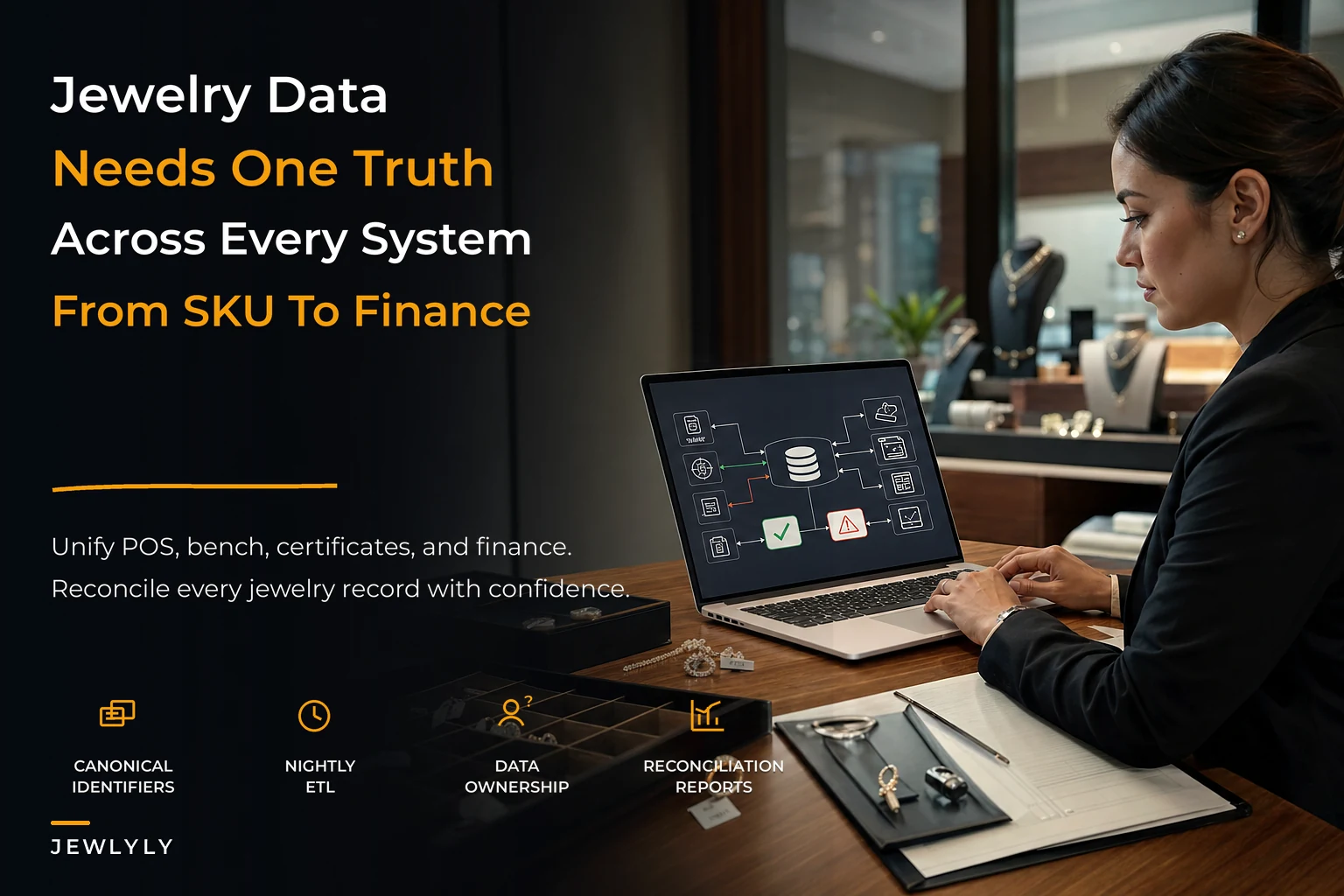
This is really an argument about jewelry data architecture — specifically, how to build a single source of truth (SSOT) that every other system reads from and writes back to, instead of having five systems each convinced they're right.
Here's how this breaks, and how to structure it so it doesn't.
The identifier problem nobody names until it hurts
Jewelry is harder than most retail because a single physical item can legitimately carry three or four different identifiers, and each department cares about a different one.
-
The SKU is what merchandising and the POS care about — it groups similar items for pricing and reorder.
-
The serial number is what the bench and security care about — it's the physical item.
-
The certificate number (GIA, IGI, etc.) is what insurance, appraisal, and high-value sales care about.
-
Your internal item ID is what your database should care about but often doesn't exist as its own thing.
The mistake that shows up constantly: stores treat the SKU as if it were the item identity. For mass-produced silver, fine — five identical stud pairs can share a SKU and nobody's hurt. But the moment you sell certified diamonds, consignment, estate, or anything one-of-a-kind, a SKU that maps to multiple physical pieces becomes a landmine. Two 1.2ct rounds sit under one SKU, one gets sold, and now your POS says one is available but nobody knows which physical stone left the building — or which certificate should have gone with it.
The fix is a boring but non-negotiable rule: every physical item gets its own immutable internal ID, generated once at intake, and never reused. SKU, serial, and certificate become attributes of that ID — not substitutes for it.
| Identifier | Owned by | Uniqueness | Changes over time? |
|---|---|---|---|
| Internal item ID | The system (SSOT) | One per physical item | Never |
| SKU | Merchandising | Many items can share | Rarely (repricing/regroup) |
| Serial number | Bench / security | One per item (if engraved) | Almost never |
| Certificate number | Appraisal / insurance | One per graded stone | New cert on re-grade |
Get the identifier layer wrong and nothing downstream reconciles — not finance, not inventory, not insurance. Everything else in this article assumes this foundation exists. If you're still designing your attribute structure, the jewelry product-data model for structured attributes and feeds covers the field-level side of this in detail.
Why the truth fractures across systems
In real operations, the fracture usually happens at the handoffs, not inside any single system. Each tool works fine on its own. It's the space between them where records drift.
Never miss a sale or shipment again.
Jewlyly helps you manage orders, track inventory, and engage customers seamlessly.
- Real-time inventory tracking
- Automated customer notifications
- Sales and order analytics
No credit card required
A typical example looks like this. A customer brings in a ring for resizing and a stone tightening. The front desk creates a repair ticket in the bench system. The bench system knows the item by its repair ID and maybe a description ("14k WG solitaire, ~1ct"). It does not know the internal item ID, because repairs usually get logged by hand. When the job's done, the labor gets rung up in the POS as a generic "repair - resize" line. Finance sees revenue. But nothing ties that revenue back to the physical item, the customer's warranty history, or the certificate on file.
-
month-end doesn't tie out,
-
an insurance claim needs a certificate that "should be" on file,
-
or a physical count turns up an item the system swears was sold.
The drift is cumulative. A store adding around 30 unique high-value pieces a month with sloppy handoffs can accumulate hundreds of unreconciled records in a year without a single dramatic failure — just a slow rise in "we'll figure it out later."
The ETL pattern that actually holds
ETL — extract, transform, load — sounds like enterprise jargon, but for a jewelry store it's really just the discipline of pulling data out of each system, normalizing it against your internal ID, and writing it into one place. The trick is deciding which system is the authority for which field.
| Data domain | Source of truth | Feeds into |
|---|---|---|
| Item existence + status | Inventory/SSOT | POS, web, finance |
| Price / cost | Merchandising/POS | Finance, web |
| Certificate + appraisal | Certificate library | POS tag, insurance, sales |
| Repair labor + parts | Bench system | Finance, warranty history |
| Payments + tax | POS/finance | Reconciliation reports |
| Consignment terms | Consignment ledger | Finance, payout schedule |
The ETL job, run nightly or in near-real-time, does three things:
-
Extract new and changed records from each system since the last run.
-
Transform them — resolve each record to an internal item ID, flag anything that can't be matched, normalize dates and amounts.
-
Load the resolved records into the SSOT and push corrected copies back out to systems that need them.
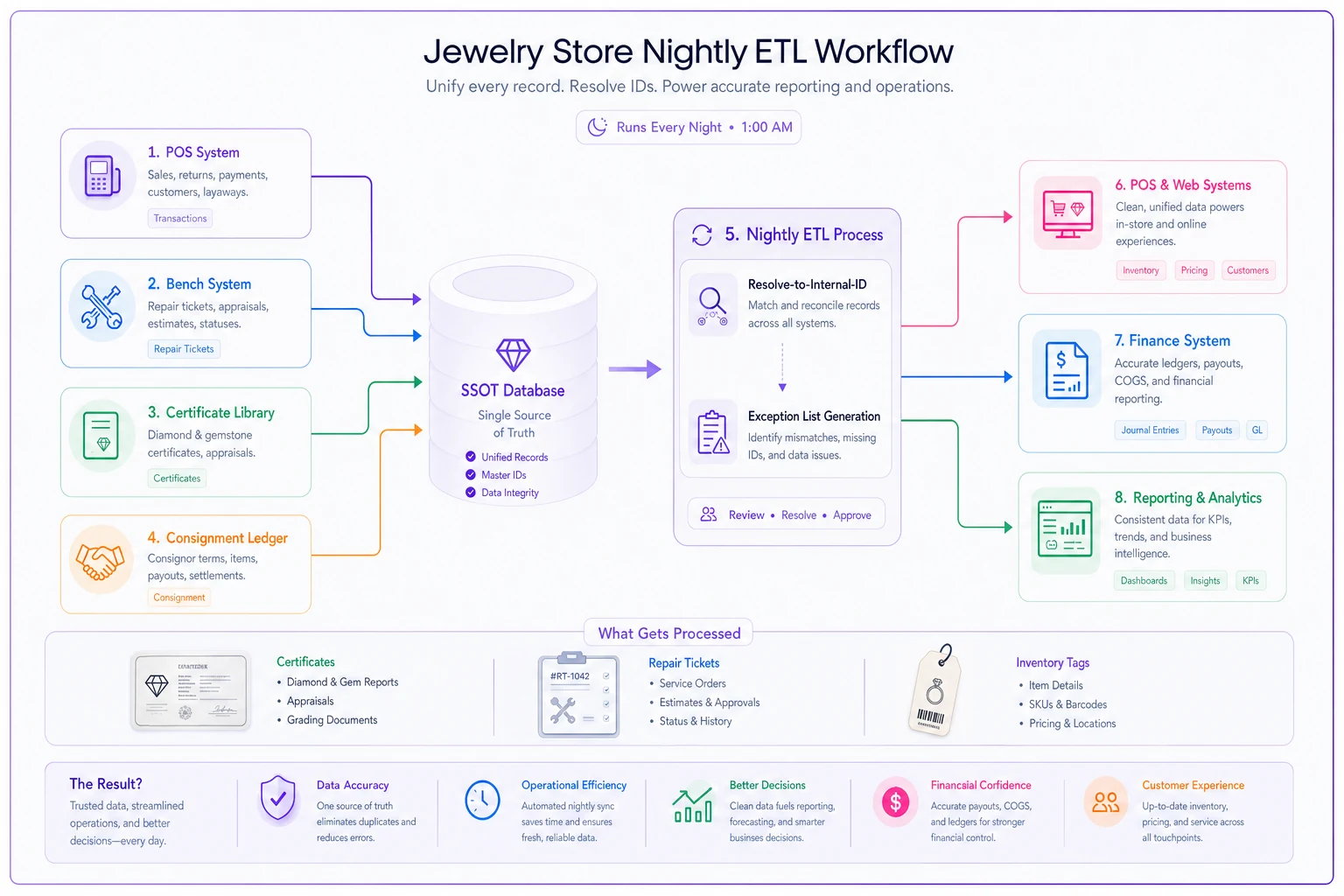
The single most important output of that job isn't the clean data — it's the exception list. Every record that couldn't be matched to an internal ID, every certificate number with no item attached, every repair with no linked piece. That list is your reconciliation work, surfaced before it becomes a month-end fire.
A worked example: joining a repair to finance
Say a repair ticket comes through with these facts:
-
Repair ID
R-4471, description "18k YG tennis bracelet, replace 2 stones" -
Labor rung in POS as
TXN-90233, $340 -
No internal item ID captured at drop-off
-
Match
R-4471to a customer via the phone number on the ticket. -
Look at that customer's owned items in the SSOT — find one 18k YG bracelet, internal ID
ITM-10882. -
Attach
R-4471andTXN-90233toITM-10882. -
Write the $340 labor to finance tagged to that item and that customer.
Now the item carries its own service history, the warranty clock is accurate, and finance can attribute the revenue. If step 2 finds zero matches or two matches, the record drops onto the exception list for a human to resolve — instead of silently posting as an untraceable generic repair.
That "two matches" case is exactly where manual systems quietly fail. A person under pressure picks one, moves on, and now the service history is on the wrong bracelet.
What breaks specifically at scale
Single location, one owner who touches everything — the architecture almost doesn't matter, because the owner's memory is the SSOT. The problems below only appear when you outgrow that.
Second location. The moment inventory moves between stores, "where is this item" becomes a real question. If both POS instances think they own the item, you get double-sells online. The SSOT has to hold a single authoritative location field that transfers ownership cleanly.
Consignment volume. Consigned pieces aren't yours, but they're in your case and on your web feed. If your finance system treats them like owned inventory, your margin and your payables both go wrong. The SSOT needs an ownership flag that finance actually respects.
Staff turnover. Institutional memory walks out the door. The store that ran on "Dana knows which certificate goes with which stone" is one resignation away from an unreconcilable certificate library.
Insurance and audits. At scale, "we can probably find that certificate" becomes "we're legally required to produce that certificate." A fractured architecture turns a claim into an archaeology project.
The pattern is consistent: the architecture failure stays invisible until a coordination event forces every system to agree, and they can't.
The ownership matrix: who owns what, in writing
Beyond system ownership of fields, you need human ownership of processes. This is the part stores skip, and it's why even good software doesn't fix the drift on its own.
-
Intake creates identity. Whoever takes in a piece — new stock, estate, consignment, repair — is responsible for generating the internal ID and linking the certificate. No item enters the building without an ID.
-
Bench owns service records. Every repair links to an existing internal ID or explicitly flags "customer-owned, not in system."
-
Finance owns reconciliation. They work the exception list, not the sales floor.
-
One person owns the SSOT itself. Not IT-in-the-abstract — a named person who decides when the model changes and who signs off on merges and corrections.
A quick checklist to pressure-test whether your ownership matrix actually exists:
-
[ ] Can you name the person responsible for the certificate library today?
-
[ ] Does every high-value item have an internal ID that isn't its SKU?
-
[ ] When a repair comes in, is it linked to a specific physical item?
-
[ ] Does finance have a standing exception list to work each week?
-
[ ] If your best staff member quit tomorrow, could someone else reconcile last month?
Make intake a two-step process (ID creation, then certificate/linking) so missing IDs are caught immediately at drop-off.
If more than one of those is a "no," the drift is already happening — you just haven't hit the event that reveals it yet.
Reconciliation reports that catch drift early
Reconciliation shouldn't be a month-end panic. It should be a boring weekly report that's usually short. The reports worth building:
-
Orphan certificates — certificate records with no linked item. These are the ones that bite hardest during a claim.
-
Untraceable revenue — POS transactions (especially repairs and custom work) that couldn't be tied to an internal item or customer.
-
Ownership conflicts — items flagged both "owned" and "consigned," or showing as available in two locations.
-
Status mismatches — item marked sold in POS but present in a physical count, or vice versa.
The point of surfacing these weekly is that a handful of exceptions is a 20-minute fix, while three months of accumulated exceptions is a two-day forensic slog. For the month-end side of this — turning those flags into books that actually tie out — the jewelry month-end reconciliation playbook goes deeper on the closing process itself.
Once the SSOT is trustworthy, your reporting stops being defensive and starts being useful. Metrics that combine POS, repair, and consignment only mean something when they read from one clean source — if you're building that layer, the tiered KPI dashboard approach for jewelers shows what to surface once the underlying data actually reconciles.
A real scenario
A two-location store carrying roughly 3,000 active SKUs, with a large share of one-of-a-kind certified and estate pieces. They ran a mainstream POS, a separate bench-tracking tool, and a shared drive full of certificate PDFs named things like GIAscanfinal_v2.pdf.
The symptom that got their attention: an insurance claim on a stolen 2ct ring where they couldn't produce the matching certificate for nearly two weeks. It existed — it was just on someone's old laptop. Around the same time, month-end was consuming roughly three full days because repair revenue never cleanly matched items, and consigned pieces kept appearing in owned-inventory margin calculations.
They didn't rip anything out. They introduced an internal-ID layer at intake, mapped each existing system as the authority for its own fields, and ran a nightly job that resolved records to those IDs and generated an exception list. Certificates got renamed by internal ID and linked at intake going forward.
The first exception list was long — a few hundred unmatched records built up over more than a year. Working through it took about a month. After that, the weekly exception list usually ran under 15 items. Month-end dropped from three days to under one, and certificate retrieval went from "hope it's on file somewhere" to a simple lookup by item ID. Revenue didn't jump. The chaos dropped — which is what actually protected margin.
When this is worth it — and when it isn't
When it makes sense: you're carrying meaningful volumes of unique, certified, consigned, or estate inventory; you have more than one location or plan to; or reconciliation and insurance retrieval already eat real hours every month.
When it's overkill: a single small shop selling mostly repeatable, low-ticket stock, run by one or two people who genuinely hold the whole picture in their heads. Building formal architecture there is solving a problem you don't have yet. Revisit it the day you add a second location, start consignment, or hire someone who doesn't have the owner's institutional memory.
Who should not attempt this cold: anyone treating it as a one-time data cleanup. Architecture that isn't maintained decays back into drift within a quarter. The nightly resolution job and the weekly exception list are the whole point — without them, you've built a very clean snapshot of a moving target.
The takeaway
The stores that reconcile easily aren't the ones with the fanciest software. They're the ones where every physical item has one identity, every system knows which fields it's allowed to own, and someone works the exception list before it turns into a month-end emergency. Good jewelry data architecture isn't about collecting more data — it's about making sure all your systems are finally telling the same story about the same ring.
Ready to elevate your jewelry store operations?
Join 500+ jewelers using Jewlyly to increase efficiency, reduce errors, and grow revenue.