

Most jewelry businesses don't have a risk problem. They have a prioritization problem. Ask any owner where the next loss is coming from and you'll get a shrug — "probably a shipment, or maybe theft." Then they'll go spend $14k on a new safe while their 3PL is sitting uninsured on $200k of consignment goods during a carrier strike.
That gap — between where you feel the risk is and where it actually lives — is the whole reason enterprise risk management exists. For a jewelry store, where a single bad event can wipe out a quarter's profit, running it loosely in your head stops working past a certain revenue line.
This piece is about building a jewelry enterprise risk management system that maps real threats to real controls, ties those controls to your insurance tiers, and gives you a repeatable way to decide where to spend. Not a risk register nobody reads. A working mechanism.
Why risk gets managed badly in jewelry specifically
A general retailer worries about shoplifting and slip-and-fall claims. A jeweler carries five or six risk categories that each behave completely differently, and that's what trips people up.
You've got physical theft, which is loud and obvious. Shipping and 3PL exposure, which is quiet until it isn't. Vendor fraud and provenance issues that can sit undetected for months. Certificate and appraisal mismatches that only surface at claim time. And the internal stuff — reconciliation gaps, staff shrinkage — that bleeds slowly.
The mistake isn't ignoring any one of these. It's treating them as separate fires instead of one connected system. In real operations, a vendor fraud problem shows up as a certificate problem, which becomes an insurance problem the day a customer's claim gets denied because the appraisal didn't match the stone. One risk category feeds the next. If your framework handles them in silos, you'll keep plugging the symptom and missing the source.
The two things most risk registers get wrong
Before getting into the framework, two patterns worth naming because they quietly ruin otherwise good intentions.
Never miss a sale or shipment again.
Jewlyly helps you manage orders, track inventory, and engage customers seamlessly.
- Real-time inventory tracking
- Automated customer notifications
- Sales and order analytics
No credit card required
First: scoring everything the same way. A lot of owners build a spreadsheet, rate everything "high / medium / low," and call it risk management. The problem is that a "high" likelihood event costing $800 and a "low" likelihood event costing $180k both end up tagged red, and now your list is useless for deciding anything. You need residual risk — what's left after your existing controls — not raw risk. Those are very different numbers.
Second: confusing having insurance with having a control. Insurance is a transfer mechanism, not a prevention one. If your policy pays out but your premium jumps 40% and your deductible eats the first $25k, you didn't manage the risk — you financed it, expensively. The goal is to reduce the frequency and severity of events first, then insure the residual. Owners who flip that order end up over-insured on cheap risks and under-insured on the one event that actually matters.
Step one: build the taxonomy, then map it to controls
The backbone of any usable framework is a risk taxonomy — a structured list of what can go wrong — mapped against a control library — the specific things you're already doing (or should be) to prevent or catch it.
Here's the part people skip: you don't invent controls from scratch. You already run most of them. Your shipping playbook for high-value orders is a control library. Your low-cost store security controls are a control library. Your tax and regulatory compliance process is one too. The framework's job is to connect them so you can see coverage and gaps in one view.
A workable taxonomy for most independent jewelers breaks into six domains:
| Risk domain | Example exposure | Primary controls | Typical severity |
|---|---|---|---|
| Physical / in-store | Smash-and-grab, after-hours burglary | Safe ratings, alarm zones, display limits, staff protocols | High |
| Shipping & transit | Lost/stolen parcel, undervalued declaration | Carrier selection, declared-value rules, signature + photo proof | High |
| 3PL / fulfillment | Uninsured storage, miscount at warehouse | Vendor insurance verification, cycle counts, SLA audits | Medium–High |
| Vendor / sourcing fraud | Fake certs, treated stones sold as natural | Supplier scorecards, independent verification, provenance fields | Medium |
| Certificate / appraisal | Mismatch between doc and item at claim time | Cert naming standards, POS tagging, digital storage | Medium |
| Internal / financial | Shrinkage, reconciliation gaps | Dual sign-off, anomaly review, month-end close | Medium |
The value isn't the table itself. It's forcing yourself to write the control next to the risk. The moment a cell is empty, you've found an uncontrolled exposure — and that's where your money should look first, before any shiny new equipment.
Step two: score residual risk, not raw risk
For each risk, estimate three things:
-
Likelihood over a 12-month window (roughly
rare / occasional / likely)
-
Severity in real dollars if it happens (replacement cost + deductible + premium impact + downtime)
-
Control strength — how well your current controls reduce that number (weak / partial / strong)
Residual risk is severity × likelihood, discounted by control strength. A high-severity event with strong existing controls might rank lower than a medium-severity event you've done nothing about.
A typical example: a store rates burglary as their top worry — severity maybe $90k, but they've got a TL-rated safe, monitored alarm, and nothing valuable left in cases overnight. Strong controls. Meanwhile their inbound shipments from two vendors arrive with declared values set at cost, not retail, and no one's checked the 3PL's insurance certificate in two years. Lower severity per event, but almost zero control. On residual scoring, the shipping and 3PL gap outranks the burglary every time — and it's a fraction of the cost to fix.
That inversion is the whole point. Owners consistently over-invest where they feel scared and under-invest where they're actually exposed.
Step three: map residual risk to insurer tiers
Most jewelry policies — jewelers block coverage especially — price you on the controls you can prove, not the ones you claim. The link between your control library and your premium is direct, and most owners never make it explicit.
-
Tier 1 — Transfer fully. Catastrophic, low-frequency events you can't prevent away (fire, major burglary despite controls). These belong on the policy with adequate limits. Your job is documenting controls well enough to get favorable terms.
-
Tier 2 — Reduce then transfer. Shipping losses, 3PL exposure. Fix the control first (declared-value rules, verified 3PL insurance), then carry a smaller rider. Reducing frequency here drops your loss history, which quietly lowers renewals.
-
Tier 3 — Retain and manage. High-frequency, low-severity stuff like minor repair damage or small reconciliation variances. Insuring these is a waste — the deductible and premium cost exceeds the losses. Self-fund and control operationally.
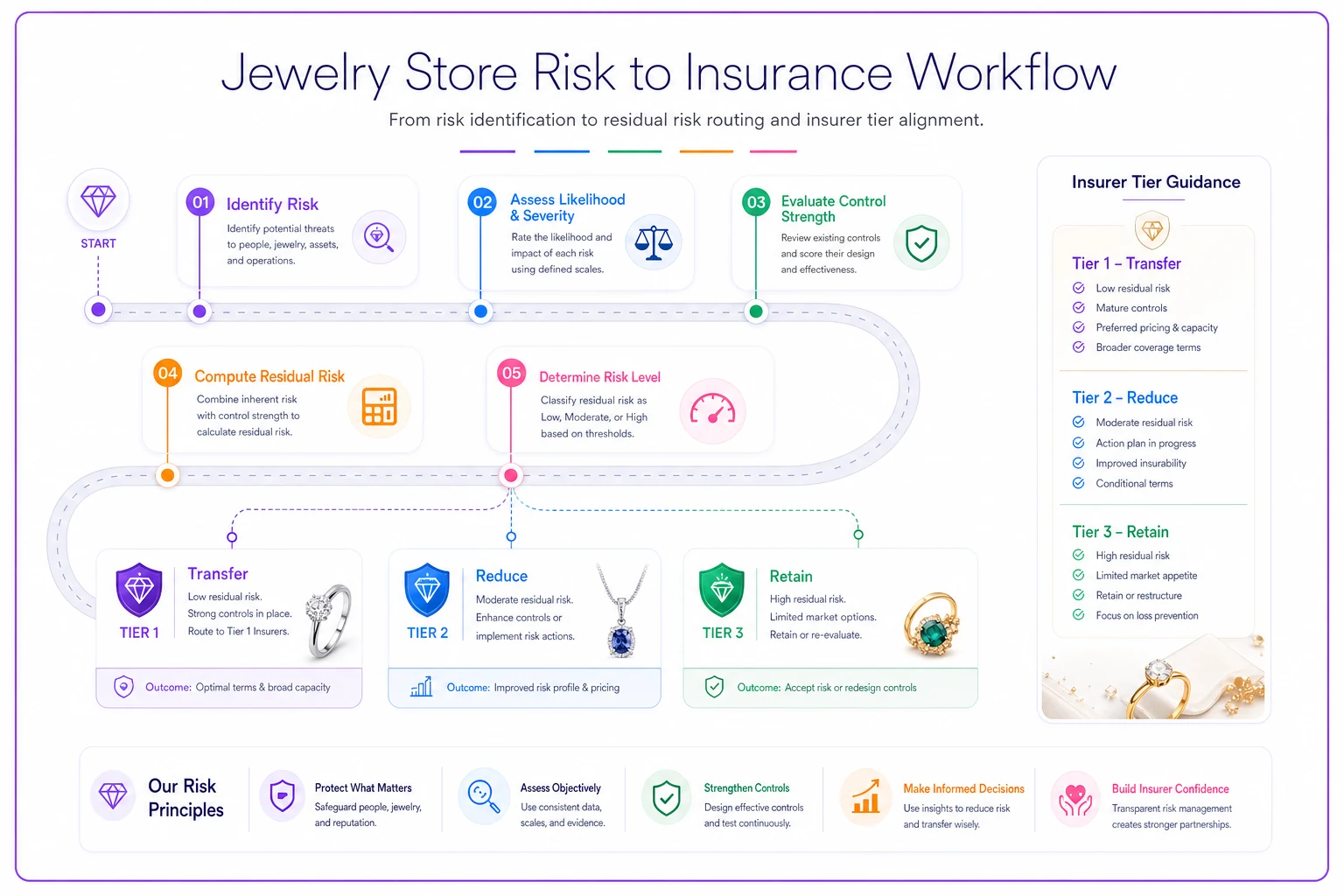
This diagram shows the flow from residual-risk scoring to insurer tiers and the decision points for transfer, reduce, or retain.
When stores actually sort risks this way, they usually find they're paying for Tier 3 coverage they'll never sensibly claim on, while carrying Tier 1 limits set years ago that no longer reflect current inventory values. Rebalancing those two alone often holds premiums flat while improving real coverage.
Setting an audit cadence that doesn't rot
A control is only real if someone checks it still works. Controls get set up during a scare, then quietly decay. The 3PL insurance cert expires. New staff never learn the declared-value rule. The anomaly review stops happening because things got busy.
-
Weekly financial anomaly review, open shipping claims, any flagged transactions
-
Monthly reconciliation close-out, certificate/appraisal tagging spot-check, repair-damage log
-
Quarterly 3PL and vendor insurance certificate verification, control-library review (any empty cells?), top-5 residual risk re-score
-
Annually full inventory valuation vs. policy limits, premium-to-loss-history review with your broker, full taxonomy refresh
The quarterly re-score is the one people skip and the one that matters most as you scale. Your risk profile at $1.2M revenue with one location is a different animal than $4M across three. New locations add transit risk between them. More vendors add fraud surface. More online volume shifts exposure toward shipping and chargebacks. If your taxonomy was built once and never revisited, it's describing a business you no longer run.
Prioritize quarterly 3PL certificate checks — they're a common point of unnoticed decay.
A cadence that holds up across a growing store:
Executive reporting: what actually belongs on the dashboard
Whether you report to a board, a partner, or just yourself at year-end, the reporting layer is where risk work becomes decisions. Most risk reports fail by being either a wall of green checkmarks nobody reads, or a panic list with no dollar context.
A useful executive risk view fits on one page and answers three questions:
-
Where is our residual risk concentrated right now? Top five, with dollar exposure and control status.
-
What changed since last quarter? New risks, controls that improved or decayed, any near-misses.
-
What's the recommended spend, and what residual reduction does it buy? This is the money question — "spend $6k verifying and bonding our 3PL to reduce roughly $180k of uninsured exposure" is a decision anyone can approve.
That third line is the whole reason to build this. You're not reporting risk to feel organized. You're converting a fuzzy fear into a priced, rankable decision — this control, this cost, this much residual reduction.
A real scenario
A two-location store doing a little over $3M combined had what looked like a solid risk posture — good safes, monitored alarms, a jewelers block policy they'd carried for years. On paper, fine.
Running the taxonomy surfaced three uncontrolled gaps nobody had scored. Their main fulfillment 3PL hadn't had its insurance certificate verified since onboarding — turned out the coverage had lapsed and renewed at a lower limit than their typical holding value. Inbound vendor shipments were declared at cost. And their appraisal documents were stored loosely, with no POS tagging, meaning roughly a third of insured pieces couldn't be quickly matched to their paperwork at claim time.
None of these were dramatic. No alarm, no obvious loss. But the combined uninsured or under-documented exposure sat somewhere around $150k–$190k at peak inventory. The fixes cost very little — verifying and contractually requiring 3PL insurance, a declared-value rule on inbound, and a weekend of certificate tagging. The following renewal came in essentially flat despite higher inventory values, because the broker could now see documented controls where before there was nothing. The real win wasn't the premium — it was that the one scenario capable of denting the whole year had been quietly defused.
When this framework makes sense — and when it's overkill
When it's worth building: Multi-location, meaningful online volume, consignment or memo inventory, or anytime your peak holding value crosses into six figures. Once you're coordinating risk across people, locations, and vendors, keeping it in your head stops working.
When it's overkill: A single small location with modest inventory and no shipping to speak of doesn't need a six-domain taxonomy and quarterly board reports. A simple control checklist and an annual policy review is proportionate. Building enterprise machinery for a corner-shop risk profile just creates work nobody maintains.
Who should not do this: Anyone treating it as a one-time compliance exercise. A risk register built once, filed, and forgotten is worse than nothing — it creates false confidence. If you won't commit to the quarterly re-score, don't bother with the full framework; just run the checklist and revisit insurance yearly.
Pulling it together
The jewelers who handle risk well aren't the ones who spend the most on security or carry the fattest policies. They're the ones who can look at a single page and say, with reasonable confidence, here's our biggest remaining exposure, here's what it costs to close, and here's what we'll self-fund instead.
Everything upstream — your shipping rules, your store controls, your compliance process, your reconciliation — produces the data this framework organizes. Enterprise risk management isn't a new pile of work bolted on top. It's the layer that makes the work you're already doing legible, so your next risk dollar goes where it reduces the most real exposure, not where last month's scare happened to point you.
Start with the taxonomy. Fill in the controls you already run. The empty cells will tell you where to go first.
Ready to elevate your jewelry store operations?
Join 500+ jewelers using Jewlyly to increase efficiency, reduce errors, and grow revenue.