


Most jewelers don't realize it until it's too late: the moment you connect two systems together, you've created a new place for a $4,800 ring to go missing — not physically, but in the data. The ring is sitting right there in the case. But your POS has it as SKU-88214, your certificate vault logged it under a GIA number that doesn't match, and the website still shows it available because the sync job failed at 2am and nobody noticed.
Integration failures in jewelry don't look like dramatic crashes. They look like a customer standing at the counter while you frantically search three screens trying to figure out which cert belongs to which stone. That's the real cost of weak jewelry api governance — and it almost always surfaces during a system cutover, when you're migrating from one platform to another or wiring a new tool into your existing stack.
This piece is about the plumbing. Not the exciting part, I know. But if you've ever lost a certificate match during a migration, or sold the same engagement ring twice because two systems disagreed about inventory, you already understand why this matters more than another dashboard.
Why jewelry integrations break differently than other retail
Most retail integration advice assumes fungible inventory. A shoe store has forty pairs of the same size-9 sneaker. If the sync is off by one, nobody cares much — it self-corrects on the next count.
-
The SKU (your internal product identity)
-
The serial number (the physical unit)
-
The certificate number (GIA, IGI, AGS, or an in-house appraisal)
-
The metal/stone attributes that drive pricing
-
The provenance or intake record for estate and consignment goods
When these travel between systems, they can get separated. A SKU survives the handoff but the cert number gets truncated. A serial number comes through fine but maps to the wrong product record. And because each item is unique, there's no herd to hide the error in. One mismatch is a real problem — potentially an insurance problem, a legal problem, or a very unhappy bride.
What shows up across a lot of jewelry operations is that these failures cluster at the boundaries between systems. The data is usually clean inside the POS and clean inside the certificate database. It breaks in transit. Which means your governance work isn't about any single platform — it's about the contracts those platforms agree to when they talk to each other.
Contract-first beats feature-first every time
The biggest mistake in jewelry system integrations is starting with features instead of data contracts. A vendor demos a slick interface, everyone gets excited, and six weeks into implementation you discover their API can't pass a certificate number longer than 15 characters, or it silently drops the serial field when a product has multiple stones.
Never miss a sale or shipment again.
Jewlyly helps you manage orders, track inventory, and engage customers seamlessly.
- Real-time inventory tracking
- Automated customer notifications
- Sales and order analytics
No credit card required
A data contract is just an agreement — written down, before anyone builds anything — about exactly what fields move between systems, what format they take, what's required, and what happens when something's missing. It sounds bureaucratic. In practice it's the single thing that prevents most cutover disasters.
Here's a stripped-down example of what a contract for a single sellable item might specify:
| Field | Type | Required | Rule |
|---|---|---|---|
sku | string | yes | Must match master catalog; rejected if unknown |
serial_number | string | yes for unique items | Unique across system; no duplicates allowed |
cert_authority | enum | yes if certified | One of: GIA, IGI, AGS, INHOUSE |
cert_number | string | yes if certified | Max 20 chars; preserved exactly, no trimming |
metal_type | enum | yes | Drives pricing recalculation downstream |
stone_carat | decimal | conditional | Required if cert_authority is set |
status | enum | yes | available / hold / sold / in_repair |
Pro-tip: include explicit maximum lengths and permitted enums in the contract to catch silent truncation and format mismatches early.
The point isn't this specific table — yours will have more fields. The point is that both sides agree on it in writing before a single record moves. When a vendor says "yes, we support certificate tracking," this is what forces them to prove it at the field level. The contract is the thing you test against. Everything downstream — your single source of truth — depends on this agreement holding firm at every handoff.
The failure modes you're actually testing for
Before you can build a test suite, you have to name the ways things go wrong. In jewelry integrations, the recurring culprits are surprisingly predictable:
-
Certificate drift — the cert number arrives attached to the wrong serial, usually because a migration script matched on the wrong key
-
Silent truncation — a long GIA number gets cut off and now matches nothing
-
Status race conditions — two systems update availability at the same time and one overwrites the other, re-listing a sold piece
-
Orphaned serials — a serial number comes through with no SKU to attach to, so it floats
-
Duplicate creation — the same physical item gets two records because the match logic didn't recognize it on re-sync
-
Format mismatches — one system stores carat as
1.01, another as1.010, and they stop matching on exact comparison
Every one of these has shown up in real cutovers. The reason they slip through is that happy-path testing — "does a normal ring sync correctly?" — never touches them. You have to test the ugly cases on purpose.
A test-case matrix built for jewelry
A test matrix is just a structured list of scenarios you run against every integration before you trust it. The trick is covering the combinations, not just the individual fields. Here's the backbone of one worth copying:
-
Clean certified item — SKU, serial, and cert all present and valid. Should pass end to end.
-
Certified item, maximum-length cert number — proves nothing truncates.
-
Multi-stone item — multiple certs on one SKU. Confirms the relationship survives.
-
Uncertified item — no cert fields. Should pass without forcing empty cert data.
-
Duplicate serial attempt — same serial submitted twice. Should be rejected, not silently accepted.
-
Mismatched cert/serial pair — deliberately wrong pairing. The system should flag it, not store it.
-
Status collision — mark an item sold in one system while updating it in another. Verify which wins and that it's logged.
-
Missing required field — drop the SKU. Should reject cleanly with a readable error.
-
Re-sync of existing item — send the same item twice. Should update, not duplicate.
-
Price-driving field change — change metal type. Confirm downstream pricing recalculates.
Run every scenario in a sandbox before anything touches live inventory. The pass/fail criteria need to be written down in advance — "flagged and logged" is a pass, "stored silently" is a fail, even if the record looks fine on screen. A huge share of certificate mismatches trace back to a test that "passed" because nobody checked whether the wrong data had quietly been accepted.
Gating the rollout: sandbox, pilot, dual-run
The gate workflow looks like this:
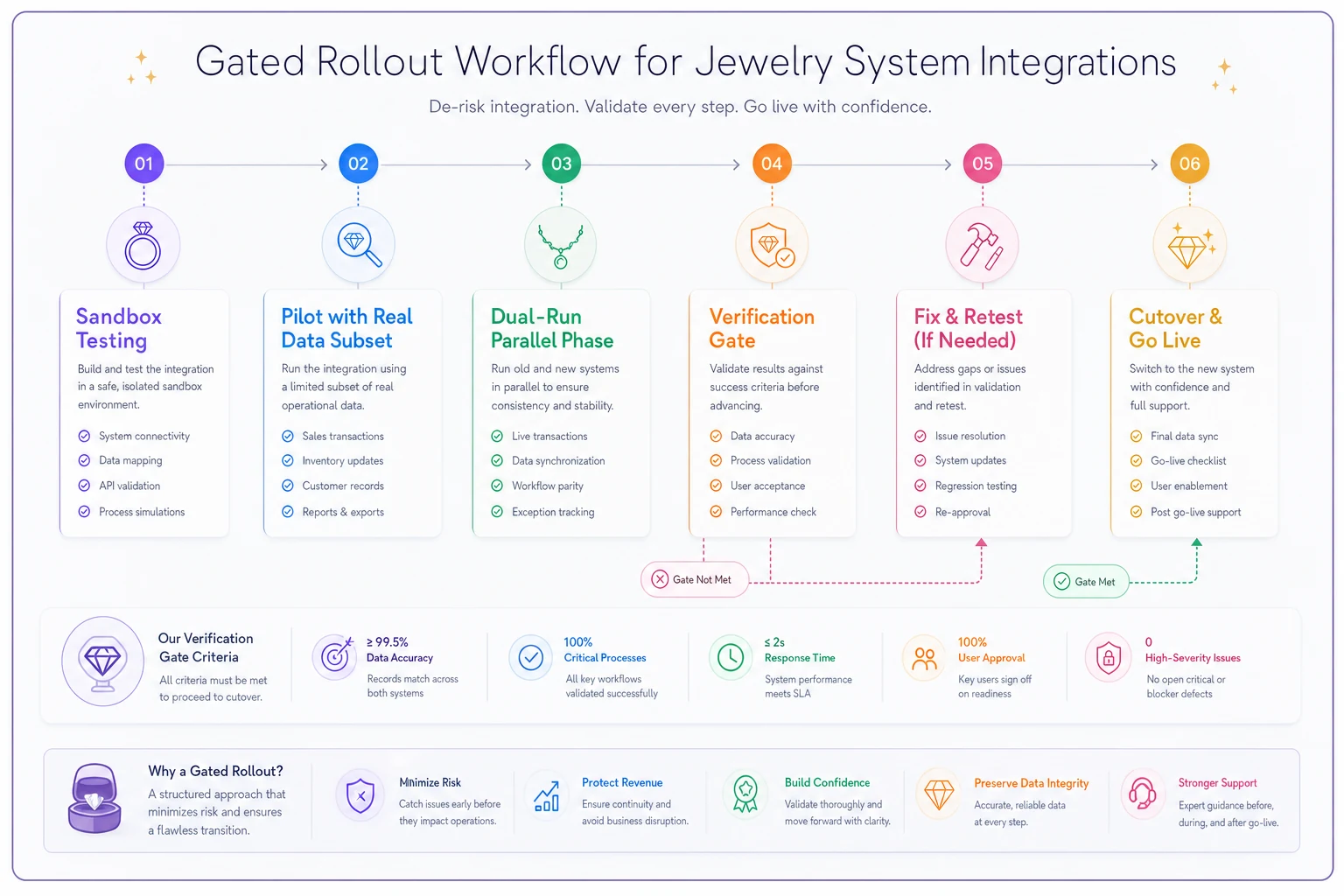
You don't flip a switch. You walk the integration through gates, and each gate has a condition that must be met before you move on. This is where a lot of the discipline from a broader technology adoption process pays off directly.
Sandbox is isolated test data. Nothing real. You run the full test matrix here and fix everything before moving on. No exceptions — "we'll catch that one in pilot" is how cutovers go sideways.
Pilot is a small slice of real data. Maybe one category, maybe one location's new intake. You're watching whether the contract holds against the messiness of actual inventory — the estate piece with a handwritten appraisal, the vintage watch with a nonstandard serial format. Real data always surprises you.
Dual-run is the gate most jewelers skip and later wish they hadn't. For a defined window — often two to four weeks — both the old system and the new one run in parallel, processing the same transactions. You compare outputs daily. If the new system's serial-to-cert mappings match the old system's for every item, you've earned confidence. If they diverge on even a handful, you've found a bug before it cost you anything.
The acceptance criterion for leaving dual-run should be concrete: zero unexplained mismatches across the full inventory for a set number of consecutive days. Not "looks good." Zero, counted and documented.
A real scenario
A mid-sized independent jeweler — two locations, roughly 2,100 active unique SKUs, heavy on bridal and estate — was moving off a legacy POS to a new platform with a connected certificate vault. On paper the migration was straightforward.
During dual-run, the comparison turned up around 40 items where the certificate number in the new system didn't match the old one. Digging in, the cause was dull and dangerous: the migration script had matched cert records to products using a shortened SKU prefix, and about two percent of their catalog shared prefixes. Those pieces had certs belonging to other stones.
If that had gone live, they'd have been handing customers certificates for the wrong diamonds. Instead it got caught in the parallel-run window, fixed with a corrected matching key, and re-verified before cutover. The dual-run phase added maybe three weeks to the timeline. Compared to the alternative — reissuing certs, explaining mismatches to insurers, and the reputation damage — nobody complained about the delay.
Rollback playbooks: decide before you need them
Every cutover needs a written rollback plan, decided calmly in advance rather than at 11pm during a crisis. A usable playbook answers a few specific questions:
-
What's the trigger? Define the condition that forces a rollback — e.g., more than X mismatches detected, or any sold-item re-listing. Make it a number, not a feeling.
-
Who calls it? One named person has authority to pull the trigger. Decision-by-committee during an outage doesn't work.
-
What's the restore point? You need a clean snapshot from immediately before cutover, with verified serial/cert integrity.
-
How do you reconcile transactions that happened during the window? Sales don't stop. You need a plan for replaying or manually re-entering anything that occurred after the snapshot.
-
How do you confirm you're actually back? Run a subset of your test matrix against the restored system before declaring the rollback complete.
The teams that recover fastest are the ones who rehearsed the rollback in sandbox at least once. A rollback plan you've never executed is a hope, not a plan.
Vendor acceptance criteria you should hold firm on
When you're evaluating or onboarding a vendor, your governance work gives you leverage most jewelers never use. Instead of trusting a demo, you hand them your test matrix and your data contract and say: prove it passes. This connects naturally to the discipline of a proper RFP process for high-value inventory systems, where you're defining requirements before you fall in love with a feature.
-
The vendor demonstrates every test-matrix scenario passing in their environment
-
Certificate and serial fields preserve exactly — no truncation, no reformatting
-
Duplicate and mismatch attempts are rejected and logged, not silently absorbed
-
The API returns readable errors, not generic failures, when a contract rule is violated
-
There's a documented way to run a dual-run comparison
-
Sync failures generate alerts rather than failing quietly
If a vendor can't or won't pass your matrix, that's not a reason to lower your standards. It's the information you were paying to get.
When this level of rigor makes sense — and when it doesn't
Full contract-first governance with dual-run gating is real work. It's worth it when you're carrying unique, certified, high-value inventory across multiple connected systems — which describes most serious jewelers. The cost of a single certificate mismatch dwarfs the cost of the testing discipline.
Who should not skip it: anyone doing a platform migration, anyone connecting their website inventory to their in-store POS, and anyone whose insurance coverage depends on certificates matching the correct stones. For those operations, the dual-run gate isn't optional caution — it's the difference between a quiet cutover and a month of cleanup.
Pulling it together
Good integration governance in jewelry isn't about technology for its own sake. It's about keeping a promise: that the certificate you hand a customer belongs to the exact stone in their ring, every time, even when that data has passed through four systems to get there.
The jewelers who cut over cleanly aren't the ones with the fanciest software. They're the ones who wrote down their data contracts first, tested the ugly scenarios on purpose, ran old and new systems side by side until the numbers agreed, and knew exactly how to roll back if they didn't. That discipline is unglamorous and it's the whole game.
Get the plumbing right, and the serials and certificates stay where they belong — which is the only thing your customers were ever trusting you to do.
Ready to elevate your jewelry store operations?
Join 500+ jewelers using Jewlyly to increase efficiency, reduce errors, and grow revenue.