

Most bad software decisions in jewelry retail don't announce themselves. The POS demo looks clean, the sales rep is sharp, the price feels reasonable, and everyone signs. The trouble shows up eight months later when a customer disputes a repair, an insurance adjuster asks for the chain of custody on a $14k piece, or a manager quietly changes a cost field and nobody can prove who did it or when.
By then you're locked into a contract, your data lives inside their schema, and switching feels impossible. The mistake wasn't the software. It was the evaluation — nobody asked the right questions before the ink dried.
This is a working jewelry retail technology checklist built around the things that actually break: audit trails, immutable records, who-can-touch-what, certificate linkage, and how the system behaves during transfers, edge cases, and integrations. If you're buying or replacing a POS, inventory system, or repair platform, this is the RFP you send before you commit.
Why generic RFPs fail jewelers
Most RFP templates online were written for restaurants, apparel retail, or general SMBs. They ask about uptime, pricing tiers, and whether there's a mobile app. Fine questions — irrelevant to your actual risk.
A jewelry store carries concentrated value in tiny objects that move between hands, benches, cases, and locations constantly. A single ring might touch a sales associate, a bench jeweler, a shipping desk, and a second store within a week. Every one of those handoffs is a moment where value can walk, get swapped, or get recorded wrong.
The systems you buy either capture that movement with evidence, or they don't. Generic evaluations never test for it, which is how stores end up with software that tracks sales beautifully but can't answer the one question that matters in a dispute: who had this item, when, and what did they do to it?
Stores that got burned once start asking the right questions on the next purchase. This checklist tries to skip you ahead so the first one doesn't have to hurt.
The five things your RFP must interrogate
Before the rubric and test cases, here's the frame. Everything below sorts into five buckets, and each maps to a specific way jewelry stores lose money or evidence.
Never miss a sale or shipment again.
Jewlyly helps you manage orders, track inventory, and engage customers seamlessly.
- Real-time inventory tracking
- Automated customer notifications
- Sales and order analytics
No credit card required
-
Audit trails — Can the system tell you the full history of every record change, not just the current state?
-
Immutability — Once something is recorded (a cost, a certificate link, a transfer), can it be silently altered or deleted?
-
Role-based access — Can you control who sees and edits sensitive fields like cost, margin, and vendor terms?
-
Certificate and appraisal linkage — Are GIA/IGI certs, appraisals, and photos permanently bound to the item record, or just loosely attached?
-
Transfer, test, and integration behavior — Does the system stay consistent when items move, when you run edge cases, and when it connects to other tools?
If a vendor can't demonstrate all five in a live environment — not a slide deck — treat that as a real signal.
Audit trails: the difference between "we think" and "we can prove"
The question isn't whether the system has logs. Almost every vendor claims logs. The question is whether the log is usable as evidence.
A weak audit trail records that "inventory was updated." A strong one records: old value, new value, user ID, timestamp, device, and a reason if one was required. When a $9,800 tennis bracelet's cost field changes from $4,200 to $4,900 the day before a commission run, you want to see exactly that on one screen without calling support.
Ask vendors to show you the audit view for a single item that has been sold, returned, repaired, and re-tagged. If they have to export a raw database log and squint at it, that's your answer. In practice, an audit trail only helps you if a store manager — not an engineer — can actually read it.
Immutability: what happens when someone tries to cover a mistake
Most fraud and most disputes aren't dramatic. They're a quiet edit. A cost gets nudged. A void gets applied and the record gets cleaned up afterward. A certificate gets swapped for a different stone.
Immutability means certain records can be corrected but never erased. A proper system handles this with append-only history: if a cost was wrong, you post a correction that shows both the original and the fix, with attribution. The original never disappears.
A common failure mode: a POS that lets an admin "edit" a completed sale and leaves no trace of the prior version. That's not a feature, it's a liability. Your RFP should require the vendor to state, in writing, exactly which record types are immutable and which are editable — and to demonstrate an attempted deletion of a locked record.
Role-based access: cost visibility is the quiet killer
Stores underestimate this one. When every associate can see cost and margin on every item, two things tend to happen. Cost data leaks — to competitors, to departing employees — and price integrity erodes because staff start freelancing discounts based on what they think the "real" number is.
Role-based access needs to be granular enough to hide cost from floor staff, restrict vendor terms to owners and buyers, and give bench staff repair access without exposing financials. Watch for systems where "roles" are really just two settings: admin and non-admin. That's not access control, that's a light switch.
Ask for the full permissions matrix. If it fits on a napkin, it's too coarse for a business where the person polishing the ring shouldn't see what you paid for it.
The RFP scoring rubric
Score each vendor from 0–5 on every dimension. Weight the categories based on your risk profile, but the defaults below reflect what actually causes losses. Anything scoring under 3 on a critical row should give you serious pause.
| Category | What you're scoring | Weight | Pass threshold |
|---|---|---|---|
| Audit trail depth | Full before/after values, user, timestamp, readable by non-technical staff | High | 4 |
| Immutability guarantees | Append-only corrections, no silent deletes, documented locked record types | High | 4 |
| Role-based access | Field-level permissions, cost/margin hiding, custom roles | High | 4 |
| Certificate linkage | Certs/appraisals bound to item, survive transfers and sales | High | 4 |
| Transfer integrity | Consistent state across locations, transit holds, reconciliation | High | 4 |
| Integration reliability | Stable APIs, error handling, no double-writes | Medium | 3 |
| Data portability | You can export everything including history, in usable format | Medium | 4 |
| Test/sandbox access | You can run edge cases before go-live | Medium | 3 |
| Support responsiveness | Real SLA, escalation path, jewelry-aware support | Low | 3 |
The data portability row deserves extra attention. Stores obsess over features and forget the exit. If you can't export your full transaction history including the audit trail in a readable format, you don't own your data — you're renting access to it. Ask this early, because the answer tells you a lot about how the vendor thinks about your leverage.
Certificate and appraisal linkage: don't let the paperwork float
A cert that lives in a shared Google Drive folder, loosely named, is not linked to anything. It's a file that happens to exist near your inventory. When the item sells, transfers, or comes back for insurance work, the connection depends entirely on a human remembering which file goes with which piece.
Proper linkage means the GIA report number, the appraisal, and the photos are attributes of the item record itself — they travel with it through every state change. When the diamond moves from your main store to a second location, the cert moves with it automatically. When it sells, the buyer's record inherits the documentation.
This ties directly into how you structure your item data in the first place. If your underlying schema is thin, no amount of software polish fixes it — which is exactly why a solid jewelry product-data model for structured attributes and feeds matters before you even start shopping for a platform. The RFP should ask: when this item transfers to another location and then sells, does the certificate reference stay bound to it end to end? Make them show it live.
The test-case matrix: run these before you sign
Vendors demo the happy path. Your job is to break things, because that's where real operations live. Ask for sandbox access and run these scenarios yourself. Don't let them drive.
Each test has a clear pass condition. If the system can't handle it cleanly, score accordingly.
| # | Scenario | What you're testing | Pass condition |
|---|---|---|---|
| 1 | Edit a completed sale's cost field | Immutability | Original value preserved and visible in history |
| 2 | Delete a repair ticket | Immutability | Blocked, or soft-delete with full record retained |
| 3 | Transfer item between two locations | Transfer integrity | Item shows in-transit; cert and photos travel with it |
| 4 | Sell an item mid-transfer | Race condition handling | System prevents it or flags conflict clearly |
| 5 | Log in as floor staff, view an item | Role-based access | Cost and margin fields hidden |
| 6 | Return a sold item, then re-sell it | State consistency | Full lifecycle visible; no orphaned records |
| 7 | Attach a cert, then transfer the item | Certificate linkage | Cert remains bound after transfer |
| 8 | Run a report as a limited-role user | Access boundaries | Restricted data does not appear |
| 9 | Void a transaction | Audit trail | Void logged with user, timestamp, prior state |
| 10 | Import a bad data file (wrong format) | Error handling | Clear rejection, no partial corrupt writes |
Test #4 catches more real problems than almost anything else on this list. In a multi-location operation, the same physical piece can appear available in two systems during a transfer window — and that's exactly how double-sells happen. If you're running any kind of cross-channel setup, the underlying architecture matters enormously. This is the same failure class covered in depth in an omnichannel architecture that prevents double-sells and secures high-value jewelry orders. The RFP test just verifies your specific vendor handles it.
The diagram below shows the typical RFP testing workflow.
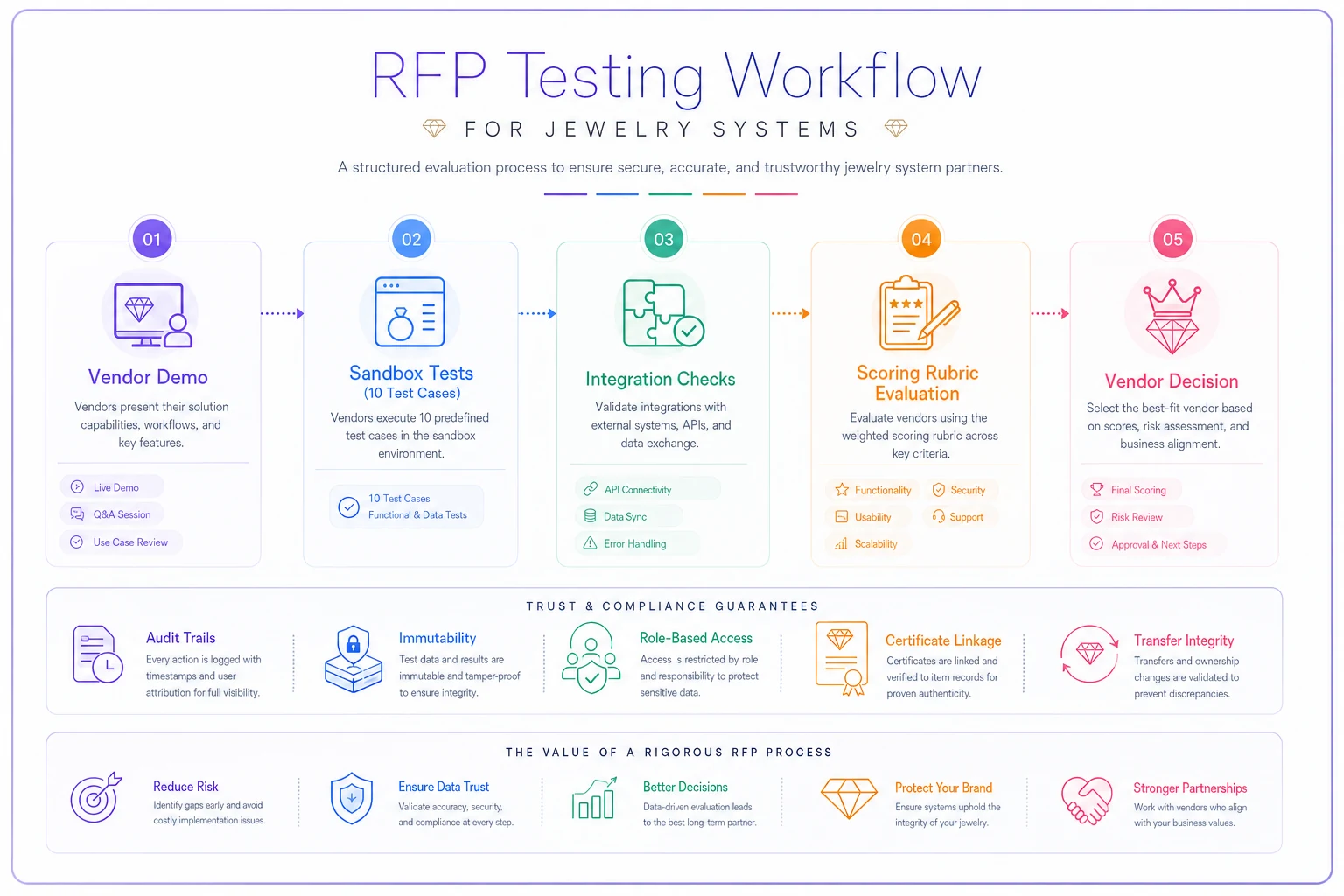
Keep this flow in mind during vendor evaluations.
Integration test cases tuned to jewelry workflows
Your POS rarely lives alone. It talks to accounting, your e-commerce catalog, shipping and insurance tools, sometimes a separate repair platform. Every integration point is a place where data can drift, and drift is expensive when the objects are worth thousands.
Run these integration-specific checks:
-
Two-way sync test. Change an item's price in the POS. Confirm it updates online within the promised window, and not the reverse in a way that overwrites your source of truth. You want one authoritative record, not two systems quietly arguing.
-
Failed sync recovery. Deliberately break the connection, make changes on both sides, then reconnect. Watch what happens. Does it queue and reconcile, or does one side silently win and erase the other's changes?
-
Duplicate write test. Push the same sale through twice, simulating a webhook retry. Confirm the accounting system doesn't book it twice. Double-writes are a classic integration bug that quietly inflates your books.
-
Certificate handoff. When an item syncs to your online store, does the cert reference and documentation come with it, or does the web listing lose that connection?
-
Partial data test. Send an item with missing required fields through the integration. Confirm it's rejected with a clear error rather than creating a broken half-record downstream.
Schedule failed-sync recovery tests during a low-traffic window so you can safely observe reconciliation without disrupting sales.
The recovery test in #2 is the one vendors hate demonstrating. Networks fail, APIs time out, and what actually matters is what the system does after — not whether it works when everything's perfect. In real operations, this is where sync-based inventory quietly goes wrong: the connection blips during a busy Saturday afternoon, and by Monday two systems disagree about what you have.
When this rigor makes sense — and when it's overkill
When a tight RFP is worth the effort:
-
You carry meaningful high-value inventory (loose diamonds, luxury watches, estate pieces)
-
You run more than one location, or plan to within two years
-
You handle repairs, custom work, or consignment where chain of custody matters
-
You've been burned before by a system you couldn't get your data out of
When you can go lighter:
-
Single-location shop with mostly low-ticket, high-volume fashion jewelry and no repair operation. The audit and transfer risks are genuinely smaller, and an exhaustive RFP process might slow you down more than it protects you.
Who should not skip this: any store planning to scale. Systems that feel fine at one location routinely fall apart at three, because coordination problems a manager could paper over by walking across the room now happen across cities. What breaks at scale isn't the feature set — it's the absence of enforced roles, reliable transfers, and audit trails that hold up when you can't personally verify everything.
A real scenario
A two-location jeweler doing roughly $3M–$4M combined in annual revenue replaced an aging POS. The old system had one meaningful gap: any employee with a login could edit item cost, and edits left no trace. Nobody flagged it during the switch because the demo looked clean and the migration was cheap.
About seven months in, a margin review turned up a cluster of items where cost had crept upward right before commission calculations. Roughly $6k–$8k in inflated payouts over a few months — and, worse, no way to prove intent or even confirm who made the changes. No audit trail meant no accountability, which meant a messy, morale-damaging internal situation with no clean resolution.
When they eventually re-evaluated systems, they ran the test-case matrix above. The finalist they chose failed nothing critical: cost was hidden from floor staff by default, cost edits required a reason and preserved history, and transfers carried certs automatically. The value wasn't some dramatic revenue jump — it was in what stopped happening. Commission disputes went quiet, insurance requests got answered in minutes, and the annual margin review became a routine check instead of an investigation.
The lesson wasn't "buy better software." It was that the second purchase asked questions the first one never did.
Bringing it together
A jewelry technology purchase is really a bet on how the system behaves under stress — during a dispute, a transfer gone sideways, an employee doing something they shouldn't, an integration dropping mid-afternoon on a Saturday. The demo never shows you any of that. The RFP and the test-case matrix are how you surface it before you're contractually committed.
Work the rubric honestly. Run the test cases in a real sandbox with your own hands. Make vendors demonstrate immutability and role-based access on live records, not slides. And treat data portability as non-negotiable, because the day you want to leave is the day you'll wish you'd asked earlier.
The stores that get this right aren't the ones with the biggest budgets. They're the ones who understood, going in, that with high-value inventory the software's job isn't just to ring up sales — it's to remember exactly what happened to every piece, and to prove it when someone asks.
Ready to elevate your jewelry store operations?
Join 500+ jewelers using Jewlyly to increase efficiency, reduce errors, and grow revenue.