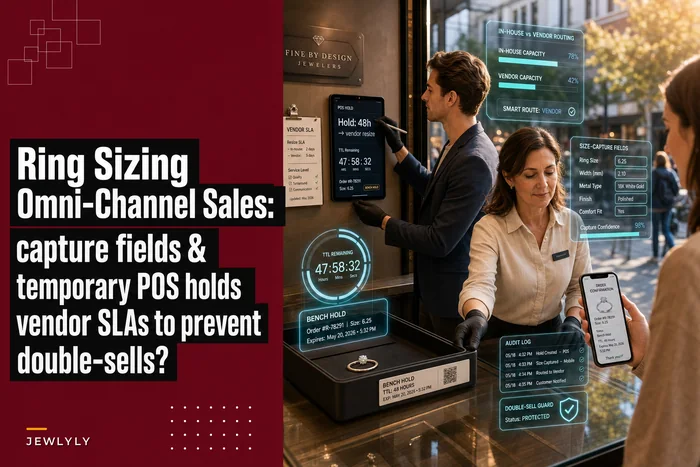



Selling jewelry across multiple channels breaks in a very specific way: you sell the same piece twice. A ring sits in the case, gets photographed, goes live on the site, someone buys it online at 11pm, and the next morning a walk-in buys it off the tray before anyone checks the phone. Now you've got two paying customers and one item.
For most retail, a double-sell is annoying. For a jeweler carrying single-quantity, high-value SKUs, it's a structural problem baked into how the store operates. You aren't selling forty of the same t-shirt. You're selling one estate piece, one 2.1ct cushion, one consigned watch. Quantity of one means every channel is fighting over the same unit, and whichever system updates last wins.
This piece is about the architecture underneath that — how inventory, order routing, appointments, and pickup all connect, where they fall apart as you add channels, and how to build guardrails so the same ring can't be committed to two buyers at once.
Why quantity-of-one breaks normal omnichannel logic
Standard omnichannel advice assumes you have inventory depth. If your website says "3 in stock" and it's actually 2, the third customer gets a "sorry, backordered" note and life goes on. That buffer doesn't exist when quantity is one.
What turns up repeatedly with small jewelers is that the real problem isn't the technology — it's that availability lives in three heads and two systems that don't talk. The floor staff know the ring is "kind of promised" to a client coming Thursday. The website shows it live. The POS shows it in stock. Nobody wrote down the soft hold.
The core insight: in a single-quantity business, your source of truth isn't inventory count. It's inventory state. A piece is available, soft-held, hard-held, in-transit, on-appointment, or sold. Count doesn't tell you enough; state does.
The single source of truth: one record, many states
Before you route a single order, you need one place where the true state of every piece lives — and every channel reads from it instead of keeping its own copy. Most stores technically have this (the POS) but then run a website that syncs on a delay, an appointment book in a separate calendar, and a consignment tracker in a spreadsheet.
Never miss a sale or shipment again.
Jewlyly helps you manage orders, track inventory, and engage customers seamlessly.
- Real-time inventory tracking
- Automated customer notifications
- Sales and order analytics
No credit card required
| State | What it means | Who can set it | Visible online? |
|---|---|---|---|
| Available | Free to sell anywhere | Any channel | Yes |
| Soft-hold | Verbally reserved, no deposit | Sales staff | No (or "inquire") |
| Hard-hold | Deposit taken / appointment locked | Sales + manager | No |
| In-appointment | Physically pulled for a client | Sales staff | No |
| In-transit | Moving between locations | Manager | No |
| Sold | Committed, paid | System on payment | No |
The moment any channel moves a piece past "available," every other channel must stop offering it immediately — not on the next sync.
Treat soft-hold as formal. A verbal hold that only exists in one salesperson's memory is exactly the gap a walk-in falls into. If it's held, it needs a recorded state, even without a deposit.
Order-routing rules for high-value pieces
Once you know the true state, the next question is what happens when an order comes in — especially online. Routing a $200 chain and routing a $22,000 solitaire should not follow the same path. For high-value single pieces, build a hold-and-verify step before finalizing the sale.
-
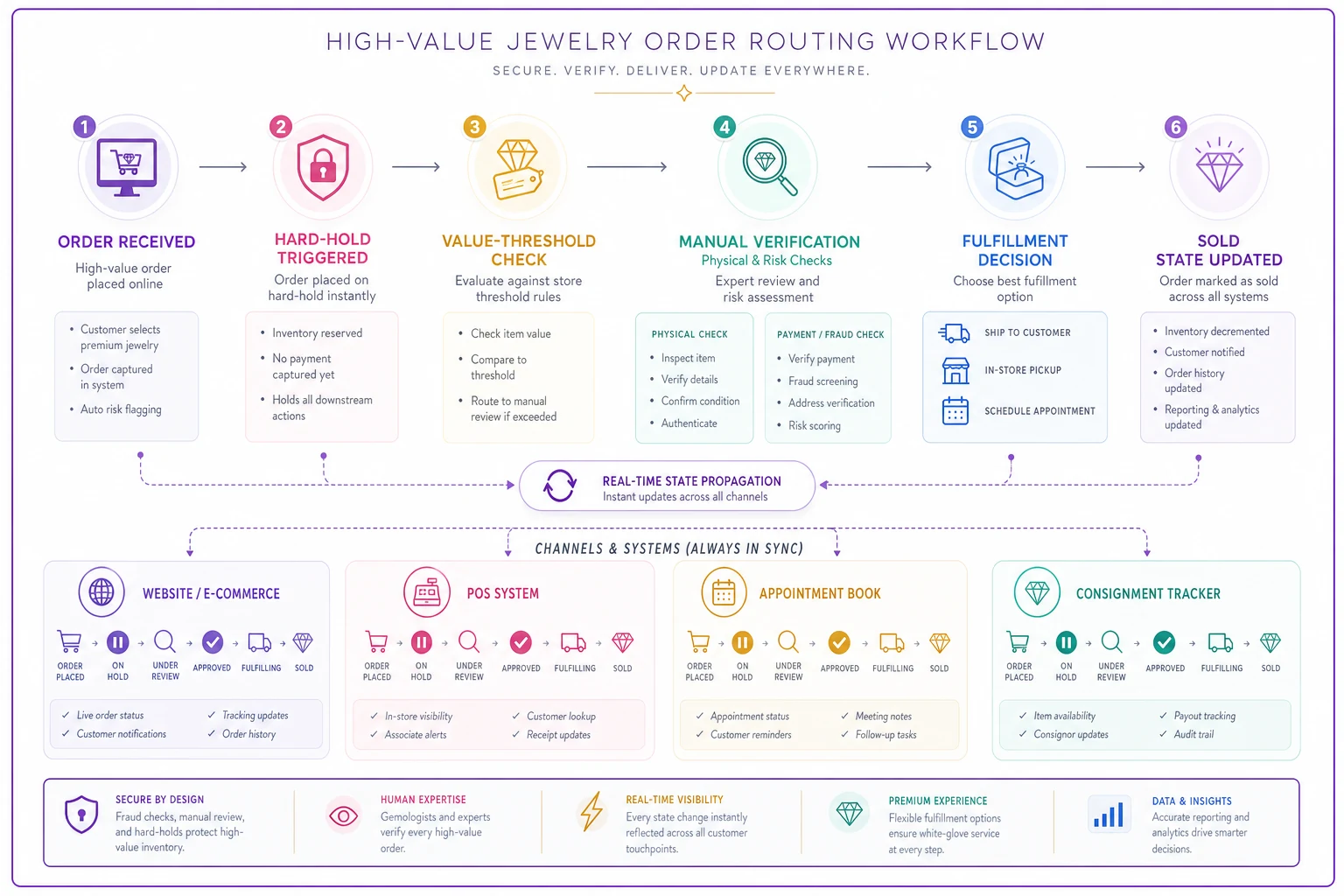
Order arrives online; item immediately flips to hard-hold, not sold, and disappears from all channels when the cart is committed.
-
Value threshold check; under threshold (e.g., ~$1,500) → auto-fulfill, over threshold → manual review queue.
-
Verification for high-value items
confirm physical presence, listing accuracy, certificate, payment clearance, and shipping/fraud checks.
-
Fulfillment decision
ship, hold for pickup, or convert to an appointment based on customer choice and item risk.
-
Finalize to sold only after verification passes; if verification fails, return the item to available and re-list automatically.
What catches stores off guard: an online "sale" on a one-of-a-kind piece is often a request to buy, not a completed sale. Treating it as instantly sold is what creates the mess when the same piece is also being shown in-store.
The hard-hold-first pattern buys you the minutes you need to verify without exposing the item to a second buyer.
Where the routing logic connects to the rest of the store
-
The floor sales tablet shows the piece as unavailable so nobody pulls it for a walk-in.
-
The appointment system blocks new bookings that involve that SKU.
-
The consignment tracker logs a pending sale so you don't promise it back to the owner.
This is the part people underestimate. A double-sell usually isn't two online orders — it's one online order and one offline action the online system never knew about. State changes must propagate everywhere before any other action happens.
Appointment and pickup flows without collisions
Appointments are where high-value jewelry actually converts, and they're also a hidden source of double-commitment. Booking an appointment for a specific SKU is effectively a soft claim on that piece and must be recorded.
-
Booking an appointment for a specific SKU places a soft-hold with an expiry tied to the appointment window plus a buffer.
-
The soft-hold auto-releases if the appointment passes without a deposit or purchase.
-
Make logging a hold faster than skipping it so staff choose the recorded path.
For pickup, the collision is different: the item is sold but still physically present. The failure mode is a piece marked "sold, awaiting pickup" that gets returned to general stock by mistake.
-
Physically segregate sold-awaiting-pickup pieces into a labeled, locked holding location rather than returning them to display.
-
Record the piece to the order and customer; perform ID verification at handoff for high-value items.
-
Keep the piece's state as sold everywhere so it can never be re-listed by mistake.
What breaks as you add channels and locations
A single location with a website can limp along with discipline. The cracks show when you add more channels, another store, or seasonal staff who don't know the informal rules.
-
One store + website
occasional double-sells from sync lag; manageable but embarrassing.
-
Add a marketplace or second sales channel
multiple systems think they own availability and double-sells increase.
-
Add a second location
transfers create an in-transit blind spot where items are unavailable but still listed.
-
Add seasonal staff
informal hold systems collapse because new people don't know them.
Every new channel multiplies the places a commitment can happen while the number of places state is tracked stays the same. An AI-assisted operational platform can help by acting as a single shared layer that logs and pushes state changes instantly and flags conflicts.
A real scenario
A two-location jeweler with roughly 900–1,100 active SKUs added an online catalog and a marketplace within a year. Within months they hit three double-sells on $6k–$14k pieces — each one a refund, an apology, and in one case a lost customer.
The fix wasn't a new POS. It was rebuilding around state rather than count: defined states for every piece, online orders over ~$1,500 flipping to hard-hold, appointment soft-holds with TTLs, and transfers logged as in-transit. Double-sells stopped almost entirely and staff stopped constantly asking "is this one available?"
When this architecture makes sense — and when it's overkill
-
Worth building
you carry meaningful single-quantity, high-value inventory and sell across more than one channel — shared state becomes essential.
-
Overkill
a single location selling repeatable items with inventory depth; standard omnichannel sync is sufficient.
-
Don't bolt it on carelessly
the system only works if staff consistently record holds, transfers, and pickups; otherwise extra fields create a false sense of safety.
Implementation checklist for boutique jewelers
As highlighted in industry software research from Gitnux, boutique retailers need unified systems that align sales, tracked inventory, and multi-channel order flows so single-quantity pieces stay synchronized in real time. Use this checklist when evaluating POS and booking tools.
-
Establish acceptable sync latency targets and require event-driven webhooks instead of periodic batch polling.
-
Define explicit actor permissions
permit associates to place temporary soft-holds; reserve hard-hold and transfer changes for managers.
-
Configure appointment TTLs so soft-holds expire after the consultation window plus a buffer and auto-release unpurchased SKUs.
-
Enforce a deposit rule to convert soft to hard holds; use structured temporary holds and capture workflows.
-
Implement SKU-level booking so scheduling tools tie to serialized pieces and apply a pre-appointment consultation playbook [High Value Appointment Playbook for Jewelers Pre Appointment Capture].
-
Centralize the core state record so every channel and register writes to a single source of truth [Jewelry Data Architecture for a Single Source of Truth].
-
Physically isolate deposit-backed and pickup stock immediately into a dedicated, locked tray labeled with order details.
-
Run concurrent-sale pilot simulations before launching a new channel to confirm the state engine rejects duplicate sales attempts.
The quick self-audit
-
Can a walk-in buy a piece that's live on your website with no system stopping it?
-
When a verbal hold happens, is it recorded anywhere or does it live in one person's memory?
-
Does an online order on a $10k piece mark it sold instantly or hold-and-verify first?
-
When a piece moves between locations, does it disappear from all channels while in transit?
-
Are sold-awaiting-pickup pieces physically separated from sellable stock?
-
If you added seasonal staff, would they know the hold rules without being told?
Stores that get this right don't have fancier tools than everyone else. They simply treat availability as a single shared state that every channel respects the instant it changes — so the same ring can never belong to two people at once.
Ready to elevate your jewelry store operations?
Join 500+ jewelers using Jewlyly to increase efficiency, reduce errors, and grow revenue.