



Most jewelers don't break because they added locations. They break because they added locations without deciding who owns what. The second store runs fine because the owner is still touching everything. By the third or fourth, someone in Store 2 is quietly editing prices, Store 3 has invented its own discount policy, and nobody can say whether the master SKU list on the back-office system matches what's actually in the cases.
This is the part nobody warns you about. Growing from one store to several isn't a bigger version of the same job — it's a different job. The skill that made a single location profitable (personal control) becomes the exact thing that sabotages you at scale. What replaces it is boring and unglamorous: a governance matrix. A written, enforced answer to "who decides, who executes, and how we check."
This article is about building that matrix across the four systems that actually cause the fights — catalog, pricing, HR, and security — and tying them together with a reconciliation cadence so nothing drifts silently. If you're managing multi-location jewelry governance, this is the connective tissue.
That's what a governance matrix does. For every recurring decision, you answer:
The core problem: authority gets fuzzy before data does
Everyone assumes the first thing to break at scale is data. Wrong SKUs, bad counts, pricing errors. Those are symptoms. The root cause shows up earlier and quieter: nobody agreed on who has authority over what.
A typical example looks like this. A three-store operation lets each store manager "adjust as needed" for local demand. Sounds reasonable. Then Store 1 marks a bridal line down 15% for a slow week, Store 3 keeps it full price, and a customer who saw the online price walks into Store 3 furious. Now you've got a margin leak, a service complaint, and two managers who both think they were doing their job correctly.
The fix isn't "communicate better." It's deciding, in writing, whether pricing is a central decision or a local one — and putting exceptions on rails.
-
Who owns the standard (sets the rule)?
-
Who can execute within the rule (act without asking)?
-
Who must approve exceptions (and how fast)?
-
How is it reconciled (checked against reality)?
Get those four columns filled in for catalog, pricing, HR, and security, and roughly 80% of your cross-store chaos disappears — not because people got better, but because they stopped having to guess.
Central vs local: the decision that shapes everything else
The whole matrix hangs on one philosophical call you have to make deliberately: what's centralized and what's local.
Never miss a sale or shipment again.
Jewlyly helps you manage orders, track inventory, and engage customers seamlessly.
- Real-time inventory tracking
- Automated customer notifications
- Sales and order analytics
No credit card required
Centralize too much and your store managers become order-takers who can't respond to their own market. Localize too much and you lose the consistency, buying power, and margin control that were the entire point of scaling. The answer is almost never all one or all the other. It's per-domain.
Here's a workable default matrix. Adjust it to your operation, but start opinionated:
| Domain | Recommended owner | Local authority | Why |
|---|---|---|---|
| Master SKU / catalog structure | Central | None (request only) | One schema or your feeds and reporting fall apart |
| List pricing | Central | None | Consistency across channels; protects margin |
| Local promos / clearance | Central sets bands | Local executes within band | Markets differ; drift must be bounded |
| Discounts at point of sale | Central sets tiers | Local approves up to a cap | Speed matters at the counter |
| Hiring & scheduling | Local | Full within budget | Managers know their floor |
| Comp structure | Central | None | Fairness and legal exposure |
| Security protocols | Central | None (execute only) | Non-negotiable; lives depend on it |
| Vendor selection | Central | Suggest only | Buying power, authenticity control |
The pattern worth noticing: the higher the risk — security, comp, catalog integrity — the more central the ownership. The closer the decision is to a live customer, the more local execution you allow. Risk goes up, local freedom goes down. That single rule of thumb resolves most "should this be central?" debates before they start.
When heavy centralization is a bad idea
If your locations serve genuinely different markets — say one store is estate-and-vintage in an older suburb and another is engagement-heavy near a university — forcing identical assortment and promo timing will leave both underperforming. Centralize the structure and guardrails, localize the mix. Own the SKU schema centrally; let the store request which of those SKUs it stocks.
Master-SKU ownership and migration rules
The catalog is where central-vs-local gets brutally practical, because a SKU that means two different things in two stores poisons every report you'll ever run.
The rule is simple to state and hard to enforce: one master SKU record, owned centrally, referenced everywhere. Stores don't create master SKUs. They request them. A single owner or small catalog team creates, edits, retires. If you've already built a purpose-built schema, this is the governance layer that keeps it clean — the schema decides how a SKU is described, governance decides who's allowed to touch it.
Where it breaks in real operations
The most common failure: a manager at a new location can't find an item in the system, so they create a "temporary" SKU to ring the sale. That temp SKU now exists forever, competes with the real one in search, and splits your sell-through data across two records. Multiply by a few dozen and your bestseller report is quietly lying to you.
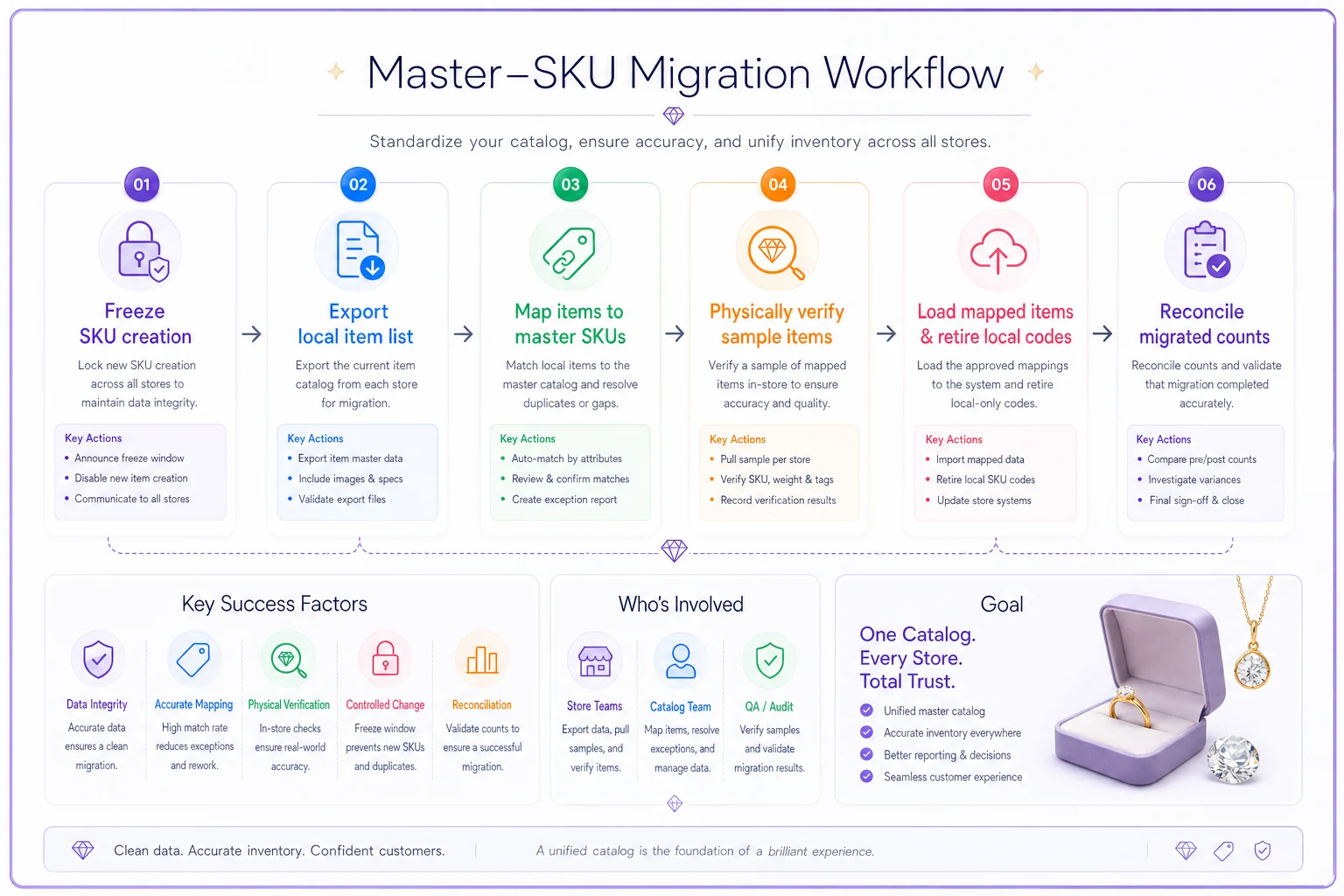
A related failure is migration — bringing a newly acquired store or a legacy location onto the central catalog. This is where most of the damage happens, because everyone's in a hurry and mapping feels like busywork.
Use a strict migration process:
-
Freeze SKU creation at the incoming location the day migration starts. No new local codes, period.
-
Export the full local item list with quantities, cost, and last-sold date.
-
Map each local item to a master SKU. Three buckets
exact match, needs-new-master, and do-not-migrate (dead stock, mystery items).
-
Physically verify a sample — pull 30–50 items and confirm the mapped master record actually matches what's in the case. Migration errors love to hide in "close enough" matches.
-
Load mapped items, retire local codes, and lock the old system to read-only.
-
Reconcile the migrated count against the physical count before you trust a single report.
That physical-verification step is the one people skip and the one that saves you. Digital mapping tells you a code matched; it doesn't tell you the ring in the drawer is actually a size 6 white gold instead of the size 7 yellow gold the master says. This is the same discipline behind a healthy inventory lifecycle — the count only means something if it's tied to reality.
A migration template worth stealing
For each incoming item, capture:
-
Local SKU / legacy code
-
Description as it appears locally
-
Proposed master SKU
-
Match type (exact / new / do-not-migrate)
-
Physical verification (Y/N + initials)
-
Cost and quantity on hand
-
Notes (condition, cert status, consignment flag)
Keep this file. When a number looks wrong three months later, the migration sheet is your audit trail.
Pricing and discounts: putting exceptions on rails
List pricing should be central and non-negotiable. The interesting governance question is exceptions — the discount a salesperson wants to give to close a $9k engagement ring, or the price-match on a competitor's quote. Those decisions happen fast, at the counter, with a customer standing there. You can't route every one to the owner's phone.
So you build a discount decision matrix that lets people act without asking — up to a line — and forces approval past it.
| Discount size | Who can approve | Documentation required | Reconciled |
|---|---|---|---|
| 0–5% | Any associate | None | Spot-check weekly |
| 6–10% | Associate + reason code | Reason code logged | Weekly review |
| 11–20% | Store manager | Reason + manager ID | Weekly review |
| 21%+ or below-cost | Central / owner | Written approval | Every instance reviewed |
The point isn't the exact percentages — set yours to your margins. The point is that every discount has a home: a clear approver and a required paper trail sized to the risk. Small stuff moves fast. Big stuff gets a human decision. Nothing large happens invisibly.
The mistake that shows up most often here is having a policy but no reason codes. "Manager approved" tells you nothing. "Price match — competitor quote #, held customer, saved a $9k sale" tells you whether the discount was actually smart. Without the reason code, your reconciliation is just counting. With it, you can see why margin is leaking and at which store.
Layered KPI tiers: reconciliation is what makes the matrix real
A governance matrix without reconciliation is just a nice document. The whole thing only works if reality gets checked against the rules on a schedule. That's where layered KPI tiers come in — different metrics, different owners, different cadences.
Think of it as three tiers:
Tier 1 — Counter/daily (store level). Cash and till reconciliation, discount log review, appointment conversion, any SKU-not-found overrides. Owned by the store manager. Checked daily.
Tier 2 — Operational/weekly (multi-store). Cross-store price consistency, margin by category, discount exceptions above threshold, transfer reconciliation, sell-through by master SKU. Owned by an ops lead. Checked weekly.
Tier 3 — Strategic/monthly (owner level). Margin trend across locations, shrink, comp-vs-revenue ratio, security audit compliance, catalog integrity — orphan SKUs, temp codes still live. Owned by the owner. Checked monthly, tied to the books.
The reason to layer it: the daily person and the monthly person should never be checking the same number. If the owner is reviewing till counts, the system has already failed — that's a Tier 1 job. The owner reviews whether Tier 1 and Tier 2 are actually happening and whether the trends are healthy.
Your month-end close is the natural checkpoint where these tiers meet the general ledger. If your reconciliation still feels like detective work every month, the fix is upstream — clean flags at the counter roll up into clean books, which is exactly the logic behind turning POS flags into clean books. Governance is what generates those clean flags in the first place.
A worked reconciliation example
Say you're reconciling weekly across three stores and the margin-by-category report shows bridal came in at 38% blended, but your target band is 44–48%. Here's the trace:
-
Pull the discount log filtered to bridal for the week.
-
Store 2 shows eleven discounts in the 11–20% band, all with the same reason code: "loyalty."
-
Cross-check
those "loyalty" discounts went to walk-ins, not loyalty members.
-
Root cause
one associate using a soft reason code to close faster.
-
The margin gap traces to roughly $2,600 in unnecessary markdowns for the week at one store.
Notice what made this findable: the discount matrix required a reason code, the KPI tier surfaced the margin miss, and the cadence caught it in a week instead of at year-end. No single control did it. The matrix did it because the pieces were wired together.
Where HR and security fit — the domains people forget to govern
Catalog and pricing get all the attention. HR and security are where the expensive surprises live, and they're usually the last things anyone writes rules for.
HR governance in a multi-store operation is really about two things: comp consistency and local scheduling freedom. Comp should be central — same commission structure, same rules — because inconsistent pay across locations creates both resentment and legal exposure. Scheduling and day-to-day management should be local, because the manager on the floor knows who's good with bridal consultations and who should be doing intake. When these get reversed — central dictating schedules, local inventing commission tweaks — you get the worst of both.
Security governance is the one domain with zero local authority. Protocols are set centrally and executed exactly, everywhere. Opening and closing procedures, dual-control on the safe, transfer handling, camera coverage. There is no "our store does it a little differently." The reconciliation here is the audit: a monthly check that each location is actually following protocol, not just claiming to. High-value stock moving between stores is a particular pressure point — the handoff between "central owns the rule" and "local executes it" is exactly where things go missing, which is why the omnichannel and transfer side has to be governed as tightly as the sales floor. If online orders and in-store stock can double-sell or vanish in transit, no amount of catalog cleanliness saves you — which is the whole argument for an omnichannel architecture that prevents double-sells.
The connective insight: HR, security, catalog, and pricing all fail the same way — through undefined authority and unchecked drift. The domains look unrelated, but the failure mode is identical, which is exactly why one matrix can govern all four.
A short real scenario
A four-location jeweler in the Midwest, roughly $6M combined revenue, had grown by acquiring two independent stores. Each came with its own POS habits and its own item codes. Eighteen months in, they had somewhere north of 400 "temporary" SKUs live, three different discount practices, and a month-end close that took the bookkeeper the better part of two weeks because nothing tied out cleanly.
They didn't buy new software first. They built the matrix — central ownership of catalog and list pricing, a four-tier discount approval table, and a weekly cross-store reconciliation. Then they ran the migration process on the two acquired stores: freeze, map, physically verify a sample, load, lock the old system.
Over the next quarter, temp SKUs dropped to near zero, the month-end close came down to about four or five days, and blended margin recovered a few points once the unauthorized markdowns had a reason code attached and a manager watching them weekly. Nothing dramatic in any single week — just drift stopping. The owner's line afterward was basically that he'd finally stopped being the reconciliation engine himself.
When this level of governance is overkill
Two stores with the same owner working both floors probably don't need a formal matrix yet — you are the governance layer, and that's fine for now. The trigger point is when you can no longer personally touch every pricing change and catalog edit. That's usually around store three, or the first time you acquire a location with its own systems.
It's also overkill if you build the matrix and then don't reconcile. A governance document nobody checks against reality is worse than none, because it creates false confidence. If you can't commit to the full cadence — daily till, weekly ops, monthly strategic — start with just the weekly tier and grow into it. One reliable checkpoint beats three aspirational ones.
The businesses that scale cleanly aren't the ones with the fanciest tools. They're the ones who decided early who owns what, put exceptions on rails, and checked their books against reality on a schedule. The matrix is just how you write that decision down before the fourth store forces you to.
The businesses that scale cleanly aren't the ones with the fanciest tools. They're the ones who decided early who owns what, put exceptions on rails, and checked their books against reality on a schedule. The matrix is just how you write that decision down before the fourth store forces you to.
Ready to elevate your jewelry store operations?
Join 500+ jewelers using Jewlyly to increase efficiency, reduce errors, and grow revenue.