

Most watch disputes don't start on the bench. They start at the counter, in the ninety seconds where someone hands you a Rolex Submariner, you write "Rolex Sub — full service" on a repair ticket, and the customer walks out with a claim check that describes almost nothing about the actual watch they left with you.
That gap is where the trouble lives. Six weeks later the watch comes back, the customer swears the bezel insert was pristine when they dropped it off, and now you're arguing about a scratch that may or may not have existed on day one. No photo, no serial confirmation, no notes on the crystal condition. Just memory and goodwill — and goodwill runs out fast when a $9,000 watch is involved.
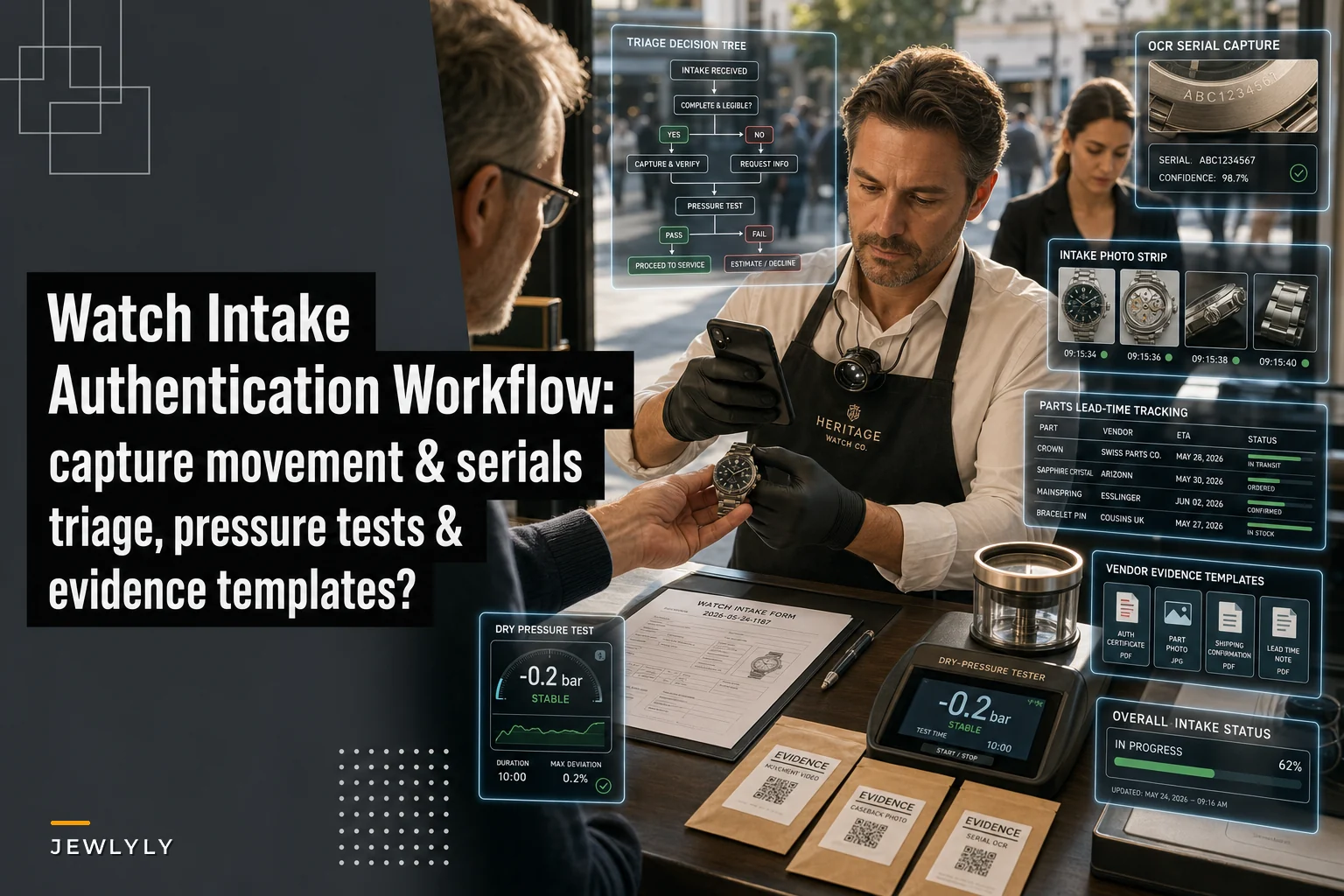
A real watch intake authentication workflow solves this before it becomes a fight. It forces the right questions at the right moment, creates evidence you can actually point to, and gives you a defensible record for both servicing and authentication. This post walks through the intake fields that matter, the triage rules that route watches correctly, how to track parts lead-times without losing your mind, and the vendor evidence templates that keep authentication honest.
Why intake tickets fail for watches specifically
General jewelry intake tickets don't translate to watches. A ring has metal, stones, and a setting. A watch is a machine — movement, case, bracelet, crystal, crown, gaskets, and a serial that lives somewhere non-obvious depending on the brand.
When a shop uses the same generic intake form for a tennis bracelet and an Omega Speedmaster, they lose exactly the details that matter most. Nobody records whether the watch was running on arrival. Nobody notes the power reserve or whether the crown screwed down properly. Nobody checks if the serial between the lugs matches the papers. Then the servicing tech opens it up and finds a movement that doesn't belong to that reference, and now you're standing in the middle of a potential fake, a possible franken-watch, or a customer who genuinely didn't know what they owned.
The pattern we see repeatedly: shops treat watch intake as a formality instead of the single most important data-capture moment in the entire service. Everything downstream — the quote, the parts order, the authentication opinion, the dispute defense — depends on what got written down in those first two minutes.
The intake fields that actually matter
The core problem with most watch intake sheets is that they capture ownership and contact info beautifully and capture the watch itself terribly.
Never miss a sale or shipment again.
Jewlyly helps you manage orders, track inventory, and engage customers seamlessly.
- Real-time inventory tracking
- Automated customer notifications
- Sales and order analytics
No credit card required
A watch intake record needs to describe the object well enough that a tech who has never seen it can understand its condition — and well enough that you can defend yourself if the customer disputes anything later. At minimum, capture these fields at the counter:
-
Brand, model name, and reference number — reference number is non-negotiable. "Rolex Datejust" is useless. "126334" tells you the exact watch.
-
Serial number and where it was read — between the lugs, on the caseback, on the movement, engraved on the rehaut. Note the location because you'll verify it again later.
-
Movement type — automatic, manual, quartz, chronograph. If you can identify the caliber, record it.
-
Running status on arrival — is it running? Keeping time? Dead? Winding but not running? This one line prevents half of all "you broke it" disputes.
-
Power reserve check — for automatics, note whether it holds a charge.
-
Crown and pusher function — does the crown screw down? Do pushers actuate? Any resistance or grit?
-
Crystal condition — scratches, chips, hairlines. Note them specifically, not as "good."
-
Case and bracelet condition — dings, deep scratches, missing links, worn clasp.
-
Water resistance history — does the customer swim or shower with it? This changes your gasket and pressure-test expectations.
-
Papers and box — present or not, and whether the serial on the papers matches the watch.
-
Aftermarket parts disclosed — has the customer had work done elsewhere? Non-original bezel, dial, hands?
The single most valuable field on that list is running status on arrival. A watch that arrives dead and leaves dead is not your fault. A watch that arrives running and leaves with a problem is a conversation you need to be prepared for. If you never recorded which one it was, you lose that conversation every time.
The pressure test and photo record: your two best defenses
Two pieces of physical evidence carry more weight than any note you write.
The pressure test matters for anything you open or anything sold as water resistant. A dry test before service and a wet test after tells you and the customer exactly what the case can handle. The mistake shops make is skipping the pre-service dry test. If you only test after service and it fails, there's no way to know whether the case was already compromised or whether your work caused it. Test on arrival, log the result, and you've protected yourself and set honest expectations.
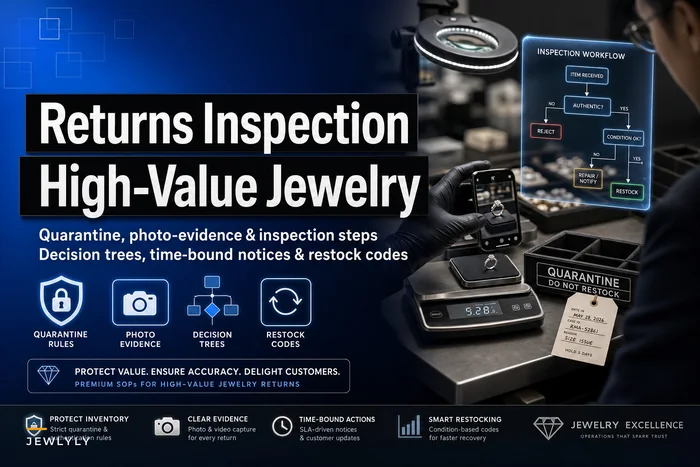
The photo record is what ends disputes before they start. Shoot the dial straight-on, both sides of the case, the caseback, the bracelet, the clasp, and macro shots of the serial and any pre-existing damage. Timestamp them. This is the same discipline that makes returns inspection and restocking work cleanly — photo evidence at the moment of handoff removes the "he said, she said" entirely.
Always timestamp intake photos and attach them directly to the ticket so they can't be separated from the record.
A typical example: a shop takes six timestamped intake photos of an incoming Tudor Black Bay, clearly showing an existing scuff on the 8 o'clock lug. Customer returns claiming the shop damaged the case. Ninety seconds of pulling up the intake photos and the conversation is over. Without those photos, that's a $400–$600 goodwill refinish you're eating to keep the peace.
Triage rules: routing the watch to the right path
Not every watch that hits your counter should follow the same path. Triage is where you decide — fast — whether something is a routine service, an authentication concern, a decline, or a case that needs your most senior person before you commit to anything.
| Signal at intake | Triage decision | Why |
|---|---|---|
| Common reference, papers present, serials match, running | Standard service queue | Low risk, quote normally |
| High-value reference, no papers, serial reads clean | Authentication hold | Verify before quoting or accepting for resale |
| Serial mismatch between watch and papers | Senior review, do NOT quote | Possible franken-watch or swapped case |
| Dial/hands/bezel look aftermarket | Authentication hold + disclosure note | Value and legitimacy both affected |
| Vintage piece, fragile movement | Specialist queue, extended timeline | Parts scarcity and handling risk |
| Water damage / condensation visible | Immediate dry test, expedite | Movement corrosion is time-sensitive |
| Customer wants same-week turnaround on obscure caliber | Parts availability check before commit | Lead-time risk on quote promise |
The rule that saves the most grief: never quote a firm price or date until triage clears. Front-counter staff want to reassure customers with a number. But if the movement turns out to need a part on an eight-week backorder, that reassurance becomes a broken promise. Triage first, quote second.
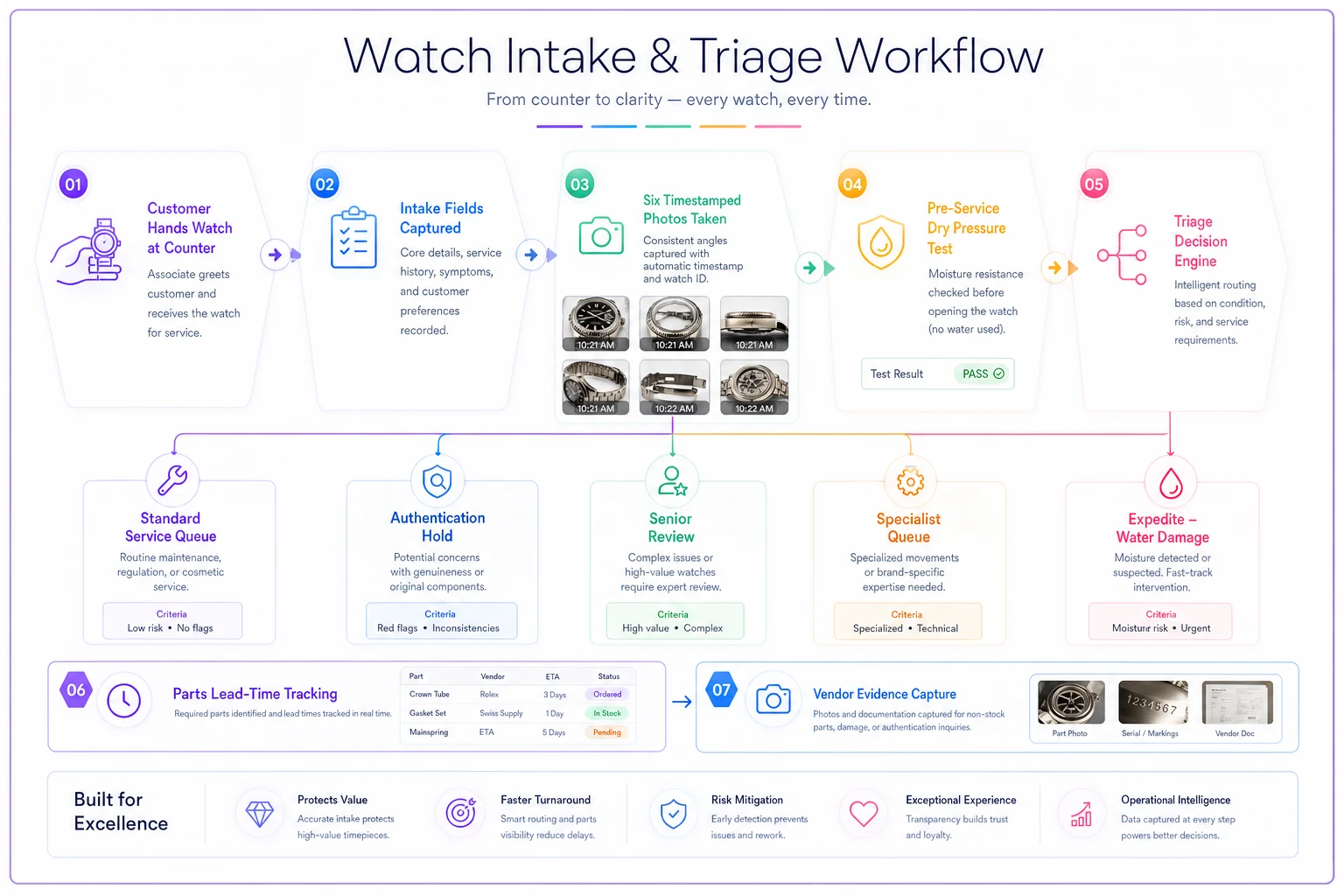
A quick visual of the intake-to-triage path helps staff understand when to stop and escalate.
When authentication triage actually matters
Authentication holds make sense when the piece is high-value, when papers are missing, when serials don't line up, or when something looks replaced. Running every $600 quartz watch through a full authentication process makes no sense — you'll bury your bench and annoy customers for no reason. Reserve the deep authentication path for pieces where being wrong costs you real money or legitimate legal exposure.
The person who should not be making authentication calls is a new front-counter hire on their second week. Triage should flag the concern; a senior, trained set of eyes should make the actual determination.
Parts lead-time tracking: the promise-keeper
Service timelines don't blow up because of bench time. They blow up because a part is sitting in a vendor backorder queue and nobody's tracking it.
The failure looks like this: a watch goes on the bench, the tech finds a cracked mainspring or a worn escape wheel, orders the part, and the ticket goes quiet. Customer calls at week three. Nobody knows where the part is. The tech ordered it but never logged an expected date, and now someone spends twenty minutes emailing the vendor to find out it shipped last Tuesday.
-
Part description and vendor part number — exact, not "spring."
-
Vendor and order date — who and when.
-
Quoted lead-time — what the vendor promised.
-
Expected arrival date — calculated from order date plus lead-time.
-
Status — ordered, backordered, shipped, received, installed.
-
Customer promised-by date — always set after the part lead-time is known, never before.
The discipline here is simple but almost never followed: the customer's promised date is derived from parts reality, not the other way around. When a shop promises a date first and orders parts second, they're guessing. When they check availability during triage and set the promise after, they keep it.
This ties directly into how bench and repair flow gets managed overall — the same coordination principles in the repair bottleneck and dispute playbook apply here. A part with no tracked ETA is a bottleneck waiting to surprise you.
Vendor evidence templates for authentication
When you rely on an outside authenticator, a brand service center, or a parts vendor to confirm legitimacy, you need their answer in a form you can keep and reference. A phone call where someone "confirmed it looks real" is worthless six months later.
-
Who evaluated it — company, individual, date.
-
What they examined — movement, serial, dial, specific reference points.
-
Their determination — authentic, inconclusive, replaced components, counterfeit.
-
Supporting documentation — invoice, service report, photos they provided.
-
Any caveats or limits — "authenticated case and movement, could not verify dial origin."
Standardizing this does two things. It gives you a defensible authentication trail if a resale is ever challenged, and it forces the vendor to commit to specifics instead of vague reassurance. Shops that keep clean vendor evidence records rarely get burned on a resale dispute, because they can produce exactly who verified what, and when.
A real scenario
A two-bench jewelry shop handling somewhere around 25–30 watch services a month kept running into the same wall: quoted turnaround times of two weeks that stretched to five, and one or two "you damaged my watch" disputes a month that ended in goodwill refunds.
They rebuilt intake around three changes. A watch-specific intake form with running status and six mandatory photos. A triage step that flagged high-value and paperless pieces before any quote went out. Parts lead-time tracking so promised dates came after the part ETA was confirmed, not before.
The disputes didn't vanish, but they dropped to maybe one every couple of months — and the ones that happened resolved quickly because the photos existed. Turnaround promises got more honest, and customers complained less even when timelines were longer, because the dates actually held. The goodwill refunds that had been quietly draining somewhere in the $500–$800 range per month mostly stopped. No new staff, no new equipment beyond a pressure tester they already owned. Just better capture at the counter.
Where this fits in your systems
You can run all of this on paper, and plenty of good shops do. But the moment your intake fields, photos, triage flags, parts ETAs, and vendor evidence live in five different places — a paper ticket, a phone camera roll, an email thread, a supplier portal, a notebook — the record falls apart exactly when you need it.
Keeping intake, condition photos, triage decisions, and parts tracking in one connected record means any staff member can pull up the full history of a watch without reconstructing it from scattered notes. That's the difference between a workflow that exists on paper and one that actually holds up when a customer is standing across the counter disputing a scratch.
Getting started this week
You don't need to overhaul everything at once. Pick the pieces with the highest payoff:
-
Rewrite your watch intake form to include running status, serial location, crystal condition, and water-resistance history.
-
Make six timestamped photos mandatory on every watch over a value threshold you set.
-
Add a pre-service pressure test for anything you'll open or anything sold as water resistant.
-
Build a one-page triage guide so counter staff know when to hold for authentication instead of quoting.
-
Stop letting promised dates get set before parts availability is confirmed.
The watches will keep coming in the same way they always have. The difference is what you know about each one the moment it hits your counter — and whether, six weeks later, you can prove it.
The watches will keep coming in the same way they always have. The difference is what you know about each one the moment it hits your counter — and whether, six weeks later, you can prove it.
Ready to elevate your jewelry store operations?
Join 500+ jewelers using Jewlyly to increase efficiency, reduce errors, and grow revenue.