

High-value jewelry returns aren't like accepting back a sweater. The difference between a legitimate return and sophisticated fraud can hide in microscopic details that untrained eyes miss during a rushed inspection.
I've watched this play out in stores where the return process was basically: quick glance, match the receipt, process the refund. One of those stores took back a platinum engagement ring—original sale was around $8,400—and only realized weeks later, when a customer came in asking about an upgrade, that the stone sitting in the case wasn't the one they'd sold. Somewhere between the return counter and the display case, nobody had checked the inclusion pattern against the original certificate photo. That mistake alone ran the store $2,100 in recovery costs, not counting the staff time and the awkward conversation with the couple who'd bought the ring the second time around.
The challenge isn't just fraud. It's building inspection processes that catch problems—whether intentional or not—without turning every legitimate customer into a suspect.
The inspection quarantine window that actually protects you
Standard retail return windows don't work for jewelry. A 30-day return policy sounds reasonable until someone returns a piece after wearing it to multiple events—or after swapping components.
The quarantine period gives you an operational buffer. Every returned piece enters a 48-72 hour hold before any refund processes. Not to stall—but to create space for proper inspection without rushing decisions.
Here's what a functional quarantine workflow looks like:
Day 1 (Receipt)
-
Immediate visual inspection at counter
-
Photo documentation of piece as received
-
Secure storage in designated quarantine zone
-
Customer receives timestamped receipt with inspection timeline
Day 2 (Detailed Inspection)
-
Weight verification against original sale records
-
Loupe inspection for stone authenticity
-
Metal testing if any doubts exist
-
Comparison against original product photos
Day 3 (Decision)
-
Final verification and decision
-
Process refund, exchange, or rejection
-
Document reasoning with supporting evidence
-
Communicate decision to customer
One thing the quarantine period solves that doesn't get talked about much: your most experienced staff won't always be there when a return walks in. Rather than having your newest associate make a $5,000 call on a Saturday afternoon, the hold creates time for proper expertise to evaluate the piece.
Most legitimate customers don't push back on the hold once you frame it right. Something like: "For high-value pieces, we run an authentication process—it protects all of our customers from fraud that would otherwise drive up prices." That framing tends to land well, especially with buyers who spent real money on a piece and want to know it's protected.
Frame the quarantine as protecting the customer's purchase—most buyers appreciate the extra verification.
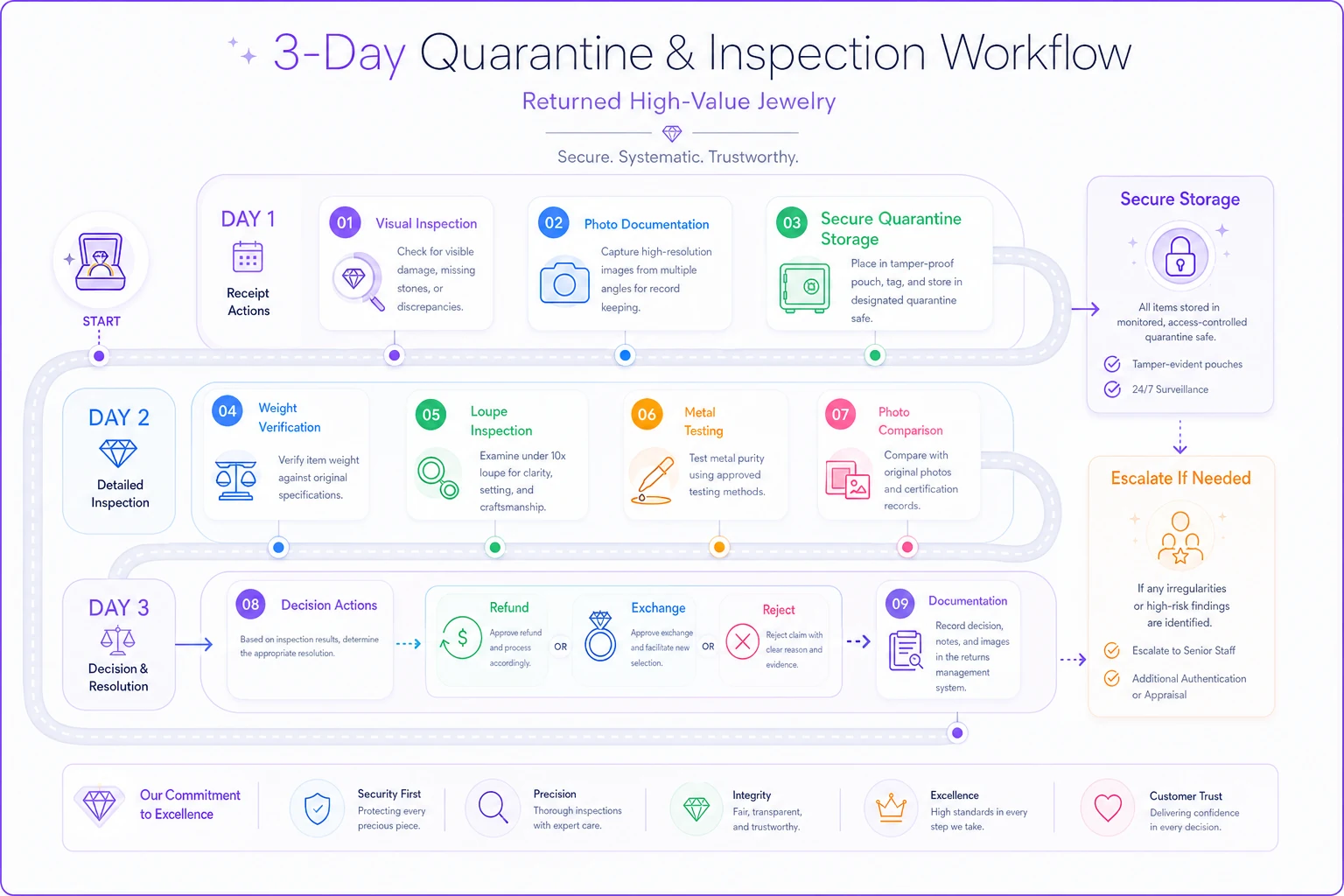
This graphic shows the 3-day quarantine workflow and where inspections and storage occur.
Photo evidence requirements that stand up to disputes
Documentation beats memory, especially three weeks later when a customer disputes your decision and nobody can clearly recall what the piece looked like when it came in.
Never miss a sale or shipment again.
Jewlyly helps you manage orders, track inventory, and engage customers seamlessly.
- Real-time inventory tracking
- Automated customer notifications
- Sales and order analytics
No credit card required
Random photos won't cut it. Your photo system needs specific standards:
Initial Sale Documentation
-
Full piece photo on neutral background
-
Close-ups of any unique characteristics
-
Serial numbers or hallmarks
-
Weight documentation
-
Stone mapping for pieces over $3,000
Return Receipt Photos
-
Same angles as original sale photos
-
Timestamp visible in frame
-
Staff member's initials on documentation card
-
Any visible damage or alterations highlighted
-
Comparison shot next to original if available
The comparison angle is more important than it sounds. Side-by-side photos make stone swaps immediately obvious—without direct comparison, even experienced staff can miss subtle differences, especially under retail lighting. I've seen cases where two photos taken two weeks apart told the whole story, and cases where the absence of those photos made it impossible to prove anything.
Cloud storage with proper folder organization keeps these photos accessible years later if needed. Local hard drives fail, paper printouts fade. Your photo documentation needs the same permanence as your financial records.
Decision trees that remove subjective judgment
Return decisions shouldn't depend on which staff member happens to be working that day. A clear decision tree removes the guesswork and protects your employees from making expensive judgment calls under pressure from an unhappy customer.
Here's a practical decision framework:
| Condition | Timeline | Decision | Action |
|---|---|---|---|
| Perfect condition, all components match | Within 14 days | Full refund | Process immediately after quarantine |
| Perfect condition, all components match | 15-30 days | Exchange only | Offer store credit at full value |
| Minor wear consistent with trying on | Within 14 days | Full refund minus 10% restocking | Document wear, process refund |
| Visible wear from use | Any timeline | Reject return | Offer repair service at cost |
| Missing components (box, papers, etc.) | Within 14 days | Refund minus component value | Document missing items |
| Stone or metal doesn't match records | Any timeline | Reject and investigate | Hold piece, contact authorities if fraud suspected |
| Custom or personalized piece | Any timeline | No returns | Refer to custom order agreement |
Build separate trees for different product categories. Estate jewelry follows different rules than new pieces. Watches need different inspection points than rings. The more specific the trees, the more consistent decisions become—regardless of who's behind the counter.
Training becomes cleaner when decisions follow logic rather than intuition. Instead of teaching staff to "use their judgment," you're teaching them to identify specific conditions and follow predetermined paths. That also gives them something to point to when a customer gets pushy. "I'm following our inspection policy" is a much easier position to hold than "this is just my opinion."
Communication scripts that prevent escalation
How you deliver a return decision often matters as much as the decision itself. A poorly worded rejection creates negative reviews and lost customers, even when you're completely in the right.
The key is removing emotion and keeping everything focused on process and documentation.
For Approved Returns:
"Thank you for your patience during our inspection process. Everything checks out, and we'll process your refund within 24 hours. You should see it in your account within 3-5 business days depending on your bank."
For Conditional Approvals:
"Our inspection found some minor signs of wear, which triggers our restocking fee as outlined in our return policy. We can process a refund of [specific amount] or offer you full value in store credit. Which would you prefer?"
For Rejected Returns:
"Our inspection identified some inconsistencies with our original sale records. Specifically, [state factual observation without accusation]. Based on our return policy, we're unable to process this return. We're happy to discuss repair or restoration options if you'd like to restore the piece to its original condition."
The rejection language avoids direct fraud accusations. You're stating observations and policy, not calling someone a thief—which matters because wrongful accusations create real liability. This framing also tends to defuse defensive reactions.
For high-value rejections, offer a second opinion: "If you'd like an independent appraisal to verify our findings, we're happy to hold the piece while you arrange that." It shows confidence in your assessment and gives legitimate customers a path forward if they genuinely believe there's been an error.
Restocking codes and inventory protection
Returns create inventory chaos without proper tracking. A piece can sit in your case for months before anyone realizes it came back with undisclosed damage. By that point, the original customer is gone and you're carrying depreciated inventory with no documentation trail.
Code Structure Example:
RT-[Date]-[Category]-[Reason]-[Inspector] RT-240115-ER-MW-JS (Return on Jan 15, 2024, Engagement Ring, Minor Wear, Inspected by JS)
This code appears on:
-
The piece's tag
-
Inventory management system
-
Photo documentation
-
Financial records
-
Any future sale documents
When a returned piece sells again, the buyer gets full disclosure about its history. Presentation matters more than the disclosure itself. Something like: "This piece was purchased and returned unworn within our inspection period. It's been fully authenticated and carries the same warranty as new inventory—we're offering it at a 5% discount due to its history." Most buyers respond well to that kind of honesty. It reads as professionalism, not a warning label.
Over time, the restocking system surfaces patterns—multiple returns from the same customer, specific pieces that keep cycling back, seasonal spikes. That data informs better inventory decisions and helps identify problems before they compound into real losses.
Metal testing and gemstone verification protocols
Visual inspection catches obvious issues, but sophisticated fraud fools the eye. Systematic testing matters, especially for pieces above $2,500.
Weight Check (Immediate red flag indicator)
Compare current weight to original sale weight. Even a 0.5-gram difference suggests tampering. Some substitutions are almost impossible to spot visually but show up immediately on a precise scale.
Magnet Test (Quick preliminary screening)
Real gold and platinum don't react to magnets. If the piece moves, you have a problem. This catches most amateur substitutions in seconds.
Electronic Testing (Verification without damage)
Electronic gold testers provide quick reads on metal purity. Test multiple points—more careful fraudsters might swap just the band while leaving clasps authentic.
Loupe Inspection (Critical for stones)
Check for laser inscriptions that should match certificates. Look for chip patterns that weren't there at sale. Compare inclusion patterns to original photography. A practiced eye with proper magnification catches most stone swaps.
Specific Gravity Testing (When in doubt)
For suspicious stones, specific gravity testing confirms identity without damage. Minimal investment, definitive answers.
Not every return needs every test. Your decision tree determines testing depth based on value and suspicion level. The point is having documented protocols so testing happens consistently—not just when someone remembers to do it.
Managing customer relationships through strict SOPs
Rigid return policies protect your business but create real friction if applied without any nuance. The goal isn't to make returns impossible—it's to make fraud unprofitable while keeping legitimate customers on your side.
VIP Customer Adjustments
-
Extended return windows for established customers
-
Waived restocking fees for customers with significant purchase history
-
Expedited inspection (24 hours instead of 72)
-
Direct manager handling for any issues
First-Time Buyer Considerations
-
Extra explanation of policies at point of sale
-
Written policy acknowledgment for pieces over $5,000
-
Follow-up call 48 hours after purchase confirming satisfaction
-
More generous interpretation of "unworn" condition
Special Circumstances
-
Medical emergencies that prevent timely returns
-
Deployment or travel that extends beyond return window
-
Inherited pieces discovered after estate settlement
-
Gifted items without receipt but verifiable purchase history
The framework stays consistent—inspection, documentation, decision trees all remain the same. But application adjusts based on relationship and circumstances.
Track the cost of exceptions. If VIP flexibility costs a few thousand dollars annually but those customers generate $80,000 in revenue, the math is clear. But if exceptions start exceeding roughly 5% of total return value, your flexibility has quietly become a vulnerability.
When refund versus exchange actually makes sense
Always Offer Exchange First
-
Keeps revenue in-house
-
Opportunity to upsell
-
Lower processing costs than refunds
-
Customer stays engaged with your store
Refund Becomes Necessary When:
-
Customer explicitly requests it—forcing an exchange creates ill will
-
The piece has documented issues you can't resolve
-
Timeline exceeds your exchange window
-
Customer threatens chargeback or legal action
Strategic Exchange Incentives
Offer 10% bonus credit for exchanges over refunds. A $3,000 return becomes $3,300 in store credit. You keep the full margin on the new sale, and most customers end up spending above the credit amount anyway.
The math works because jewelry margins support it. At roughly 50% average margin, that 10% bonus costs around $150 in actual cost basis. You keep the customer, avoid refund processing fees, and usually generate additional revenue on the exchange transaction.
One thing worth flagging: don't treat exchanges casually just because "the money stays here." Exchanges need the same inspection rigor as refunds. A swapped stone hurts your margin whether the customer walked out with cash or store credit.
Building inspection capabilities with the team you have
Not every store has a certified gemologist on staff. Most operate with sales associates who learned on the job. Your SOP needs to work with realistic staffing.
Tier 1 - Any Staff Member
-
Receive return and start quarantine
-
Complete basic photo documentation
-
Note obvious damage or inconsistencies
-
Secure piece in designated area
Tier 2 - Experienced Associates
-
Conduct weight verification
-
Perform magnet and electronic tests
-
Complete detailed photo comparison
-
Make recommendations on clear cases
Tier 3 - Manager/Owner Only
-
Final decision on all rejections
-
Handle any piece over $5,000
-
Manage customer escalations
-
Approve all exceptions to policy
This tiered approach prevents bottlenecks while maintaining security. Your part-time weekend associate can still process returns without making calls beyond their expertise.
Train staff to recognize and document—not to judge whether something is fraudulent. That distinction matters. It protects them from confrontation and ensures problems get flagged to the right level rather than quietly dismissed.
The gap between Tier 2 and Tier 3 capability often determines how vulnerable you are during absences. If only the owner can make informed decisions, everything stalls. Building Tier 2 capability through training and clear protocols reduces that dependency over time—and it's one of those things that takes longer than expected to actually happen in practice.
Technology and tools that streamline verification
Manual inspection catches most issues, but the right tools speed things up and provide backup documentation that's hard to argue with.
Digital Scale (0.01g precision minimum)
More precise than you'd think you need—essential for catching subtle substitutions. Around $200 for a quality model.
USB Microscope
Connects to a computer for captured images. Shows details invisible to loupes, and produces documentation you can actually share. Roughly $300-500 for professional quality. This one tool changes how stone verification works—what takes 10 minutes with a loupe takes 30 seconds with proper imaging, and you get a saved file.
Electronic Metal Tester
Non-destructive testing for metal purity. Faster than acid testing. $400-800 depending on capabilities.
Cloud Storage System
Organized folders for every transaction. Searchable, permanent, accessible from anywhere. $20-50 monthly for adequate storage.
Barcode/QR System
Links physical pieces to digital records instantly. Eliminates manual lookup errors. $500-1,500 for a complete setup.
None of these tools replace human judgment. They amplify capabilities and create documentation. The person operating them still needs training and clear protocols.
Integrating returns data into broader operations
Returns aren't isolated events—they're data points that should inform multiple areas of the business. Most stores treat them as one-off problems instead of mining them for patterns.
Product Quality Issues
If the same style keeps coming back, investigate why. Manufacturing defect? Sizing issue? Misleading photography? Fix the root cause instead of processing endless returns on the same SKU.
Sales Training Gaps
High returns from specific salespeople suggests overselling or poor expectation-setting at the point of sale.
Pricing Misalignment
Excessive returns in certain price bands might indicate a value perception problem—customers expect more at that price point than you're delivering.
Seasonal Patterns
January return spikes after holiday purchases. Post-Valentine's Day returns from broken engagements. Plan staffing and cash flow accordingly.
Customer Behavior Profiles
Some customers are serial returners. Adjust your approach based on history, not just on the current transaction.
An AI-powered operational platform can track these patterns automatically, flagging anomalies and surfacing trends before they compound into real losses. When returns data lives in isolation, those connections get missed. When it integrates into your broader operational platform, every return teaches you something useful—about products, customers, staff, or seasonal dynamics.
The reality of implementing these SOPs
Building comprehensive returns inspection processes feels overwhelming when you're already running daily operations. The temptation is to implement everything at once, which usually fails. Teams get confused, customers notice friction, and the system gets quietly abandoned within a few weeks.
Start with photo documentation and quarantine periods. Those two changes alone prevent most major losses. Add testing protocols once the basic workflow becomes routine. Build decision trees after you've processed enough returns to see your actual patterns.
The documentation feels excessive until it saves you once—and then it becomes standard practice without anyone needing to be reminded. A single prevented fraud or resolved dispute justifies months of careful photography and filing. The first time you pull up a side-by-side photo comparison during a dispute and the customer goes quiet, you stop questioning whether it's worth the effort.
These SOPs also protect your team. Clear protocols remove the anxiety of making expensive decisions under pressure. Custom order deposits and milestone templates that reduce disputes for bespoke jewelry operates on the same principle—structure creates confidence, for staff and customers alike.
Your returns process connects to repair operations too. Stop repair bottlenecks and disputes: an operational playbook for jewelry repairs & aftercare covers how documentation and clear protocols prevent similar issues in the service department.
Build what you can maintain, then expand as your team's capabilities grow. A basic SOP followed consistently beats an elaborate system used sporadically—and the margins you protect over time compound into a real operational advantage while competitors absorb losses from sloppy returns handling.
Ready to elevate your jewelry store operations?
Join 500+ jewelers using Jewlyly to increase efficiency, reduce errors, and grow revenue.