

Most jewelry VIP programs are designed by someone in marketing who never looked at a margin sheet. They pick a reward that sounds generous — "10% off for VIPs," or "free annual cleaning plus a birthday gift" — and nobody runs the math on what that costs when the buyer is spending $14k on an engagement ring instead of $140 on a pair of studs.
On high-ticket purchases, a flat percentage discount isn't a loyalty perk. It's a margin leak with a logo on it. And because jewelry has so much variance in markup across categories — bridal, loose stones, branded watches, estate pieces — the same "10% VIP discount" can mean giving away 4 points of margin on one sale and 22 points on another.
This article is narrowly about the operations behind a VIP program that actually protects margin: the benefit-cost math, the redemption fraud rules, how you map rewards into your POS and CRM, and the expiry and reconciliation templates that keep the liability from piling up on your books. We'll also walk through a couple of worked LTV scenarios so you can see what "lift" actually looks like when the program is built on real numbers.
Start with benefit-cost, not with the reward
The mistake almost every jeweler makes is designing the reward first and costing it later. Flip that.
Before you promise anything, you need a benefit-cost template that answers one question per reward: what does this cost us in real margin dollars, and what behavior does it need to drive to pay for itself?
Here's the structure that works. For every proposed VIP benefit, fill in:
-
Reward type (discount, service credit, gift, early access, financing perk)
-
Hard cost to you (what you actually pay — cost of goods on a gift, bench labor on a free service)
-
Margin impact (points of gross margin given up if it's a discount)
-
Trigger (what the customer must do to earn or redeem it)
-
Breakeven behavior (incremental spend or retention needed to cover the cost)
A typical example: say you want to offer VIP buyers "free annual rhodium re-plating" on white gold pieces. Feels generous, costs you maybe $35–$55 in bench time and materials per visit. If that perk keeps a customer coming back and they buy even one $600 pendant every couple of years that they'd otherwise have bought elsewhere, it pays for itself many times over. That's a good benefit — low hard cost, high relationship value, and it pulls them physically back into the store.
Compare that to "10% off for VIPs." On a $9,000 bridal set where your margin is already compressed because you're competing online, 10% off might be handing back 40–50% of your gross profit on that single transaction. That's not loyalty. That's a liquidation event you're voluntarily signing up for.
A simple benefit-cost comparison
| Reward | Hard cost to you | Margin risk | Pulls them back in-store? | Verdict |
|---|---|---|---|---|
| Free annual cleaning/inspection | $15–$30 labor | Very low | Yes | Strong |
| Free rhodium re-plating | $35–$55 | Low | Yes | Strong |
| Service credit ($150 toward repair/custom) | Cost of fulfillment, not face value | Low–medium | Yes | Good |
| Early access to new collections | Near zero | None | Yes | Underrated |
| Flat 10% off any purchase | $0 | High & unpredictable | No | Dangerous on high-ticket |
| Points redeemable as cash discount | Varies | Medium, needs caps | Sometimes | Only with rules |
The pattern is clear once you lay it out: service-based and access-based rewards protect margin far better than discount-based rewards, and they do something a discount never does — they create a reason to walk back through your door, where the real selling happens.
The redemption fraud problem nobody talks about
VIP programs on high-ticket goods attract a specific kind of abuse, and it rarely comes from customers. It comes from the point of sale, from the floor, and from the soft edges of your redemption rules.
Never miss a sale or shipment again.
Jewlyly helps you manage orders, track inventory, and engage customers seamlessly.
- Real-time inventory tracking
- Automated customer notifications
- Sales and order analytics
No credit card required
In practice, this usually happens three ways:
Stacking. A sales associate applies the VIP discount and a seasonal promo and takes the aging-inventory markdown — three layers on one $7k sale — because the POS let them. Nobody set a rule that VIP benefits don't stack with other discounts.
Self-crediting. Staff enroll friends, family, or themselves as VIPs, or apply points to their own purchases. On high-ticket items, a single abused redemption can be worth more than a week of a part-timer's wages.
Ghost redemptions. A "service credit" or "gift" gets logged as redeemed but the customer never actually received it — the value walks out the back door.
The fix isn't suspicion. It's rules enforced in the system, not in people's heads.
Your redemption fraud ruleset should include, at minimum:
-
VIP benefits never stack with other discounts unless explicitly flagged by a manager (and that override is logged with a name attached)
-
A hard cap on discount value per transaction — no single redemption exceeds a set dollar amount without manager approval
-
Employee and family accounts are flagged and excluded from auto-enrollment and point accrual
-
Every service-credit redemption requires a fulfillment confirmation — the credit isn't closed out until the service is logged as delivered
-
High-value redemptions over a threshold route to a second set of eyes before they finalize
This connects directly to the kind of discipline you'd already apply to internal controls elsewhere. If you've built out anomaly detection and investigation logs for POS activity, your VIP redemption rules should live inside that same framework — the same triage cadence, the same ownership. Loyalty redemptions are just another transaction type that can be gamed.
Mapping rewards into POS and CRM (where most programs quietly break)
A VIP program is only as good as its plumbing. The reason so many programs fail isn't the concept — it's that the reward lives in a spreadsheet, the customer lives in the CRM, and the transaction lives in the POS, and none of them talk to each other.
What that breakage looks like day to day: a VIP walks in, the associate has no idea they're a VIP because the tier isn't visible at the register, so either the benefit gets missed (customer feels forgotten) or it gets applied manually and inconsistently (margin leaks, no tracking).
The mapping you need is boringly specific:
-
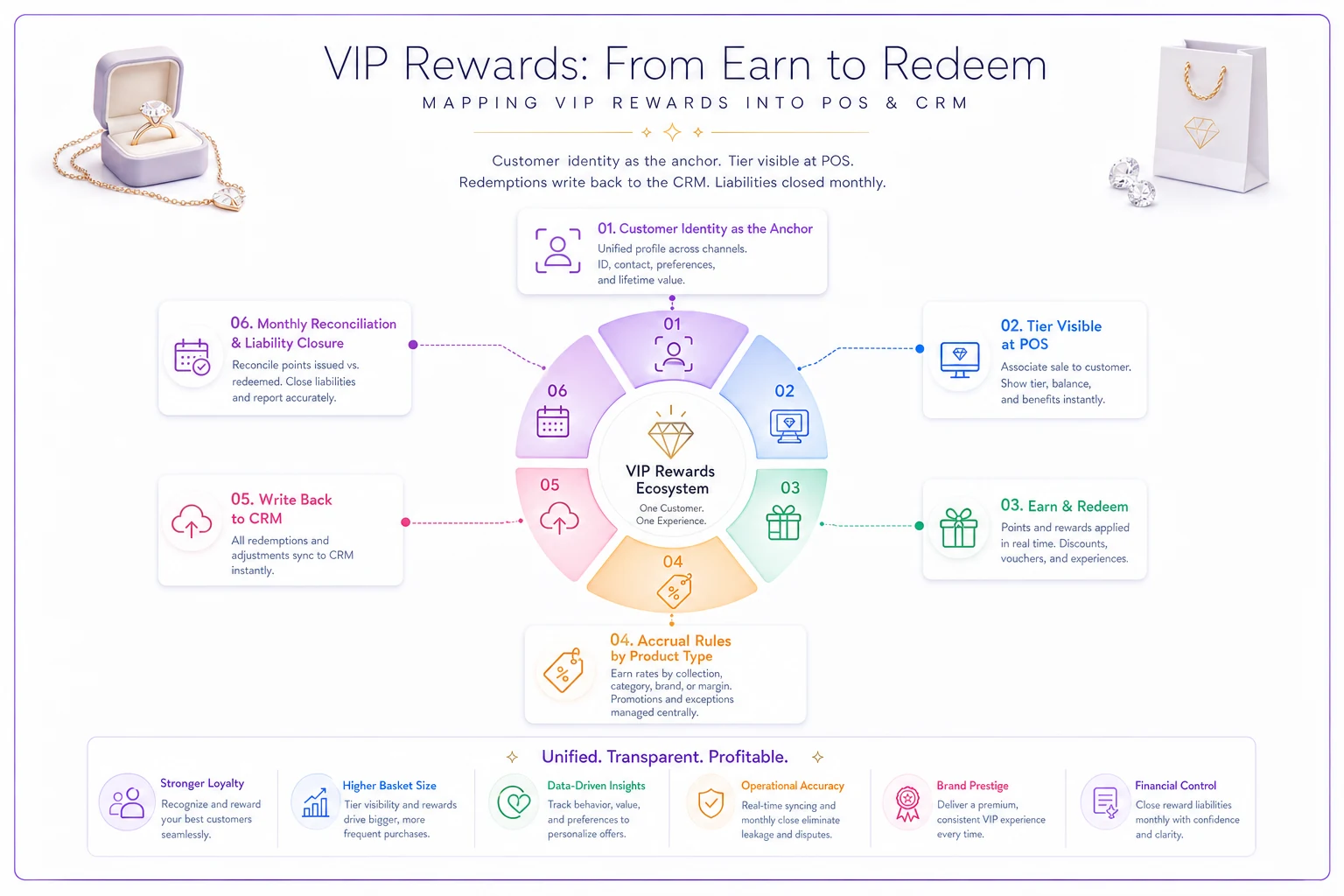
Customer identity is the anchor. Every VIP is a single clean record in the CRM — not three duplicate profiles from online, in-store, and repair intake. If your customer data isn't unified, fix that before you launch anything, because the program will multiply the mess.
-
Tier and benefit status pushes into the POS, visible at the moment of sale, so the associate sees "Platinum VIP — eligible for service credit, NOT eligible to stack discounts" right on the customer lookup.
-
Redemptions write back to the CRM automatically, decrementing available benefits and timestamping what was used, by whom, on which transaction.
-
Accrual rules are categorized by product type, so bridal, loose stones, and watches can earn at different rates — because their margins are different. This is the step almost everyone skips, and it's the one that keeps the program financially sane.
That last point matters more than it sounds. If a loose diamond at razor-thin margin earns points at the same rate as a high-margin fashion piece, your program rewards your least profitable sales the most. Accrual should be tied to margin contribution, not just ticket price.
Tie accrual rates to product margin tiers to avoid rewarding low-margin sales.
This is also where VIP operations overlap with broader lifecycle work. A well-mapped program feeds naturally into the kind of CRM triggers, warranties and automated aftercare that move a one-time buyer into a repeat relationship — the VIP tier just becomes one more signal in that lifecycle, driving the right follow-up at the right time.
Visualize this mapping workflow:
If your customer data isn't unified, fix that before you launch anything, because the program will multiply the mess.
Expiry and reconciliation: the liability you forgot you created
This is the part that bites jewelers 18 months in. Every unredeemed point, every unused service credit, every "we'll honor that" is a liability sitting on your books. Points are a promise to give away margin later. If you never set expiry rules or reconcile the balance, that promise compounds quietly until you're carrying tens of thousands in outstanding obligations you've never accounted for.
A typical example: a store runs points for three years with no expiry, no reconciliation. Then they get acquired, or their accountant finally asks, and there's suddenly a pile of outstanding point balances representing — at full redemption — somewhere north of $40k in potential discounts. Nobody budgeted for it. Nobody knows which balances belong to active customers versus people who moved away years ago.
Two templates prevent this:
The expiry policy template. Decide and document:
-
Points expire after a set window of inactivity (12–24 months is common)
-
Service credits expire on a fixed date, not a rolling one — easier to track
-
Expiry warnings fire automatically before the deadline (this is also a re-engagement tool — "you have a $150 credit expiring in 30 days" is a legitimately good reason for a VIP to come back in)
-
Expired value is written off the liability on a set schedule
The reconciliation template. Monthly, you reconcile outstanding program liability the same way you'd reconcile anything else:
-
Total points/credits issued this period
-
Total redeemed (and the margin cost of those redemptions)
-
Total expired/written off
-
Running outstanding liability balance
-
Flag
any redemption that looks anomalous (value, frequency, employee-linked)
If you already run a disciplined month-end close, bolt the VIP liability line directly onto it. Loyalty balances shouldn't be a mystery you discover once a year — they should be a number you watch every month, right next to the rest of your reconciliation.
Worked LTV scenarios on high-ticket purchases
Let's make "lift" concrete, because "improves LTV" is meaningless without numbers behind it.
Scenario A — the discount-driven program (what to avoid). A customer buys a $6,500 engagement ring. VIP program gives them 10% off, so you eat $650 off a sale where your gross margin was maybe $1,600. You just gave back roughly 40% of your margin on acquisition. Over the next two years they come back once for a $900 wedding band, 10% off again (–$90). Two transactions, roughly $740 in margin handed back, and nothing in the program structurally pulled them back — they'd have returned for the band anyway.
Scenario B — the service-and-access program (what works). Same $6,500 ring, full margin preserved — no discount at point of sale. Instead the buyer gets: free annual cleaning/inspection, free resizing in year one, a service credit toward their eventual wedding band, and early access to new bridal pieces. The cleaning and inspection pull them into the store twice in the first year. During one of those visits they buy a $1,200 pendant they weren't planning on. The wedding band sale closes with a $150 service credit applied (cost to you: maybe $60 in fulfillment, not $150 face). Then, because the relationship is warm and the aftercare is consistent, they refer a family member who buys bridal the following year.
The difference isn't marginal. Program A trains the customer that your prices are soft and gives them no reason to return. Program B protects full margin on the anchor purchase, manufactures repeat visits, and those visits are where the incremental, higher-margin sales actually happen.
Across the kinds of programs that hold up, the lift comes from visit frequency, not discount depth. A VIP who comes in three times a year is worth far more than one who got 10% off once — and the service-based structure is what creates those visits.
This is also why VIP operations pair well with aftercare subscriptions that reduce churn. A paid or included care plan and a VIP tier are doing the same fundamental job from two angles: both give the customer a recurring, legitimate reason to come back, and both let you build the relationship instead of buying it with margin.
A short real scenario
A single-location independent jeweler, mostly bridal and custom, had been running a "VIP = 10% off everything" card for about two years. Average ticket was high — a lot of $5k–$12k sales — so the discount was bleeding real money, and because it was applied manually, associates were stacking it with aging-inventory markdowns without anyone noticing.
They rebuilt the program around service and access: dropped the blanket discount entirely, added included cleanings and inspections, a modest service credit toward future purchases, and early collection access for top-tier customers. They mapped the tier into the POS so it was visible at checkout, set redemption rules that killed stacking, and added a monthly reconciliation line for outstanding credits.
Within roughly two quarters the margin recovery was obvious — they weren't handing back several points on every large sale anymore — and VIP customers were coming in noticeably more often for the free services, which turned into unplanned smaller purchases on those visits. The outstanding-liability number, which had been completely untracked before, was finally a figure they reviewed every month instead of a surprise. No dramatic revenue explosion — just a program that stopped leaking and started pulling people back in.
When a VIP program makes sense — and when it doesn't
When this actually makes sense: You have a meaningful base of repeat-capable customers (bridal leads to bands and anniversaries, estate buyers come back for more), your margins are high enough to fund service-based perks, and you have a POS/CRM that can actually track identity and redemptions. If you're already investing in lifecycle and aftercare, a VIP tier is a natural extension.
When this is a bad idea: Your customer data is a duplicated mess across channels, your POS can't enforce discount rules, and you have no capacity to run monthly reconciliation. Launching a VIP program on broken plumbing just adds a new way to leak margin and a new liability you can't see.
Who should NOT do this: Anyone whose instinct is to make the reward a flat percentage discount on high-ticket items. If that's the plan, don't launch — you'll give back more margin than the program could ever recover, and you'll train your best customers to wait for the discount.
The real takeaway
The whole game in jewelry VIP program operations comes down to this: on high-ticket purchases, protect the margin on the anchor sale and create reasons to return. Discount-based loyalty does the opposite — it surrenders margin up front and builds nothing. Service, access, and credits — with real benefit-cost math behind them, redemption rules that can't be gamed, clean POS/CRM mapping, and expiry plus reconciliation discipline — give you a program that genuinely lifts lifetime value instead of quietly funding its own failure.
Build the math first. Build the rules into the system, not into people's memory. Watch the liability every month. Do that, and the program earns its keep. Skip it, and you've just built a very expensive discount card.
Build the math first. Build the rules into the system, not into people's memory. Watch the liability every month. Do that, and the program earns its keep. Skip it, and you've just built a very expensive discount card.
Ready to elevate your jewelry store operations?
Join 500+ jewelers using Jewlyly to increase efficiency, reduce errors, and grow revenue.