


Most jewelers already sell aftercare in some form. Free cleanings for life. A prong-check "whenever you're in the neighborhood." A discount on the first resize. The problem isn't the intent—it's that none of it is built as an operational product. It lives in a salesperson's memory, a sticky note on a warranty envelope, and a vague promise the customer half-remembers two years later.
When you turn aftercare into a subscription with real tiers, you're not just adding a revenue line. You're building something with actual moving parts: SKUs that behave consistently in the POS, contracts that define what you actually owe, flags that tell the front counter what a customer is entitled to, fulfillment playbooks that keep bench work on schedule, and renewal logic that fires before the card expires. Get one part wrong and the whole thing leaks—usually through churn you never see coming.
This is a systems article. The goal is to show how the pieces connect, where they break as volume climbs, and what a clean version looks like end to end.
Why aftercare programs fall apart before they scale
The typical failure isn't the offer. It's that the offer was never encoded anywhere the system could actually enforce.
A store launches a "Care Plan" at $12/month. Sales loves it. Six months in, three things are quietly happening at once. The bench is doing free rhodium plating for people who only paid for cleanings, because nobody flagged the tier difference at intake. Renewals are failing silently because the plan was set up as a one-off charge instead of a recurring one, and nobody's watching the failed-payment report. Accounting is booking the full year of revenue in month one, which looks great until you have to true it up.
None of these are exotic problems. They're what happens when a subscription gets sold as a marketing idea and never gets designed as an operation. This usually surfaces around the point where you cross a few hundred active members—the volume where memory and goodwill stop being a system.
The other pattern worth naming: aftercare programs churn hardest when the customer can't tell what they're paying for. If the plan is invisible between purchases, the monthly charge starts to feel like a subscription they forgot to cancel. The fix isn't a better pitch—it's operational visibility. The customer needs to use the thing on a predictable cadence, and your team needs the system to remind them.
Start with the SKU model, not the marketing
Everything downstream depends on how you define the product in your catalog. If your aftercare tiers aren't structured SKUs, your POS can't enforce entitlements, your reporting can't separate plan revenue from repairs, and your renewals have nothing clean to bill against.
Never miss a sale or shipment again.
Jewlyly helps you manage orders, track inventory, and engage customers seamlessly.
- Real-time inventory tracking
- Automated customer notifications
- Sales and order analytics
No credit card required
The cleanest approach is a small set of parent aftercare SKUs, each with a defined service bundle, mapped to a recurring billing cadence. Here's a workable three-tier structure:
| Attribute | Essential | Protect | Concierge |
|---|---|---|---|
| Price (monthly) | $9–$12 | $19–$24 | $39–$49 |
| Cleaning & inspection | 2x/year | Unlimited | Unlimited + priority |
| Prong/setting check | 1x/year | 2x/year | Ongoing |
| Rhodium re-plating | — | 1x/year | 2x/year |
| Resize credit | — | 1 per term | 2 per term |
| Repair labor discount | 10% | 20% | 30% + waived rush fees |
| Loss/damage handling | Referral only | Assisted claim | Full concierge claim support |
| Turnaround priority | Standard | Elevated | Front of queue |
The tiers matter less than the discipline behind them. Each entitlement has to be a countable, trackable unit—"unlimited cleaning" is fine, but "1 resize per term" needs the POS to decrement a counter so the customer can't burn three resizes and argue they were owed them.
A mistake that comes up constantly: stores build tiers around price points that feel good but bundle services with wildly different fulfillment costs. Rhodium plating and resizing eat bench hours; cleaning and inspection barely register. If your $19 tier includes two resizes a year and your bench cost per resize runs $40–$60, you've built a plan that loses money on anyone who actually uses it. Cost your tiers against real bench time before you print a price.
If you want the deeper version of how these plans connect to the whole customer journey, we covered the upstream side in customer lifecycle mapping for jewelers—the aftercare subscription is essentially the paid, structured version of the automated aftercare described there.
POS and CRM: the flags that make entitlements enforceable
The subscription only works if the front counter can see, in one glance, what the person standing there is entitled to. This is where most programs quietly fall apart—the plan exists in a billing system that nobody at the counter opens mid-transaction.
-
Active tier (Essential / Protect / Concierge / None)
-
Entitlement balance (cleanings used, resize credits remaining, plating due/available)
-
Plan status (active, payment failed, in grace, lapsed)
POS capture rules that prevent the common leaks:
-
When aftercare service is rendered, the transaction must reference the plan SKU—not be rung as $0 or comped. Comped work is invisible work, and invisible work can't be measured or costed.
-
Every entitlement used decrements a counter on the customer record at the moment of fulfillment, not at month-end.
-
A payment-failed status must hard-flag the account so the counter sees it before performing plan-included service. Grace-period service is a policy decision, not an accident.
-
Plan enrollment and cancellation both write a timestamped event to the CRM, so renewal and churn reporting have clean anchors.
Pro-tip: make entitlement decrements atomic with work-order closure to avoid mismatches between bench records and POS counters.
The reconciliation side of this matters more than people expect. If plan revenue, comped services, and discounted repairs all blur together in the POS, your month-end becomes a guessing game. We walked through the flag-to-books discipline in detail in this month-end reconciliation playbook, and aftercare subscriptions are exactly the kind of recurring, multi-component revenue that punishes sloppy POS capture.
Contract language that defines what you actually owe
A subscription without a clear contract is a dispute waiting to happen. You don't need a lawyer's novel, but you need language that pins down scope, exclusions, and cancellation. A few snippets worth adapting:
Scope of service: > "This Care Plan covers routine maintenance services as listed in your selected tier. Covered services include professional cleaning, setting inspection, and the specific benefits enumerated for your tier. Services not listed—including but not limited to repairs from damage, loss, theft, or alteration by a third party—are not covered and will be quoted separately."
Entitlement limits: > "Benefits with defined quantities (e.g., resize credits, re-plating) reset at the start of each 12-month term and do not roll over. Unused benefits expire at term end and carry no cash value."
Payment and lapse: > "Membership renews automatically each month. If a payment fails, your plan enters a 15-day grace period during which benefits are suspended. If payment is not resolved within the grace period, the plan lapses and benefits are forfeited."
Cancellation: > "You may cancel at any time. Cancellation stops future billing; no partial-month refunds are issued. Benefits used during a paid term are not clawed back."
The exclusions clause is the one that actually saves you. The dispute that eats an afternoon is almost always someone who dropped their ring, assumed "the plan covers it," and is now upset at the counter. Write the boundary clearly, and train the team to point to it kindly.
SLA and fulfillment playbooks
Tiers are a promise about how fast and how much, and if the bench doesn't honor the SLA the whole value proposition collapses. Concierge members who wait the same three weeks as walk-ins will churn, and they'll tell people why.
A simple fulfillment playbook keyed to tier:
-
Intake Scan the plan status at drop-off. Tag the work order with the tier so it enters the queue at the correct priority. A Concierge resize should never sit behind a standard walk-in resize.
-
Priority routing Essential = standard queue. Protect = elevated (target turnaround shaved by a few days). Concierge = front of queue with proactive status updates.
-
Proactive contact For higher tiers, the promise isn't just speed—it's communication. A short "your piece is ready" or "running a day behind, here's why" note is what people are actually paying for at the top tier.
-
Fulfillment logging Every plan-covered service closes the work order and decrements the entitlement counter in the same step. If those two things happen separately, one of them eventually gets skipped.
The real operational issue here: your aftercare SLAs and your bench capacity are the same conversation. If you sell 200 Concierge memberships promising front-of-queue turnaround and your bench is already stretched, you've oversold a promise you can't keep. Size the program against real bench hours, not enrollment enthusiasm.
Revenue recognition: worked examples
This is where owners get burned, because subscriptions and one-time sales book completely differently, and the mismatch tends to show up at tax time or during a review.
The core rule: a monthly aftercare charge is earned as the service period elapses, not when the card is charged. If someone prepays annually, you can't recognize all of it in month one.
Worked example—monthly plan: A Protect member pays $22/month. Each month, you recognize $22 as earned revenue for that month. The complication is fulfillment cost—if that member uses a rhodium re-plating in month 4 that costs you $45 in bench time, that's a cost against the plan, and your plan margin is only meaningful across the full term, not month by month.
Worked example—annual prepay: A Concierge member prepays $528 for the year (roughly $44/month × 12). At the moment of charge, that $528 is a liability—deferred revenue—not income. You recognize $44 each month as the service period passes. If they cancel at month 5 with no refund policy, you recognize the remaining deferred balance at cancellation.
Worked example—plan margin over a term: Say you have 150 Protect members at $22/month. That's roughly $39,600 in annual plan revenue. Now cost the fulfillment: assume average usage of one plating ($45) and 1.5 cleanings' worth of bench time (~$20) per member per year, plus the occasional resize credit. If your blended fulfillment cost lands around $90–$110 per member per year, you're looking at roughly $16k–$18k in fulfillment cost against that $39.6k—healthy, but only because you costed the tiers honestly up front. Under-price the resize-heavy tier and that margin disappears fast.
The pattern to internalize: aftercare revenue is smooth and predictable, aftercare cost is lumpy and usage-driven. You manage the program on term-level margin, not monthly cash.
Renewal automation tied to LTV
Renewals are where churn is won or lost, and almost all of the loss is silent—failed payments nobody chased, expired cards nobody updated, term-end lapses nobody flagged.
A workable renewal flow, in sequence:
-
T-minus 30 days (annual) or ongoing (monthly) System checks card expiry. If the card expires before the next charge, trigger an update request early, before it fails.
-
Payment attempt On failure, enter the grace period, suspend benefits per the contract, and start a retry sequence (retry at day 3, day 7, day 12).
-
Grace-period contact Notify the member their benefits are paused and the card needs attention. Keep it factual, not aggressive—these are usually good customers with a dead card, not people trying to leave.
-
Lapse handling If unresolved by day 15, the plan lapses, benefits forfeit, and the account moves to a win-back segment.
-
Win-back Members who used their benefits actively before lapsing are your highest-value re-enrollment targets. Segment them separately from members who never engaged.
The LTV piece is what most stores skip. Not every member is worth the same effort to save. A Concierge member who's been active for three years and refers people is a different retention priority than a first-month Essential member who's never come in. Tie your renewal intensity to lifetime value—heavier, more personal outreach for high-LTV members, lighter automation for the rest.
Underneath all of it: your renewal system is really a churn early-warning system. A failed payment isn't just a billing event—it's often the first visible sign of a customer drifting away. Catching it in the grace period, before the relationship goes cold, is worth far more than any acquisition campaign.
A real scenario
A single-location store with roughly 900 active customers launched a two-tier aftercare plan the messy way—rung as one-off charges, entitlements tracked in a spreadsheet, renewals handled "when someone noticed."
Within about eight months they had close to 140 members but were bleeding in two spots. Failed renewals were sitting undetected for weeks, and their monthly member count was quietly drifting down even though new sign-ups looked fine—classic silent churn. On the fulfillment side, the bench was doing free plating for cleaning-tier members because nobody could see tier at intake.
They rebuilt it: structured SKUs with tier flags surfaced at the POS, proper deferred-revenue treatment for the handful of annual prepays, and an automated grace-period retry sequence on failed cards. Nothing complicated.
The change that mattered most wasn't a revenue jump—it was that failed payments started getting resolved inside the grace window instead of turning into quiet lapses. Member retention moved from "leaking a handful every month" to roughly stable, and the free-plating leak at the bench stopped because the counter could finally see who was entitled to what. Plan revenue steadied into a predictable few thousand a month they could actually forecast.
When a tiered aftercare subscription makes sense—and when it doesn't
When it makes sense:
-
You have a repair bench (in-house or reliable partner) that can absorb predictable maintenance volume.
-
You have enough repeat customers that recurring engagement is realistic, not aspirational.
-
Your POS and CRM can hold tier flags and entitlement counters—or you're willing to build that.
When it's a bad idea:
-
Your bench is already at capacity and any added standing obligation will blow your turnaround SLAs.
-
You can't cleanly separate plan revenue from repair revenue in your books. Launch it and you'll create a reconciliation mess.
-
Your customer base is mostly one-time gift buyers with no reason to return. A subscription needs recurring touchpoints to justify itself.
Brand-new stores without a stable service workflow yet should probably hold off. Aftercare subscriptions amplify whatever operational discipline you already have. If intake, work-order tracking, and month-end are still shaky, fix those first—the subscription will only expose the cracks faster.
Bringing it together
A jewelry aftercare subscription isn't a marketing feature you bolt on. It's an operation with five interlocking parts: SKUs that define the product, POS and CRM flags that enforce it, contracts that bound it, fulfillment playbooks that deliver it, and renewal logic that protects it. Weaken any one and the churn you were trying to prevent walks right back in through the gap.
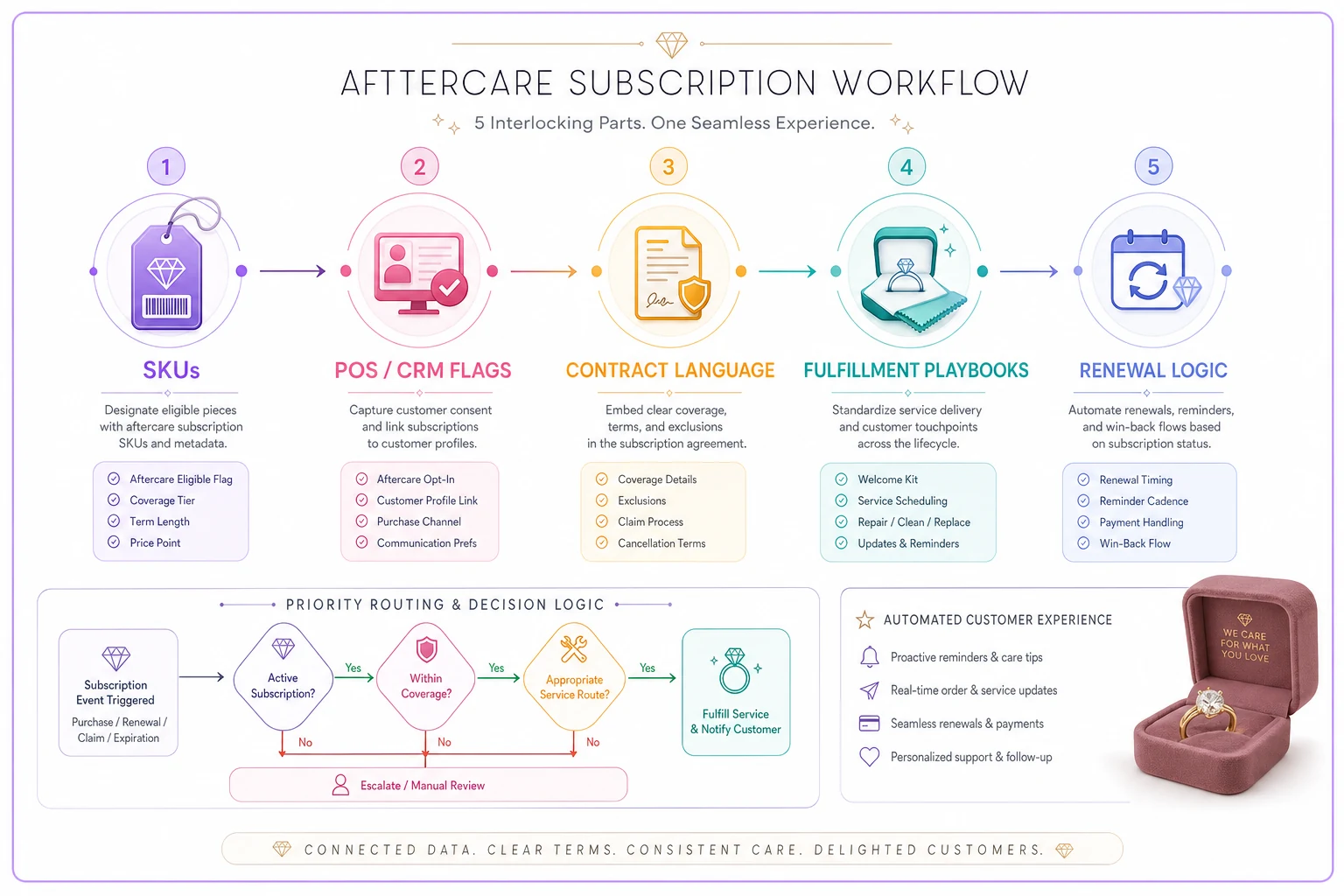
Here's a simple workflow view showing how those five parts connect and where handoffs need to be enforced.
The stores that make aftercare pay off aren't the ones with the cleverest tier names. They're the ones who costed their tiers against real bench hours, made entitlements visible at the counter, treated deferred revenue correctly, and chased failed payments before they turned into lapses. That's the whole game, really—get the operational foundation right, and aftercare stops being a promise you hope to keep and becomes a system that quietly keeps your best customers coming back.
A jewelry aftercare subscription isn't a marketing feature you bolt on. It's an operation with five interlocking parts: SKUs that define the product, POS and CRM flags that enforce it, contracts that bound it, fulfillment playbooks that deliver it, and renewal logic that protects it. Weaken any one and the churn you were trying to prevent walks right back in through the gap.
The stores that make aftercare pay off aren't the ones with the cleverest tier names. They're the ones who costed their tiers against real bench hours, made entitlements visible at the counter, treated deferred revenue correctly, and chased failed payments before they turned into lapses. That's the whole game, really—get the operational foundation right, and aftercare stops being a promise you hope to keep and becomes a system that quietly keeps your best customers coming back.
Ready to elevate your jewelry store operations?
Join 500+ jewelers using Jewlyly to increase efficiency, reduce errors, and grow revenue.