

Most jewelers treat a sale as an ending. The ring goes out the door, the card gets swiped, the customer says thank you, and the file basically closes. What actually happened is you just opened a five-to-fifteen year relationship and immediately stopped paying attention to it.
That's the whole problem. The jewelry customer lifecycle isn't a funnel that ends at checkout — it's a long series of moments where the customer either comes back or quietly drifts to someone else. Warranty check-ins, sizing tweaks, cleaning visits, the first anniversary, the "we're expanding the family" upgrade, the eventual second big purchase. Every one of those is revenue. Every one of those is also a moment where a store forgets to reach out, and the customer forgets you exist.
This piece is about mapping that lifecycle as an actual system — sale to warranty to service to anniversary triggers — and wiring it so the right message goes out at the right time without someone having to remember. Because "we'll follow up manually" is exactly where it always falls apart.
The lifecycle most stores are actually running (and don't realize it)
Here's the uncomfortable version of what happens in a lot of shops. A couple buys an engagement ring. The sale is huge, everyone's happy, maybe there's a photo. Then:
-
The ring comes back for sizing three weeks later. Handled fine, no note taken.
-
Six months in, it needs a prong check. The customer thinks about calling but doesn't, because nobody told them prongs need checking.
-
The wedding happens. You don't know, because you never captured the date.
-
The first anniversary passes. That's prime "matching band" or "push present" territory. Silence.
-
Two years later they walk into a competitor's store for anniversary earrings because that store sent a birthday email.
None of that is a talent problem. Your staff are good. It's that the lifecycle exists whether or not you manage it, and if you don't map it, the customer fills in the gaps elsewhere.
What you see across a lot of small jewelry operations is that the data to run this is almost always sitting right there in the POS and the repair log. Purchase date, item type, ring size, customer contact, warranty terms, repair history. It's captured. It's just never connected to any kind of follow-up. The information is trapped in records nobody looks at again.
Mapping the trigger points: sale → warranty → service → anniversary
Before any automation talk, you need the map itself. A trigger is just "an event that should cause an action." The art is picking events that are (a) predictable and (b) tied to something the customer actually cares about.
Never miss a sale or shipment again.
Jewlyly helps you manage orders, track inventory, and engage customers seamlessly.
- Real-time inventory tracking
- Automated customer notifications
- Sales and order analytics
No credit card required
Below is a base map that works for most stores. Adjust the timing to your own repair SLAs and warranty terms.
| Trigger event | When it fires | What the customer needs | The commercial angle |
|---|---|---|---|
| Purchase complete | Day 0 | Confirmation, care basics, warranty registration | Sets up every future touch |
| First care nudge | Day 30 | "Here's how to clean it, bring it in free" | Gets them back in the door |
| Warranty check-in | Every 6 months | Free prong/setting inspection reminder | Prevents claims and creates visits |
| Post-repair follow-up | 3–5 days after pickup | "Everything holding up?" | Catches problems, builds trust |
| Sizing/adjustment window | Day 14–45 | Reminder that free resize window is open | Reduces "I forgot" resentment |
| Anniversary of purchase | Yearly | Occasion reminder, matching pieces | Highest-intent upsell moment |
| Wedding date (if captured) | Yearly | Anniversary gift ideas | Bridal-specific, very high LTV |
| Lapsed customer | 18–24 months no contact | Re-engagement, event invite | Recovers drifting customers |
The mistake most people make when first building this is stacking too many triggers too close together. You don't need to message someone four times in the first month. You need the right few, spaced so each one feels like service, not marketing. A warranty inspection reminder is service. A "buy more stuff" email two weeks after a $9k purchase is noise.
One thing worth flagging: your warranty and repair touchpoints are the backbone of this whole system, not the anniversary upsells everyone gets excited about. If your repair and aftercare process is a mess, the follow-up sequences just draw attention to that mess. It's worth getting the repair and aftercare operations tight first, because a warranty reminder that leads to a two-week bench backlog does more damage than sending nothing.
A quick visual of that trigger flow:
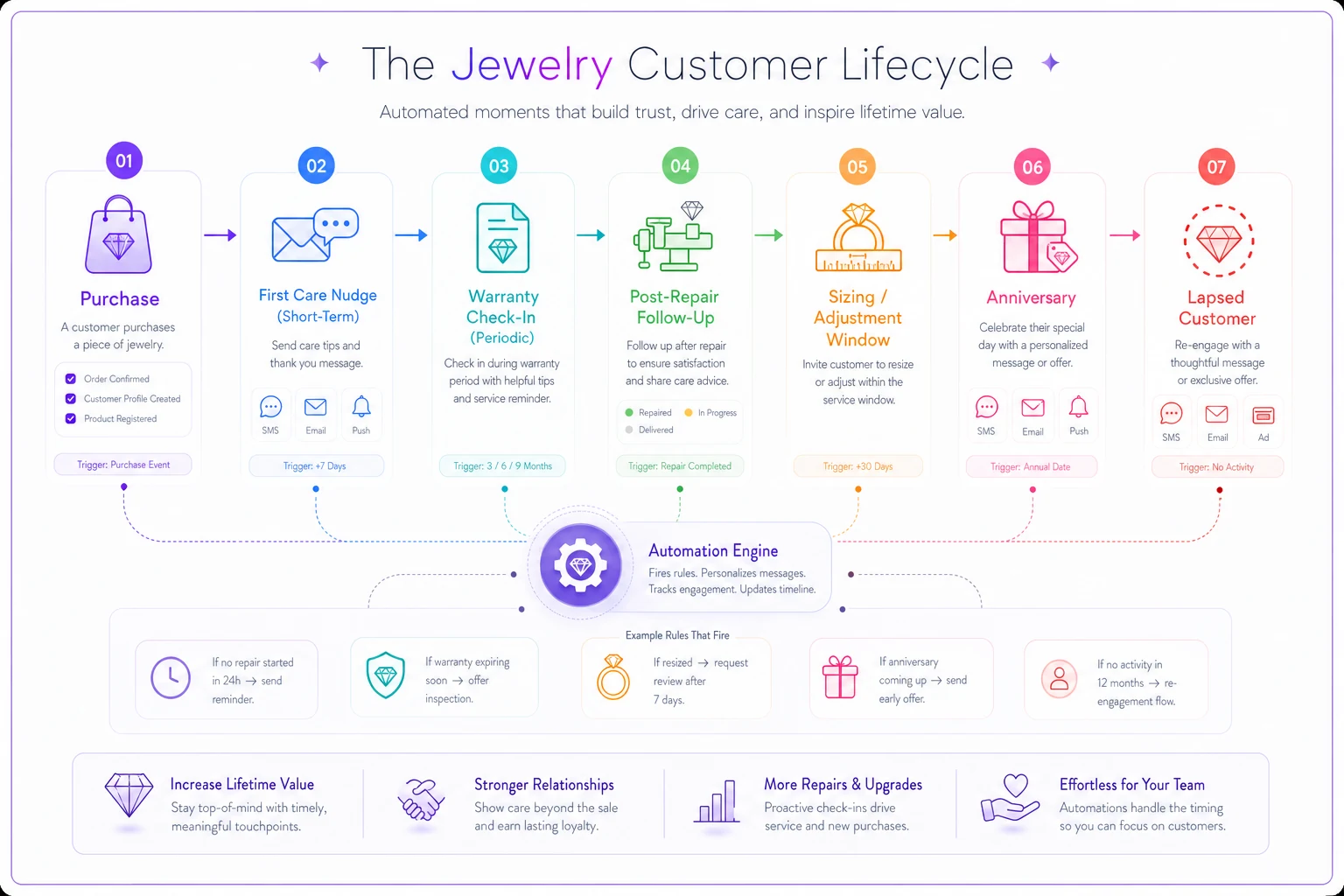
Prioritize warranty and repair reminders first — they're service moments that reliably pull customers back to the bench.
The mistake most people make when first building this is stacking too many triggers too close together. You don't need to message someone four times in the first month. You need the right few, spaced so each one feels like service, not marketing. A warranty inspection reminder is service. A "buy more stuff" email two weeks after a $9k purchase is noise.
Category-specific flows: bridal is a different animal than fashion
This is where a lot of generic "CRM for retail" advice falls flat. You can't run bridal and fashion jewelry on the same lifecycle. Different time horizons, different emotional weight, completely different reorder logic.
Bridal flow
-
Engagement ring sale — capture proposal date, and ask (gently) about the expected wedding timeframe.
-
Wedding band cadence — most couples buy bands 2–4 months before the wedding. If you captured the wedding date, this is an automatic, well-timed touch.
-
Post-wedding care — warranty inspections matter more here because these rings get worn every single day.
-
Anniversary triggers — year one is huge. Then years three, five, and ten tend to be gift-heavy.
-
Life-event expansions — anniversary bands, upgrade programs, push presents. These aren't scheduled, but a well-timed anniversary message often surfaces them.
The key bridal insight: capture the wedding date, not just the purchase date. Almost nobody does this, and it's the single most valuable field for bridal upsell timing. If you know the wedding was June 14, you know exactly when the year-one and year-five anniversary windows open.
Fashion flow
-
Faster cadence — a fashion buyer might purchase 2–4 times a year. Your touches can be more frequent without feeling pushy.
-
Occasion-driven — birthdays, holidays, Mother's Day, Valentine's. If you have a birthday on file, that's your anchor trigger.
-
Style-based recommendations — someone who buys gold hoops is a candidate for matching pieces, not diamond studs. Category history matters.
-
Replenishment and gifting — "shopping for someone else again?" around the same time last year's gift purchase happened.
The pattern worth noticing: bridal LTV comes from depth (a few big moments over many years), while fashion LTV comes from frequency (many smaller purchases per year). Run one playbook for both and you'll over-message bridal customers and under-message fashion ones — which is exactly backwards.
Sample sequences you can actually send
Templates are only useful if they sound like a jeweler wrote them, not a marketing department. Keep them short. Keep the commercial ask soft or absent in the service touches.
Bridal — 6-month warranty inspection (SMS): > Hi [Name], it's [Store]. Your [ring] is due for its free 6-month prong & setting check. Everyday wear is hard on settings — a quick inspection now prevents a lost stone later. Reply to book a time. No charge.
Bridal — first anniversary (email): > Subject: Happy first anniversary 💍 > Hi [Name], a year ago we helped you pick out [item] — congratulations. First anniversaries are a lovely time for a matching band or a small piece to mark the year. No pressure at all, but if you'd like to come look, we've set aside a few ideas in your style. And your ring is welcome anytime for a free cleaning.
Fashion — birthday (SMS): > Happy birthday from [Store], [Name]! Treat yourself — 15% off anything this week as our gift. Last time you loved the [category], we've got new arrivals in that line.
Post-repair follow-up (SMS), any category: > Hi [Name], checking in after your recent repair at [Store]. Is everything holding up well? Just reply if anything feels off — we stand behind our bench work.
That last one is quietly one of the highest-value messages you can send. It catches problems before they become angry reviews, and it signals you actually care after the transaction. Costs almost nothing, and it's the message stores forget most often.
The LTV math, done honestly
Say your store does around 900 transactions a year across bridal and fashion. Break the lifecycle value down instead of just looking at first-purchase revenue.
Without lifecycle management:
-
Average first purchase across all categories
~$1,400
-
Repeat purchase rate within 3 years
maybe 18–22%
-
Most customers make one purchase and vanish
With a working lifecycle system:
-
Consider a single bridal customer. Engagement ring at $6,500. If you actually stay in the relationship:
-
Wedding bands
~$1,800 (two bands)
-
Year-one anniversary piece
~$900
-
Year-three/five gifts
~$1,500 combined
-
Ongoing service visits that pull them past the counter repeatedly
That one customer moves from a $6,500 transaction to somewhere closer to $10k–$11k over five years — and they refer, because people who feel taken care of after a big emotional purchase talk about it.
Scale it out. If lifecycle touches lift your 3-year repeat rate from around 20% to 30% — a modest, achievable shift — across 900 customers that's roughly 90 additional repeat customers you weren't capturing. At even a conservative $800 average repeat purchase, that's somewhere in the range of $70k in revenue already sitting in your customer base. You didn't acquire anyone new. You just stopped letting existing customers forget you.
The honest caveat: these numbers depend entirely on execution. Reminders that go out late, to the wrong people, with broken links, actively cost you goodwill. The math only works if the system is reliable.
Where this breaks at scale (and why manual doesn't survive growth)
At 300 customers, a diligent owner can sort of run this by memory and sticky notes. At 2,000+ active customers with mixed bridal and fashion histories, overlapping warranty windows, and repair timelines, manual tracking collapses. Nobody can hold that many trigger dates in their head or in a spreadsheet.
Common failure points as you grow:
-
Missed anniversary dates because they live in a POS field nobody queries.
-
Warranty reminders that never fire, so customers only think of you when something breaks — and by then they're already frustrated.
-
Duplicate or contradictory messages when different staff reach out to the same customer.
-
Bridal customers getting fashion-frequency messaging and unsubscribing out of annoyance.
-
No connection between repair status and follow-up, so you send "how's it holding up?" to someone whose item is still on the bench.
This is where operational software with sensible automation stops being a luxury. Not the flashy kind — the practical kind that watches your purchase dates, warranty terms, and repair records, and quietly fires the right trigger at the right time. The value isn't in generating clever copy. The value is that the system remembers 2,000 anniversary dates so your staff don't have to, and it won't send a cleaning reminder to someone mid-repair because it can see the repair status.
Where AI automation genuinely helps is in the coordination layer: matching category history to the right sequence, suppressing conflicting messages, adjusting timing based on actual repair completion instead of a guessed date, and flagging lapsed high-value customers who deserve a personal call rather than an automated blast. It handles the tedious tracking so your people can focus on the customers who warrant a human touch.
When this makes sense — and when it doesn't
When it's worth building fully:
-
You have real bridal volume, where LTV is measured in years and thousands of dollars.
-
Your customer count has outgrown anyone's memory.
-
You already capture clean purchase and contact data at POS.
When to keep it simple:
-
Very small shop, few hundred customers, owner knows everyone by name. Start with just two triggers — warranty inspection and anniversary — and don't over-engineer it.
Who should NOT rush this:
-
Stores whose repair and service operations aren't reliable yet. If bench turnaround is chaotic, automated aftercare just advertises the chaos. Fix the operational base first. The same logic applies to custom work — your deposit and milestone workflows need to be solid before you layer lifecycle messaging on top, or you'll be sending "how's your custom piece?" while the customer is still waiting on it.
The same logic applies to custom work — your deposit and milestone workflows need to be solid before you layer lifecycle messaging on top, or you'll be sending "how's your custom piece?" while the customer is still waiting on it.
A short real scenario
A family-owned store doing a mix of bridal and fashion — around 1,100 active customer records — had almost no post-sale contact beyond the occasional repair call. Purchase dates were in the POS, wedding dates weren't captured at all, and anniversary outreach was basically "if the owner happened to remember."
They started small: captured wedding dates going forward, turned on 6-month warranty inspection reminders, added a first-anniversary email for bridal buyers. Nothing elaborate. Within roughly a year, the warranty reminders alone were pulling customers back in for free inspections — and those visits turned into cleaning sales, repair work they'd been putting off, and a handful of anniversary purchases that probably wouldn't have happened otherwise. The owner's rough estimate was somewhere in the low five figures of added revenue in the first year, almost entirely from customers they already had.
The interesting part wasn't the revenue number. It was that customers started saying things like "I love that you reminded me." A warranty check-in reads as care, not marketing — and that reframes the entire relationship.
The takeaway
Treat the lifecycle as the actual product. The ring is what you sell once; the relationship is what you sell for the next decade. Map your triggers deliberately, split bridal from fashion because they genuinely behave differently, keep the service touches feeling like service, and don't try to hold 2,000 anniversary dates in your head.
The revenue is already in your customer base — the only real question is whether your operations are set up to go collect it, or whether you'll keep letting customers drift to whoever remembered to send them a birthday message.
Treat the lifecycle as the actual product. The ring is what you sell once; the relationship is what you sell for the next decade. Map your triggers deliberately, split bridal from fashion because they genuinely behave differently, keep the service touches feeling like service, and don't try to hold 2,000 anniversary dates in your head. The revenue is already in your customer base — the only real question is whether your operations are set up to go collect it, or whether you'll keep letting customers drift to whoever remembered to send them a birthday message.
Ready to elevate your jewelry store operations?
Join 500+ jewelers using Jewlyly to increase efficiency, reduce errors, and grow revenue.