

Most jewelry businesses can tell you their margin on a diamond down to the dollar. Ask them to prove where it was cut, who polished it, or which trader sat between the mine and the memo — and the paper trail usually dissolves somewhere around "our supplier said it was fine."
That gap doesn't matter until it suddenly does. A wholesale buyer requests chain-of-custody documentation before placing an order. An insurer wants provenance on an estate piece before writing a rider. A customer who's read a few articles about conflict minerals asks a question your sales associate can't answer without calling the vendor and hoping someone picks up. In every one of those moments, the store's credibility is riding on records that were never designed to be pulled back up.
A real jewelry responsible sourcing system isn't a binder of vendor certificates. It's a set of connected records — intake forms, scorecards, audit cadences, and disclosure language — that lets you trace any SKU back through the supply chain without a scramble. The stores that get this right treat provenance the same way they treat inventory: something that lives at the item level, gets scored, and gets reviewed on a schedule.
Why sourcing records fall apart in the first place
The core problem is that provenance data enters the business at the worst possible moment for capturing it — during a buying trip, a trade show, or a rushed memo deal — and then never gets structured.
A typical example: a store owner buys a parcel of colored stones at a show. The dealer hands over an invoice, maybe a lab report on the bigger pieces, and a verbal "these are all Sri Lankan, ethically mined." The owner trusts the relationship, pays, and moves on. Six months later those stones are set into finished pieces, sold across three sales associates, and the only record connecting them to their origin is a paper invoice in a drawer that says "assorted sapphires."
The stones are untraceable — not because anyone lied, but because the data was never attached to the SKU. Origin claims, when they exist at all, live in the seller's memory and a receipt.
-
Provenance is captured at the parcel level, not the item level. You bought forty stones under one origin claim. Once they're split, set, and sold, that claim can't follow the individual stone.
-
Vendor trust replaces vendor verification. Long relationships feel like documentation. They aren't. The friendly dealer you've bought from for a decade may have zero visibility into his own upstream supply.
-
Nobody owns the records after purchase. Buying is one person's job. Documentation is nobody's job. So it doesn't happen.
The sourcing "system" at most jewelry operations is really just an accumulation of trust decisions made under time pressure, with no structure holding them together afterward.
What breaks when you scale
A single-location store with one buyer can sometimes get away with the drawer-of-invoices approach because one person holds the context in their head. That falls apart fast under any kind of growth.
Never miss a sale or shipment again.
Jewlyly helps you manage orders, track inventory, and engage customers seamlessly.
- Real-time inventory tracking
- Automated customer notifications
- Sales and order analytics
No credit card required
Add a second buyer and now two people are making origin judgments with no shared standard. One of them audits vendors informally; the other takes everything at face value. Add a second location and inventory starts moving between stores, carrying finished pieces whose provenance was documented — or wasn't — under two different mental models.
-
Inconsistent vendor standards. Without a scorecard, every buyer decides for themselves what "acceptable" looks like. Two buyers, two different bars.
-
No red-flag memory. A vendor who gave you sketchy paperwork two years ago gets treated the same as a fully-documented supplier, because nobody wrote it down where the next buyer would see it.
-
Disclosure drift. Marketing wants to say "ethically sourced." Legal wants to say as little as possible. With no shared template, sales associates improvise claims the business can't back up — which is a genuine liability, not just a branding problem.
The connective tissue that's missing is a system where vendor quality, item-level origin, and the language you're allowed to use about it all reference the same underlying records.
The three layers of a traceable sourcing system
Think of it in three connected layers, each feeding the next.
Layer one — vendor onboarding and intake. Before you buy, you capture who the vendor is, what they can document, and what they're actually claiming. This is a form, not a conversation.
Layer two — SKU-level provenance. When goods arrive, origin and documentation fields attach to the item record, not the invoice. This is the layer everyone skips, and it's the one that makes the whole thing traceable.
Layer three — ongoing audit and scoring. Vendors get re-checked on a cadence, red flags get scored, and the scorecard becomes the thing your team consults before placing the next order.
When these three connect, any finished piece can be traced back through its SKU to its provenance fields, to its vendor record, to that vendor's current audit standing. A chain you can actually walk backward.
Here's a simple workflow to visualize how the layers connect.
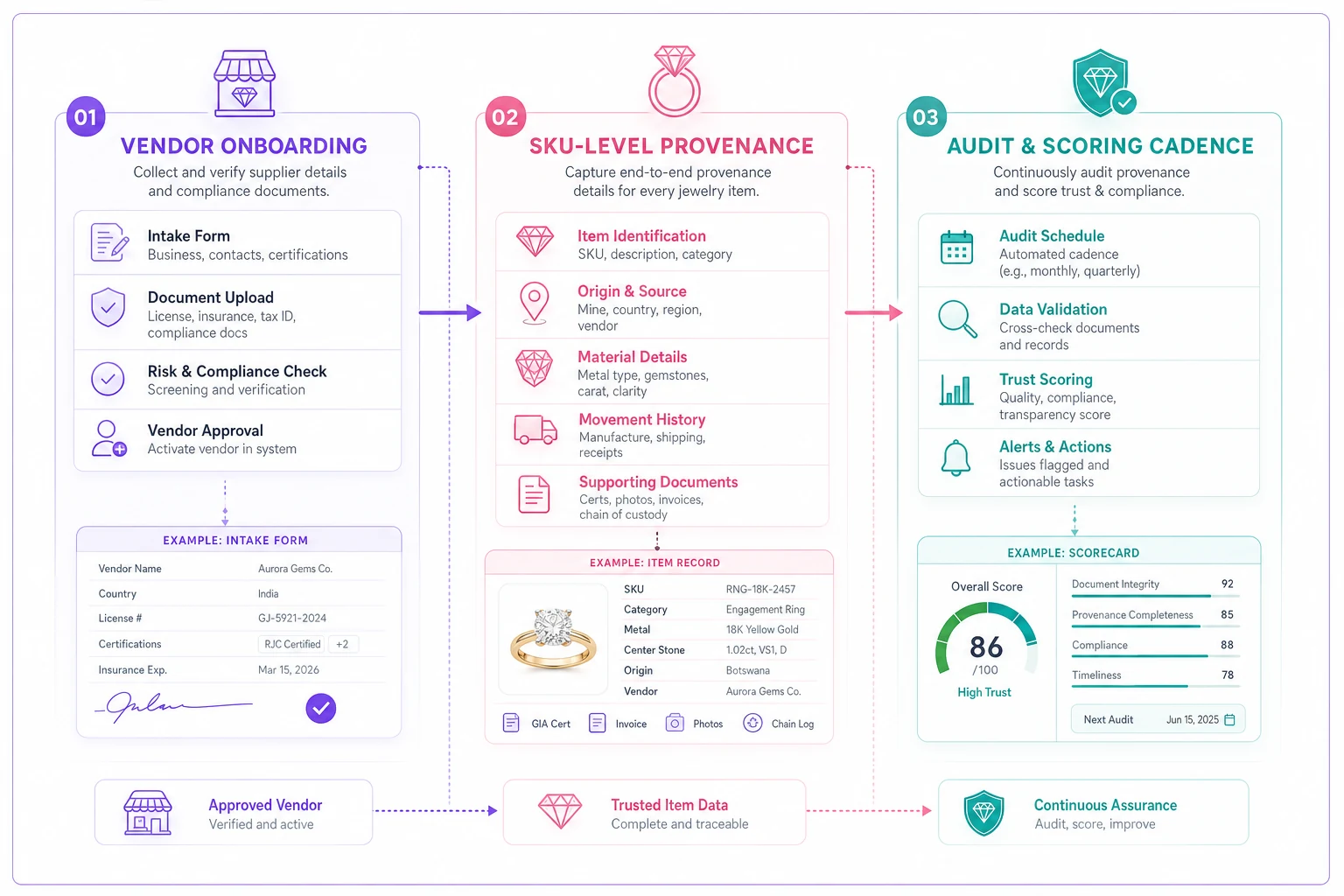
A chain you can actually walk backward.
Layer one: supplier onboarding and the intake form
The intake form exists to force the questions people skip when a deal feels good. It should be uncomfortable to fill out for a vendor who can't back up their claims — that discomfort is the point.
A workable supplier intake form captures:
-
Legal entity and ownership. Registered business name, not just "Danny from the show." Who owns it, where it's registered.
-
Position in the supply chain. Are they a miner, cutter, manufacturer, importer, or trader? A trader four steps removed from origin can't credibly certify mine of origin — you need to know that up front.
-
Documentation they can provide. Lab reports, Kimberley Process certificates, invoices with country of origin, chain-of-custody paperwork, recycled-metal certifications. Check boxes for what exists, not what they promise.
-
Origin claims and the basis for them. If they claim "recycled gold" or "natural, untreated," what's the evidence — a certificate, a supplier attestation, or a handshake?
-
Compliance attestations. Anti-money-laundering posture, sanctions screening, conflict-minerals policy. For higher-risk categories this isn't optional, and it ties directly into your broader tax and regulatory compliance obligations.
Require vendors to upload at least one supporting document during onboarding to avoid later surprises.
The mistake is treating the form as a one-time hurdle. A vendor who checked "can provide chain-of-custody docs" during onboarding but never actually produces them on a real order should get flagged — the intake answer and the delivered reality need to be compared, not filed and forgotten.
Layer two: SKU-level provenance fields
This is where most systems either succeed or quietly fail. Provenance has to live at the item level or it doesn't survive the business's own workflow.
The finished ring you sell isn't just "a ring." It's a center stone with an origin story, side stones with a different one, and metal with its own sourcing claim. If you want to make any responsible-sourcing statement about that ring, each component needs its own traceable field, and those fields need to roll up to the SKU.
Provenance fields worth carrying at the item or component level:
-
Origin claim (country/region, or "recycled," or "reclaimed/estate")
-
Basis of claim (lab report number, vendor attestation, Kimberley cert reference)
-
Vendor of record (linked to the vendor's scorecard)
-
Treatment/enhancement disclosures (heat, fracture-fill, etc.)
-
Documentation location (where the actual PDF or cert lives, so it's retrievable)
-
Confidence level (verified / attested / unverified)
That last field — confidence level — is the one almost nobody uses, and it's the one that changes everything. It's an honest acknowledgment that not every claim is equally solid. A stone with a lab report and full chain-of-custody is "verified." A stone with only a dealer's word is "attested." Marketing gets to speak confidently about the first and stays vague about the second. Legal has a defensible record either way.
This layer connects directly to how your item records are built. If your SKU schema doesn't have room for provenance and confidence level, you'll end up bolting it on in a notes field where it can't be searched or reported — which is functionally the same as not having it.
Layer three: vendor audit cadence and red-flag scoring
Onboarding is a snapshot. Vendors change. A supplier who was solid two years ago may have new upstream partners, a new owner, or a slipping documentation habit. Without a cadence, you never notice until a problem surfaces.
The audit cadence should scale with risk, not treat every vendor identically:
| Vendor risk tier | Trigger for tier | Audit cadence | What gets re-checked |
|---|---|---|---|
| Low | Established, fully-documented, recycled/domestic sourcing | Annual | Entity status, updated compliance attestations |
| Medium | Moderate volume, some origin claims relying on attestation | Every 6 months | Documentation delivery rate, origin claim consistency |
| High | High-value colored stones, complex origin, newer relationship | Quarterly + per-shipment spot check | Full documentation review, origin verification, red-flag rescoring |
Red-flag scoring is what turns audits from a filing exercise into a decision tool. Instead of a vague "we like this vendor," each supplier carries a score built from weighted flags:
-
Origin claims that shift between orders on the same material
-
Documentation promised at intake but not delivered on real shipments
-
Pricing that's implausibly below market for the claimed quality or origin
-
Reluctance to name their position in the supply chain
-
Missing or expired compliance attestations
-
Prior returns or authenticity disputes tied to that vendor
Each flag adds points; past a threshold, the vendor moves up a risk tier and gets more scrutiny — or gets paused. The scoring model is what makes red flags institutional memory instead of one buyer's gut feeling. If you've already built out vendor evaluation, this extends that same logic — the mechanics of vendor scorecards and procurement SOPs are the natural foundation to embed provenance and red-flag scoring into.
Balancing disclosure between marketing and legal
The tension that quietly creates the most exposure: marketing wants to make claims that sell, and legal wants to make claims that can be defended. Left uncoordinated, sales associates end up saying things on the floor that the business can't actually back up.
The fix is a small set of disclosure templates keyed to the confidence level in your provenance fields:
-
Verified claims (lab report + chain-of-custody)
full marketing language permitted. "This diamond's origin is documented through certified chain-of-custody."
-
Attested claims (vendor attestation only)
softer, sourced language. "Sourced from suppliers who attest to responsible practices." No specific origin guarantees.
-
Unverified (no documentation)
no origin claim at all. Describe the piece, not its sourcing story.
Most stores think they have to choose between marketing that oversells and legal that says nothing. You don't. You tier the language to the strength of the evidence. Marketing gets to be confident exactly where you can afford confidence, and legal is protected everywhere else.
The template lives next to the SKU, so whoever writes the listing or talks to the customer is using language the records already support.
A short real scenario
A two-location store doing a mix of bridal and colored stones landed a recurring wholesale account that required documented sourcing on any piece over a certain value. Their existing records were invoice-based — origin claims sat in parcel receipts, nothing at the item level.
The first order request took the team the better part of two weeks to fulfill because they had to reconstruct provenance from old invoices and chase vendors for documentation they'd assumed existed. One vendor couldn't produce anything, which meant a chunk of otherwise sellable inventory couldn't be used for that account at all.
After restructuring, they onboarded vendors through a standard intake form, moved provenance to item-level fields with a confidence flag, and put their top-volume colored-stone suppliers on a quarterly audit. Two of those suppliers turned out to be pure traders who couldn't substantiate the origin claims they'd been making — those got dropped or downgraded to "attested" language.
The next comparable wholesale request took a couple of days instead of two weeks, most of it pulling and confirming records that already existed. Roughly a fifth of their vendor list got re-tiered once red-flag scoring was applied consistently. Nothing about the sourcing got dramatically more expensive — it just became traceable, which is exactly what the account had been asking for.
When this level of rigor makes sense — and when it doesn't
When it's worth it: You sell high-value stones, you're pursuing or holding wholesale or corporate accounts, you handle estate and consignment pieces where provenance affects value, or you're making any public responsible-sourcing claims. In those cases the traceability isn't overhead — it's protecting revenue and reducing real legal exposure.
When it's overkill: A very small store selling almost entirely finished, mass-produced fashion pieces from a couple of stable domestic distributors probably doesn't need quarterly audits and component-level provenance on a $40 sterling pendant. Match the rigor to the risk and the value.
Who should skip the heavy version: If you're not making origin claims, not selling into accounts that demand documentation, and not dealing in high-value or estate goods, a full three-layer system will slow you down more than it protects you. Keep a basic vendor intake and skip the rest until your product mix or customer base changes.
Most stores sit somewhere in the middle — worth building the intake form and item-level fields now, worth reserving the full audit cadence for the high-value vendors where it actually pays off.
Where the tooling fits
None of this requires exotic software, but it does require records that connect. The reason sourcing systems fail on spreadsheets is that vendor scores, SKU provenance, and disclosure language end up in three separate files that never reference each other — so tracing a piece backward means opening all three and hoping they agree.
An operational platform that keeps vendor records, item-level attributes, and audit history in one place is what lets you walk that chain backward on demand. When a wholesale buyer asks for provenance, or an insurer wants documentation, or a customer asks a pointed question, the answer is a lookup — not a two-week reconstruction project. AI-assisted flagging can help surface inconsistencies along the way, like a vendor whose origin claims shift between orders or a documentation promise that never turned into an actual cert — but the value isn't the automation. It's that the records finally live together instead of scattered across three drawers and someone's memory.
Bringing it together
A jewelry responsible sourcing system isn't a compliance checkbox or a marketing slogan. It's the difference between a store that can prove its sourcing story and one that hopes never to be asked. The three layers — structured vendor intake, SKU-level provenance with honest confidence levels, and a risk-tiered audit cadence with red-flag scoring — connect into a chain you can actually trace. Disclosure templates keyed to that chain keep your marketing bold where the evidence is strong and quiet where it isn't.
The stores that struggle here aren't dishonest. They just captured provenance at the wrong level, trusted relationships in place of records, and never gave the documentation an owner. Fix those three things and the rest is mostly discipline and cadence — which, unlike a good buying relationship, is something you can build into the system rather than carry in your head.
A jewelry responsible sourcing system isn't a compliance checkbox or a marketing slogan. It's the difference between a store that can prove its sourcing story and one that hopes never to be asked. The three layers — structured vendor intake, SKU-level provenance with honest confidence levels, and a risk-tiered audit cadence with red-flag scoring — connect into a chain you can actually trace. Disclosure templates keyed to that chain keep your marketing bold where the evidence is strong and quiet where it isn't.
The stores that struggle here aren't dishonest. They just captured provenance at the wrong level, trusted relationships in place of records, and never gave the documentation an owner. Fix those three things and the rest is mostly discipline and cadence — which, unlike a good buying relationship, is something you can build into the system rather than carry in your head.
Ready to elevate your jewelry store operations?
Join 500+ jewelers using Jewlyly to increase efficiency, reduce errors, and grow revenue.