


Most trade-in losses don't happen at the counter. They happen in the two weeks after, when a piece sits in a drawer waiting for someone to decide what it actually is, what it's worth, and where it should go. By the time it gets touched again, the metal price has moved, the "quick estimate" the sales associate scribbled turns out to be $300 optimistic, and the piece ends up in the scrap pile because nobody had time to figure out the alternative.
That gap — between intake and disposition — is where trade-in margin quietly bleeds out. This post is about closing it with three things: a grading matrix that anyone on your team can apply, valuation worksheets that don't rely on the owner's gut, and hard rules for when to refurbish, when to part out, and when to melt.
This post is about closing it with three things: a grading matrix that anyone on your team can apply, valuation worksheets that don't rely on the owner's gut, and hard rules for when to refurbish, when to part out, and when to melt.
The core problem: trade-ins get valued twice, and both times poorly
Here's the pattern that shows up in most stores. A customer walks in with an old ring they want to trade toward something new. The associate quotes a number based on rough weight and a mental melt calculation — usually low, because nobody wants to overpay and get chewed out later.
Then the piece goes into the back. Weeks later, whoever handles disposition looks at it and makes a second decision with no notes attached. Was that a 1.2ct center or a 1.0? Is the shank worn to the point of needing a rebuild? Did the associate promise the customer anything? Nobody wrote it down, so the second person defaults to the safest, laziest option: scrap it.
The result is a store that scraps pieces it could have refurbished for 3–4x the melt value, and quotes customers so conservatively that half of them walk out and sell elsewhere. You lose on both ends.
The fix isn't a better appraiser. It's a repeatable grading and decision process that captures enough information at intake so the disposition decision is obvious, and consistent no matter who makes it.
Step one: a grading matrix your whole team can run
The point of a grading matrix isn't to replace expert judgment — it's to make the first pass fast and standardized so nothing gets misclassified before it reaches someone who knows better. Keep it to a handful of tiers per category. Overcomplicated grading systems get ignored within a month.
Never miss a sale or shipment again.
Jewlyly helps you manage orders, track inventory, and engage customers seamlessly.
- Real-time inventory tracking
- Automated customer notifications
- Sales and order analytics
No credit card required
Here's a working structure for rings, which are the bulk of most trade-in volume:
| Grade | Condition | Typical disposition path |
|---|---|---|
| A | Barely worn, current style, stones tight, no visible wear on prongs | Refurb light → resale as pre-owned retail |
| B | Moderate wear, dated but desirable setting, minor prong wear | Refurb full → resale or online channel |
| C | Heavy wear, damaged shank, but stones recoverable and worth pulling | Part-out (pull stones, scrap metal) |
| D | Low-value stones, worn mounting, common metal | Scrap / melt |
The grade should be assigned at intake, on the same ticket where you capture weight, metal stamp, stone measurements, and any customer promises. The associate doesn't need to be right about the final decision — they need to capture enough that the disposition person isn't starting from zero.
One thing worth flagging: prong and shank wear is where most misgrades happen. A ring that looks like a B under counter lighting is often a C once it's under a loupe. Build a quick rule — anything with visible prong tip wear gets flagged for a second look before it's committed to a refurb budget.
Step two: the valuation worksheet that keeps quotes honest
The reason counter quotes swing wildly is that people are doing the math in their head against a moving metal price. A simple worksheet fixes this, and it needs exactly four inputs:
-
Metal value — weight × current spot × purity factor, pulled from that morning's price, not last week's.
-
Stone recovery value — the realistic resale or reuse value of any stones worth pulling, discounted for the fact that recovered stones sell below cert value.
-
Refurb cost estimate — the bench hours plus materials to bring the piece to sellable condition, tied to the grade.
-
Target resale price — what the finished piece realistically sells for in your channel, not what you wish it sold for.
From there, your trade-in offer is a function of the best disposition path, not just melt. If a Grade A ring melts at $180 but refurbishes for $90 and sells at $850, your trade-in offer can be far more generous than the scrap number — and you still clear a healthy margin.
A typical example: a customer brings in a 14k white gold engagement ring with a 0.9ct center. Melt value comes out around $210. The associate, quoting off melt alone, offers $150 as trade credit. But graded as a B, the ring needs roughly $120 of refurb — new prongs, rhodium, polish — and sells pre-owned at about $1,100. The correct trade-in offer, protecting a solid margin, is closer to $450–$550. That's a $300 swing on a single piece, and the customer stays instead of shopping your offer against a pawn shop.
The worksheet forces the second number to surface at the counter. Without it, you default to melt every time.
Step three: the repair-vs-part-out decision rules
This is the decision that gets made emotionally instead of with rules, and it's where refurb budgets get wasted. The temptation is to refurbish everything that could be saved. Refurb only makes sense when the finished resale price comfortably clears the refurb cost plus your acquisition cost plus your margin target.
Use a simple threshold. Refurbish when:
-
The estimated finished resale price is at least 2.5x the total refurb + acquisition cost, AND
-
The piece fits something you actually sell (don't refurb a style your customers won't buy), AND
-
The refurb can be completed within your turnaround target (more on that below).
Part out — pull the stones, scrap the mounting — when:
-
The mounting is beyond economical repair, but stones are worth $150+ recovered, OR
-
The style is dead and won't sell refurbished at any reasonable price, but the center stone has real resale value.
Scrap when neither the mounting nor the stones clear the bother of processing them separately.
The mistake here is refurbishing pieces emotionally — "it's such a nice ring, someone will want it." If it fails the 2.5x rule, it's a part-out or a scrap, regardless of how pretty it is. Sentiment about inventory is one of the quietest margin killers in this whole process.
When refurb is a bad idea
Refurb stops making sense fast when your bench is already backed up. If your repair queue is running weeks long, every hour spent refurbishing a speculative trade-in is an hour not spent on paid customer repairs that are already sold. In that situation, part-out and scrap become the right call more often — you convert to cash instead of tying up bench capacity you don't have.
It's also a bad idea for high-fashion or brand-heavy pieces you can't authenticate. A worn designer piece you're unsure about should go through a proper authentication path before it touches a refurb budget — the same discipline you'd apply in your vendor and procurement authenticity process. Refurbishing a fake is a fast way to burn money and reputation at once.
Turnaround targets: the number nobody sets
Trade-in pieces have no customer waiting on them, so they get infinite patience — which is exactly why they rot in drawers. A refurb-and-resale operation needs turnaround targets the same way custom orders do.
A reasonable framework:
-
Grade assigned within 48 hours of intake
-
Disposition decision (refurb / part-out / scrap) within 5 business days
-
Refurb completed and listed within 3 weeks of the decision
The reason for hard targets isn't tidiness — it's that trade-in value erodes with time. Metal moves. Styles date further. Every week a piece sits, it's dead capital. A store carrying 30–40 trade-in pieces in limbo can easily have several thousand dollars frozen in indecision.
Assign one person to own the disposition queue and review it weekly. Pieces that miss the decision deadline get force-decided in that review — no more drifting. Aging trade-in inventory is one of those problems that's invisible on the P&L until you actually count what's sitting in the back.
Resale-channel templates: matching the piece to the buyer
Not every refurbished piece belongs in your front case. Matching disposition to channel is what protects your resale margin:
-
Front case / pre-owned section Grade A pieces in current styles that fit your typical customer. Highest margin, slowest turn.
-
Online marketplace / your own site Grade B pieces and anything niche that a wider audience finds faster than your walk-in traffic will.
-
Wholesale / dealer network Pieces that are fine but off-brand for your store. Lower margin, but fast cash and no carrying cost.
-
Melt / stone recovery Everything that failed the refurb math.
The channel decision should be made at disposition, not after the piece has sat unsold in your case for two months. Deciding the channel up front sets the pricing and the listing workflow immediately, which is half the reason pieces actually move.
If any of these trade-ins come in through consignment-style arrangements or blur into consignment territory, keep the accounting cleanly separated — the intake and reconciliation discipline in a proper consignment SOP applies directly, because mixing owned trade-in inventory with consigned goods is how reconciliation nightmares start.
A real scenario: the drawer of "someday" rings
A mid-size independent store — one bench jeweler, three sales staff — was scrapping nearly everything traded in. Their reasoning was practical: nobody had time to figure out the alternative, and scrap was a guaranteed, if small, number.
An audit of one quarter's trade-ins found roughly 40 pieces sent to melt for a combined recovery of about $4,200. When those same pieces were re-graded against a proper matrix, around a third of them were Grade A or B — pieces that, refurbished at an estimated $2,000–$2,500 in total bench cost, would have carried a realistic resale value somewhere in the $14k–$16k range.
They'd melted somewhere around $10k of refurbishable margin in three months because the disposition decision defaulted to scrap. After putting a grading matrix and a five-day disposition deadline in place, the store didn't need more staff or more skill — they needed a process that told them, consistently, what each piece was actually worth keeping.
Where the process usually breaks — and how to keep it running
The grading matrix and worksheets only work if the information actually travels with the piece from counter to bench to listing. In practice, that's where it falls apart: the grade gets scribbled on a paper ticket that gets separated from the ring, the valuation math lives in someone's head, and the turnaround deadline exists only as good intentions.
This is the part worth systematizing. When trade-in intake, grading, valuation, and disposition all live in the same operational record — tied to the piece, visible to whoever touches it next, with the turnaround clock actually tracked — the decisions stop drifting. AI-assisted operational tools can help here in a low-drama way: flagging pieces that have blown past their disposition deadline, pulling the current metal price into the valuation worksheet automatically, surfacing the aging trade-in queue before it turns into frozen capital.
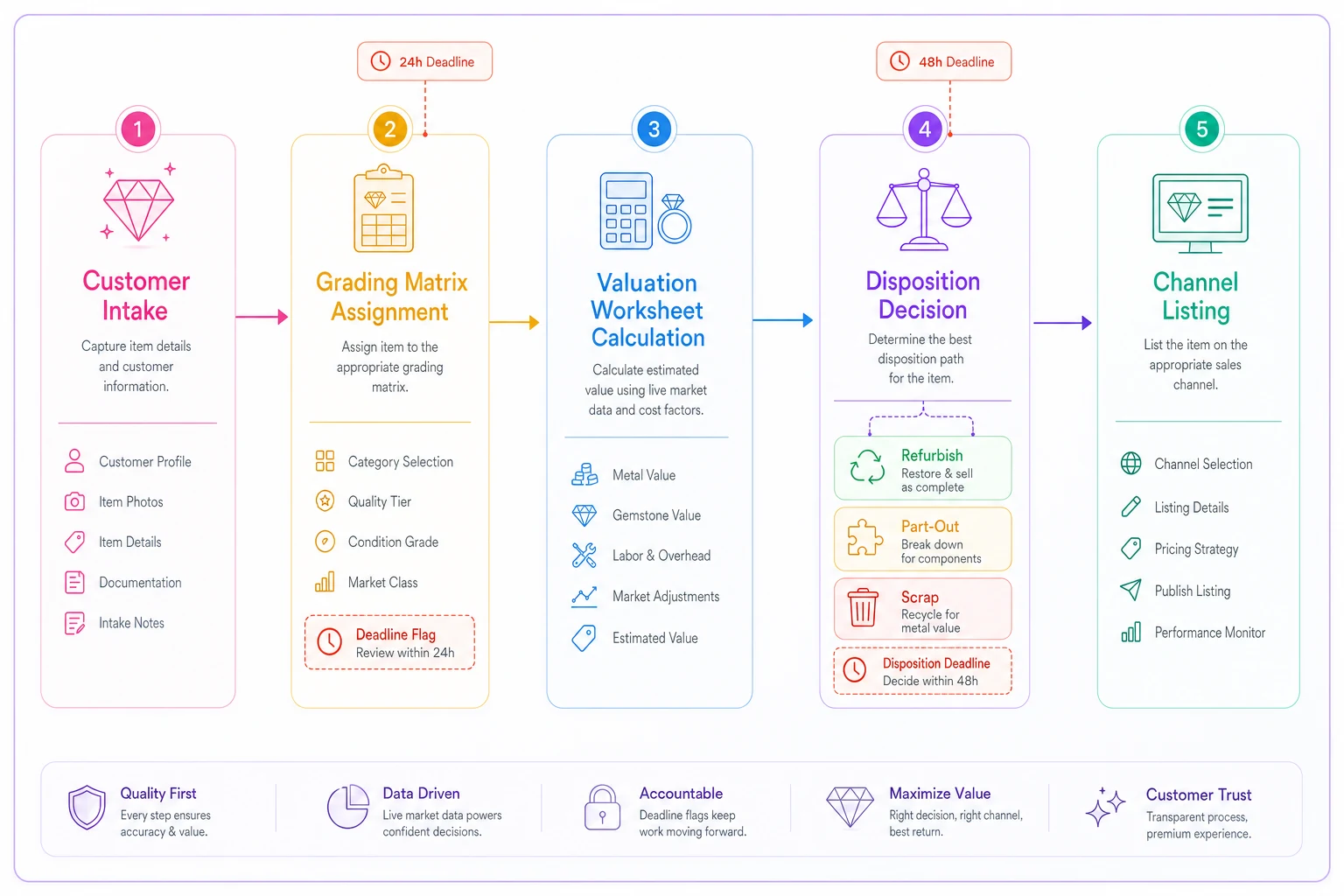
A simple visual of the intake → grade → value → disposition → listing flow makes it obvious where information gets lost and where deadline flags should sit.
Keep the intake ticket physically attached or use a barcode/label so the grading and valuation data never separate from the piece.
Nothing fancy — just making sure the piece and its information never get separated, and that deadlines get enforced without someone having to remember to check.
Getting started this week
You don't need to build all of this at once. Start with what hurts most:
-
Build the four-tier grading matrix for rings first — it's most of your volume.
-
Create the four-input valuation worksheet and require it on every trade-in over a threshold you set.
-
Set the three turnaround deadlines and assign one owner to the weekly disposition review.
-
Pull your last quarter of scrapped trade-ins and re-grade a sample. If more than a fifth of them should have been refurb or part-out, you've found real money.
Trade-ins are one of the few inventory sources where you control the acquisition price and the disposition. That's a rare amount of leverage. The stores that lose money on trade-ins aren't paying too much at the counter — they're deciding too slowly and too randomly on the back end. Fix the grading and the decision rules, and the margin was there the whole time.
Trade-ins are one of the few inventory sources where you control the acquisition price and the disposition. That's a rare amount of leverage. The stores that lose money on trade-ins aren't paying too much at the counter — they're deciding too slowly and too randomly on the back end. Fix the grading and the decision rules, and the margin was there the whole time.
Ready to elevate your jewelry store operations?
Join 500+ jewelers using Jewlyly to increase efficiency, reduce errors, and grow revenue.