


Jewelry consignment falls apart in predictable ways. A customer brings in her grandmother's estate pieces, you agree on a 60/40 split, and three months later you're arguing about whether that emerald ring was priced at $4,200 or $4,500. Another consignor insists they never agreed to reduce their vintage Rolex after 90 days, even though you're certain you covered that conversation.
The disputes aren't really the problem. The problem is that most jewelry stores treat consignment like a side business rather than a legitimate revenue stream that needs actual operational structure. Handwritten agreements in filing cabinets. Commission math on sticky notes. Reconciliation happening whenever someone gets around to it.
Stores that take consignment seriously can see it generate 15–25% of monthly revenue. Stores that wing it barely break even once you account for dispute resolution and the time spent tracking down paperwork.
The intake contract fields that actually prevent disputes
Most consignment contracts miss the fields that matter. Name, address, and commission percentage aren't enough.
You need an explicit price reduction schedule. Not some vague clause buried in paragraph seven about prices "may be adjusted." An actual table:
-
Original asking price
$4,500
-
After 30 days
$4,200
-
After 60 days
$3,900
-
After 90 days
$3,600 or return to consignor
Include a minimum acceptable price field. This prevents the awkward mid-sale phone call when a customer offers $2,800 and you have no idea if the consignor will take it. Get the number upfront.
Authentication and condition documentation needs its own dedicated section — not just "14k gold ring with emerald," but:
-
Metal purity verification method (tested/stamped/certified)
-
Stone details including any treatments
-
Existing damage or wear
-
Missing stones or parts
-
Previous repairs visible
Insurance responsibility is another field most contracts skip entirely. Who covers the piece if it's stolen? What if it's damaged during normal display? Most stores assume this is understood, then get blindsided when something goes wrong.
The payout preference section saves more headaches than people expect. Check mailed? Direct deposit? Store credit? Cash pickup? Get it documented at intake with backup contact info. Same goes for a return condition clause — if something doesn't sell, what state does it need to be in for the consignor to take it back? That field prevents consignors from claiming damage that was there when they walked in.
Building an intake checklist that protects both parties
The physical intake process needs to be standardized beyond just filling out forms. Too many stores rush through it and miss details that turn into problems two months later.
Never miss a sale or shipment again.
Jewlyly helps you manage orders, track inventory, and engage customers seamlessly.
- Real-time inventory tracking
- Automated customer notifications
- Sales and order analytics
No credit card required
Take photos before the consignor leaves. Six minimum:
-
Full piece from above
-
Angle showing hallmarks
-
Close-up of any stones
-
Back or inside view
-
Problem areas (scratches, worn prongs)
-
Piece on scale showing weight
Create a consistent intake station. Nothing fancy — just the same setup every time. Magnifying lamp, scale, camera mount, metal testing kit, printed forms, all in one spot. When things are scattered across the store, steps get skipped.
The verification sequence matters too.
Test metals while the consignor is still there. Even if they insist it's 18k, test it and document the actual result, not just "verified gold." This prevents any later suggestion that you switched their piece.
Weigh everything and put it on the contract. Include total weight and, for pieces with stones, note "total weight including stones." This protects against claims of switched stones or missing metal down the line.
Check for loose stones and damaged settings. Run a fingernail over the prongs. Tap pieces lightly and listen for rattling. A loose stone that falls out two weeks later becomes your liability if you didn't note it at intake.
Talk through display and pricing openly. Where will the piece sit? Does it go in the safe overnight? Can customers try it on? Some consignors have strong preferences, and not surfacing them upfront creates friction later.
Simple pieces should take 15–20 minutes. Complex estate lots can run 45 minutes. Rushing intake to "save time" usually costs hours in dispute resolution.
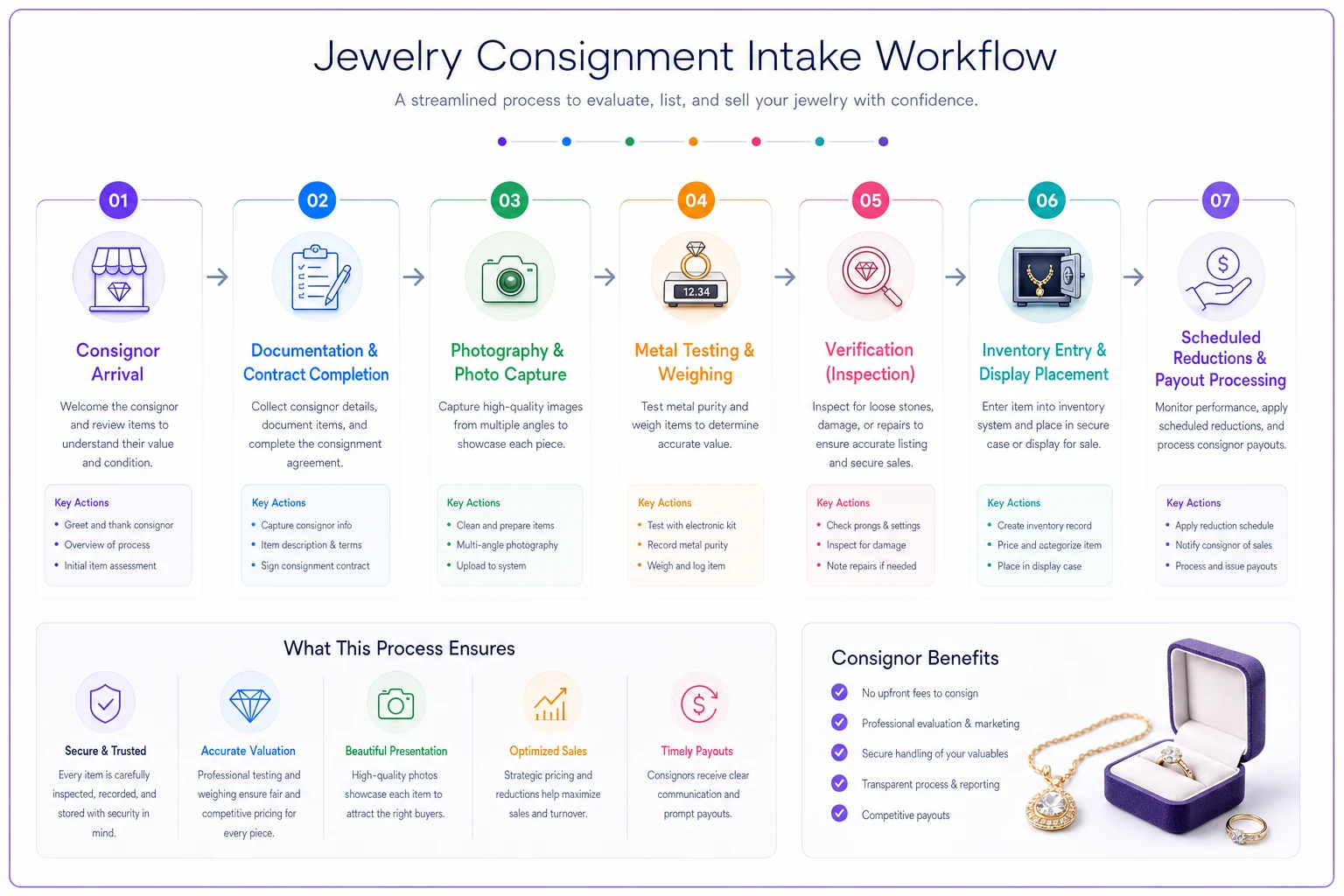
Visualize the intake workflow with this simple diagram.
Use a plain neutral background and include a ruler or scale in photos for reference.
Keep the station consistent and follow the verification steps every time to prevent disputes later.
Commission calculations that eliminate confusion
Commission math feels simple until you're calculating splits on bundled sales, negotiated prices, or pieces that moved during a storewide promotion. Clear calculation rules prevent most payout disputes.
Standard full-price math is easy. Item lists for $3,000, sells for $3,000, consignor gets 60% ($1,800), store keeps 40% ($1,200). But this rarely describes what actually happens on the floor.
Negotiated sales need explicit rules. Customer offers $2,700 on a $3,000 piece. Who absorbs the discount? Three approaches work:
Proportional split: Both parties absorb the discount in proportion to their split. $2,700 sale means consignor gets 60% of $2,700 ($1,620), store gets 40% ($1,080). Most common, and generally the fairest.
Store absorbs up to X%: Store absorbs the first 10% discount out of their commission. At $2,700 (10% off), consignor still gets $1,800, store gets $900. Beyond 10%, proportional split kicks in.
Minimum guarantee: Consignor always gets at least a set percentage of the original list price. If guaranteed 50% of $3,000 ($1,500 minimum), any sale above $2,500 means the store keeps the excess.
Here's how those play out with real numbers:
| Sale Scenario | List Price | Sale Price | Proportional (60/40) | Store Absorbs 10% | 50% Minimum |
|---|---|---|---|---|---|
| Full price | $3,000 | $3,000 | C: $1,800 / S: $1,200 | C: $1,800 / S: $1,200 | C: $1,800 / S: $1,200 |
| Small discount | $3,000 | $2,700 | C: $1,620 / S: $1,080 | C: $1,800 / S: $900 | C: $1,620 / S: $1,080 |
| Large discount | $3,000 | $2,400 | C: $1,440 / S: $960 | C: $1,440 / S: $960 | C: $1,500 / S: $900 |
(C = Consignor, S = Store)
Bundled sales are more complicated. Customer buys three consignment pieces together for $8,000 when they're individually priced at $3,000 + $2,500 + $3,500 = $9,000. You can't apply a flat reduction across everything if the pieces have different commission rates or different consignors.
Weighted reduction: Each piece absorbs the discount proportional to its share of the original total. The $3,000 piece represents 33.3% of the $9,000, so it absorbs 33.3% of the $1,000 discount.
Priority order: Discount applies to pieces in a specific documented order — oldest inventory first, highest commission rate first, whatever you decide. The key is that it's written into the contract before the sale happens.
One more thing worth spelling out explicitly: sales tax. If you sell a $3,000 piece and collect $240 in tax, the commission calculates on $3,000, not $3,240. Obvious to you. Not always obvious to a consignor looking at the total on a receipt.
Realistic timelines from intake to payout
Vague promises like "payment within 30 days of sale" cause disputes because consignors have wildly different ideas of when that clock starts. Your timeline needs to be specific and written into the contract.
A functional structure:
Intake to display: 2–3 business days. Pieces need photography for online listings, pricing research if needed, and entry into your inventory system. Don't promise same-day display unless you have staff dedicated to consignment intake.
Display period: 90–120 days for an initial term. Shorter periods mean constant returns and reprocessing. Longer periods mean display space tied up with stale inventory. Most stores use 90 days with optional 30-day extensions.
Sale to verification: 24–48 hours. Confirm the sale processed correctly, payment cleared, no return is pending. Don't cut checks for sales that might reverse.
Verification to payout: 15–30 days is standard. Batching payouts makes sense operationally — cutting individual checks daily is inefficient. But stretching it to 45–60 days frustrates consignors and generates unnecessary complaints.
A realistic timeline might look like:
-
Day 1
Intake and documentation
-
Day 3
Piece displayed in store and online
-
Day 45
First price reduction (if applicable)
-
Day 78
Piece sells
-
Day 80
Sale verified, added to payout batch
-
Day 95
Check cut in bi-monthly payout run
-
Day 97
Check mailed or available for pickup
Put specifics in the contract. Something like "payouts processed on the 15th and last day of each month for sales verified by the 10th and 25th respectively" leaves no room for interpretation.
Also build in buffer time for the situations that fall outside the normal flow. Estate consignments with 40+ pieces take longer to process. High-value items may need additional authentication. International consignors can have longer payout processing requirements for tax documentation.
Monthly reconciliation samples that actually work
Most stores either skip monthly reconciliation entirely or do such a surface-level pass that errors accumulate until consignors start calling with questions. That's the wrong way around.
Start with a three-list comparison:
Physical inventory: What consignment pieces are actually in your store right now?
System inventory: What does your POS show as active consignment stock?
Consignor records: What do your contracts say should be on hand?
Discrepancies between these three lists surface problems immediately — missing pieces, sold items still showing as available, returned items still in the system, intake paperwork that never made it into the POS.
Here's what an actual reconciliation worksheet looks like for one consignor:
| Item | Contract # | List Price | Status-Physical | Status-System | Status-Contract | Action Needed |
|---|---|---|---|---|---|---|
| Diamond tennis bracelet | MT-0315-001 | $4,500 | In case | Active | Active | None |
| Pearl necklace | MT-0315-002 | $1,200 | Not found | Active | Active | Locate or investigate |
| Gold cocktail ring | MT-0315-003 | $2,800 | In case | Sold 5/12 | Active | Process payout |
| Emerald earrings | MT-0315-004 | $3,200 | In case | Active | Returned 5/30 | Update contract, return item |
Three issues visible immediately: a missing pearl necklace that needs investigation, a sold ring with no payout processed, and earrings marked as returned that are still sitting in the case.
Run reconciliation on the same date each month. The 5th tends to work well — month-end sales reports are finalized, but there's still enough time to correct issues before mid-month payouts go out.
For stores with 50+ consignment pieces, break it into weekly chunks. Week 1: consignors A–F. Week 2: consignors G–M. Single-day reconciliation sessions for large inventories lead to rushed mistakes.
Document findings even when everything matches. A simple log entry — "June reconciliation: 47 pieces verified, no discrepancies" — provides evidence of proper management if a dispute comes up months later.
Also track patterns. If the same consignor consistently has discrepancies, your intake process for their items might need tightening. If small earrings or loose stones keep showing inventory issues, your storage protocols might need a second look.
Preventing the slow-motion disasters
Consignment operations rarely blow up all at once. They deteriorate through accumulated small failures. A missing document here, a calculation done slightly differently there, a payout batch that slips two weeks. Then one day you're managing disputes instead of sales.
The stores that run profitable consignment share certain habits. They treat intake with the same seriousness as buying inventory outright. They maintain documentation standards even when they're slammed. They reconcile monthly even when everything seems fine. They use documented commission rules instead of making judgment calls deal by deal.
Spending a few hours building solid contract templates, intake checklists, and reconciliation spreadsheets pays back quickly. But more than the time savings, it changes what consignment actually is for your business — from an ongoing source of friction to a reliable revenue stream.
The operational discipline involved isn't excessive. It's mostly about consistency: take the photos every time, run the calculations the same way, process payouts on schedule. These aren't complex tasks. They just require choosing process over convenience.
When consignment runs well, it creates a real feedback loop. Satisfied consignors refer others. Word gets around that you're trustworthy. Better quality pieces come in. Sales follow. The initial investment in building proper procedures compounds over time in ways that are genuinely hard to replicate through any other operational change.
The math on this is pretty straightforward: invest in structure now, or pay for it later in disputes, damaged relationships, and lost revenue. Prevention is almost always cheaper than correction in jewelry consignment.
Ready to elevate your jewelry store operations?
Join 500+ jewelers using Jewlyly to increase efficiency, reduce errors, and grow revenue.