


Most jewelry claims don't get denied because something sketchy happened. They get denied — or underpaid — because the retailer couldn't prove what was lost, couldn't prove what it was worth, or submitted the claim in a format that gave the adjuster room to haggle. The theft happened. The pipe burst. The package vanished. None of that is in dispute. What's in dispute is your paperwork.
By the time you need the claim, it's already too late to fix the gaps. The photo you didn't take, the appraisal that expired, the serial number you never logged — those decisions were made months or years before the loss event. A real jewelry insurance claims playbook isn't a document you open after a loss. It's a set of habits that make the claim almost boring to file.
This article covers three things most jewelers get wrong: choosing the right insurer for the type of risk you actually carry, building an evidence package that an adjuster can't pick apart, and reconciling the eventual payout against your books so you actually know whether you came out whole.
Not all jewelry risk is the same — and neither are the insurers
The single biggest mistake we see is treating "jewelry insurance" as one product. A retailer signs a Jewelers Block policy, assumes it covers everything, and then discovers during a claim that in-transit loss had a sub-limit a quarter of what they thought, or that off-premises theft required a specific alarm certification they never maintained.
Different loss types behave completely differently in a claim. Theft from a locked safe during business hours is a different animal than mysterious disappearance, which is different from carrier loss in transit, which is different from damage during a bench repair. Some carriers are generous and fast on one and brutal on another.
Here's a decision matrix worth using when you're evaluating where a given risk type actually belongs:
| Risk type | What usually goes wrong in the claim | What the right insurer looks like | Red flag to avoid |
|---|---|---|---|
| On-premises theft / burglary | Alarm or safe spec not maintained to policy terms | Clear alarm/safe requirements in plain language, no surprise certifications | Vague "approved protective devices" wording |
| Mysterious disappearance | Insurer disputes whether a "loss" even occurred | Carrier with explicit mysterious-disappearance coverage and a reasonable proof bar | Policies that exclude it entirely or bury a tiny sub-limit |
| In-transit / shipping loss | Sub-limits far below shipment value; carrier vs. insurer finger-pointing | High per-package and per-conveyance limits, parcel carrier agnostic | Default limits that assume you ship cheap goods |
| Memo / consignment goods | Dispute over whether unsold vendor goods are "yours" to claim | Explicit memo coverage with vendor documentation path | Silence on consignment in the policy wording |
| Bench / repair damage | Blame shifts between store and customer's own insurer | Coverage for customer goods in your care, custody, control | Exclusions for "property of others" |
| Off-site events / trunk shows | Off-premises coverage lower than showroom; location not scheduled | Flexible off-premises scheduling you can update per event | Static schedules requiring 30-day notice |
The pattern worth internalizing: you don't pick an insurer, you pick the insurer whose strengths line up with your actual risk concentration. A store doing heavy e-commerce fulfillment lives or dies on in-transit limits. A high-foot-traffic showroom with memo goods from five vendors has a completely different center of gravity. Map your loss exposure first, then shop carriers against that map — not against premium alone.
One underrated step: ask any prospective carrier for their average claim-to-close timeline by loss type, and ask it specifically. "How fast do you pay a burglary with a police report?" gets you a different answer than "how fast do you pay a mysterious disappearance?" Carriers who get cagey on the second question are telling you something.
When a specialty Jewelers Block policy makes sense — and when it doesn't
Specialty block coverage almost always wins for a dedicated jewelry retailer carrying real inventory value. The exception is the very small operator — a part-time estate reseller moving a handful of pieces a month — where a scheduled rider on a business policy might be cheaper and the claim complexity is low enough not to matter.
Who should not go the cheap route: anyone shipping high-value parcels regularly, anyone holding memo goods, and anyone with a bench doing customer repairs. In those cases a generic policy will have exactly the sub-limits and exclusions that bite during a claim.
The evidence package: what "insurer-grade" actually means
Adjusters aren't trying to be difficult. They're trying to establish two facts: that the item existed and was in your possession, and that it was worth what you say. Everything in your evidence package should serve one of those two goals. If a document does neither, it's noise.
Never miss a sale or shipment again.
Jewlyly helps you manage orders, track inventory, and engage customers seamlessly.
- Real-time inventory tracking
- Automated customer notifications
- Sales and order analytics
No credit card required
The problem is that most stores capture evidence reactively — scrambling after the loss to pull whatever photos and invoices they can find. What you get is inconsistent: some items photographed well, others with a blurry phone shot from two years ago, a few with no image at all. An adjuster seizes on the gaps. If three of your twelve claimed pieces have no contemporaneous photo, they'll question all twelve.
The fix is boring and it works: every high-value piece gets a standardized evidence record at intake, before it ever sits in a case. We've covered the image side of this in the jewelry product photography SOP work and the broader certificate and appraisal workflow, and the same discipline is exactly what an insurer wants to see.
What an insurer-grade record contains
-
Multiple photos — overhead, side, hallmark/stamp close-up, and any inclusions or distinguishing features visible under magnification
-
Metadata intact — original capture date embedded in the file, not stripped by a re-export or a messaging app
-
Consistent filename convention tying the image to the SKU or item ID so the photo isn't an orphan
-
The appraisal or lab certificate, with the appraisal date and appraiser credentials
-
Purchase or acquisition invoice showing your cost and acquisition date
-
Serial numbers or laser inscriptions logged as text, not just visible in a photo
-
Current replacement valuation dated within the window your policy requires (many require revaluation every 2–3 years)
The metadata point is the one that trips people up most often. A photo with no embedded date proves the item exists but not when you had it. A screenshot of a screenshot proves almost nothing. When you re-export images for a product feed or a social post, you often strip the original EXIF data — which means your "evidence" photo now carries the same evidentiary weight as something you could have taken yesterday. Keep an untouched master copy of every capture.
Keep an untouched master copy of every capture so EXIF metadata remains intact.
The filing format matters more than people think
An adjuster working through forty claims this month will process the clean submission first and the messy one last. "Last" sometimes means after they've already made up their mind to lowball. A submission that arrives as a single organized package — item list, per-item evidence, valuations, police report, and a plain-language loss narrative — gets taken seriously in a way that a drip of forwarded emails never does.
-
Cover summary — loss date, loss type, total claimed value, policy number, contact
-
Loss narrative — factual, chronological, no speculation about who or why
-
Itemized schedule — one row per lost item
item ID, description, serial/inscription, your cost, appraised/replacement value, claimed value
-
Per-item evidence appendix — photos, appraisal, invoice grouped by item ID
-
Supporting documents — police report, carrier loss confirmation, alarm log, or repair ticket depending on loss type
-
Prior correspondence — any report numbers, claim numbers, or acknowledgments
The itemized schedule is where most money is won or lost. When each row cleanly links "this item → this serial → this appraisal → this photo," there's nothing to argue about. When the link is fuzzy, every fuzzy row becomes a negotiation.
Here's a simple workflow graphic to visualize assembling the submission package.
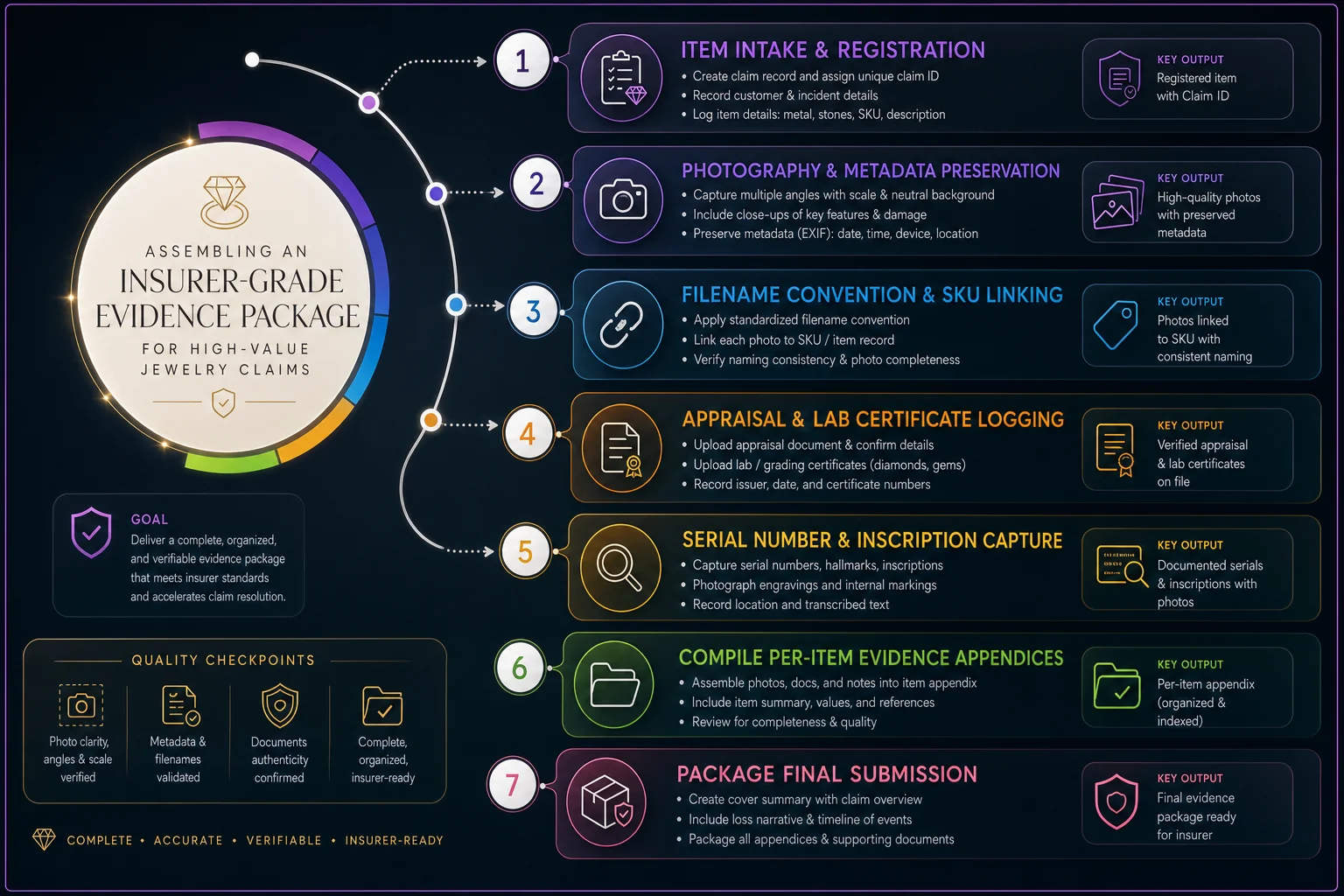
Keep the submission structure consistent so an adjuster can trace each claimed line straight through to its supporting documents.
A real scenario: the in-transit loss that almost got halved
A mid-size retailer shipped a repaired three-stone ring and a loose 1.4ct diamond to a customer — combined declared value around $18k. The parcel never arrived; the carrier confirmed loss. The store filed with their Jewelers Block carrier expecting a clean payout.
First offer from the adjuster: roughly $9k–$10k. Their reasoning was that the loose diamond's valuation was from a four-year-old appraisal, and they questioned whether the repaired ring — which had been modified — still matched its original appraisal description.
Here's what saved it. The store had dated intake photos with intact metadata for both pieces, the loose stone had a logged GIA inscription number that matched the lab report exactly, and the repair ticket documented the modification with before-and-after images. They resubmitted with the serial match front and center and the repair documentation attached to that specific line item.
The revised payout came in around $16,500 — not the full $18k (the four-year-old valuation did cost them something on replacement cost basis), but close to double the first offer. The entire difference came from documentation captured before the loss, not after. The lesson they took was to tighten revaluation cadence so no scheduled stone ever drifts past three years without a fresh appraisal.
If you ship high-value parcels regularly, that side of the risk deserves its own hard look — we broke it down in the shipping playbook for high-value jewelry orders, and the declared-value and packaging decisions covered there directly affect how clean an eventual claim turns out.
Timeline expectations: what a claim actually looks like week to week
Owners get anxious during claims mostly because they don't know what normal looks like, so every quiet week feels like a bad sign. Rough expectations for a well-documented claim:
-
Days 0–3 Report the loss, get a claim number, file the police report or carrier loss confirmation. Do not wait on this — late reporting is a gift to the adjuster.
-
Week 1 Submit the full evidence package. The faster this is complete, the faster the clock runs in your favor.
-
Weeks 2–4 Adjuster review, possible questions or requests for additional documentation. This is where clean filing pays off — unclear submissions generate more back-and-forth and can stretch this phase for weeks.
-
Weeks 4–8 Valuation agreement and settlement offer. Larger or disputed claims run longer; a straightforward documented burglary can settle faster.
Every time the adjuster has to come back to you with a question, you lose roughly a week to the round trip. The entire value of a tight evidence package is that it collapses this cycle. Stores that submit everything cleanly on day one routinely close in half the time of stores that drip documents over a month.
Reconciling the payout against your P&L
This is the step almost everyone skips, and it's where you find out whether the claim actually made you whole. A payout lands in the bank, everyone exhales, and nobody checks it against what the loss actually cost. The result is a hidden hole in your margins that shows up later as inventory that doesn't reconcile.
Worked example
| Line | Amount |
|---|---|
| Replacement cost to re-source both pieces | ~$13,500 (your cost, not retail) |
| Insurance payout received | +$16,500 |
| Policy deductible | −$1,000 |
| Net payout after deductible | $15,500 |
| Covered against your actual cost | +$2,000 cushion over cost |
On paper this looks like a win — the payout exceeded replacement cost. But the reconciliation isn't done. You also lost the gross margin on a sale that was already made (the customer still needs their pieces, so you re-source and re-ship at cost), you absorbed staff time on the claim, and your loss ratio just moved, which affects renewal premium. A payout that beats your cost basis can still be a net drag once the renewal bump is priced in over the following years.
A simple post-claim reconciliation checklist
-
[ ] Payout amount matches the agreed settlement figure to the dollar
-
[ ] Deductible applied is the correct deductible for that loss type
-
[ ] Replacement cost of lost inventory removed from on-hand value
-
[ ] Any valuation gap (what you claimed vs. what you got) logged as a loss
-
[ ] Staff hours spent on the claim roughly estimated and noted
-
[ ] Renewal premium impact flagged for your next policy review
-
[ ] Root cause recorded so the same loss type doesn't repeat
That last line is the one that pays off over years. A store that reconciles claims consistently starts to see which loss types keep recurring — and that pattern tells you whether the problem is a carrier mismatch, a process gap, or a premium you're overpaying for coverage you never use.
Where software quietly carries the weight
Most of what makes a claim go smoothly isn't a decision you make during the claim — it's whether the evidence was captured and kept in order long before. That's fundamentally a data-discipline problem, and it's where operational software earns its keep without anyone thinking about insurance day to day.
When intake photos, metadata, serial numbers, appraisals, and valuations are captured as part of normal item intake — tied to the SKU, dated, and stored so nothing gets orphaned — the evidence package essentially assembles itself. Automated reminders when an appraisal is aging past your revaluation window mean no scheduled stone silently drifts out of date. And when a loss does happen, pulling a clean itemized schedule with linked evidence becomes an export, not a two-day scramble.
The point isn't the software. The point is that the claim becomes boring, and in insurance, boring is exactly what you want.
The takeaway
The retailers who do well on claims aren't luckier or better at negotiating. They've just front-loaded the work. They matched their insurer to their real risk concentration instead of chasing the lowest premium. They capture insurer-grade evidence at intake as a reflex. They submit clean, itemized packages that leave adjusters nothing to haggle over. And they reconcile every payout against their actual P&L so they know whether they came out ahead.
A jewelry insurance claims playbook is really just a set of decisions you make before anything goes wrong, so that when it does, the claim is a formality instead of a fight. Build those habits now, while nothing is on fire — because the day you need them, it's already too late to start.
Ready to elevate your jewelry store operations?
Join 500+ jewelers using Jewlyly to increase efficiency, reduce errors, and grow revenue.