

Most estate buys don't go sideways because someone paid too much. They go sideways months later — when a family member calls asking about grandma's ring, when an insurance adjuster wants provenance you never captured, or when a piece you priced at $4,200 turns out to have a repair-shop replacement center stone you never caught. The margin was fine at intake. The problem was everything you didn't write down.
Estate jewelry is the one category where the counter transaction and the legal exposure happen at the exact same moment. You're buying from someone who's often grieving, sometimes selling under financial pressure, and occasionally selling something that isn't fully theirs to sell. A tight intake process isn't bureaucracy — it's the difference between a clean resale and a piece you can't legally move, or a chargeback you can't defend.
This is a working checklist for that moment at the counter, plus the fields you need to capture so the piece flows cleanly into valuation, disposition, and channel prep.
Where estate buys actually break
Before the checklist, it's worth being honest about the failure points, because they're not the ones people expect.
The first is provenance gaps that surface at resale, not intake. You buy a 1960s Omega and a diamond tennis bracelet from an estate. Six weeks later a buyer asks "where did this come from?" and all you have is a first name and a cash payout. That's not fraud on your part, but it looks bad, and for higher-value pieces it can kill the sale.
The second is valuation errors baked in by rushed inspection. Estate pieces are frequently modified — recut stones, replaced heads, laser-welded shanks, aftermarket clasps. This usually happens when a buyer eyeballs a piece, quotes off metal weight and a rough stone estimate, and never loupes the mounting. A replaced center stone or a repair-welded shank can swing resale value 20–40%.
The third, and the one that generates actual legal risk, is buying something the seller doesn't have clear title to. Divorce disputes, contested estates, and the occasional stolen piece all show up at the counter looking completely ordinary. Your protection isn't intuition. It's ID capture, a signed statement of ownership, and a hold period that matches your local requirements.
The intake checklist
Run this at the counter, in order, before money changes hands. It takes roughly eight to twelve minutes per lot once your staff has done it a few times — and that time is entirely worth it.
Never miss a sale or shipment again.
Jewlyly helps you manage orders, track inventory, and engage customers seamlessly.
- Real-time inventory tracking
- Automated customer notifications
- Sales and order analytics
No credit card required
Seller identity and authority
-
Government photo ID scanned or photographed, tied to the transaction record
-
Seller's relationship to the item (owner, heir, executor, agent)
-
If executor/agent
note of documentation shown (letters testamentary, POA)
-
Signed statement of ownership / right to sell
-
Contact details verified against ID address
Item-level provenance
-
How the seller acquired it (inherited, purchased, gift) and rough date
-
Any original documents
receipts, prior appraisals, certs, warranty cards
-
Original box/papers present (yes/no — this matters on branded pieces)
-
Known service or repair history the seller can recall
-
Engravings, monograms, or hallmarks photographed and transcribed
Physical condition and authenticity
-
Metal tested (not assumed from stamp) — acid, XRF, or specific gravity noted
-
Each stone
loupe inspection for replacement, damage, treatment indicators
-
Mounting inspected for repair welds, replaced heads, mismatched prongs
-
Weight recorded (gross and, where relevant, estimated stone-excluded)
-
Photos
overall, hallmark/stamp, each significant stone, any damage or repair
Valuation inputs
-
Live metal spot at time of quote (recorded, not remembered)
-
Melt value floor calculated
-
Resale-as-is estimate vs. refurb-and-resale estimate
-
Comparable sold references if it's a branded or notable piece
Skipping the metal-test line is the single most common shortcut, and it's the one that costs real money on plated or low-karat pieces sold with a convincing stamp.
Chain-of-custody and provenance capture fields
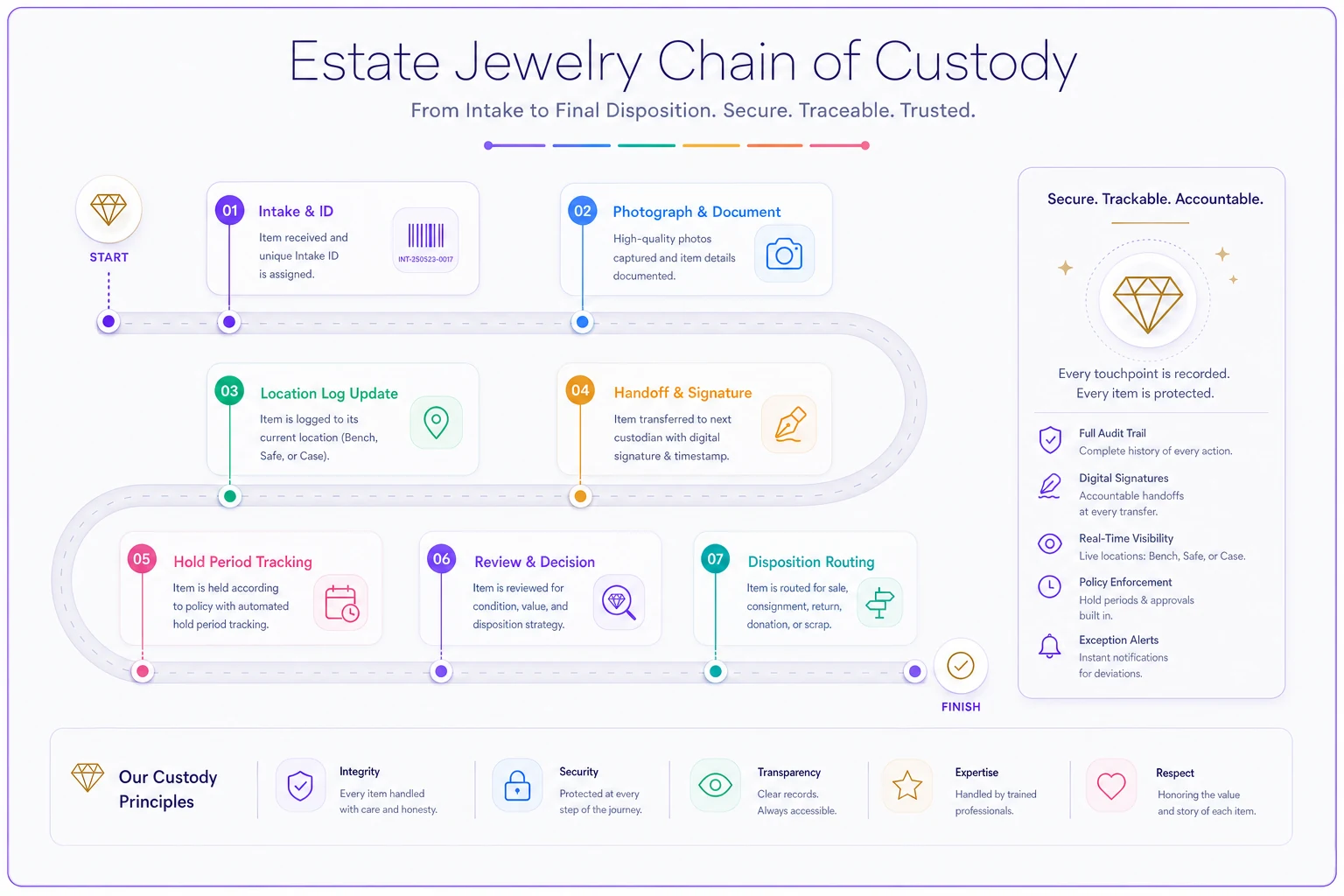
Once the item is bought, it needs to move through your shop without losing its history. This is where a lot of stores fall down — the intake sheet lives in a drawer while the piece goes to the bench, then to a case, and by the time it sells the paper trail is completely disconnected from the item.
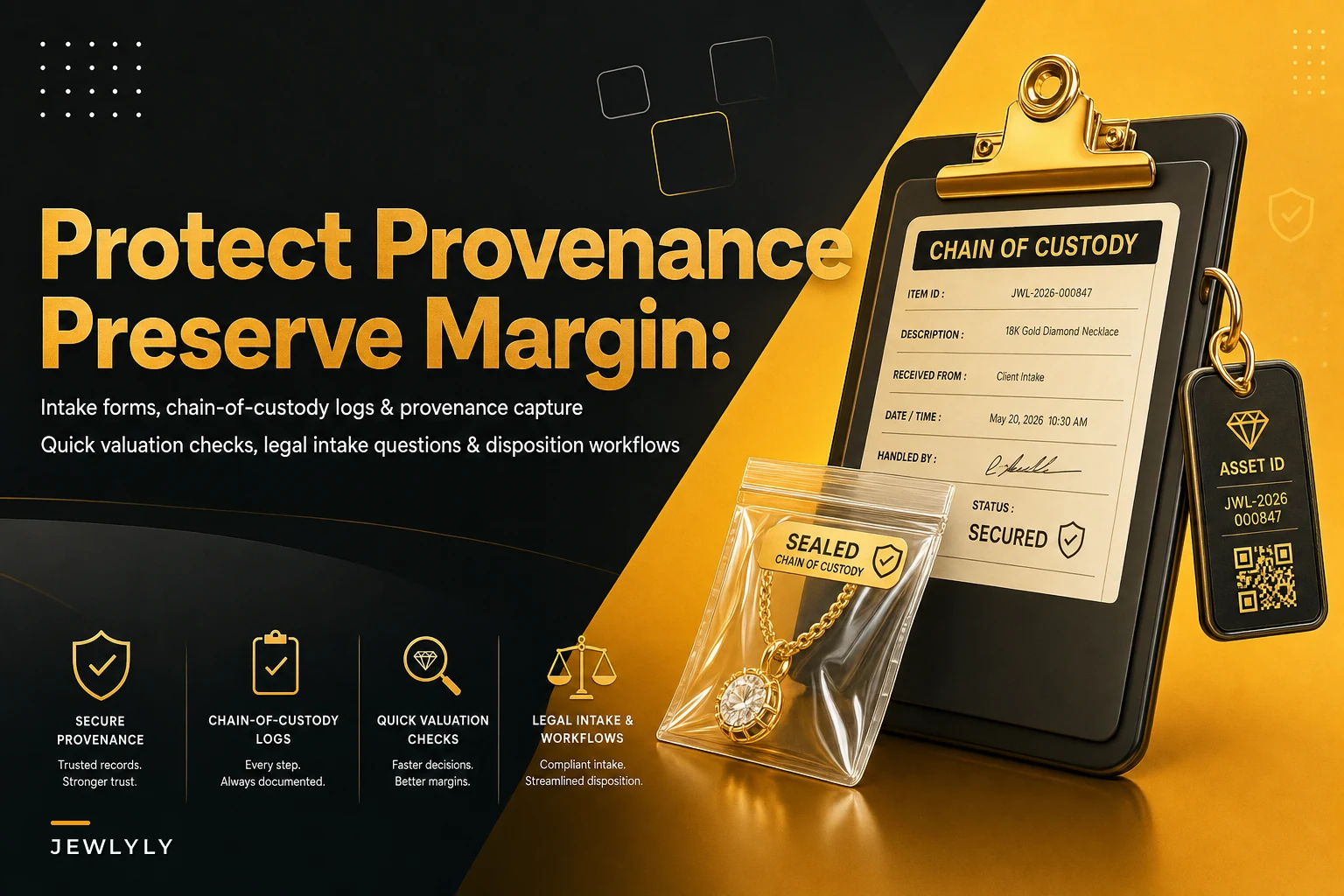
The fix is a chain-of-custody record that follows the item by ID from the moment it enters. Minimum fields:
| Field | Why it matters |
|---|---|
| Intake ID / lot number | Ties every photo, note, and appraisal to one item |
| Date/time in + buyer initials | Establishes when you took possession |
| Hold status + release date | Enforces your local hold period before resale/melt |
| Location log | Bench, safe, case, sent-out — with dates |
| Handoff signatures | Who had it, when, and who received it next |
| Disposition decision | Melt, refurb-and-resell, as-is, consign, wholesale |
| Final outcome + date | Closes the loop for audits and returns |
The location log matters more than people think. When a piece "goes missing" in a small shop, it's almost never theft — it's an untracked handoff between the buyer and the bench. A simple in/out log with initials clears up the vast majority of those situations.
For higher-value or branded pieces, keep the provenance capture separate from the transaction record so it travels with the item into your catalog.
A simple visual helps staff follow the chain of custody.
When you eventually list it, that captured history becomes selling copy: original box and papers, prior appraisal on file, single-owner since 1978. Those details move product.
Quick valuation checks that stop you from overpaying
You don't need a full appraisal at the counter. You need three fast checks that catch the expensive mistakes.
-
Metal floor first. Test the metal, weigh it, calculate melt at live spot. This is your absolute floor and it should be recorded on the ticket. On a scrap-heavy lot, melt is often the real number and everything else is upside.
-
Stone reality check. Loupe every center and accent stone for signs of replacement or damage before you value them. A typical scenario: a ring quoted at $3,800 on the assumption of a natural 1.2ct center, where a ten-second loupe check reveals abraded girdle facets and a slightly-off table flagging it for lab testing. If it comes back lab-grown, the resale number drops by more than half.
-
Modification scan. Check the mounting for repair welds, replaced heads, and mismatched prongs. Modified pieces aren't worthless — but they're refurb candidates, not as-is pieces, and that changes both disposition and price.
The pattern worth internalizing: estate valuation errors almost always come from valuing the piece you assumed, not the piece in front of you. Two minutes with a loupe and a metal tester eliminates most of them.
If you're buying enough estate volume to resell, it's worth building consistent grading standards into this step. The same discipline that makes trade-ins profitable through grading, valuation and channel rules applies directly to estate lots — the pieces move through your shop the same way.
Legal intake questions and the hold-period discipline
The legal questions aren't about interrogating a grieving widow. They're about creating a clean, documented record that protects you if anyone ever contests the sale.
-
Are you the legal owner of this item, or authorized to sell it?
-
How did you come to own it?
-
Is this item part of an estate currently in probate?
-
Is anyone else's authorization required to sell it?
-
Are you aware of any lien, claim, or dispute involving this item?
Then get the ownership statement signed. It's a single page, it takes thirty seconds, and it transforms a he-said-she-said dispute into a documented transaction where the seller made a written representation.
The hold period is the other non-negotiable. Most jurisdictions require you to hold purchased secondhand goods for a set number of days before resale or melt, and to report certain buys to local law enforcement. Build the release date into your chain-of-custody record so nothing gets sold or scrapped early. The expensive version of this mistake: melting a piece inside the hold window, then getting a stolen-property inquiry you can no longer resolve because the evidence is gone.
Check your specific local requirements — they vary significantly by state and city, and "I didn't know" is not a defense that holds up.
Disposition decision matrix
Once a piece is bought, held, and verified, it needs a channel. Defaulting everything to the showcase is a slow way to leak margin — good pieces sit for months, scrap takes up space, and nothing moves efficiently. A simple decision matrix keeps things moving.
| Piece profile | Best disposition | Why |
|---|---|---|
| Low-karat / plated / broken | Melt / refinery | No resale story, floor value only |
| Solid metal, dated style, decent stones | Refurb → resell as-is | Refresh lifts perceived value |
| Branded, papers present, good condition | Retail case + online listing | Provenance justifies premium |
| High-value, niche, no local demand | Wholesale or specialist consignment | Wrong local market wastes shelf time |
| Modified / questionable stones | Refurb or part-out | Salvage usable components |
Most shops miss this: disposition isn't really about a piece's quality, it's about where that piece will sell fastest at the best margin. A gorgeous Art Deco brooch is a dead asset in a shop whose customers buy engagement rings. Route it to the channel that actually has buyers for it.
Channel-specific preparation workflows
Each disposition path needs its own prep so the piece is actually ready to move.
Retail case: professional cleaning, refurb of any flagged issues, a fresh appraisal or valuation attached, and a full photo set. The provenance you captured at intake becomes the tag copy.
Online listing: everything above, plus consistent photography and a written condition disclosure. Estate pieces sell online partly because of their history — surface it. Disclosing modifications honestly prevents returns and chargebacks far more than it costs you sales.
Wholesale / dealer: minimal cosmetic prep, but complete verification. Dealers buy on accurate metal and stone data, not presentation. If you've verified authenticity properly, this is a fast, clean sale. The same authenticity discipline in your vendor scorecards and procurement SOPs applies in reverse when you're the seller.
Melt: confirm the hold period has cleared, record the payout against the refinery, and close the chain-of-custody record.
A real scenario
A two-location jeweler doing steady estate buys was running intake off a paper pad and gut feel. The recurring problems: pieces sitting untracked between counter and bench, occasional overpays on modified rings, and two contested-ownership situations in a single year that ate legal time and one full refund.
They tightened three things — mandatory metal testing and loupe check on every buy, a signed ownership statement on every transaction, and an intake ID that followed each piece through a simple location log. Nothing complicated.
Over the following several months, the overpay problem mostly disappeared because the modification scan caught issues upfront. The "where did this piece go" panics stopped. And when a family member called disputing an estate sale, they had a scanned ID, a signed statement, and a documented hold — the conversation wrapped up in about ten minutes instead of escalating to a lawyer's letter. Estate margins improved by a rough 6–9%, mostly from not overpaying on modified pieces previously valued as pristine.
When this level of rigor makes sense — and when it doesn't
If you're doing occasional low-value scrap buys off the street, the full provenance-and-chain-of-custody workflow is overkill. Test the metal, record the ID and hold, pay melt, done.
The full checklist earns its keep the moment you're buying pieces you intend to resell — anything where provenance, authenticity, or a contested-ownership risk affects the outcome. That's where the extra minutes at intake protect both your margin and your legal standing.
The stores that struggle with estate buys aren't usually the ones paying wrong prices. They're the ones treating a legally sensitive resale transaction like a quick cash exchange — and discovering, weeks later, that the missing paperwork was the whole point.
Ready to elevate your jewelry store operations?
Join 500+ jewelers using Jewlyly to increase efficiency, reduce errors, and grow revenue.