


Most jewelry retailers don't lose money to one dramatic fraud event. They lose it to a hundred small gaps that never talk to each other. The POS team catches a weird void but doesn't log it. The BNPL rep sees a decline pattern but has no way to flag it. Returns gets a suspicious "wrong size" claim on a $6k pendant and handles it as a routine restock. Each team is doing their job. Nobody is watching the whole board.
That's the real problem a jewelry fraud risk program solves. Not catching the single bad actor — stitching together the signals that already exist across your operation so they actually add up to something actionable. Fraud doesn't happen in one channel. Your detection shouldn't either.
This piece walks through how the whole system connects: which vectors matter for jewelry specifically, how to turn each into detection rules, what a usable evidence package looks like, how escalation flows without clogging up your bench, and what you review monthly so the program doesn't quietly rot.
Why jewelry fraud is a different animal
High ticket, high liquidity, easy to resize or reset. A stolen or fraudulently acquired diamond ring doesn't need a specialist fence — it moves through pawn, private sale, or gets broken for stones and metal within days. That speed is exactly why generic retail fraud playbooks fail here. By the time a chargeback lands 45 days later, the item is long gone.
The second difference is the transaction mix. A single sale can touch in-store POS, a financing provider, a gift card tender, a trade-in credit, and a later return. Fraud rides the seams between these systems. The loss almost always happens at a handoff — where one system's record doesn't reconcile cleanly with another's, and nobody owns the gap.
A program built around channel-by-channel defense misses the point entirely. You need a cross-functional map where a signal in one vector automatically raises suspicion in the others.
The vector map: where losses actually originate
Before you write a single rule, you need to know which doors fraud walks through. For jewelry specifically, five vectors generate the overwhelming majority of real losses. Each has its own tells.
Never miss a sale or shipment again.
Jewlyly helps you manage orders, track inventory, and engage customers seamlessly.
- Real-time inventory tracking
- Automated customer notifications
- Sales and order analytics
No credit card required
| Vector | Common jewelry-specific pattern | What it looks like operationally |
|---|---|---|
| POS anomalies | Manual price overrides, post-sale voids, discount stacking on high-ticket SKUs | A void entered after close, a 40% "employee adjustment" on a $9k watch |
| BNPL / financing | Synthetic identities, first-payment default, device/address mismatch | Approved financing, item collected same day, zero payments made |
| Returns / refunds | Switch fraud (real stone out, CZ in), empty-box, receipt-less refunds | "Didn't fit" return where the diamond weighs 0.3ct less than sold |
| Gift cards | Balance draining, cloned cards, refund-to-card laundering | Return credited to a gift card, drained online within the hour |
| Transfers / inventory | Transfer "shrinkage," fake transit holds, consignment diversion | Item logged as in-transit between locations, never arrives, no camera trail |
The insight most owners miss: these aren't separate problems. A returns-switch scam and a gift-card drain are frequently the same transaction. The switched-out stone gets returned for a gift card, the gift card gets laundered. If your returns rule and your gift-card rule live in different spreadsheets owned by different people, you'll catch neither.
Turning vectors into detection rules
A detection rule is just a condition plus a threshold plus an action. The art is setting thresholds that catch fraud without burying your staff in false positives. Set them too tight and your team starts ignoring alerts within a week. Too loose and you're reviewing every legitimate ring resize.
Here's a sample rule matrix you can adapt. Treat the thresholds as starting points — your own data will tell you where the real noise is.
| Rule ID | Vector | Condition | Threshold / trigger | Auto-action |
|---|---|---|---|---|
| POS-01 | POS | Void after batch close on item > $2,500 | Any occurrence | Flag + require manager note |
| POS-04 | POS | Discount override by same associate on > 3 high-ticket items | Within 7 days | Open investigation log |
| BNPL-02 | Financing | Same-day collection + address ≠ billing | Mismatch | Hold item 24h, verify |
| BNPL-05 | Financing | First-payment default on order > $4,000 | 1 missed | Evidence package auto-built |
| RET-03 | Returns | Return weight/measurement ≠ original record | Any variance | Quarantine + bench re-inspection |
| RET-07 | Returns | Receiptless refund > $1,000 to gift card | Any occurrence | Escalate to manager, no same-day credit |
| GC-02 | Gift card | Gift card created via refund, drained online | Within 48h | Freeze card, open case |
| TRF-01 | Transfers | Transit hold exceeds SLA by 48h | 2 days late | Reconciliation review |
The rules that pay for themselves fastest are the cross-vector ones — like RET-07, which links a returns event to a gift-card event. That's the seam where the real money leaks.
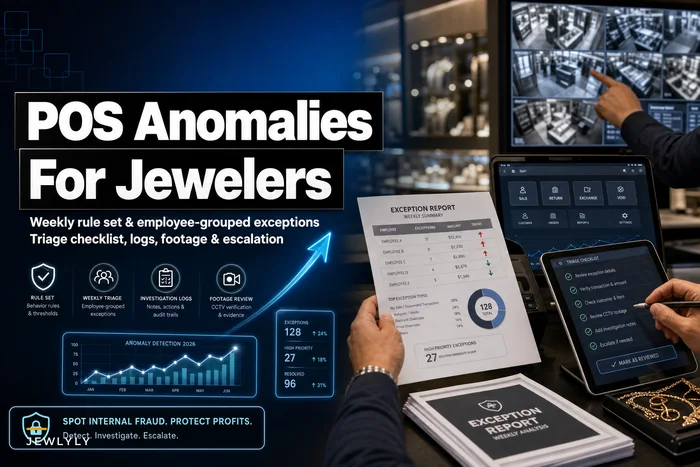
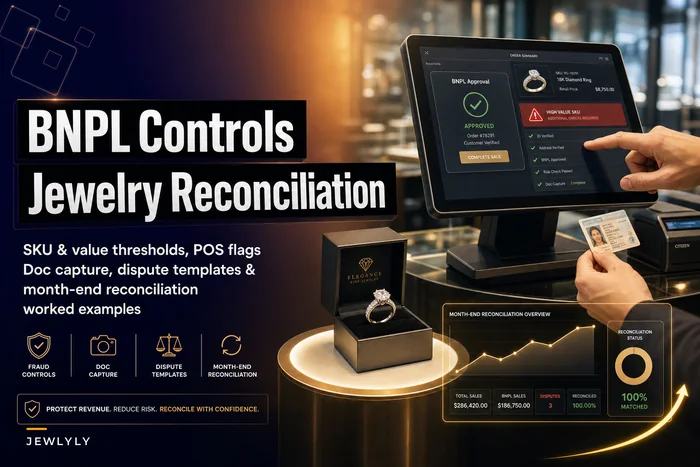
For the deeper mechanics on the POS side, the rule set and triage cadence in our write-up on POS anomaly detection for jewelers goes further than I can cover here. Same for the financing side — the controls and reconciliation logic in BNPL operations for high-ticket jewelry are worth reading before you set your BNPL thresholds, because the first-payment-default pattern is particularly brutal in this category.
What a usable evidence package contains
This is where a lot of programs fall apart. A rule fires, someone eyeballs it, decides it's probably fine, and moves on. Nothing is captured. Three months later a chargeback arrives and there's no trail to fight it with.
An evidence package is the standardized file you build the moment a rule triggers. It should be boring, repeatable, and complete enough that someone who wasn't there can understand what happened. For jewelry, a solid package includes:
-
The original transaction record (SKU, serial/certificate number, tender type, associate)
-
Before/after item photos with the certificate or appraisal reference
-
POS log excerpt showing the anomaly (the void, the override, the discount)
-
Any financing or gift-card reference IDs tied to the transaction
-
Camera timestamp references for the counter and the transfer area
-
The associate's note and the manager's review note
-
Weight/measurement verification for any returned stone
Photograph and re-weigh returns at intake to lock evidence quality at the moment of the event.
Evidence quality is decided at the moment of the event, not later. If your returns staff don't photograph and re-weigh at intake, no amount of investigation afterward reconstructs it. The package template forces capture when the information still exists.
Escalation flow: who touches a case and when
A detection program dies when every alert goes to the owner. You'll stop looking. The flow has to triage by severity so your attention lands where it matters.
A workable escalation flow runs in tiers:
-
Tier 1 — Associate / shift lead. Low-value flags (sub-$1,000 receiptless returns, minor overrides). Logged, resolved, and closed at the floor level with a note. No further action unless the pattern repeats.
-
Tier 2 — Store manager. Mid-value or cross-vector flags. Manager reviews the evidence package within 24 hours, decides hold/release, and either closes or promotes.
-
Tier 3 — Loss prevention / owner. High-value (> $4k), repeat associates, confirmed switch fraud, or any case touching two or more vectors. Full investigation log, potential law-enforcement referral, insurance notification.
The connective tissue is the investigation log. Every case gets one, even the ones closed at Tier 1, because the value isn't in the single case — it's the pattern across cases. One receiptless return is a shrug. The same associate on four of them in a month is a Tier 3 conversation.
| Field | Example |
|---|---|
| Case ID | FR-2026-0417 |
| Date / location | 04/17, Store 2 |
| Rule triggered | RET-03 (weight variance) |
| Item / value | Pendant, cert #D-88214, $6,200 |
| Finding | Returned stone 0.28ct light vs. sold weight |
| Tier | 3 |
| Status | Open — bench re-inspection + camera pull |
| Owner | LP lead |
The log structure matters less than the habit of actually filling it in consistently. Blank fields on closed cases are where pattern-spotting dies.
A worked remediation case
A two-location retailer kept seeing margin erosion on returns that none of their standard reports explained. Roughly $3k–$5k a month was just gone, scattered across small write-offs nobody connected.
When they started logging returns against original weights and tying refund tenders to the gift-card system, the picture snapped into focus. A single customer profile had run six returns over about ten weeks — each a "sizing" or "fit" issue, each refunded to a gift card, each card drained online within a day or two. On two of the pieces, the returned stones were measurably lighter than what was sold. Switch fraud laundered through gift cards, exactly the cross-vector pattern their separate spreadsheets had been hiding.
Once RET-03 and GC-02 were linked and refunds over $1,000 stopped going to instant gift-card credit, the pattern couldn't run anymore. The monthly mystery shrink dropped to a fraction of what it had been within two cycles. No new cameras, no new locks — just connecting two signals that were already there.
The monthly governance dashboard
Rules decay. Thresholds that worked in Q1 generate noise by Q3 as volume shifts. Fraud tactics adapt faster than most store policies do. Without a governance rhythm, your program becomes a folder of ignored alerts.
-
Flags raised per vector, and the trend vs. prior months
-
False-positive rate per rule (anything over roughly 60% false positives needs retuning)
-
Cases by tier, and average time-to-close
-
Confirmed loss recovered vs. written off
-
Repeat-associate and repeat-customer patterns
-
Rules that fired zero times (dead rules or blind spots?)
The number that tells you the most is false-positive rate by rule. A rule nobody trusts is worse than no rule, because it trains your team to click past alerts. Retuning thresholds is the actual maintenance work of a fraud program, and it only happens if someone owns the monthly review.
This governance loop also ties directly into your books. Every confirmed loss, recovery, and write-off needs to land cleanly in reconciliation — which is why this program works best sitting alongside a disciplined month-end reconciliation playbook. The fraud flags and the financial close are two views of the same transactions.
When a full program makes sense — and when it's overkill
A single-location shop doing modest volume probably doesn't need five tiers and a formal dashboard. You need the evidence-capture habit and two or three high-value rules. The overhead of a full governance cadence would eat more time than it saves.
The program earns its keep when you hit real complexity: multiple locations, meaningful BNPL volume, active trade-in and estate buying, or a returns rate high enough that switch fraud can hide in the noise. Once transactions move across systems that don't automatically reconcile, the seams multiply and manual watching stops working.
Who should not build this yet: if you don't already capture item serials, certificate numbers, and intake photos consistently, start there first. A detection program with no clean underlying data just generates alerts you can't investigate. Fix the capture layer, then layer detection on top.
Making the system actually run
The hardest part isn't designing the rules — it's keeping everything coordinated across people and locations without it becoming a second job. This is where an operational platform that centralizes POS data, returns records, financing references, and transfer logs in one place changes the math considerably. When your rules can see across vectors automatically, and AI-assisted anomaly detection surfaces cross-channel patterns a human reviewing separate spreadsheets would never catch, the program runs quietly in the background instead of demanding constant attention. Evidence packages build from data you're already capturing, and the monthly dashboard assembles without someone stitching reports together by hand.
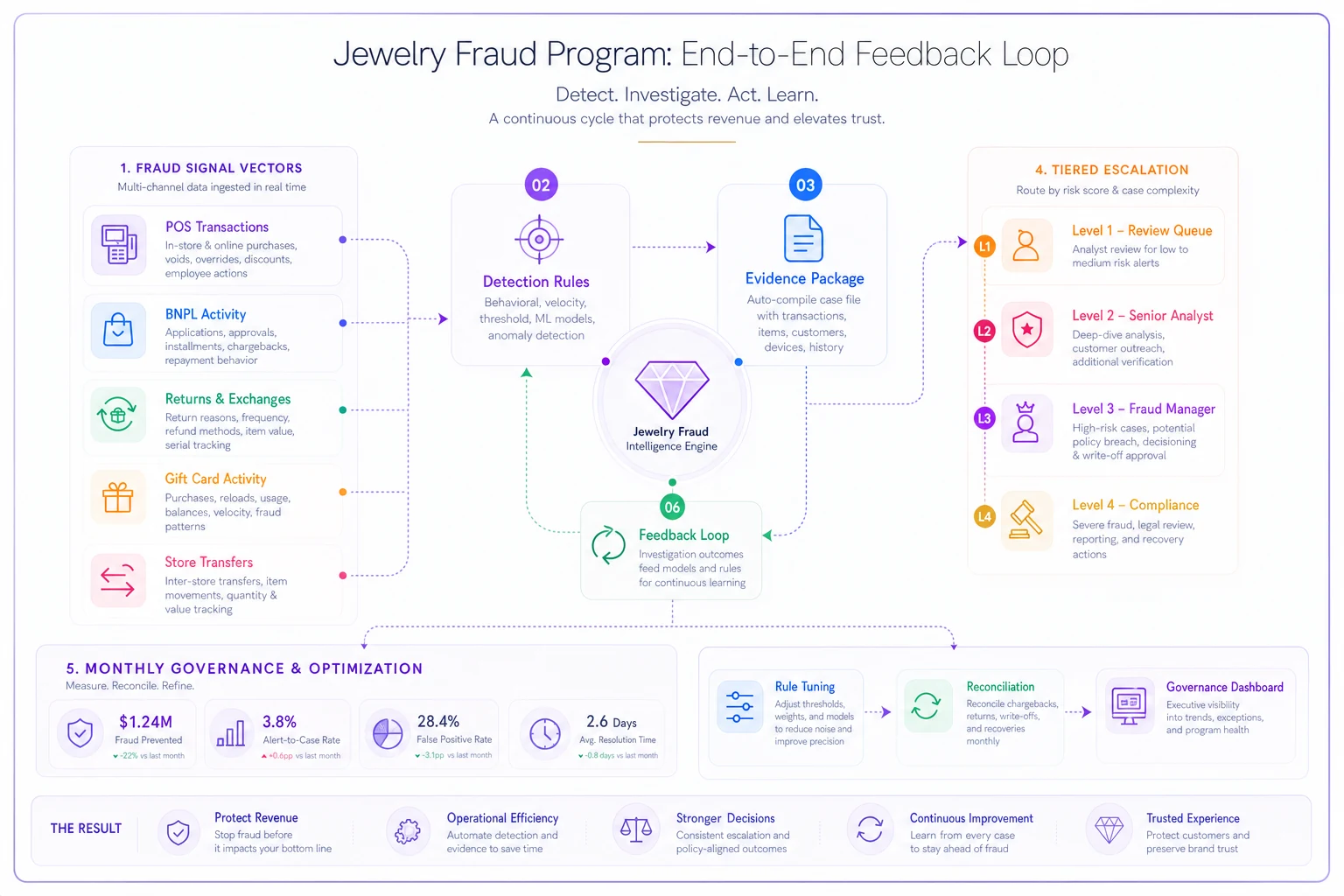
This workflow illustrates how vectors map to rules, produce evidence packages, route through escalation tiers, and feed the monthly governance review.
The real shift isn't replacing judgment — your Tier 2 and Tier 3 decisions still need a human who knows the business. But the detection, logging, and pattern-surfacing stop depending on whether a busy associate remembered to flag something.
A fraud program isn't a wall you build once. It's a feedback loop: vectors map to rules, rules generate evidence, evidence flows through escalation, and the monthly review tunes the whole thing back against what's actually happening on your counters. Build the loop, and the hundred small gaps stop adding up to real money walking out the door.
Ready to elevate your jewelry store operations?
Join 500+ jewelers using Jewlyly to increase efficiency, reduce errors, and grow revenue.