

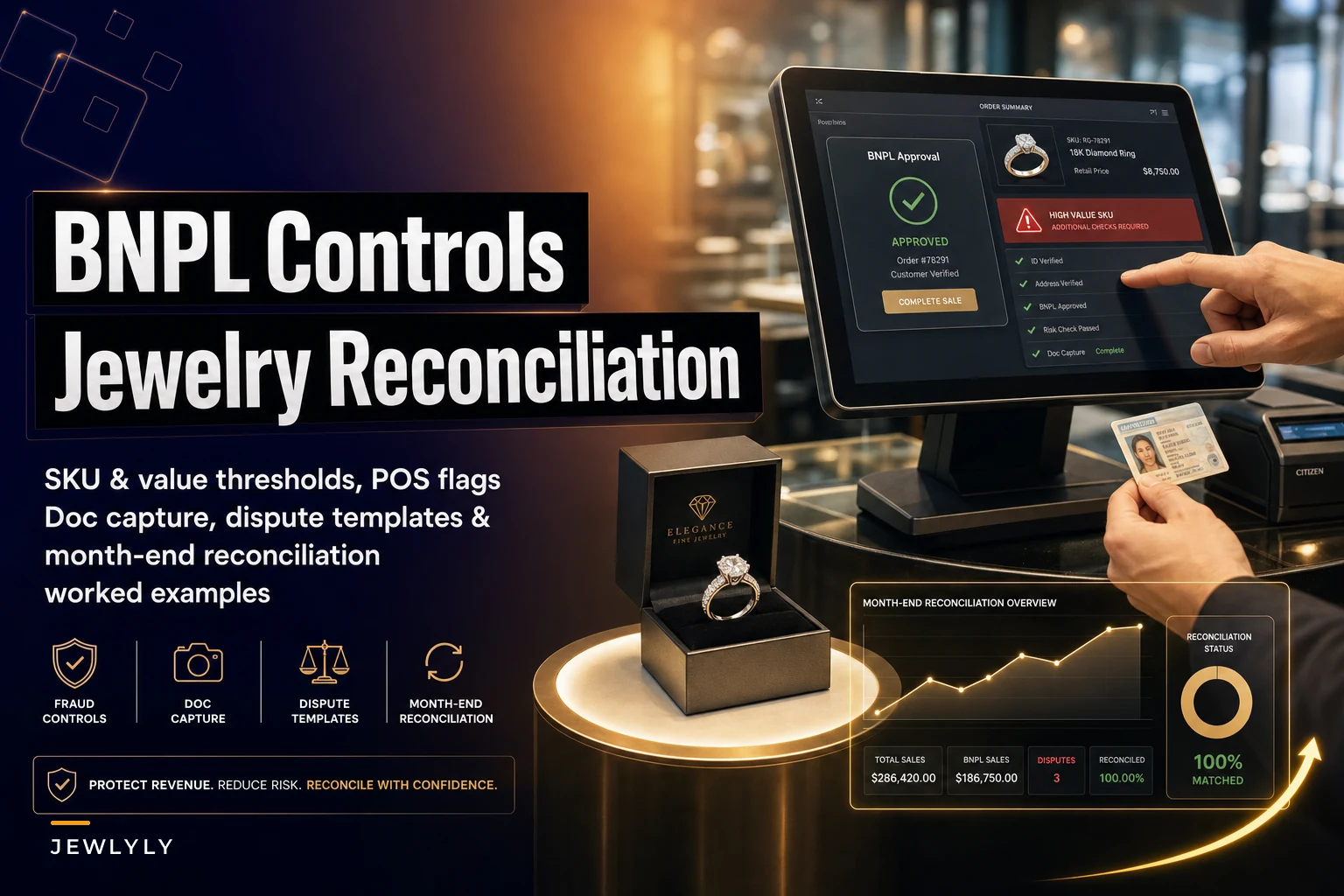
Most jewelers turned on BNPL the same way they turned on Apple Pay: flip the switch, put the logo on the counter, move on. That works fine when your average ticket is $180. It stops working the second someone walks out with a $6,800 tennis bracelet financed through a provider you barely vetted, and three weeks later you get a chargeback with your settlement already spent.
The problem isn't BNPL itself. Klarna, Affirm, Sezzle, and the rest can genuinely lift conversion on high-consideration purchases — engagement rings, anniversaries, self-purchase buyers who want the piece today but would rather spread the cost. The problem is that jewelry sits in a weird spot: high ticket, high resale value, easy to fence, and often walking out the door same-day. That combination attracts a specific kind of fraud that BNPL providers don't fully protect you against, and it creates reconciliation messes that most jewelry books aren't set up to catch.
This post is narrowly about the operational side: which transactions you should actually allow BNPL on, what to capture at the register, how settlement timing quietly breaks your books, and how to build dispute evidence that actually wins.
Where the money actually leaks
Before getting into rules, it helps to be honest about the three places BNPL costs jewelers real money — because they're not obvious from the provider's dashboard.
First, "merchant of record" confusion on returns. A customer finances a $4,200 ring through a BNPL provider. Two weeks later they return it. Your POS refunds the sale. But the BNPL provider already paid you at settlement, minus their fee — and depending on the provider, the refund flow doesn't automatically claw back that same fee amount. You end up refunding the full $4,200 while never recovering the ~$180 provider fee you paid on the original sale. On one transaction, whatever. Across a busy quarter of bridal returns, that leakage adds up quietly.
Second, same-day fraud on financed high-ticket items. BNPL approvals are fast and soft. A synthetic or stolen identity can clear a $5k approval in seconds. The provider takes on the credit risk for repayment — but if the transaction is later flagged as fraudulent, some provider agreements still push chargeback liability back to you if you didn't follow their verification requirements. Most jewelers never read those requirements. They exist, they're specific, and they're where you lose.
Third, split-settlement timing that scrambles reconciliation. BNPL funds don't land like card batches. A sale on the 30th might settle on the 2nd, arrive net of fees, and show up in a completely separate deposit line from your card processor. If your month-end matches deposits to sales by date, BNPL transactions straddle the close and show up as unexplained variances.
SKU and value thresholds: decide what BNPL can touch
The single biggest control is refusing to treat all inventory the same. A $200 pair of studs and a $9,000 loose diamond should not have the same BNPL rules.
Never miss a sale or shipment again.
Jewlyly helps you manage orders, track inventory, and engage customers seamlessly.
- Real-time inventory tracking
- Automated customer notifications
- Sales and order analytics
No credit card required
| Transaction profile | BNPL allowed? | Extra controls required |
|---|---|---|
| Under $1,500, stock item | Yes, standard | None beyond normal |
| $1,500–$4,000, stock item | Yes | Photo ID capture, name-on-card match |
| $4,000+, stock item | Yes, with review | ID + secondary ID or address verify, manager sign-off |
| Loose stones / high-resale generic gold | Case-by-case | Manager approval always, hold-to-clear option |
| Custom / special order with deposit | Deposit only via BNPL | Balance on cleared funds, not financed |
| Estate or consignment pieces | Manager approval | Ownership/consignment status confirmed first |
The logic behind the tiers: fraud follows resale liquidity. A stamped chain or a loose one-carat round is basically cash. Those are exactly the items a fraud ring wants financed and out the door in minutes. A signed designer piece with a serial number is far harder to fence, so it carries less same-day fraud risk even at higher price points.
One pattern worth flagging — fraud attempts tend to cluster on generic, high-liquidity SKUs in the $3k–$6k band, not on the $15k statement pieces. It's counterintuitive. The very high tickets get more scrutiny naturally; the mid-high band gets waved through because it "feels normal." That's exactly where you need the tightest controls.
What to capture at the register (and why the paperwork wins disputes)
BNPL providers will happily tell you "you're covered" until a dispute lands. Then their team asks for specific documentation, and if you don't have it, you lose — even when you did nothing wrong.
-
Photo of the physical ID, name matching the financing account
-
Signed pickup acknowledgment — customer signs that they received the specific item, listed by SKU and serial
-
Timestamped photo of the item at handoff, ideally with the customer present
-
The item's serial or certificate number logged in the sale record
-
Delivery method — in-store handoff vs. shipped, with tracking if shipped
-
Any address the customer provided, cross-checked against the financing account
The mistake most stores make is capturing this stuff inconsistently — the associate who's slammed on a Saturday skips the photo, and that's always the transaction that gets disputed. The fix is making capture a hard requirement in the sale flow, not a "when you remember" step. If your POS lets you gate a BNPL tender behind required fields for high-ticket sales, use it. If it doesn't, a laminated card at the register with the five required captures is a low-tech version that still works.
One underused move: for shipped BNPL orders, require signature-on-delivery and log the tracking against the sale. "Item not received" is one of the most common BNPL dispute reasons, and signature confirmation ends that argument fast. This dovetails with the same evidence discipline you'd use across any high-value order.
POS flags: making the register enforce your rules
Rules that live in a binder don't get followed on a Saturday afternoon. They have to live in the transaction.
-
BNPL tender selected + ticket over $4,000 → prompt for manager PIN and ID capture before completing.
-
BNPL + item category = loose stones or generic gold → force manager approval regardless of value.
-
BNPL + shipping selected → require tracking field before the sale can settle.
-
BNPL + return within X days → flag for reconciliation review so the fee-clawback gets checked.
-
Multiple BNPL sales, same customer, short window → flag for review; velocity is a classic fraud tell.
That last one matters more than people expect. A single financed purchase is fine. Three financed purchases from the same name in one week across your locations is a pattern worth a phone call before the third pickup. Most POS systems can surface this if you're tagging BNPL tenders cleanly — which is the whole point of consistent flags in the first place. The same discipline that powers a clean month-end reconciliation is what makes these fraud flags possible at all.
Here's the workflow for how POS flags should route high-ticket BNPL transactions.
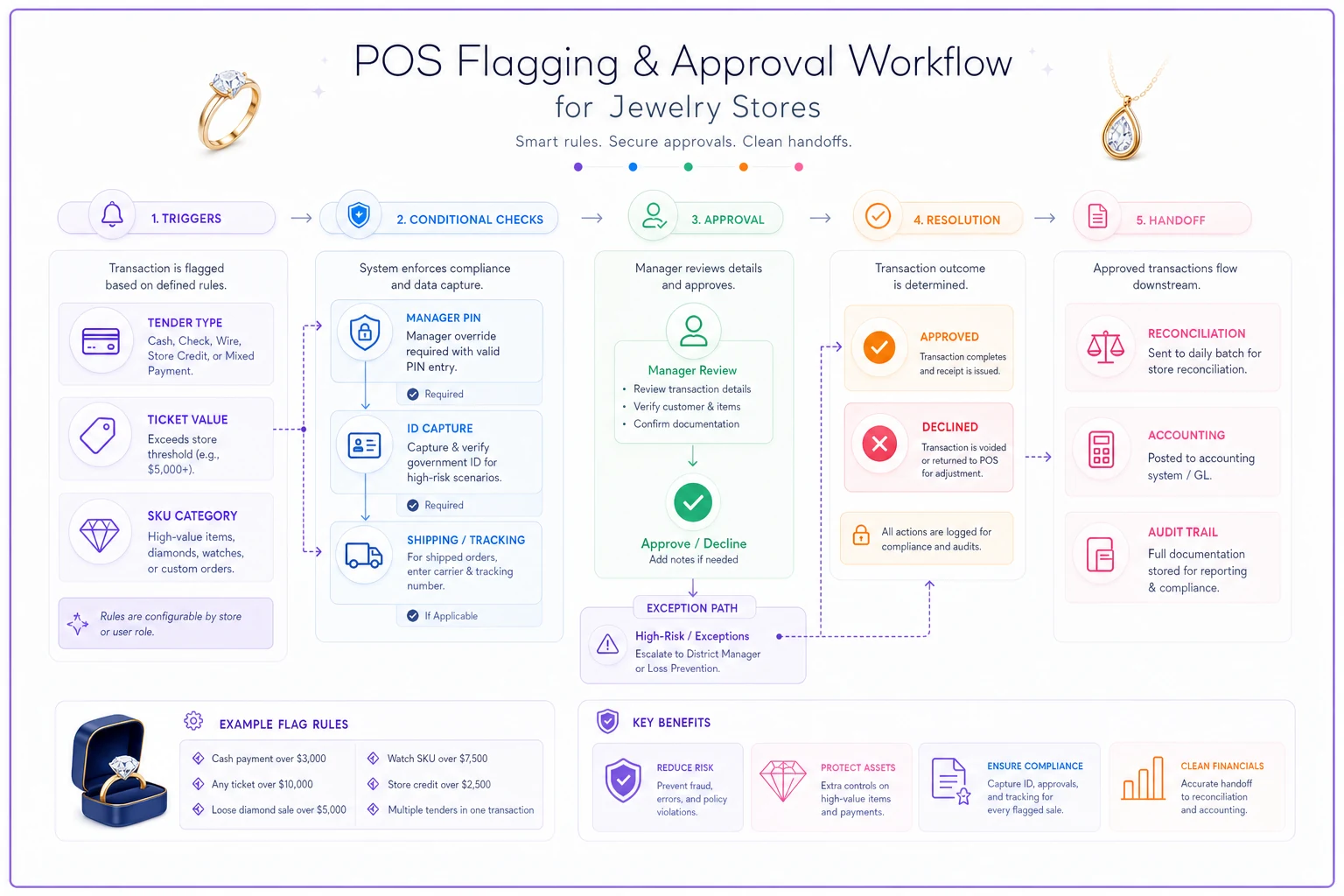
Use this as a blueprint when configuring your POS flags.
Settlement timing: the reconciliation trap nobody warns you about
This is the part that eats your bookkeeper's time.
Card batches settle predictably. BNPL doesn't. Each provider has its own settlement cadence, its own fee structure, and its own deposit line in your bank. So a single day's sales might fund across three different timelines:
-
Card sales
next-day batch
-
Affirm sales
settled in 1–3 business days, net of merchant fee
-
Sezzle sales
different cadence, different fee
When your close date lands mid-cycle, some BNPL sales are recognized as revenue but the cash hasn't arrived, and some cash arrives for sales recognized in the prior period. If you're matching deposits to daily sales totals, this shows up as variance you can't explain — and people waste hours "finding" money that was never lost.
A worked example
-
March 30 $4,200 BNPL sale (Affirm)
-
March 31 $2,800 BNPL sale (Klarna), plus normal card sales
-
April 1 $6,100 BNPL sale (Affirm)
Your POS shows March revenue including the 30th and 31st BNPL sales — $7,000 of BNPL gross. But the bank deposits for those don't land until April 2–3, net of fees. Meanwhile, a February BNPL sale's deposit might land April 1, muddying that day too.
If you close by matching bank deposits to POS gross, March looks short by ~$7,000 and April looks flush. Nothing is wrong — it's timing. But without a BNPL clearing account, it looks like a hole.
The fix is a BNPL clearing (in-transit) account:
-
At the sale, record revenue and debit "BNPL Receivable – [Provider]" for the gross.
-
When the deposit lands, credit BNPL Receivable for the gross, debit cash for the net, and debit "BNPL Fees" for the difference.
-
At month-end, your BNPL Receivable balance should equal sales made but not yet settled. That number should tie to the provider's pending-payout report.
Now the variance has a home. A $7,000 receivable balance at close isn't a mystery — it's exactly the sales sitting in the settlement pipeline. Anything that doesn't tie is a real problem worth chasing: a missing deposit, an unreturned fee, a partial refund that didn't clear right.
Month-end reconciliation checklist for BNPL
Run this alongside your normal close:
-
[ ] Pull each provider's settlement/payout report for the month
-
[ ] Confirm every BNPL sale in POS has a matching settlement or sits in the receivable balance
-
[ ] Verify BNPL Receivable balance equals total unsettled sales
-
[ ] Reconcile fees charged against the provider's fee schedule (catch overcharges)
-
[ ] For every BNPL return in the period, confirm the original fee was clawed back — flag any that weren't
-
[ ] Match any disputed/reversed transactions to your evidence file
-
[ ] Confirm shipped BNPL orders have delivery confirmation logged
The return-fee check is the one most stores skip and the one that quietly costs the most. Build it into the close so it happens every month, not "when someone remembers." If you already run a structured close, this slots right into your existing month-end reconciliation playbook rather than becoming a separate process.
Dispute evidence templates and provider playbooks
When a BNPL dispute lands, you usually have a short response window — often 7 to 14 days. Scrambling to assemble evidence in that window is how good stores lose winnable cases. Build the packet in advance.
Standard dispute evidence packet (per transaction):
-
Sale receipt with SKU, serial, price, date, tender type
-
Photo of ID captured at sale
-
Signed pickup acknowledgment or delivery signature
-
Timestamped handoff photo
-
Any address/identity verification performed
-
Communication log with the customer, if any
Match your response to the dispute reason:
| Dispute reason | Winning evidence |
|---|---|
| "Item not received" | Delivery signature + tracking, or signed in-store pickup |
| "Fraudulent transaction" | ID photo + name match + verification steps taken |
| "Item not as described" | Timestamped photo, item spec sheet, cert number |
| "Duplicate charge" | Full tender log showing single BNPL charge |
| "Wrong amount" | Itemized receipt, signed acknowledgment of total |
The operational trick is keeping this evidence attached to the sale record from day one, so responding to a dispute is a two-minute export, not a two-hour hunt through security footage and the email inbox. Stores that win BNPL disputes aren't luckier — they just documented at the point of sale instead of after the fact.
When BNPL on high-ticket jewelry actually makes sense — and when it doesn't
It makes sense for stock designer and branded pieces in the $1,500–$5,000 range sold to walk-in and appointment customers you can ID at handoff. Conversion lift is real, fraud risk is manageable with the controls above, and reconciliation is clean once your clearing account exists.
It's a bad idea for loose stones, generic high-karat gold, and anything with cash-like resale liquidity handed over same-day with no verification. That's where fraud rings concentrate, and it's not worth the conversion bump.
Don't finance the full balance on custom orders. Take the deposit however the customer likes, but the balance should come from cleared funds before the piece leaves. Custom pieces already carry their own dispute risk, and layering BNPL settlement timing on top of milestone billing creates a mess. The cleaner path is standard deposit-and-milestone handling — closer to how you'd run any layaway or financing workflow with staged, cleared payments.
A short real scenario
A two-location jeweler with an average BNPL ticket around $3,400 turned on Affirm and Klarna with no thresholds and no capture rules. Over about five months they absorbed two same-day fraud losses on financed generic gold chains — roughly $9k combined — plus a stack of small fee leakages on returns they never noticed until a bookkeeper flagged that the receivable account never balanced.
They didn't kill BNPL. They put in tiered thresholds, gated high-ticket BNPL behind manager PIN and ID capture, added a clearing account, and started clawing back return fees at close. Same-day fraud on financed chains dropped to zero over the next two quarters — the manager-approval prompt alone deterred most of the walk-in attempts — and the month-end BNPL variance went from hours of hunting to a receivable balance that tied to the provider report on the first pass. Conversion on their mid-band designer pieces held steady. They didn't lose sales, they just stopped losing money on the wrong ones.
The takeaway
BNPL for jewelry isn't risky because of the financing model — it's risky because most stores run it with retail-counter habits on high-ticket, high-liquidity goods. The fix isn't complicated: decide which SKUs and value bands BNPL can touch, force ID and item-handoff capture into the sale flow for the high tickets, run a clearing account so settlement timing stops scrambling your close, and keep dispute evidence attached from the moment of sale. Do those four things and BNPL becomes what it should be — a conversion tool that doesn't quietly cost you a fortune in fraud losses and reconciliation headaches.
Ready to elevate your jewelry store operations?
Join 500+ jewelers using Jewlyly to increase efficiency, reduce errors, and grow revenue.