

Most jewelry stores operate with three different versions of their inventory truth. There's what's actually in the safe and display cases, what shows online, and what the owner thinks should be there based on last quarter's buying decisions. When these three realities drift apart—and they always do—you get empty display spots during peak traffic, online orders for pieces that sold in-store yesterday, and $40k in slow-moving inventory hiding in the back while your bestsellers sit backordered.
The real challenge isn't just tracking what you have. It's building a jewelry merchandising system that connects buying decisions to display rules, online visibility to local demand, and replenishment triggers to actual sales patterns. Stores that thrive treat merchandising as an integrated workflow, not three separate jobs that happen to share the same address.
Why traditional retail merchandising breaks down for jewelry
Regular retail merchandising assumes products are interchangeable within categories. Target can shuffle shampoo brands between stores based on local demographics. A jewelry store can't do the same with engagement rings—each piece carries specific price points, stone qualities, and style preferences that vary wildly by neighborhood.
A store in suburban Phoenix kept ordering vintage-inspired pieces because that's what sold at their original downtown location five years earlier. Their new customer base wanted modern minimalist designs. They had around $85k in slow-moving vintage inventory while turning away three or four customers weekly asking for simple solitaires they didn't carry. The owner kept insisting "our customers love vintage"—but those weren't their customers anymore.
It gets more complicated when you layer in consignment pieces, custom orders, and vendor exclusives. A standard retail system treats a $3k tennis bracelet the same whether you own it outright, have it on 60-day terms, or it's consigned at 40% commission. But your merchandising decisions absolutely need to account for those differences. You can't feature consignment pieces in paid ads without eating your margin. You can't promise two-day shipping on memo items.
Traditional merchandising also assumes stable pricing. Jewelry prices shift with metal markets, seasonal demand, and vendor relationships. The 14k gold chain that made sense at $400 in January might need repricing by March when gold moves up. Your system needs to factor those margin pressures into what you feature, what you clearance, and what you reorder.
Building demand signals that actually predict jewelry sales
Most jewelers think they understand their demand signals. December is huge for luxury gifts, February drives engagement rings, May brings mother's jewelry. But real demand signals go much deeper than seasonal patterns.
Never miss a sale or shipment again.
Jewlyly helps you manage orders, track inventory, and engage customers seamlessly.
- Real-time inventory tracking
- Automated customer notifications
- Sales and order analytics
No credit card required
Start with your appointment book. When someone schedules a viewing for diamond studs, that's a demand signal—not just for that customer, but for the category. Track appointment requests by category over 90 days and patterns start showing up. One store found they got around twelve requests monthly for rose gold pieces but only stocked three SKUs in that metal. They were turning away demonstrated demand without even realizing it.
Your repair bench generates signals too. When the same style clasp breaks on multiple tennis bracelets, customers start asking about more secure options. When you resize five rings smaller in a month, you might be serving an older demographic than you assumed. These operational touchpoints reveal purchase intent before it becomes a sale—or a lost customer.
Online behavior tells a different story than in-store traffic. If people spend four minutes on your vintage emerald pages but bounce immediately from contemporary styles, that's signal. If they zoom into certification details but never on lifestyle shots, specs matter more to them than story. Most stores capture none of this because their websites run completely separately from inventory management.
Watch your custom order patterns too. When three customers independently ask for similar modifications to catalog pieces—a lower setting height or specific prong style—you're seeing unmet demand for a variation worth stocking. The category planning framework we covered earlier helps structure these observations into actual buying decisions.
What most stores miss: demand signals from what doesn't sell. If pearl necklaces sit for six months despite prominent display, that's signal. But you need to dig deeper. Are they priced too high for your market? Wrong length for your demographic? Poor quality relative to the price point? Each non-sale teaches you something if you're paying attention.
From spreadsheet chaos to assortment planning that works
The typical jewelry store "assortment plan" is actually five Excel sheets that don't talk to each other, last season's buying notes, and whatever the owner remembers from the last trade show. This leads to duplicate orders, gaps in popular sizes, and too much money tied up in pieces that appeal to nobody.
Real assortment planning starts with inventory velocity by category, not just overall turnover. Your engagement rings might turn four times annually while fashion earrings turn eight times. But if you dig deeper, solitaires might turn six times while three-stone rings turn twice. That granularity changes how much open-to-buy budget each subcategory actually deserves.
Sample allocation is where theory meets reality. You get one new collection with twelve pieces. Do you put all twelve in your flagship case? Split between locations? Keep four in back-stock for online exclusives? Most stores guess. The smarter approach: if a subcategory sells 70% in-store and 30% online, that's how samples get allocated. Simple math that somehow eludes most operations.
Price architecture matters more than most jewelers realize. You need clear entry, core, and luxury price points in each category. Not just "we have tennis bracelets from $500 to $5,000" but deliberate stepping stones—maybe $650, $1,200, $2,100, and $3,500, each offering clear value progression. When your assortment has proper price architecture, sales associates can naturally upsell without awkward jumps that kill the conversation.
The integration between assortment planning and your SKU structure determines whether any of this actually works. If your SKUs don't capture the attributes that matter—metal type, stone quality, style family—you can't track performance accurately enough to adjust your assortment intelligently.
Channel rules that prevent the dreaded "sold in store, still online" disaster
Nothing damages credibility faster than selling jewelry that's already gone. Yet it happens constantly because most stores treat their physical and digital presence as separate operations instead of channels sharing the same inventory pool.
The simplest rule most stores violate: high-value unique pieces need single-channel commitment. If you have one $8k sapphire ring, it's either in-store or online—not both. The complexity of managing photography, descriptions, and real-time updates for one-of-a-kind pieces across channels isn't worth the risk of double-selling.
For volume categories like wedding bands or standard chains, you need more structured rules. A basic gold band might show online whenever you have two or more in stock, hide when you drop to one (reserved for walk-ins), and trigger reorder at zero. These rules need to be automatic. Manual updates guarantee inconsistency, usually at the worst possible moment.
Consider building exclusive online collections—pieces that photograph well but don't need to showcase in-store. Delicate layering necklaces, stackable rings, minimal studs. Give online shoppers something they can't find in-store and your website stops being just a catalog of what's in the cases. One store built an online-only vintage collection at lower price points with better margins and no conflict with in-store inventory. Revenue jumped roughly 20% in four months.
Channel rules need to account for vendor agreements too. Some brands restrict online sales or require MAP pricing. Others allow online but not marketplace selling. Build these restrictions in from the start—nothing worse than launching a piece online and getting a cease-and-desist from the vendor three weeks later.
Reserve single high-value unique pieces for one channel to avoid double-selling and vendor complications.
The photography pipeline affects everything. If it takes two weeks to photograph and list new pieces, your channel rules need to account for that lag. Maybe new arrivals get 14 days of in-store exclusivity while photography happens. These timing rules prevent the constant fire-fighting of manual inventory shuffling.
KPI gates and thresholds for jewelry replenishment
Most jewelry stores reorder when things run out. That's not a system—it's a reaction. Real replenishment planning uses KPI gates that trigger specific actions before you hit crisis mode.
Start with velocity gates. If a piece sells three times in 30 days, that's a reorder signal regardless of current stock. If something hasn't moved in 90 days despite prime placement, that triggers markdown consideration. These aren't suggestions—they're automatic gates that force a decision.
Margin gates protect profitability. Set minimum margin thresholds by category. Fashion jewelry might need a 2.5x markup while branded watches accept 1.8x. When a piece drops below threshold due to metal prices or vendor changes, it gates out of reorder consideration until pricing gets resolved.
Display density matters more than most realize. Your cases have optimal piece-per-square-foot ratios. Too sparse looks cheap. Too crowded looks chaotic. Build gates around those ratios. When wedding bands drop below eight styles per case section, trigger reorder. When fashion earrings exceed fifteen pairs per display tier, gate new purchases until sell-through improves.
Here's a threshold framework that works in practice:
| Category | Reorder Trigger | Stop-Buy Signal | Markdown Gate |
|---|---|---|---|
| Engagement Rings | <3 per style family | >8 slow sellers | 120 days no movement |
| Wedding Bands | <2 per size run | >5 per style | 90 days no movement |
| Fashion Earrings | <4 per price tier | >20 total SKUs | 60 days no movement |
| Chains/Necklaces | <2 per length/style | >12 variants | 75 days no movement |
| Branded Watches | <1 per core model | >3 slow sellers | 150 days no movement |
Velocity isn't everything though. Quality of sale matters. A piece that sells once monthly at full price beats one that moves weekly at 40% off. Build gates around discount depth. If something only sells with markdowns deeper than 30%, it shouldn't trigger reorder regardless of velocity.
Seasonal gates override standard rules. October engagement ring reorders get expedited. July fashion jewelry orders get restricted. December luxury gifts get priority. These overrides need to be programmed in advance—not decided in the moment when you're already overwhelmed with holiday traffic.
Connecting displays to local preferences (not corporate planograms)
Big jewelry chains use planograms—exact diagrams of what goes where in every case. Independent stores sometimes copy this thinking and wonder why their cases feel generic. Your local market doesn't want what corporate thinks looks good.
A store near a university noticed parents bought conservative pearl sets while students gravitated toward edgy silver pieces. They built split displays—classic on the left, contemporary on the right. Sales improved because customers could find their style immediately instead of hunting through mixed messages.
Weather affects display strategy more than you'd expect. Phoenix stores don't need heavy chains featured in summer when nobody layers. Seattle stores can run statement necklaces year-round. One Michigan store rotates their window display monthly based on actual temperature, not the calendar—lighter pieces as it warms up, regardless of what season it's technically supposed to be.
Local events drive temporary shifts too. If there's a charity gala coming, build a "black-tie ready" section two weeks out. Country club towns need golf-appropriate pieces that won't snag. Business districts need subtle office jewelry. These aren't permanent changes—they're responsive displays that adapt to local rhythms.
The prosperity level of surrounding businesses matters more than people admit. Stores near law firms and medical offices can display higher price points prominently. Those near retail workers need strong opening price points visible from the entrance. One store mapped average incomes by distance from their location and arranged cases accordingly—premium pieces toward the back where established customers browse, accessible price points up front for walk-ins.
Your display system needs feedback loops. When someone asks for something you don't have displayed, track it. When they pass by prominent pieces without stopping, note it. After 30 days, patterns emerge. Maybe everyone asks about rose gold but you're showing yellow gold prominently. Maybe your vintage case gets ignored while people cluster around contemporary designs. That's your market telling you something worth listening to.
Making online catalogs match inventory reality
The biggest lie in jewelry e-commerce is "in stock." Half the time it means "we can probably get it," not "it's sitting in our safe." Building an online catalog that reflects reality requires being honest about what you actually control.
Start by segmenting your catalog into ownership tiers: owned inventory you can ship today, memo pieces that need vendor approval, virtual inventory you can get within five to seven days, and custom options that take three to four weeks. Each tier needs different display rules, shipping promises, and return policies.
Your online catalog shouldn't show everything you can theoretically sell. It should showcase what you sell well. If tungsten rings have a 60% return rate online because people order the wrong size, maybe they're in-store only. If vintage pieces need extensive explanation before someone buys, maybe they need video content before going live.
Photography truth matters more than most stores acknowledge. That ring photographed on a size 5 finger looks different on a size 8. Build your catalog with realistic expectations—show pieces on different skin tones, include measurement references, display chains at actual lengths instead of artfully arranged.
The technical bridge between inventory and catalog usually breaks at attributes. Your POS tracks "14k yellow gold ring." Your website needs "14k yellow gold vintage-inspired halo engagement ring with round brilliant center." Building proper attribute mapping isn't exciting work, but it's what prevents showing out-of-stock items or burying bestsellers where nobody finds them.
Consider an online-only clearance section that never appears in-store. Move aged inventory online at deeper discounts than you'd offer in person—your online shoppers are price-comparing anyway. One store moves anything over 180 days old to online-only at 40% off. They clear old inventory without training in-store customers to expect sales.
Warning signs your merchandising is broken
Sometimes the signs are obvious—empty cases during busy periods, constant requests for items you don't stock, online orders you have to cancel. But the subtle signals matter more.
When sales associates start hiding pieces for their regular customers, your allocation system is broken. They shouldn't need to game the system to serve clients well. If your top seller keeps a private stash of popular items, you're not reading demand correctly.
Watch for channel conflict. If in-store customers consistently ask "is it cheaper online?" you've created price confusion. If online customers call to verify stock before ordering, they don't trust your inventory accuracy. When customers screenshot online items to show in-store staff, your channels aren't as connected as they should be.
Inventory concentration reveals problems. If 60% of your value sits in 20% of your SKUs, you're either buying wrong or pricing wrong. Healthy jewelry inventory follows a smoother distribution curve. Extreme concentration usually means you're guessing instead of planning.
When vendor reps start making your buying decisions—suggesting what to stock, how much to order, where to display—you've lost control of merchandising. They're optimizing for their sales goals, not your customer needs. A good merchandising system makes you the expert on your market, not dependent on vendor recommendations.
Building your complete merchandising workflow
A functioning jewelry merchandising system isn't built overnight, but the foundation can be established in about 30 days if you're deliberate about it.
The process typically follows four phases:
-
Audit your current reality. Count everything, verify online listings, check display rules. Document the gaps between what you think you have and what's actually there. Track every customer request you can't fulfill. This baseline tells you where the biggest problems are hiding.
-
Build your demand tracking system. Simple at first—a way for staff to log requests, repairs, and browsing patterns. Create categories that match how customers ask for things, not how vendors organize catalogs. "Stackable rings" not "fashion rings under 3mm."
-
Design your channel rules and KPI gates. Start with the highest-value categories where mistakes hurt most. If you only fix engagement ring merchandising this month and nothing else, you've still protected significant revenue. Write the rules down, share them with staff, and stick to them even when it's inconvenient.
-
Connect the pieces. Map demand signals to assortment plans. Apply channel rules to current inventory. Set your first round of reorder gates. It won't be perfect, but it's a system instead of chaos.
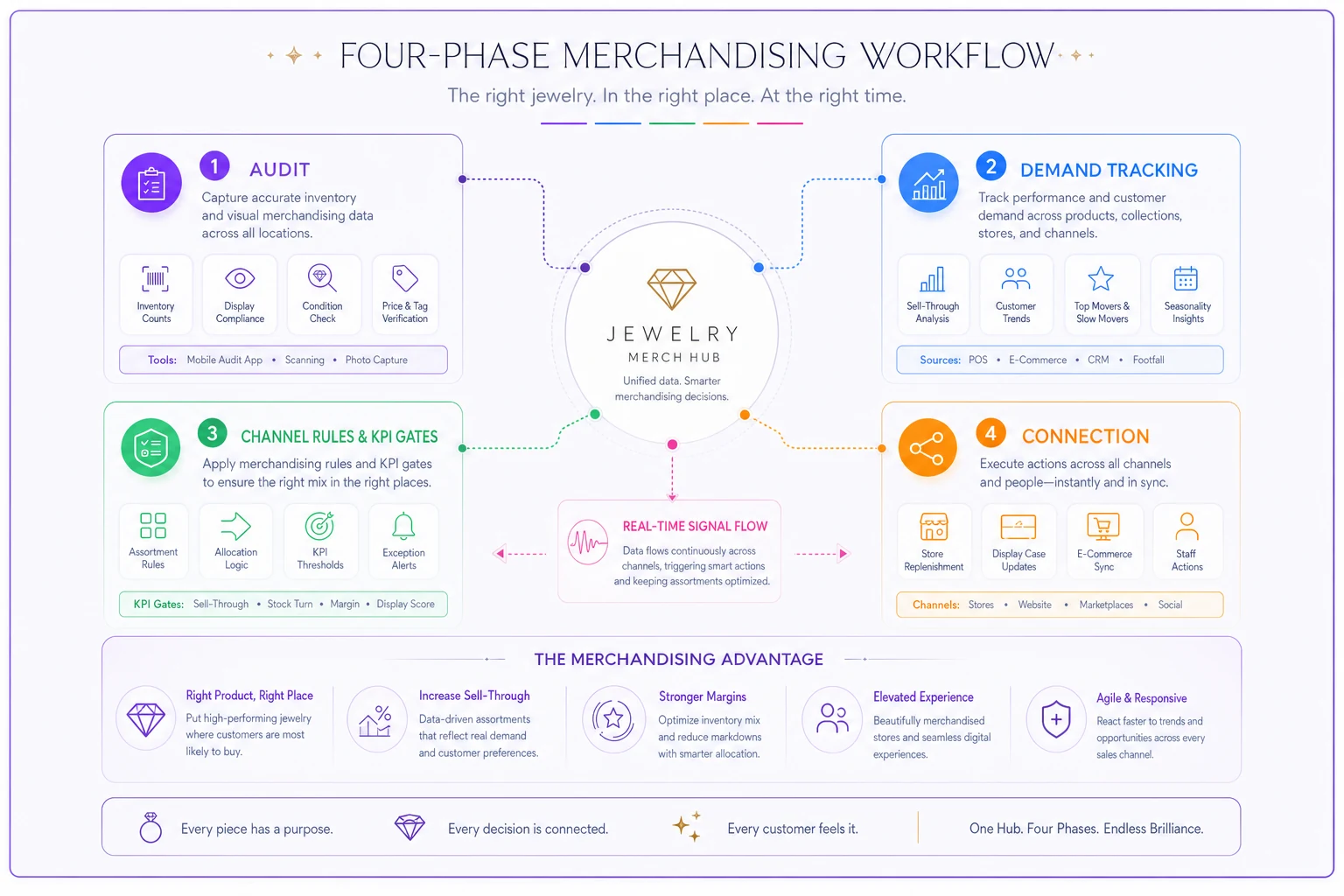
This visual shows the four-phase workflow and how signals flow between inventory, displays, and channels.
The ongoing challenge is maintaining discipline when the system says one thing but your gut says another. Maybe the data says reorder more silver, but you personally prefer gold. The system doesn't care about preferences—it tracks what customers actually buy.
AI-powered operational software can automate most of this workflow. Modern platforms now track demand signals automatically, suggest assortment adjustments based on local patterns, and enforce channel rules without manual oversight—connecting your POS, website, and buying decisions into one coordinated system. The same automation that handles attribute mapping and inventory synchronization can flag which pieces are likely to move based on historical patterns and local events. It doesn't replace judgment, but it removes a lot of the manual work that tends to slip through the cracks.
Even with good tools, someone needs to own the merchandising system. Not as a job title, but in the sense that they actually care when display cases don't convert. This person needs authority to override vendor suggestions, adjust buying plans, and enforce channel rules even when it's politically uncomfortable.
The real impact of systematic merchandising
A proper jewelry merchandising system doesn't just organize inventory—it changes how the whole operation runs. Instead of reacting to empty cases and customer complaints, you're anticipating needs and positioning inventory where it actually sells.
The financial impact hits multiple angles. Inventory turns faster because you're stocking what sells, not what you hope might sell. Margins improve because channel rules prevent desperate discounting. Cash flow smooths out because replenishment gates trigger before you hit crisis points.
The operational calm might be worth even more than the numbers. Staff stops scrambling. Your online manager stops apologizing for out-of-stock items. Your buyers stop guessing. Everyone works from the same reality instead of their own version of what's happening.
The coordination between physical and digital presence means customers get consistent experiences regardless of how they shop—research online, buy in-store, or the reverse—without confusion or disappointment. That consistency builds the kind of trust that turns browsers into buyers and buyers into customers who come back for every special occasion.
Building this system means accepting that jewelry merchandising is fundamentally different from other retail categories. The solution isn't trying harder with traditional retail tactics—it's building workflows that match how jewelry actually sells in your specific market. Once those workflows are in place and consistently followed, what felt like constant chaos becomes predictable, manageable, and profitable.
Ready to elevate your jewelry store operations?
Join 500+ jewelers using Jewlyly to increase efficiency, reduce errors, and grow revenue.