

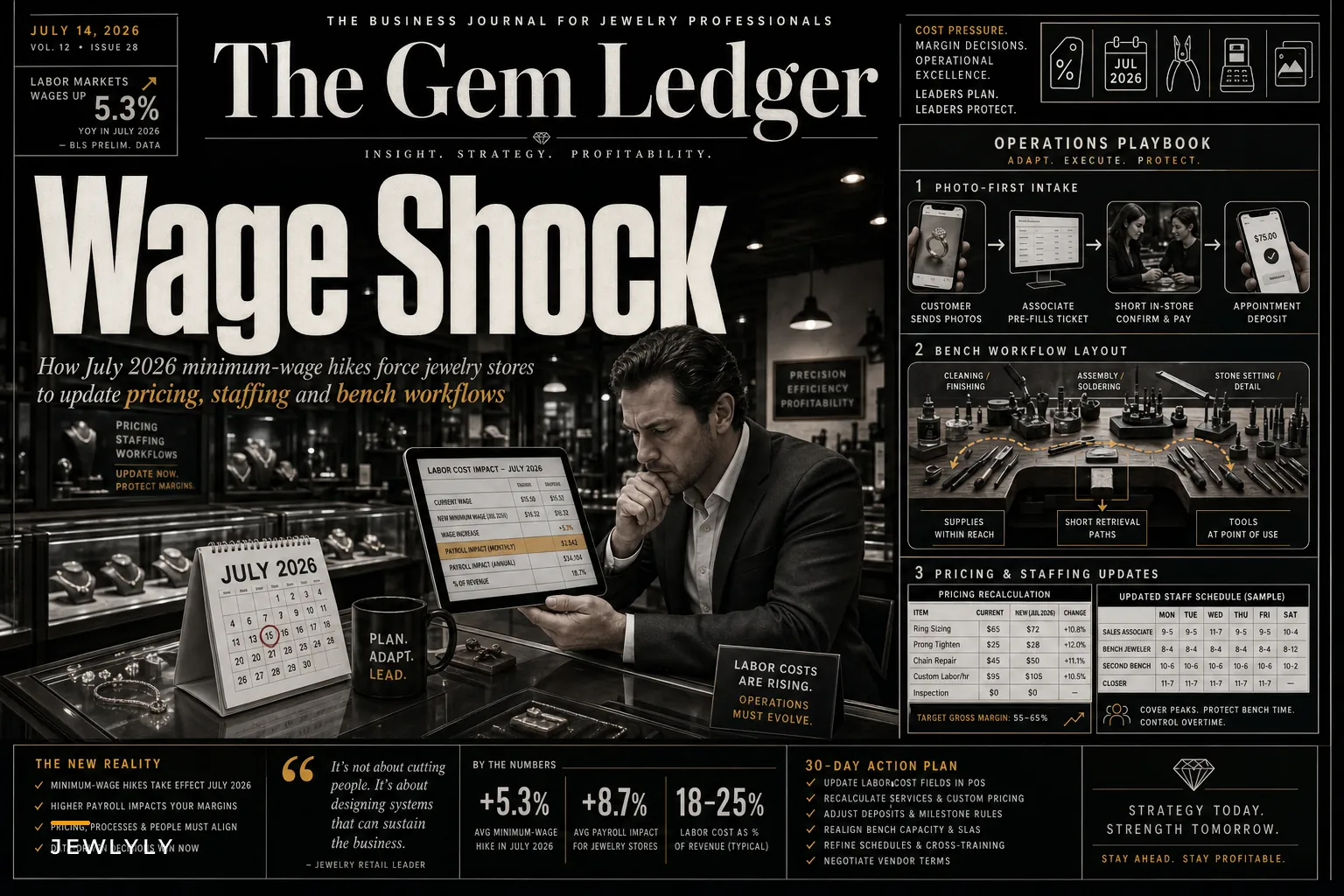

The numbers hit different when you see them on actual payroll runs. Oregon jewelry stores are staring at $16.80 hourly minimums in Portland metro areas as of July 1st, while D.C. shops now face $18.40 base rates. Alaska jumped to $14.00. These aren't gradual increases—they're immediate operational shocks that landed right as summer foot traffic picks up.
I pulled payroll data from three jewelry stores this week. A Portland shop with four full-time associates and two part-time bench jewelers saw monthly labor costs jump by $3,400. That's before overtime, benefits, or the ripple effect of bumping experienced staff wages to maintain pay differentials. The owner texted me at 11pm: "This wipes out my entire August marketing budget. What do I cut?"
Jewelry stores are particularly vulnerable here because you can't just reduce headcount like a typical retailer might. Your bench jeweler can't also run the sales floor. Your sales associate can't size rings. Every position requires specific expertise, certifications, or a level of trust that takes months to build. You need someone watching the floor when high-value pieces are out. You need bench coverage during business hours for quick evaluations. The standard retail playbook of "do more with less" falls apart fast when a single unattended moment could mean a $15,000 loss.
The hidden multiplication effect
When minimum wage increases hit jewelry stores, the real damage happens in places most owners don't immediately see. Your established sales associate making $22/hour suddenly realizes the new hire is at $16.80. That compression forces you to bump everyone up to maintain morale and internal hierarchy. Your bench jeweler who was happy at $28/hour now needs $32 to feel valued above the new floor.
The bigger problem is your repair and custom work pricing. Most jewelry stores set their labor rates years ago—maybe $65/hour for basic repairs, $85/hour for custom work. These rates assumed certain wage levels. When your bench costs jump 18%, those repair tickets that barely broke even before now actively lose money.
A family jewelry store in Seattle ran into this last month. They'd been charging $45 for watch battery replacements, assuming 15 minutes of bench time plus parts. At their old wage structure, they made $8 profit. After Washington's increases, they were losing $3 per battery. Literally paying customers to bring them work.
The multiplication continues into appointment-based selling too. That private showing for engagement rings where you dedicate an associate for 90 minutes? Your cost per appointment just went up $12–15. The Saturday rush where you need all hands on deck? That's an extra $200–300 per weekend in labor alone.
Why traditional cost-cutting destroys jewelry store operations
Most retail consultants will tell you to cut hours, reduce staff, or eliminate positions. That advice wrecks jewelry stores.
Never miss a sale or shipment again.
Jewlyly helps you manage orders, track inventory, and engage customers seamlessly.
- Real-time inventory tracking
- Automated customer notifications
- Sales and order analytics
No credit card required
Security protocols require minimum staffing levels. Insurance companies mandate two people present when the safe opens. You need someone watching the floor whenever someone else is showing high-value pieces. Cutting below these thresholds doesn't save money—it voids your coverage.
Customer expectations in jewelry are also fundamentally different from regular retail. Someone dropping $8,000 on an engagement ring expects immediate, knowledgeable attention. They expect their resize done within three days. They expect the store to remember their preferences, their anniversary, their wife's ring size. Every service cut degrades these relationships in ways that don't show up on a spreadsheet until it's too late.
The real operational disaster happens when stores try to merge roles. I've seen shops have sales associates handle simple repairs. Within six weeks, you've got damaged pieces, angry customers, and seasoned associates quitting because they didn't sign up for bench work. One Chicago store tried this—they lost two of their top sellers and ended up with a $30,000 insurance claim from a botched resizing.
Bench capacity is especially sensitive. Cut bench hours to save on wages, and repair tickets pile up. Customers get frustrated. Google reviews start mentioning slow service. That engagement ring customer goes elsewhere because you can't promise sizing within their timeline. The savings evaporate as revenue walks out the door.
Smart labor reallocation without service degradation
Instead of cutting, successful stores are restructuring how they deploy existing labor. The key is figuring out which tasks actually require your most experienced people versus what can be handled by newer team members with the right support.
Map every task in your store, then assign minimum skill levels. In most stores, somewhere between 30–40% of senior staff time goes to tasks a properly trained newer employee could handle just fine.
| Role | Wage Range | Primary Responsibilities |
|---|---|---|
| Senior Associates | $28–35/hr | Engagement ring consultations, custom design discussions, estate jewelry evaluations, high-value sales (over $3,000), vendor negotiations |
| Mid-level Associates | $20–25/hr | General sales under $3,000, repair intake with checklist support, inventory receiving and tagging, customer follow-up calls, basic cleaning |
| Entry Associates | $16–18/hr | Appointment scheduling, inventory counts, display maintenance, social media posts, data entry and filing |
This isn't about degrading service. Your customer still gets expert attention for their engagement ring—appointment booking just happens through a junior associate following a clear script.
The pricing recalibration most stores get wrong
Raising prices seems obvious, but jewelry stores often increase the wrong prices in the wrong ways. Blanket percentage increases across all services and products usually backfire because your market will bear very different increases depending on the category.
Repair pricing has the most flexibility. Customers already expect these services to cost more over time. Watch battery replacements can go from $15 to $20 without much pushback. Ring sizing from $45 to $55 feels reasonable. Complex repairs from $85 to $105 actually reinforces the perception of quality.
Where stores mess up is raising prices on competitive items at the same time—basic wedding bands, popular designer pieces—where customers price-shop online. A 10% increase on a $400 wedding band sends customers to Blue Nile. That same 10% on a custom redesign of grandmother's ring barely gets noticed.
According to the Department of Labor's updated wage tables, states are implementing increases ranging from 5% to 15% this July. Your pricing adjustments should be surgical, not uniform. High-touch, expertise-heavy services can absorb 15–20% increases. Commodity items might only handle 3–5%.
The smart play is bundling price increases with service improvements. Raise ring sizing from $45 to $55, but guarantee 48-hour turnaround. Increase custom consultation fees from $100 to $150, but include CAD renderings. Customers accept higher prices when they can see the difference.
Immediate workflow optimizations that actually cut costs
Before you touch staffing or pricing, fix your operational waste. Most jewelry stores bleed money through inefficient workflows that higher wages make unsustainable.
Repair intake alone probably takes 15–20 minutes per customer. Examining the piece, discussing options, filling out forms, creating tickets, explaining timelines—at new wage levels, each intake costs $8–12 in labor.
Build a photo-first intake system. Customer sends photos before coming in. Associate pre-populates the ticket. The in-store visit drops to 5–7 minutes for confirmation and payment. You've cut intake costs by around 60% without reducing service quality.
Start requiring $50 refundable deposits for appointments over 60 minutes. No-shows drop significantly, and serious buyers don't mind.
Bench workflow needs similar attention. Track how often your bench jeweler walks to get tools, findings, or supplies. In a typical 8-hour day, poor organization adds 45–60 minutes of non-productive movement. At $32/hour, that's close to $5,000 annually in wasted wages. A $500 investment in proper bench organization pays back ten times over.
The Oregon minimum wage schedule shows these increases aren't stopping—they're accelerating. Stores that don't address operational efficiency now will face compounding pressure as wages keep climbing.
Here's a simple visual of the intake and bench workflow you should standardize.
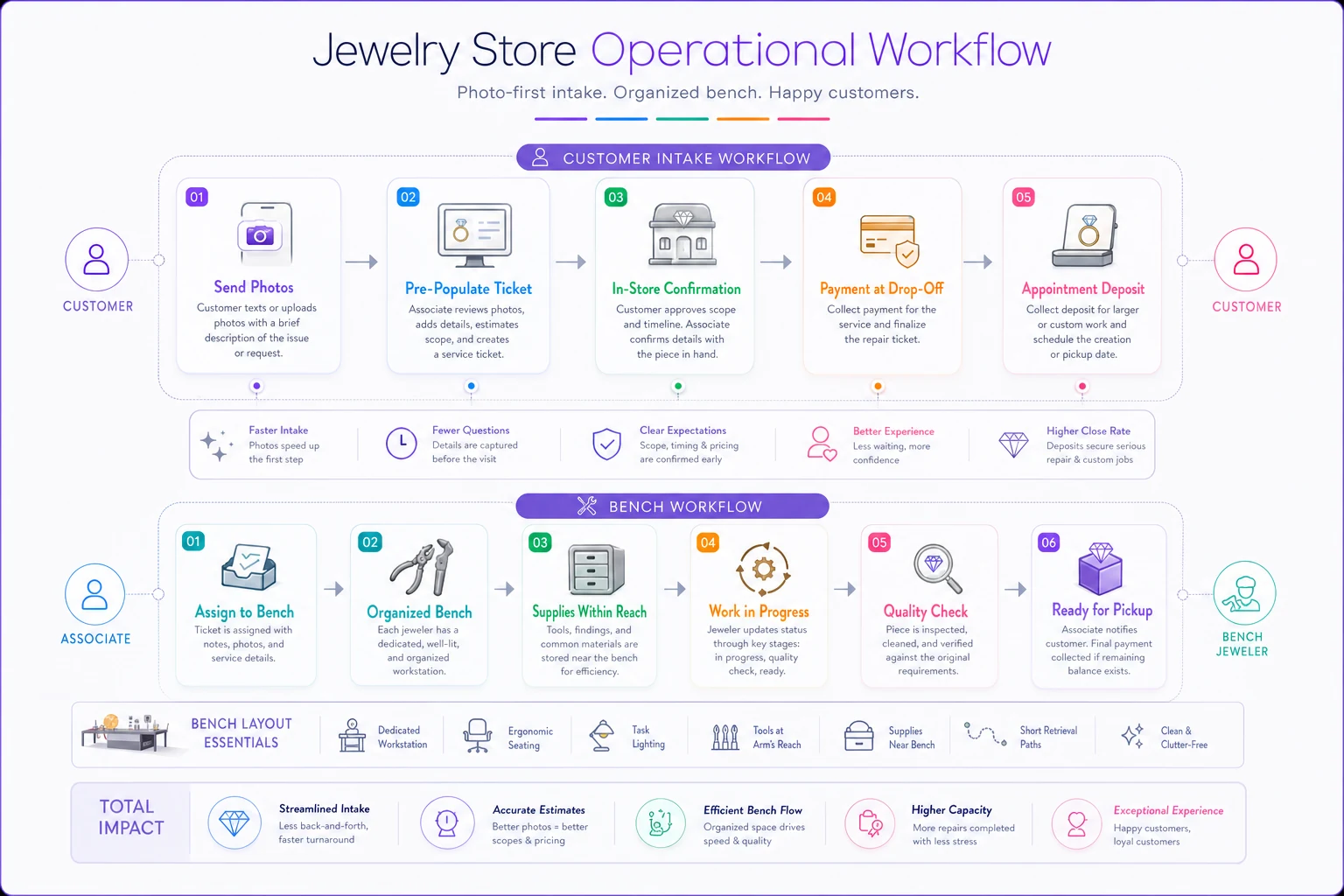
Use this to train staff quickly: follow the photo-first intake, require deposits for long appointments, and standardize bench layout so every movement is minimized.
Start with a single technician's bench and time their movements for a week—small layout tweaks often cut 10–20 minutes/day immediately.
Appointment no-shows are another hidden cost. That Saturday engagement ring appointment where nobody showed? At new wages, it cost you $45 in dedicated associate time. Start requiring $50 refundable deposits for appointments over 60 minutes. No-shows drop significantly, and serious buyers don't mind.
Technology bridges that don't require massive investment
You don't need a $50,000 POS overhaul, but targeted automation in specific bottlenecks pays for itself within months.
Start with appointment scheduling. An associate spending 10 minutes on the phone coordinating calendars costs $5–8 per appointment at new wage rates. Basic online scheduling tools run $30–50 monthly and eliminate most of these calls. Break-even after 8–10 appointments.
Inventory counting burns massive labor hours. Manual counts for a typical 2,000-SKU jewelry store take 40–50 person-hours monthly. At minimum wage, that's $700–900 in labor for a task that adds zero customer value. Simple barcode scanning systems cut this by around 75%.
Customer communication is another area worth addressing. Following up on repairs, reminding about cleanings, notifying about events—these tasks consume 15–20 hours weekly in most stores. Automated email and text sequences handle the routine stuff, freeing your team for actual revenue-generating work.
That said, don't automate the touchpoints that build relationships. The thank-you call after a major purchase, the personal invitation to view new estate pieces, the birthday card with a handwritten note—those stay human. Automate the routine so your team has bandwidth for what actually matters.
This connects directly to broader capacity planning. As I covered in our guide on bench capacity planning and SLAs, having clear systems for tracking and allocating skilled labor becomes critical when every hour costs more. Shops that already mapped their bench utilization are handling these wage increases far better than those operating on gut feel.
The competitive advantage hidden in wage pressures
Higher minimum wages will push weak operators out of the jewelry business. Stores running on thin margins with sloppy operations won't survive. That creates real opportunity for well-run stores to capture market share.
Look at which competitors are vulnerable. The store that's always running "50% off everything" sales operates on razor-thin margins—they can't absorb wage increases without cutting service. The family shop where the owner still handles everything manually faces impossible math.
While competitors cut corners, you maintain standards. While they extend repair times, you hit your SLAs. While they reduce hours, you stay open. Customers notice these differences, especially for important purchases.
The wage increases also create hiring opportunities for prepared stores. That talented associate at your competitor who just got compressed toward minimum wage is probably looking. The skilled bench jeweler frustrated by reduced hours elsewhere is available. Build a reputation as the store that values and properly compensates talent, and people will find you.
Your marketing message shifts too. Stop competing on price—you can't win that game with higher labor costs. Emphasize expertise, service, and reliability. "We're not the cheapest, we're the best" lands differently when customers have been burned by corner-cutting competitors.
Three-month action plan for jewelry stores
Month 1: Stabilize and assess
-
Map all current staff wages and hours
-
Calculate true hourly costs including taxes and benefits
-
Review all service pricing against new labor costs
-
Identify top 20% of customers by lifetime value
-
Document every task performed by each role
-
Measure time spent on non-revenue activities
Month 2: Optimize and adjust
-
Implement tiered task assignments
-
Adjust repair and service pricing (not product pricing yet)
-
Install basic automation for scheduling and communication
-
Reorganize physical workspace for efficiency
-
Train junior staff on senior tasks with checklist support
-
Start requiring deposits for lengthy appointments
Month 3: Differentiate and grow
-
Launch "craftsman quality" marketing positioning
-
Recruit talent from struggling competitors
-
Adjust product pricing strategically
-
Expand high-margin services
-
Create membership or service plans
-
Build recurring revenue streams
After two months of tightening operations, you'll have enough real data to make smarter decisions about where to push further.
Making the math work long-term
The minimum wage increases jewelry stores face aren't an anomaly—they're the new normal. States will keep raising floors, compression will keep forcing ladder adjustments, and traditional retail economics will keep breaking down for stores that aren't paying attention.
But jewelry stores have advantages other retailers don't. Your average transaction value supports higher service costs. Your customer relationships enable premium pricing. Your specialization creates barriers competitors can't easily cross.
The stores thriving after these wage increases share some common traits. They've separated commodity sales from experiential sales. They've built operational systems that maximize expensive expertise. They've embraced appropriate technology without losing the human element. And they've stopped trying to be everything to everyone.
That Portland store facing the $3,400 monthly increase? Three months later they're actually more profitable. They raised repair prices 18%, implemented photo-first intake, required appointment deposits, and built a junior associate development program. Google reviews improved because service got faster and more consistent. Their best bench jeweler stayed because they could pay competitively. Revenue per square foot went up 12% as they focused on higher-margin work.
The wage increase forced them to fix problems they'd tolerated for years. Inefficient workflows, underpriced services, poor time allocation—these costs were always there. They were just easier to ignore before labor jumped overnight. That's the part most owners don't want to hear, but it's also the most useful thing to take away from all this.
The wage increase forced them to fix problems they'd tolerated for years. Inefficient workflows, underpriced services, poor time allocation—these costs were always there. They were just easier to ignore before labor jumped overnight. That's the part most owners don't want to hear, but it's also the most useful thing to take away from all this.
Ready to elevate your jewelry store operations?
Join 500+ jewelers using Jewlyly to increase efficiency, reduce errors, and grow revenue.