



The numbers that came out on October 29 surprised almost everyone. U.S. GDP accelerated in the third quarter, powered by consumer spending that refused to cool and a wave of AI-related business investment that kept pulling the economy forward. Reuters reported the growth came in well above expectations, and on the same day a separate report showed September inflation heating up while spending kept climbing.
For most retail categories, that's a tidy headline. For jewelers, it's a planning headache disguised as good news. A stronger-than-expected consumer plus sticky inflation means your holiday season will probably be busier and more expensive to stock — and the window to react is shorter than it was a year ago.
The stores that win this quarter aren't the ones with the biggest ad budget. They're the ones whose jewelry inventory forecasting can absorb a demand surprise without either stocking out of best-sellers or drowning in slow-moving SKUs they bought on a hunch. Here's what this spike actually changes operationally, and where most jewelers quietly lose money when demand runs hot.
What the growth spike actually does to your replenishment math
The part that doesn't make the headlines: when consumer confidence is strong and spending is already elevated going into Q4, demand doesn't just rise — it gets less predictable. The spread between your best weeks and your worst weeks widens. That matters enormously for a category where a single bridal or anniversary piece can represent a meaningful chunk of a day's margin.
-
Supplier lead times are already tight heading into peak season, and a hot economy means vendors are fielding bigger orders from everyone.
-
Inflation is nudging replacement cost up, so the piece you reorder in December may cost more than the one you sold in November.
That's the squeeze. You're being asked to carry more depth on your winners, react faster, and do it while your cost basis is shifting underneath you. The old approach — look at last year's December, add a little, call your reps — breaks down when the base assumptions aren't stable.
A pattern worth naming: most forecasting mistakes in jewelry don't actually come from bad demand estimates. They come from treating every SKU with the same reorder logic. A $180 sterling pendant and a $6,400 bridal set should never be forecast the same way, but a lot of stores still run them through one mental model.
Where jewelers lose money when demand runs hot
The instinct during a strong season is to buy aggressively across the board. That's usually where the margin leaks start. The losses tend to cluster in a few predictable places.
Never miss a sale or shipment again.
Jewlyly helps you manage orders, track inventory, and engage customers seamlessly.
- Real-time inventory tracking
- Automated customer notifications
- Sales and order analytics
No credit card required
Over-buying the middle. The $400–$900 range feels safe, so stores load up. But that's often the slowest-turning band because it's neither an impulse gift nor a milestone purchase. You tie up cash that your fast movers actually needed.
Under-depthing the true winners. The pieces that sell themselves in December are usually a short list — specific chains, stud sizes, a couple of bridal mountings. Stores chronically under-order these because the unit cost feels high, then stock out in the second week of December when there's no lead time left to recover.
Ignoring velocity shifts inside categories. Demand doesn't rise evenly. In a strong-spending season, the higher-ticket end of each category often moves faster than usual because customers trade up. If your reorder triggers are calibrated to last year's price points, you'll be chasing the wrong tier.
A simple comparison of how the same holiday season plays out depending on whether your forecasting is tier-aware:
| Scenario | Flat forecasting (one model for all SKUs) | Tier-aware forecasting |
|---|---|---|
| Fast movers | Stock out early, lost high-margin sales | Depth protected, reorder triggers tightened |
| Mid-range | Over-bought, cash tied up into Q1 | Bought to actual turn rate |
| High-ticket | Under-ordered out of cost caution | Positioned for trade-up demand |
| Reaction speed | Weekly, manual, reactive | Daily signal, proactive |
| Post-season | Markdown pressure in January | Cleaner carryover |
The difference between those two columns is rarely talent. It's whether the store has the discipline to treat SKUs differently and the systems to act before the shelf is empty.
A workable forecasting approach for a compressed season
You don't need a data science team to handle a demand surprise. You need a repeatable process that updates faster than once a month. Here's a sequence that holds up under pressure:
-
Segment your catalog into velocity tiers, not just price tiers. Fast, steady, slow, and seasonal-spike. Most stores find roughly 15–20% of SKUs drive the majority of holiday margin.
-
Set per-tier reorder rules. Fast movers get tight triggers and pre-negotiated replenishment with your best vendors. Slow movers get a hard cap — no emotional reorders in December.
-
Pull sell-through weekly, not monthly, through the back half of November. During a volatile season, a four-week-old number is a liability.
-
Lock in vendor commitments early on your short list of true winners, even if it means a slightly larger upfront buy. Lead time disappears faster than cash in December.
-
Reforecast the high-ticket tier separately. Watch whether customers are trading up and shift depth accordingly.
-
Hold a reserve-cash line for the one or two unexpected winners every season produces. You'll always miss at least one, and the ability to react in week two is worth more than being perfectly right in October.
Here's a quick checklist to pressure-test your plan before Black Friday:
-
- [ ] Do you know your top 20 margin-driving SKUs by unit margin times velocity, not just revenue?
-
- [ ] Are reorder triggers set per tier, or is it one rule for everything?
-
- [ ] Do you have at least two vendors who can turn your fast movers inside 10 days?
-
- [ ] Is your POS data clean enough that sell-through pulls are trustworthy?
-
- [ ] Have you set a hard "do not reorder" list for known slow stock?
-
- [ ] Is online inventory synced to in-store so a hot SKU doesn't double-sell?
That last one gets overlooked constantly. During a surge, the same ring can sell online and in the case within the same hour if your channels aren't connected.
Pre-negotiate small depth commitments with your top vendors so you can top up quickly without redoing terms mid-December.
Here's a simple workflow to implement the sequence.
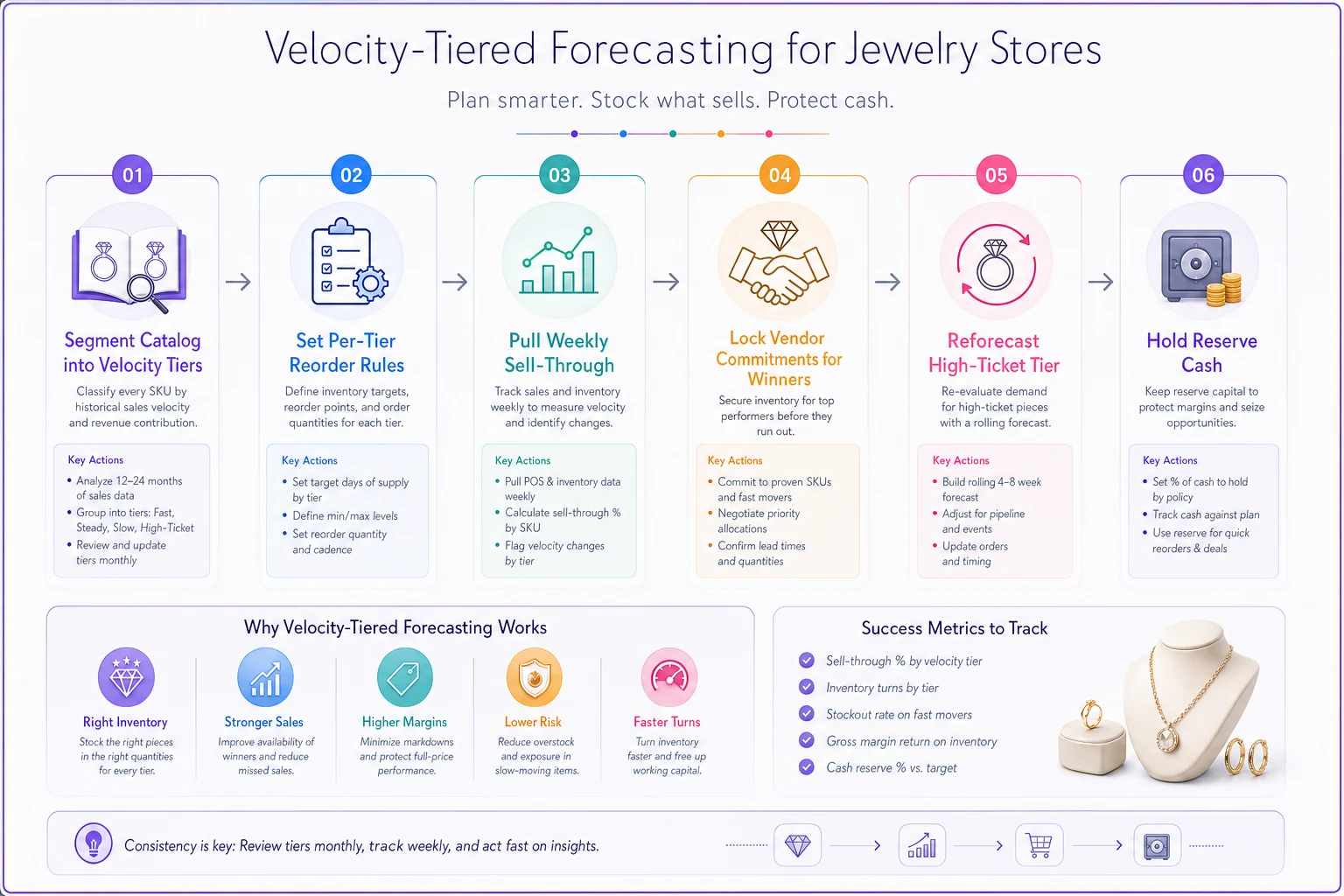
Use this flow as an operational checklist the team can run weekly through the back half of November.
A real scenario: the two-location store that got caught flat-footed
A two-location independent doing roughly $2.1M in annual revenue, with about 40% of it landing in Q4, went into the previous holiday season forecasting off last year plus a flat 8% bump across the board.
What happened: bridal pieces and higher-end diamond studs sold out by the second week of December. They'd ordered conservatively on those because the unit costs made them nervous. Meanwhile, they were sitting on a wall of mid-range fashion pieces — the "safe" buys — that eventually moved in January at markdown.
The rough damage: somewhere around $30k–$40k in missed high-margin sales they couldn't fulfill, plus a January that opened heavier than they wanted. Not a catastrophe, but a painful amount of money left on the table in a season that was otherwise strong.
The fix wasn't complicated. They rebuilt reorder logic into velocity tiers, pre-committed depth with two vendors on their proven winners, and started pulling sell-through weekly from mid-November. The following season they still got surprised by one unexpected best-seller — everyone does — but they caught it in week two instead of the post-mortem. Carryover into January was noticeably cleaner.
The lesson isn't "buy more diamonds." It's that their flat model hid the single most important fact about their business: not all SKUs behave the same, especially when demand runs hot.
When faster forecasting is worth it — and when it isn't
More frequent reforecasting has a real cost in staff time, so it's worth being honest about when it actually pays off.
When it makes sense: You carry meaningful high-ticket depth, Q4 is a large share of annual revenue, or you're running multiple locations where a stockout in one store can't easily pull from another. In a volatile demand year like this one, the payback is pretty immediate.
When it's overkill: A single small location with a tight, slow-moving assortment and predictable repeat customers probably doesn't need weekly reforecasting. Monthly is likely fine. Don't build process you won't maintain.
Who should hold off entirely: Stores whose POS data is still messy. If your sell-through numbers can't be trusted — duplicate SKUs, inconsistent categories, manual entry errors — faster forecasting just means reacting faster to bad data. Clean the data layer first. Everything downstream depends on it.
The deeper problem the spike exposes
A demand surprise like this quarter's is really a stress test. It reveals whether your operation can turn signal into action fast enough to matter. The stores that struggle in a hot season almost always have the same gap: data is fragmented, reorder decisions live in someone's head, and the reaction cycle is measured in weeks when the market is moving in days.
This is where the AI-investment side of the current economic story quietly connects to what's happening at the store level. The same wave of automation reshaping the broader economy makes it realistic for a small jeweler to run velocity-tiered forecasting without a dedicated analyst. Operational platforms now handle the heavy lifting — pulling clean sell-through, flagging when a SKU crosses a reorder threshold, catching channel sync gaps before they cause a double-sell — so your team can focus on the judgment calls that actually need a human.
But tooling only helps if the data underneath it is solid. A forecast is only as good as the catalog and sales history feeding it. If you want to move from reactive reordering to genuinely predictive inventory, the groundwork matters more than the algorithm — which is exactly what we laid out in our jewelry data maturity roadmap to predictive inventory and customer models. That progression — clean data first, then automation, then prediction — is the difference between a tool that saves you time and one that produces confident-looking garbage.
What to do in the next three weeks
The spike is already priced into the season. You can't change the macro picture, but you can control whether you enter December with the right depth on the right SKUs.
Start narrow. Pull your real top-margin SKUs — unit margin times velocity, not gross revenue — and make sure those are protected with vendor depth and tight reorder triggers. Cap your known slow movers so emotion doesn't creep into December buys. Get online and in-store inventory synced so a hot piece doesn't sell twice. Move your sell-through review to weekly through the back half of November so you catch the inevitable surprise winner while there's still time to act on it.
A strong-spending holiday season rewards stores that react fast and punishes stores that confuse a busy sales floor with a healthy inventory position. Those aren't the same thing. The jewelers who come out of this quarter with clean January carryover won't be the ones who guessed best in October — they'll be the ones whose forecasting was built to adjust when the numbers moved, because this year, they definitely will.
Ready to elevate your jewelry store operations?
Join 500+ jewelers using Jewlyly to increase efficiency, reduce errors, and grow revenue.