

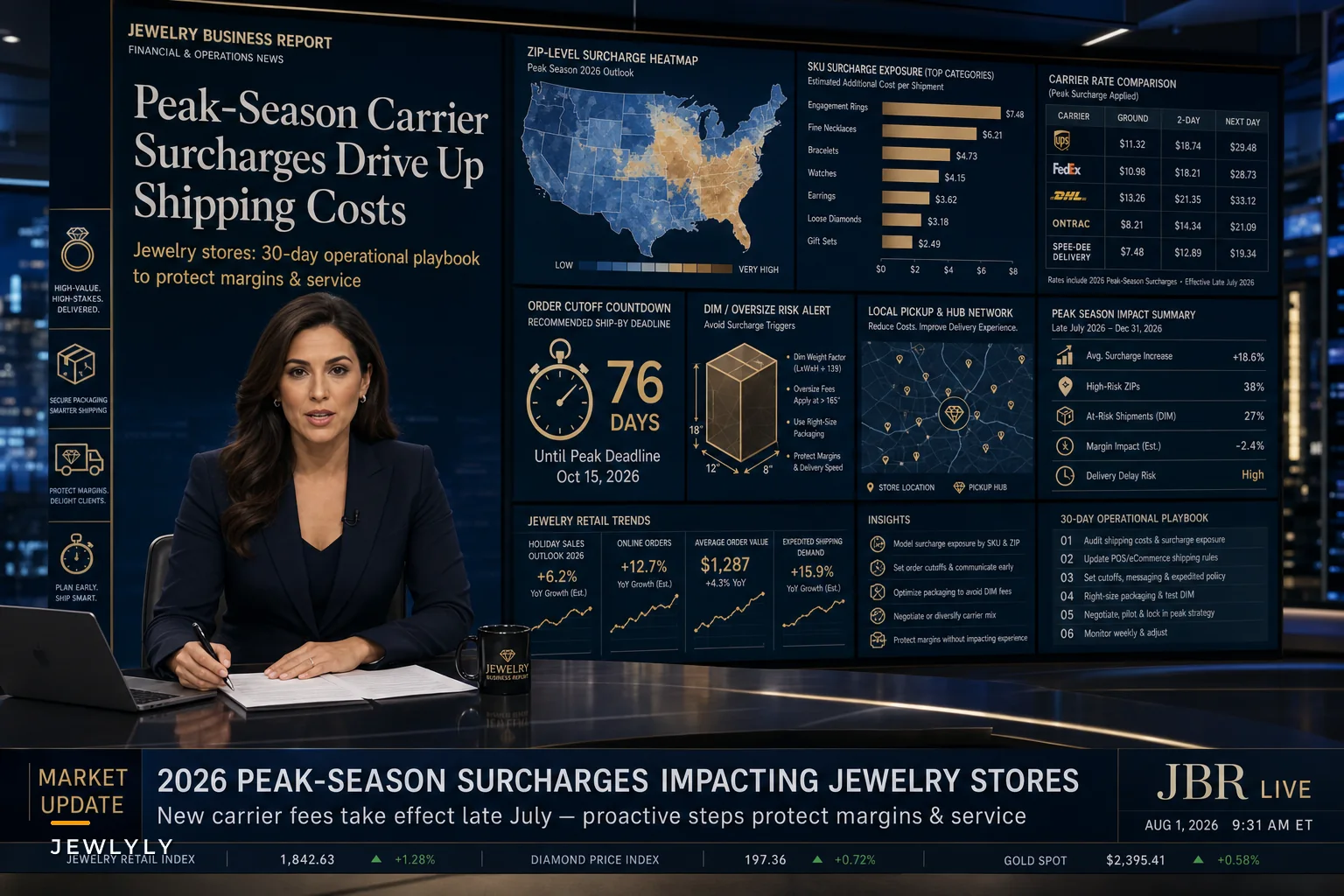

Last week I got a text from a jewelry store owner in Phoenix who ships around 120 packages a month. She'd just opened her FedEx invoice preview and her stomach dropped — the 2026 peak surcharges were already showing up in her cost estimates, and they were worse than she expected.
Not because of the headline numbers. Because of how these surcharges stack.
FedEx announced their 2026 peak season fees in late July, with residential delivery surcharges jumping to $5.50 per package during peak windows that now stretch from mid-October through January. UPS followed with similar increases. On paper, an extra few bucks per shipment sounds manageable.
It's not. Not for jewelry stores.
The stacking problem
Start with that $5.50 residential surcharge. Add the additional handling fee because your secure jewelry box triggers dimensional weight pricing — another $13.50. Your insurance declaration pushes you into a different service tier. Signature confirmation costs more during peak. By the time all the holiday shipping surcharges for 2026 compound, that single shipment to a residential address costs $47 more than it did in September.
Multiply that across your holiday volume. If you're shipping 40 high-value pieces weekly through November and December, you're looking at somewhere around $15,000 in additional shipping costs that weren't in your budget.
The Phoenix store owner runs two locations, does about $3.2M annually. Her November-December shipping typically accounts for 35% of annual volume. With these new surcharges, her shipping costs increase by roughly $8,400 just for those two months. That's her entire January marketing budget, gone.
Why jewelry stores get hit harder
Most retailers can absorb shipping increases by tweaking free shipping thresholds or adjusting packaging. Jewelry stores can't.
Never miss a sale or shipment again.
Jewlyly helps you manage orders, track inventory, and engage customers seamlessly.
- Real-time inventory tracking
- Automated customer notifications
- Sales and order analytics
No credit card required
You need specific box sizes for security. You can't skip signature confirmation on a $5,000 necklace. You can't use cheaper ground shipping when a customer expects their anniversary gift by Friday. Every cost-saving trick that works for regular e-commerce falls apart when you're shipping items worth more than a used car.
Looking at shipping data from around 47 independent jewelry stores, the pattern is consistent: the average jewelry shipment triggers 2.8 different surcharges. During peak season, that jumps to 4.1 per package.
Compare that to general retail, where most packages trigger maybe one surcharge. A clothing retailer shipping a sweater pays the base rate plus maybe a fuel surcharge. You're paying base rate, residential delivery, additional handling, declared value fees, adult signature, and often Saturday delivery — because customers buying engagement rings don't particularly care that Saturday costs extra.
The margin squeeze that starts October 14
According to the published schedules, peak surcharges kick in October 14 and run through January 17. That's 14 weeks of elevated costs hitting right when you're trying to maximize holiday profits.
Here's the cost breakdown side by side:
| Fee Type | Pre-Peak (through Oct 13) | Peak Period (Oct 14 – Jan 17) |
|---|---|---|
| Residential delivery surcharge | Included | $5.50 |
| Additional handling | $13.50 | $18.50 |
| Adult signature | $6.70 | $7.85 |
| Declared value (per $100) | $1.30 | $1.55 |
Run those numbers on a typical $3,500 bracelet shipment. Pre-peak cost: $52. Peak cost: $79. That's a 52% increase before you even get into oversize charges from shipping multiple items together.
The jump from pre-peak to peak isn't just one line item changing — it's every line item changing at once, which is exactly why jewelry stores feel it so much harder than other retailers.
The insurance trap
Higher shipping costs create a secondary problem most jewelry stores don't catch until it's too late: insurance gaps.
When costs spike, stores try to save money by adjusting their insurance declarations. They declare wholesale cost instead of retail value. Or they bundle multiple items to save on base shipping rates — which triggers oversize fees AND creates insurance complications if the package goes missing.
A store in Austin ran into this last December. They shipped three custom pieces together to save on shipping, declared value $8,900. The package triggered oversize fees, adding $31. Then it got lost. Their carrier insurance only covered $5,000 per package unless they'd paid for excess valuation. Actual loss after insurance: $3,900.
Then factor in the customer side — three people furious about missing gifts, three rush replacements shipped at premium rates, three rounds of apology discounts. Total damage to that store was close to $7,000, all from one shipping decision made to save maybe $18.
Three tactical plays for peak season
First, restructure checkout to capture more margin upfront.
Stop absorbing shipping costs past a threshold. Instead of "free shipping over $500," switch to "free standard shipping over $500" and charge actual costs for expedited options. One store in Denver made this change and recovered $18,000 in shipping costs during the 2025 holiday season.
Build a shipping calculator that shows real costs. When customers see that Saturday delivery adds $47, about 70% choose standard delivery instead. That's margin you keep without losing the sale.
Show the delivery price gap on product pages so customers pick the lower-cost option before checkout.
Second, redesign your packaging around dimensional weight.
Most jewelry stores use boxes that are too large. A ring that could ship in a 4x4x3 box goes out in a 6x6x4 because it "looks more premium." That size difference triggers dimensional weight pricing on every shipment.
FedEx and UPS use 139 as their dimensional divisor. A 6x6x4 box = 144 cubic inches / 139 = 1.04 dimensional pounds. Actual weight is maybe 0.3 pounds. You're paying for phantom weight on every single package.
Get boxes manufactured at 5.5x5.5x3.5 — just under the threshold. One store in Los Angeles saved around $4,200 annually from that change alone.
Third, shift volume to alternative fulfillment methods before peak kicks in.
The best way to avoid peak surcharges is to not ship during peak. Obvious, but most stores don't actually build this into their operations.
Create a "local pickup discount" that's genuinely meaningful — 3% off for store pickup. Push it starting October 1st, before peak pricing hits. Set up appointment slots to manage traffic. One store in Houston shifted 30% of their November shipments to store pickup using this approach.
For customers who won't pick up, establish delivery windows that push orders to ship before October 14 or after January 17 when possible. "Order your Valentine's gifts now and save on December shipping" works when you show them the $40+ difference.
The technology piece
When you're managing fluctuating shipping costs across dozens of orders, manual calculations create expensive mistakes fast. The stores handling this well have automated their shipping decision trees.
``
SHIPPING ROUTING LOGIC (simplified)

Order received
  ↓
Check delivery deadline + customer zone
  ↓
Compare carrier rates (FedEx vs UPS) including peak surcharges
  ↓
Check origin location (multi-store: route from closest to customer)
  ↓
Apply declared value + insurance tier
  ↓
Output: carrier, service level, total landed cost
``
Here's a quick visual of that routing workflow.
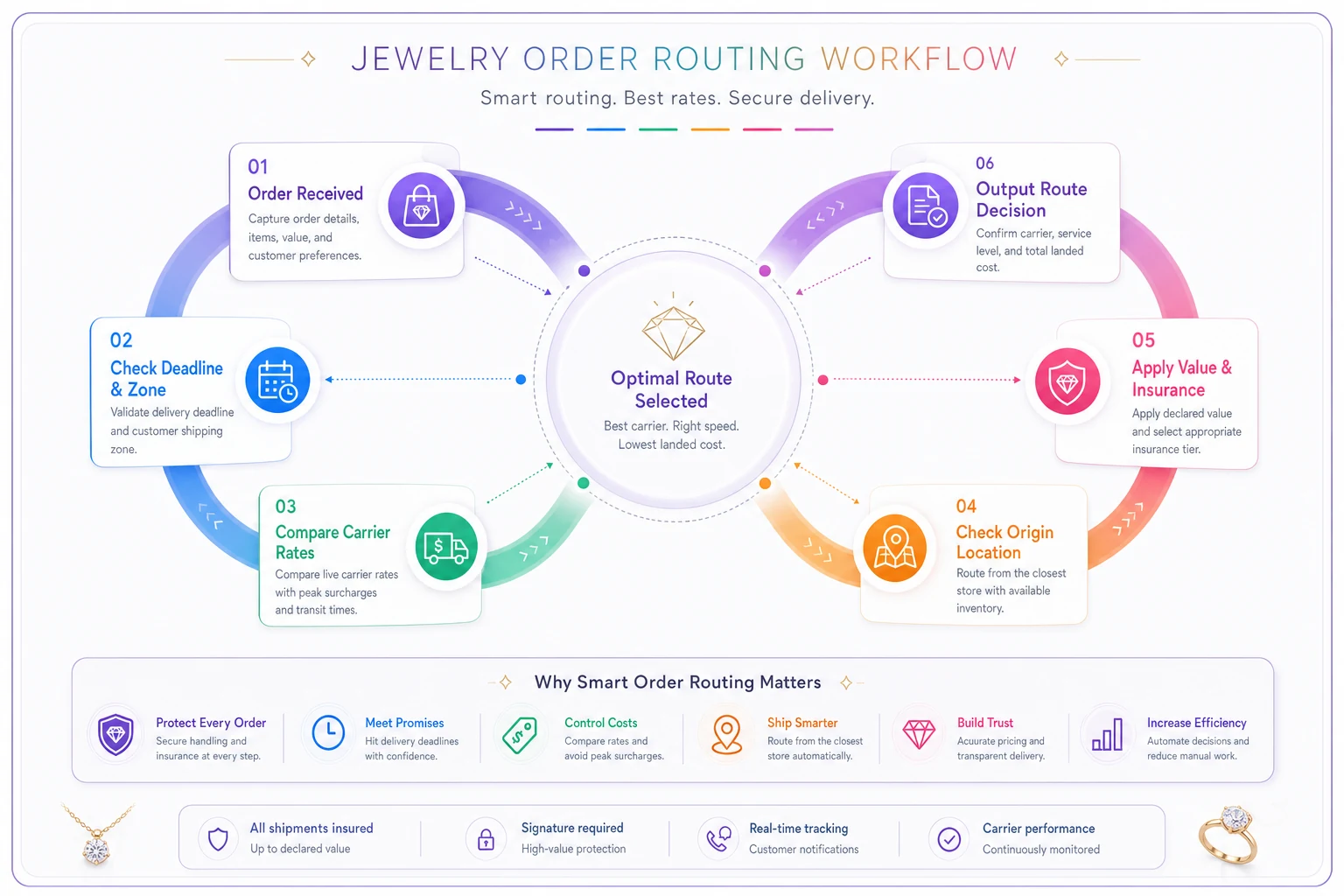
Their systems route orders automatically based on delivery requirements, customer location, and current carrier rates. When a customer orders a $1,200 pendant for delivery to Zone 8, the system already knows whether FedEx 2-Day or UPS Ground with upgraded insurance is cheaper.
That same logic applies to inventory positioning. If you run multiple locations, orders should automatically fulfill from whichever location minimizes shipping costs while still meeting the delivery promise — ship from Phoenix to California customers, Dallas to Texas customers. Basic geography, but a lot of stores still ship everything from their flagship. AI-powered routing can also monitor carrier performance and shift providers when one starts missing service levels. Last December when FedEx had weather delays, stores with intelligent routing automatically moved time-sensitive shipments to UPS and avoided a wave of late delivery complaints.
The pricing conversation
Don't wait until October 14 to adjust your pricing. Start now.
Update your website with a shipping policy page that explicitly mentions 2026 holiday surcharges — dates, additional costs, all of it. Customers handle transparency well. What kills them is sticker shock at checkout.
Build a tiered structure that makes sense for jewelry:
-
Standard (5-7 days)
$12-18
-
Priority (2-3 days)
$32-45
-
Overnight
$75-95
-
Saturday delivery
$120+
These aren't arbitrary numbers — they reflect actual costs with a small margin buffer. The key is how your staff positions them. "Would you prefer to save $40 and receive it Thursday instead of Tuesday?" closes better than "shipping is really expensive right now."
September action checklist
Work through this before October 1st:
-
Run your shipping audit — Pull last December's invoices. Calculate your actual cost per package including all surcharges. That's your real baseline.
-
Renegotiate carrier contracts now — You have zero leverage once peak starts. Call your rep this week and ask specifically about waiving residential delivery surcharges for accounts shipping 100+ packages monthly.
-
Redesign your packaging — Measure every box you use. Calculate dimensional weight. If you need custom boxes, order by September 15th — lead times run about six weeks.
-
Update your shipping calculator — Hard-code the peak surcharges to go live October 14. Don't count on your e-commerce platform to push updates on time.
-
Create pickup appointment slots — Calendly works fine for this. Have it ready by October 1st.
-
Train your team on shipping alternatives — Every sales associate should be able to position store pickup as a benefit, not a consolation prize.
-
Set up shipping rules in your POS — Configure automatic routing based on zones, delivery dates, and package values.
-
Draft your customer communications — Email, website banner, checkout message. Write them now, schedule for October 1st.
Write them now, schedule for October 1st.
Don't let shipping eat your holiday profits
The stores that come out of peak season with their margins intact aren't the ones absorbing every carrier increase. They're the ones who understand the actual economics of shipping jewelry and build operations around it.
That Phoenix store owner is implementing a hybrid model — free shipping on full-price items over $2,000, actual shipping costs on sale items and under-threshold orders, plus a "Ship to Store" program for customers within 50 miles. Early projections show she'll recover about $6,200 of that $8,400 surge.
The 2026 peak window is longer, and the surcharges stack higher than previous years. But the stores with the right operational playbook can protect their margins while still delivering the experience jewelry customers expect.
Every package shipped between October 14 and January 17 costs meaningfully more than the base rate suggests. Plan for it, price transparently, and give customers alternatives that work for your business — not just theirs.
For stores looking to systemize their entire shipping operation — from rate shopping to insurance documentation — our shipping playbook for high-value jewelry orders covers the workflows and controls you need when every package represents thousands in inventory value.
Ready to elevate your jewelry store operations?
Join 500+ jewelers using Jewlyly to increase efficiency, reduce errors, and grow revenue.