



The Conference Board's August print came in at 89.4, and if you weren't watching the number, you probably felt it anyway. The slight dip in consumer confidence doesn't look alarming on paper, but for stores that depend on higher-ticket sales and seasonal buys, a soft August quietly rearranges your Q4 before you've even placed half your holiday orders. National Jeweler captured it well in their coverage of the August drop, pointing to "anticipatory anxieties" driving the shift — people aren't broke, they're hesitant. Hesitant buyers behave very differently from broke ones.
That distinction matters more than the headline number. A hesitant customer still walks in. They still browse. They've still got that ring in the back of their mind. But they stretch the decision window, throw out more "let me think about it" responses, and drift toward the safer, lower-anchor purchase. Your job over the next 60 days isn't to panic-discount your way through fall. It's to reforecast fast, adjust what you're committing to, and protect margin on the pieces that are still moving.
This is really a forecasting problem wearing a confidence-index costume.
Start by re-reading your own last soft cycle, not the news
Before you touch a single reorder, pull your sales data from the last time discretionary spending got jumpy. Most stores have a stretch buried in their history — a slow period where footfall held but average ticket sagged. That internal data tells you more than any national index, because it shows how your specific customer base actually reacts when they get nervous.
What you're looking for is the shape of the softening, not just the size. A confidence dip almost never hits categories evenly. The pattern that tends to show up: bridal engagement stays surprisingly resilient because it's emotionally locked in, while self-purchase and gift-anniversary segments soften first and hardest. Fashion pieces above a certain price point stall, but the sub-$500 gift tier can actually pick up — nervous gift-buyers trade down rather than skip the occasion entirely.
If you can work out which of your categories are "decision-elastic" (people delay) versus "occasion-locked" (people still buy, just cheaper), you've basically built your reforecasting map. Everything downstream — buys, promotions, staffing — flows from that split.
Reforecast in three passes, not one big spreadsheet rewrite
The mistake stores make here is trying to rebuild the whole annual plan in a weekend. You don't need to. Three fast, focused passes is enough.
Never miss a sale or shipment again.
Jewlyly helps you manage orders, track inventory, and engage customers seamlessly.
- Real-time inventory tracking
- Automated customer notifications
- Sales and order analytics
No credit card required
-
1. Adjust unit volume by tier, not overall. Take your holiday forecast and haircut the top price bands while holding or slightly raising your entry-and-mid bands. If you were expecting fifteen pieces above $5k to move in Q4, model it at ten to twelve and see what that does to your open-to-buy. Don't apply a flat percentage cut across everything — that punishes the tiers that are still actually selling.
-
2. Recalculate turnover assumptions. Slower discretionary spending stretches your sell-through timeline. A piece you assumed would turn in 60 days might now take 90. That single change ripples into your reorder cadence and your cash flow, and it's the number most stores forget to touch.
-
3. Stress-test cash, not just revenue. Model what happens to your cash position if your top tier moves 20% slower than plan. If that scenario makes you uncomfortable, shift budget toward faster-turning inventory before you commit vendor orders, not after.
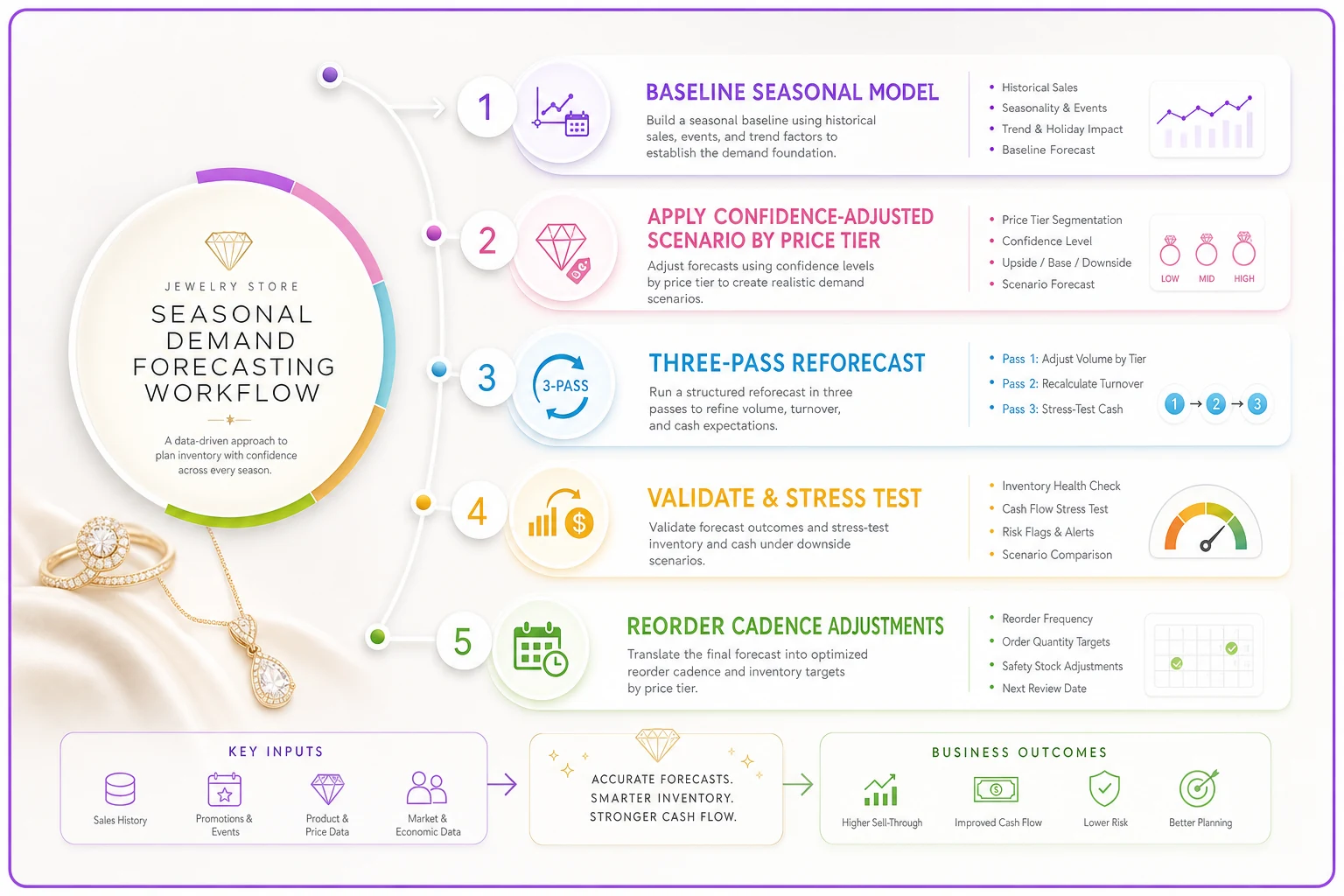
If you've already built seasonal models, this is where they earn their keep. Layering a confidence-adjusted scenario on top of your baseline is exactly the kind of thing covered in our deeper walkthrough on jewelry demand forecasting with seasonal models and reorder automation — the mechanics of feeding softer assumptions into reorder triggers apply directly here.
Rebalance the assortment toward the "trade-down" buyer
When confidence dips, the money doesn't fully disappear — it slides down a tier. Stores that get hurt are the ones whose case is weighted 70% toward pieces that only sell when buyers feel flush. Stores that hold up have depth in the "still feels like a treat, doesn't require a financing conversation" range.
Here's a rough breakdown of how the assortment logic shifts:
| Category | Normal-Confidence Weighting | Soft-Confidence Adjustment | Why |
|---|---|---|---|
| Bridal / engagement | Hold | Hold | Occasion-locked, emotionally committed |
| High fashion ($3k+) | Aggressive | Trim depth, keep hero pieces | Decision-elastic, buyers delay |
| Mid-tier gift ($500–$1,500) | Moderate | Increase depth | Trade-down destination |
| Entry gift (under $500) | Thin | Widen selection | Captures nervous gift-buyers |
| Repairs / custom / trade-in intake | Steady | Lean into it | Non-discretionary, margin-friendly |
That last row matters more than most people expect. When new-piece sales soften, the service side — repairs, resizing, restringing, trade-in refurb — becomes a bigger share of revenue and a bigger driver of foot traffic. Nervous customers who won't buy a new tennis bracelet will absolutely pay to fix the one they already own. Make sure your bench isn't so stretched chasing holiday retail that you end up starving the service revenue that actually holds up in a soft cycle.
Protect margin before you touch price
The reflex during a confidence dip is to reach for promotions. Resist it as your first move. Discounting is the fastest way to turn a demand-timing problem into a permanent margin problem — once you train your local market to expect 20% off, you don't easily untrain them.
-
Tighten pricing discipline on pieces that are still selling. If bridal is holding, it does not need a discount. Full stop.
-
Use targeted incentives, not blanket sales. A financing promotion or a "spend $X, get a service credit" offer moves buyers without gutting your ticket the way a straight percentage cut does.
-
Bundle service, not price. Free sizing, a year of complimentary cleaning, or a warranty extension protects the sticker while lowering the buyer's perceived risk — which is exactly what a hesitant customer is weighing.
-
Reserve real markdowns for genuinely slow inventory. Pull your aged stock report and discount those pieces deliberately, rather than broadcasting a storewide event that also discounts things that were selling fine.
The underlying principle: a confidence-driven slowdown is about hesitation, not affordability. Shrinking the perceived risk of buying is a different problem than shrinking the price, and they call for different tools.
Tighten reorder cadence so you don't get caught long
Slow turnover quietly becomes a cash trap when you're not watching closely. If you keep reordering at your normal-confidence rhythm while sell-through stretches, you end up over-invested in inventory moving at three-quarters speed, right when your cash needs to stay flexible.
The fix is to shorten your reorder decision loop and lower quantities on the elastic categories. Instead of reordering a top-tier line in your usual pack of six, order three and watch how it reads. Let actual velocity — not last year's holiday assumption — tell you when to go deeper. Fast, smaller, data-triggered reorders beat one big confident buy in an uncertain window pretty much every time.
Use velocity thresholds in your POS or inventory system to automatically flag when to cut reorder quantities rather than relying on calendar-based restocks.
This is also the moment to lean on whatever operational system tracks your sell-through, because eyeballing it across a full case is where errors creep in. A platform that flags when a category's velocity drops below your adjusted threshold — and holds the reorder until you confirm — keeps you from auto-restocking into a slowdown. Not glamorous, but it's often the difference between ending Q4 with clean shelves and ending it with capital frozen in slow stock.
A real scenario: independent store, soft self-purchase segment
Consider an independent shop doing roughly $1.4M a year, with a case that skewed heavily toward fashion pieces in the $2k–$6k range. Heading into a soft stretch, they held their normal buy and kept promoting across the board. By mid-November, their top tier was moving about 30% slower than planned, and they'd already discounted enough that even the pieces that were selling came in at compressed margin. Cash got tight right when they needed flexibility for holiday restocks.
The following soft cycle, they ran it differently. They trimmed depth on anything above $3k, roughly doubled their sub-$1,500 gift selection, and swapped the storewide sale for a financing offer plus a bundled cleaning-and-warranty package on mid-tier pieces. Reorder quantities got cut in half on fashion, with velocity dictating re-buys. Overall unit volume came in about flat versus the prior soft year — but average margin held, cash stayed loose, and they weren't sitting on a case full of aged high-ticket inventory in January.
Same demand environment, very different balance sheet. The lesson wasn't "sell cheaper stuff." It was: match your buy and your incentives to how a hesitant customer actually behaves, instead of fighting the cycle at full price and panic-discounting on the back end.
When to hold your line — and when not to
A soft confidence reading doesn't mean every store should scramble. If your business is heavily bridal, sits in a stable local market, and your aged-inventory report is already clean, the smartest move might be to barely change anything except tightening reorder discipline. Over-reacting to a national index when your own numbers are fine is its own kind of mistake — you can talk yourself into discounts your customers weren't even asking for.
The stores that genuinely need to move are the ones carrying deep, expensive fashion inventory, serving a discretionary-gift-heavy customer base, or already watching turnover slip. If two or more of those describe your situation, treat the August reading as an early warning and start the reforecast now rather than in October when your buys are locked.
If you're somewhere in between, do the cheapest high-value thing first: pull your last soft-cycle data, re-read your category elasticity, and adjust only your reorder quantities and your promotional plan. That alone protects most of the downside without over-correcting.
What this actually comes down to
The August dip isn't really a demand story — it's a timing and hesitation story. Buyers are still out there. They're stretching decisions, trading down a tier, and looking for reasons to feel comfortable about a purchase.
Stores that reforecast quickly, rebalance toward the trade-down buyer, protect margin before reaching for the discount lever, and tighten their reorder loop will move through fall in decent shape. Stores that keep buying and pricing like it's a full-confidence market — and then discount their way out in December — will pay for it in compressed margin and frozen cash come January.
Read your own history, adjust in tiers, keep reorders small and data-driven, and let the service side carry more of the load while new-piece demand catches its breath. The index will move again. Your operational discipline through this window is what determines whether the dip costs you a little or a lot.
Ready to elevate your jewelry store operations?
Join 500+ jewelers using Jewlyly to increase efficiency, reduce errors, and grow revenue.