

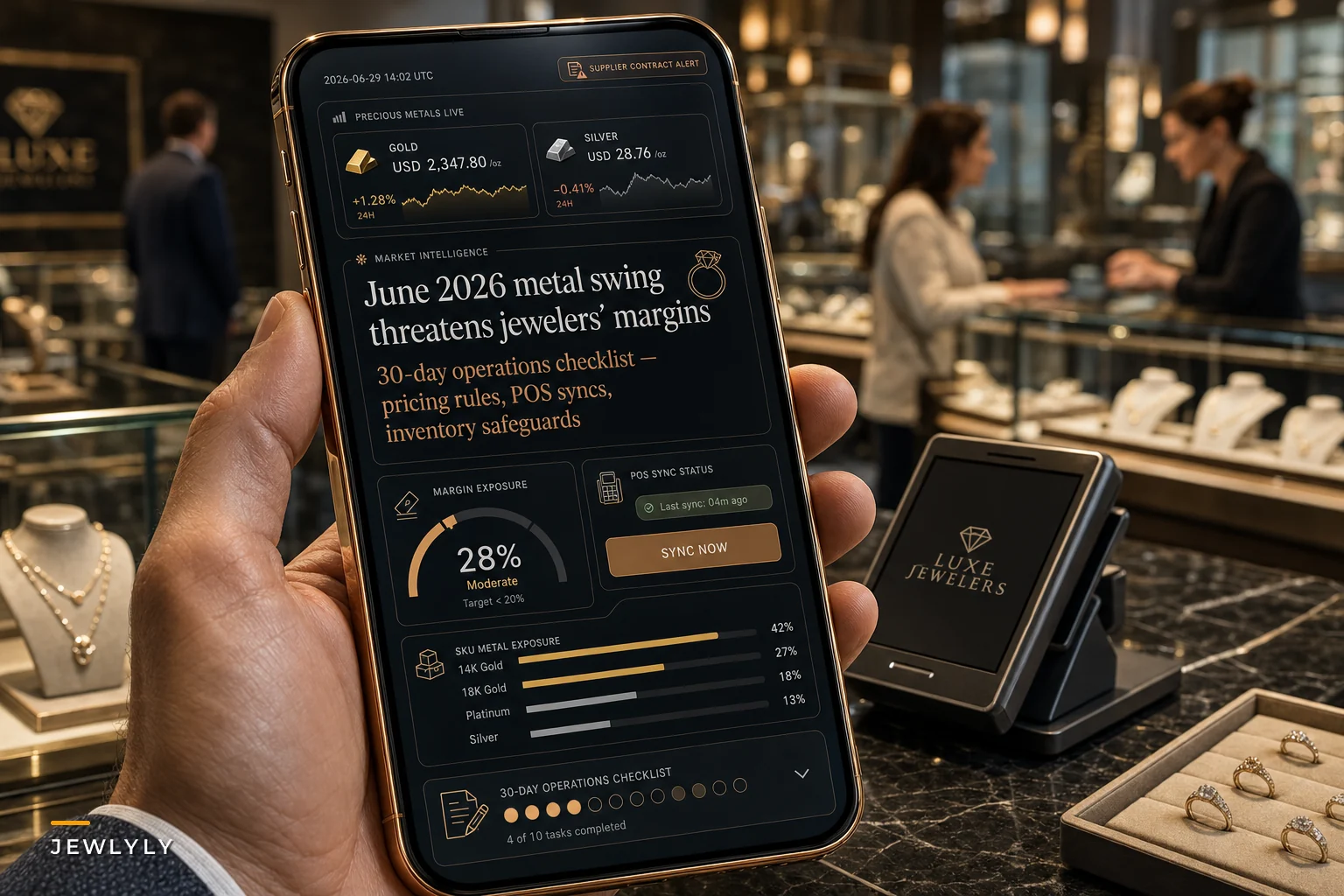

Last week felt like whiplash. Gold dropped from $4,100 to around $3,700, bounced back to $3,950, then settled somewhere near $3,800. CNBC reported the metal hovering around the $4,000 mark as markets tried to figure out whether the Fed's hawkish stance was real or just talk. Silver did its usual thing—moved three times as violently as gold, swinging from $62 down to $54 in two trading sessions.
For jewelry stores, that kind of move creates immediate operational chaos. Your floor inventory was priced three weeks ago. Custom orders quoted last month now carry different metal costs. Staff are fielding questions they can't answer. Meanwhile you're trying to decide whether to hold inventory, move it fast, or swap every price tag before the weekend rush.
The problem runs deeper than repricing though. When metals swing hard, your entire operational system gets tested—supplier relationships, customer deposits, margin calculations, staff training, inventory mix. Most jewelers respond by either freezing up or overreacting with rushed decisions that create bigger problems. Neither works.
The stores that actually protect margins don't just react to swings. They have systematic responses already in place.
The first 48 hours: triage your exposure
When metals move violently, you have roughly 48 hours before customers notice pricing inconsistencies and suppliers start adjusting terms. The immediate priority isn't repricing everything—it's figuring out where you're actually exposed.
Start with custom orders in progress. Pull every order placed in the last 60 days that hasn't been delivered. Check what metal price you quoted versus current spot. If you quoted a wedding band at $3,600 gold and it's now $4,000, that's a $400 hit per ounce of material you're absorbing—unless your contract terms protected you.
Then look at held inventory. Separate your floor pieces into three buckets: high metal content (chains, heavy rings, bangles), pieces where metal is secondary to stones (most engagement rings), and fashion pieces where brand matters more than melt value. That first bucket needs immediate attention. The second can wait. The third barely matters for metal pricing purposes.
Check repair jobs too. Any sizing or restoration quoted more than two weeks ago might be underwater if you included metal costs. A simple sizing needing 2 grams of gold just got $25 more expensive if gold jumped $400.
Here's the exposure assessment you need within 48 hours:
Custom Orders
-
Total orders with fixed prices
count and value
-
Orders with price adjustment clauses
count and value
-
Average metal weight per order
-
Potential margin impact at current prices
Floor Inventory
-
High metal content pieces
total value at old cost basis
-
Current replacement cost for same inventory
-
Pieces that can't be repriced (consignment, memo)
-
Online listings that need updating
Pending Repairs
-
Jobs quoted but not started
-
Metal-heavy repairs (chain repair, reshanking)
-
Customer deposits already collected
Most stores find somewhere between $30k and $80k of exposure during volatile periods. The bigger issue is that staff usually have no idea how to handle customer questions when prices shift between last week and today.
Week one priorities: stabilize your pricing system
After triage, you need systematic pricing updates that don't create more confusion. The worst move is randomly updating some prices while leaving others—customers notice the inconsistency fast, and it undermines trust.
Never miss a sale or shipment again.
Jewlyly helps you manage orders, track inventory, and engage customers seamlessly.
- Real-time inventory tracking
- Automated customer notifications
- Sales and order analytics
No credit card required
Physical floor pricing needs a clear strategy. If you're still on paper tags, assign one person to handle all updates. Have them work by category, not randomly walking the floor. Start with high-visibility, high-metal pieces—chains, bracelets. Work through systematically: men's bands, plain bands, fashion rings, then everything else.
Digital pricing is a different headache. Your website might update automatically if it's connected to your POS, but marketplace listings (Etsy, eBay, specialty platforms) usually need manual updates. It gets worse when the same piece shows different prices across channels. A customer screenshots your website price, finds a cheaper version on your Instagram shop, and now you're trying to explain why your own listings don't match.
For pieces with significant stone value, you might hold pricing steady even when metal moves. A $12,000 engagement ring with a $10,000 center stone and $2,000 of platinum doesn't need immediate repricing if platinum moves 10%. A $2,000 Cuban chain that's mostly gold weight does.
The pricing update sequence that minimizes confusion:
-
Update POS system with new metal prices (this becomes your source of truth)
-
Print new tags for high-metal pieces
-
Update website pricing if not automated
-
Check and update marketplace listings
-
Brief all staff on which categories changed and why
-
Prepare standard responses for customer questions
Some stores try to update everything simultaneously and create paralysis. Others update nothing and bleed margin for weeks. Sequential updates with clear communication about what's changing—and when—is what actually works.
Managing customer deposits during volatility
Custom order deposits get contentious fast when metals swing. Customer places an order with 50% down when gold was $3,600. Three weeks later when you're ready to cast, gold is sitting at $4,000. Do you eat the difference? Ask for more money? Hope they don't notice?
The contractual answer might be clear, but operations matter more than contracts here. Even if your agreement technically allows price adjustments, surprising a customer two weeks before their wedding with a $400 increase creates problems. They'll pay it, but they'll also leave a bad review and never come back.
Progressive billing works better than surprise adjustments. When metals are volatile, break custom orders into smaller milestones:
-
Initial deposit
30% to start design
-
Material deposit
20% when ordering metals/stones (adjusted to current prices)
-
Production deposit
30% when starting fabrication
-
Final payment
20% plus any adjustments at pickup
This structure lets you adjust for metal prices at the material deposit stage, when customers expect to pay for materials anyway. It feels logical rather than punitive.
For existing orders already caught in the swing, transparency beats surprise. Call customers with significant exposure before they call you. Explain the situation, show them the numbers, and offer options. Maybe they pay the full increase, maybe you split it, maybe you offer store credit. The conversation is always easier when you initiate it.
Track deposit exposure systematically:
| Order Date | Customer | Original Gold Price | Current Gold Price | Metal Weight | Exposure | Resolution |
|---|---|---|---|---|---|---|
| May 15 | Johnson | $3,600 | $4,000 | 0.5 oz | $200 | Split difference |
| May 22 | Chen | $3,650 | $4,000 | 0.3 oz | $105 | Customer paid |
| June 2 | Williams | $3,750 | $4,000 | 0.8 oz | $200 | Absorbed |
Without tracking like this, you end up making different decisions for similar situations—and customers eventually notice and resent the inconsistency.
Inventory adjustments that actually protect margins
Beyond repricing, volatility should trigger an inventory mix review. When gold spikes, customers shift behavior in pretty predictable ways. They buy lighter pieces, choose silver over gold, delay big purchases, and start asking about alternative metals they wouldn't normally consider.
The typical store response is to wait it out, keeping the same inventory mix while sales patterns shift underneath them. But volatile periods are exactly when you should adjust your floor to match changing demand.
Start with your metal allocation. If gold jumps 20% but silver only moves 5%, shift more floor space toward silver. Not permanently—just for the volatile stretch. Pull some gold pieces to the safe, feature more silver in cases. A customer who walked in planning to spend $2,000 on gold might spend $2,000 on silver instead if that's what you're actually showcasing.
Alternative metals become relevant during spikes too. Titanium, tungsten, surgical steel—these don't fluctuate with commodity markets. A $400 titanium band carries the same margin whether gold is $3,000 or $4,000. During volatility, these pieces deserve better floor placement.
Chain inventory needs special attention. Chains are basically metal by weight, so price changes hit them hardest. When gold spikes, consider switching from outright sales to layaway programs. Customer puts 20% down, pays over 3-6 months at locked-in pricing. You get the sale without the inventory exposure; they get the chain without the sticker shock.
The inventory adjustment checklist for volatile periods:
Immediate adjustments (week 1):
-
Move high-metal pieces to less prominent positions
-
Feature stone-focused designs in prime cases
-
Add alternative metal options to empty spots
-
Update layaway terms and promote them
Sustained volatility adjustments (week 2-4):
-
Reduce automatic reorders for heavy pieces
-
Increase silver/alternative metal orders
-
Negotiate memo terms for high-value gold pieces
-
Consider launching a metal recycling program
Running a recycling program during spikes serves two purposes. Customers can trade in old gold when prices are high—they feel smart doing it—and you acquire metal at slightly below spot for custom work. Set recycling prices at 80-85% of spot. You're still ahead compared to buying from suppliers at spot plus fabrication charges. It also drives foot traffic during what's usually a slow, uncertain stretch.
The supplier conversation you need to have this week
Metal volatility changes supplier relationships fast. A vendor who's been reliable for years might suddenly demand COD terms or pause orders if they think prices will keep climbing. Your usual payment terms might disappear. Minimums might double.
Call your top three suppliers within the first week. Not email—call. Ask directly about their volatility policies. Some suppliers lock prices at order time, others at shipping, others at invoice date. During the 2022 volatility, the difference between those policies meant thousands of dollars in margin impact for typical stores.
Negotiate volatility-specific terms while you still have leverage. If you're a solid customer during stable periods, suppliers should work with you when things get choppy. Ask for price locks at order confirmation rather than shipping, extended payment terms for existing orders, the ability to cancel unshipped orders if prices reverse, and volume discounts for forward orders.
Document everything. That phone call where they agreed to hold pricing? Follow up with an email. "Per our call, confirming you'll hold the $3,850 gold price for order #4521 regardless of spot movement before shipping."
Some suppliers offer hedging products during volatility—locking in metal prices for 30-90 days for a premium, usually 2-3%. Whether that makes sense depends on your risk tolerance and cash position. Paying 3% extra for price certainty might be worth it if you have multiple large custom orders in progress.
The supplier conversation framework:
"I want to check on our terms during this volatility. We've been working together for [time period], doing roughly [$X] monthly. With metals moving like this, I need to understand: when are prices locked for orders? Can we maintain our net-30 terms? What happens to pending orders if spot drops 10%? Can we lock pricing for the next 30 days?"
If they won't budge, start testing alternatives. Volatility reveals which suppliers actually value long-term relationships versus those just riding market momentum.
Staff training that prevents costly mistakes
Your team makes dozens of micro-decisions daily that affect margins during volatility. The salesperson quoting a custom piece. The repair desk estimating a restoration. The buyer deciding what to reorder. Without clear guidance, they're guessing—and guesses during volatility cost real money.
Start with pricing authority. Who can honor old prices when customers push back? Who can offer discounts to close a sale? Who decides whether to accept a custom order with uncertain metal costs? Define these boundaries explicitly. Old prices can be honored up to 7 days old with a maximum $200 difference. Normal discount authority gets reduced during volatile periods. Custom quotes over $3,000 need manager review. Price matching gets suspended entirely.
Create simple reference sheets for common situations. Not lengthy policies—one-page guides they can actually use mid-conversation. Include exact phrases for common objections:
"I saw this cheaper last week" Response: "You're right, metal prices moved significantly this week. We update pricing based on current replacement costs—what you're seeing reflects what we'd pay to reorder this piece today."
"Will prices go back down?" Response: "Metal prices change daily based on global markets. We can lock in today's price with a deposit, which protects you if prices keep rising."
"Can you honor the old price?" Response: "Let me check when you saw that price. For recent views within the past week, we can often work something out."
Then run a 30-minute training session covering current metal prices and recent movement, which pieces are most affected, standard responses to price questions, when to involve a manager, and how to position layaway and payment plans.
One poorly handled price objection can cost a $5,000 sale. One wrong custom quote can wipe the margin on a $10,000 order. The training pays for itself fast.
Technology changes that reduce manual scrambling
Most jewelry stores still update prices manually across multiple systems during volatility. POS shows one price, website shows another, tags say something else, marketplace listings are somewhere in between. The scramble to sync everything wastes days and still leaves gaps.
The immediate fix isn't buying new systems—it's connecting what you already have. Your POS likely has API connections or export functions you're not using. Set up automated daily exports of high-metal SKUs to a spreadsheet. Even if you update other systems manually, you at least have a single source of truth to work from.
For websites, check whether your platform supports price rules based on metal costs. Many jewelry-specific platforms let you set prices as formulas: metal weight × spot price × markup + labor. When spot moves, prices update automatically. The setup takes a few hours but saves days of manual work during volatile stretches.
Below is a rough workflow for how price updates should flow through your systems during a volatile period:
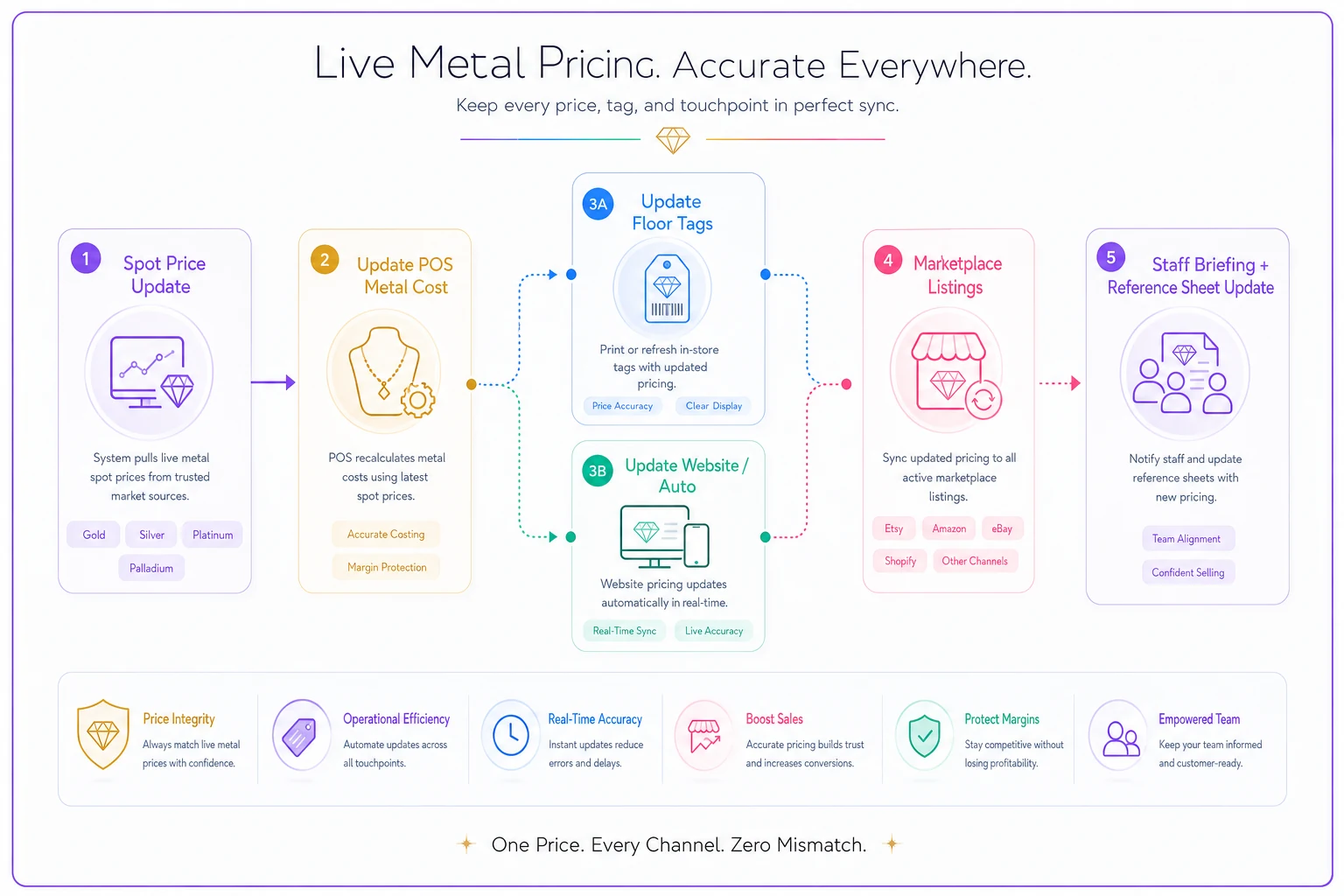
The immediate fix isn't buying new systems—it's connecting what you already have.
Marketplace integration is trickier but doable. Inventory management platforms can push updates to multiple channels—you update once in the central system and it propagates out. The $200-300 monthly cost pays for itself the first time metals swing hard.
Price monitoring matters too. Set up Google Alerts for your store name plus "price" to catch customer complaints before they spread. Check your own listings weekly for consistency. Review competitor pricing occasionally to make sure you're not way out of line.
The longer-term approach that really helps is building pricing rules that automatically adjust based on metal costs. Instead of manually updating hundreds of SKUs, you update the spot price and everything recalculates. But this requires setup before volatility hits, not during it.
A real volatility response: Greene & Associates Fine Jewelry
Greene & Associates in North Carolina faced the June volatility with about $400k in floor inventory and 20 custom orders in progress. When gold swung from $3,600 to $4,000, their exposure was roughly $35,000 if they did nothing.
Day one, they pulled their custom order list and found eight orders significantly underwater. They called each customer within 48 hours, explained the situation, and offered three options: pay the difference, cancel for a full refund, or wait 30 days to see if prices stabilized. Five customers paid the difference—about $1,800 total. Two decided to wait. One canceled.
For floor inventory, they implemented zone pricing. High-metal pieces updated every three days. Stone-heavy pieces weekly. Fashion jewelry stayed at original prices. One person handled all updates, working through zones systematically each morning before opening.
Their smartest move was launching a "Metal Market Special" promotion. Customers who traded in old gold got spot price plus 10% toward new purchases. It drove traffic during a slow stretch while they acquired metal below their supplier costs. They collected about 400 grams of gold over two weeks, saving roughly $3,000 versus buying from suppliers.
Margins dropped only 2% during the volatile month, compared to the 5-7% drops they'd seen in previous volatility events. More importantly, staff had clear processes to follow instead of daily chaos. Customer complaints dropped because everyone had consistent answers. The owner stopped fielding panic calls because the systematic response was already running.
When stability returns: lessons for next time
Volatility always ends. It also always comes back. The stores that handle it well aren't the ones that reacted fastest—they're the ones that prepared during calm periods.
Document everything from this stretch. Which suppliers helped, which didn't. Which pricing strategies worked, which failed. Which staff stepped up, which needed more guidance. This becomes your playbook.
Update your standard contracts now, while the pain is fresh. Add metal adjustment clauses to custom orders. Define deposit policies clearly. Set volatility triggers that automatically activate certain policies when spot prices move more than 10% in a week.
Build technology connections while you have time. API integrations, automated pricing rules, inventory management systems—set them up during stable periods. When volatility hits, you want to execute plans, not build them on the fly.
Train your team on the full cycle too. They've just lived through how volatility affects operations. Help them understand the connections between metal prices, customer behavior, margin pressure, and operational response. Next time, they'll recognize the patterns earlier and respond faster.
CNBC noted that gold's recent moves are tied to ongoing uncertainty around Fed rate decisions—which means this kind of volatility isn't going away anytime soon. That's not a reason to panic. It's a reason to get your systems right while things are calm.
The 30-day checklist
Here's your prioritized action list for the next 30 days:
Week 1: Immediate Stabilization
-
Assess exposure across custom orders, inventory, and repairs
-
Contact customers with significantly underwater custom orders
-
Update high-metal floor inventory prices
-
Brief staff on standard responses to price questions
-
Contact top 3 suppliers about volatility terms
Week 2: Systematic Adjustments
-
Implement zone-based pricing updates
-
Adjust inventory mix toward silver/alternatives
-
Launch metal recycling program
-
Update website and marketplace prices
-
Create reference sheets for common situations
Week 3: Process Improvements
-
Document supplier responses and terms
-
Run staff training on volatility procedures
-
Set up automated price exports from POS
-
Review and adjust custom order deposits
-
Negotiate forward pricing with suppliers
Week 4: Future Preparation
-
Update standard contracts with metal clauses
-
Build pricing rule templates
-
Create volatility trigger policies
-
Document lessons learned
-
Set up monitoring systems for next time
The difference between stores that lose margins during volatility and those that protect them isn't luck or timing. It's systematic response versus reactive scrambling. Every volatile period tests your operational foundation—the question is whether you have processes ready or you're just hoping it passes quickly.
Metal prices will keep swinging. The jewelry stores that come out ahead won't be the ones that predicted the move correctly. They'll be the ones with operational systems that handle volatility without requiring a crisis meeting every time spot moves $200.
Ready to elevate your jewelry store operations?
Join 500+ jewelers using Jewlyly to increase efficiency, reduce errors, and grow revenue.