



The jewelry business runs on weird physics. Your inventory value shifts every morning at 8:30 AM when London fixes gold prices. Meanwhile your prices—printed on tags, loaded in your POS, listed online—stay frozen from whenever you last updated them three months ago.
Most jewelers treat pricing like it's 1985. Calculate cost, add markup, print tag, done. Except now gold swings $50 in a day, silver moves 8% overnight, and that engagement ring you priced at healthy margins last month is quietly bleeding money at today's spot prices.
The math gets uglier when you factor in everything else. Stone costs fluctuate with supply disruptions. Your bench jeweler raised rates twice this year. Overhead creeps up quarterly. But those price tags? Still showing numbers from last spring.
Why traditional jewelry pricing breaks down
Traditional markup formulas assume stable inputs. Take a standard 14k gold chain. Old-school pricing says cost plus 2.5x markup equals retail. Simple enough when gold sat at $400 an ounce for years.
Now watch what happens with actual movement. You price that chain when gold hits $1,850. Three weeks later gold jumps to $2,050. Your replacement cost just increased 11% but the price tag hasn't moved. Sell it and you can't buy the same piece back at wholesale.
The reverse hurts differently. Gold drops from $2,100 to $1,900. Your inventory looks overpriced compared to competitors who bought at lower spot. Sales slow. You're stuck choosing between holding dead inventory or taking losses to move product.
Most jewelers handle this by guessing. They'll adjust prices when it "feels" like metals moved enough. Maybe update custom quotes weekly. Perhaps revise showcase prices quarterly. This randomness creates margin leaks everywhere—some pieces underpriced by 20%, others sitting unsold because nobody adjusted them down.
The coordination problem multiplies across channels too. Your website shows one price. In-store tags show another. Your sales team quotes custom pieces using last month's metal costs. Instagram posts promote items at prices that made sense six weeks ago. Every channel runs its own pricing reality.
Breaking down real jewelry costs
Understanding true product cost means tracking four distinct components that move independently.
Never miss a sale or shipment again.
Jewlyly helps you manage orders, track inventory, and engage customers seamlessly.
- Real-time inventory tracking
- Automated customer notifications
- Sales and order analytics
No credit card required
Metal cost forms the volatile base. For a 5-gram 14k gold ring, metal cost equals:
-
Spot price per gram × actual weight × alloy percentage
-
At $65/gram spot
$65 × 5 grams × 0.585 = $190.13 metal value
-
Add 8% fabrication loss during manufacturing = $205.34 base metal cost
Stone cost varies by source timing. A VS1 half-carat diamond might cost:
-
$1,800 from your regular supplier
-
$2,100 from backup suppliers during shortages
-
$1,500 on memo deals with payment terms
Factor in setting complexity too. Channel settings eat 3-5% of stones through damage. Micro-pavé work breaks 8-10% during setting. These losses compound into real cost.
Labor allocation depends on piece complexity:
-
Simple solitaire setting
0.75 hours at $85/hour = $63.75
-
Three-stone setting with sizing
2.5 hours = $212.50
-
Custom CAD work plus setting
8 hours = $680
Don't forget the hidden labor. Cleaning, inspection, packaging, and documentation typically add 20 minutes per piece minimum. That's another $28 most jewelers never capture in pricing.
Overhead burden spreads across inventory turns. A typical jewelry store runs 25-35% overhead on cost of goods. For that $2,000 cost ring:
-
Rent allocation
$180
-
Insurance and security
$95
-
Sales commission (future)
$150
-
General operations
$275
-
Total overhead burden
$700
Stack these up and that "simple" ring with $2,000 in obvious costs actually runs $2,700 all-in. Miss any component and margins evaporate.
Building dynamic markup bands
Static markups assume static costs. Dynamic markup bands adjust to market reality.
Start with base markup tiers tied to price points and metal content:
| Price Range | Low Metal % | High Metal % | Spot Stable | Spot Volatile |
|---|---|---|---|---|
| Under $500 | 2.8x | 2.3x | 2.5x | 2.2x |
| $500-2,000 | 2.5x | 2.0x | 2.2x | 1.95x |
| $2,000-5,000 | 2.2x | 1.85x | 2.0x | 1.75x |
| $5,000-10,000 | 2.0x | 1.7x | 1.85x | 1.65x |
| Over $10,000 | 1.85x | 1.6x | 1.7x | 1.55x |
These bands shift based on metal volatility indicators. When 30-day gold volatility exceeds 12%, drop to the volatile column. This prevents getting stuck with overpriced inventory during rapid moves.
Spot movement triggers:
-
5% move in primary metal
Review all related inventory pricing
-
8% move
Mandatory repricing of items over 50% metal cost
-
12% move
Full category repricing required
-
15% move
Freeze new orders until pricing stabilizes
Time-based triggers:
-
Weekly
Review custom quote calculations
-
Biweekly
Check high-metal-content items
-
Monthly
Full inventory margin analysis
-
Quarterly
Adjust base markup bands
Competition triggers:
-
Competitor repricing detected
Review comparable items within 48 hours
-
Online price aggregators show 10% variance
Investigate and adjust
-
Customer mentions lower prices elsewhere
Document and review category
A simple workflow for trigger-based repricing:
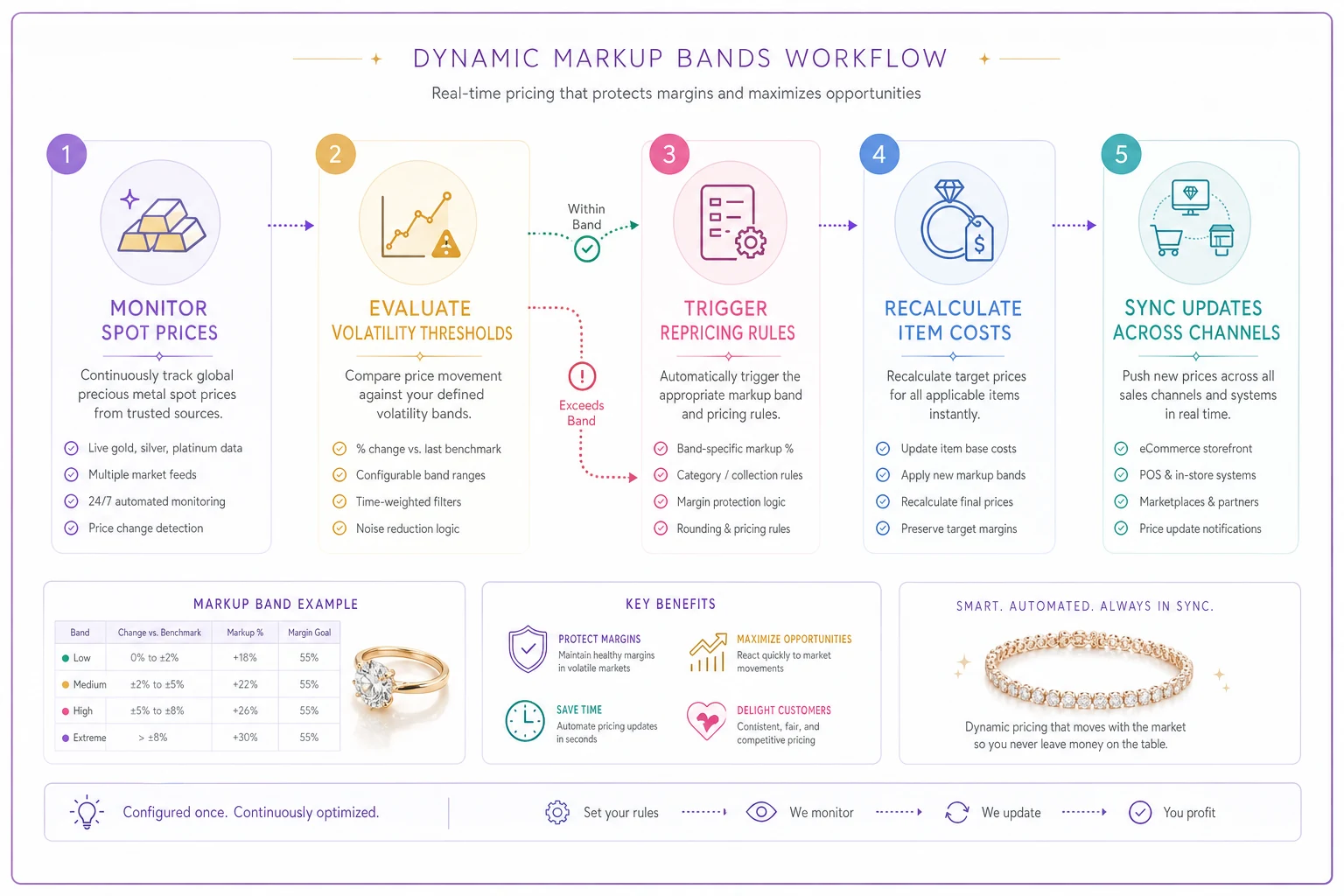
The key is making these triggers systematic, not discretionary. When gold moves 8%, repricing happens automatically—not when someone remembers to check.
Channel synchronization rules
Different sales channels need different prices, but they can't conflict randomly. Build rules that maintain relationships while allowing flexibility.
Primary channel hierarchy:
-
In-store showcase (baseline prices)
-
Website (typically matches or 3-5% below showcase)
-
Online marketplaces (5-10% above website for fee coverage)
-
Instagram/social (matches website for consistency)
-
Custom quotes (uses real-time calculation)
Set maximum allowable variance between channels. A ring priced at $3,000 in-store shouldn't exceed these ranges:
-
Website
$2,850 - $3,000
-
Marketplace
$3,150 - $3,300
-
Social media
$2,850 - $3,000
-
Custom similar piece
$2,700 - $3,300
When spot prices trigger repricing, channels update in sequence:
-
First
Custom quote calculator (immediate)
-
Second
Website pricing (within 24 hours)
-
Third
Marketplace listings (within 48 hours)
-
Fourth
Physical tags (within 72 hours)
-
Last
Marketing materials (next campaign)
This sequencing prevents the chaos of partial updates. Customers don't see three different prices for identical items.
Some jewelers try updating everything simultaneously. This usually means nothing gets updated properly. Your website person waits for new tags. Tag printing waits for the final spreadsheet. Spreadsheet waits for owner approval. Three weeks pass, spot moved again, cycle repeats.
Controlled inconsistency beats frozen pricing. A 48-hour lag between website and showcase is fine. Both showing three-month-old prices is not.
Real pricing scenario walkthrough
Track an actual emerald and diamond ring through this system.
Initial costing (March 1st):
-
1.2ct emerald
$3,400
-
0.75ctw diamonds
$1,875
-
18k white gold setting (8g)
$420
-
Setting labor
$340
-
Overhead allocation
$1,810
-
Total cost
$7,845
Initial pricing:
-
Base markup (2.2x for this range)
$17,259
-
Rounds to
$17,500 showcase price
-
Website
$17,250
-
Marketplace
$18,375
March 15th - Gold up 6%:
Metal cost increases $25 Triggers review but under 8% threshold No price change yet
March 28th - Gold up 11% cumulative:
Metal component now $467 Crosses 8% trigger threshold New total cost: $7,892 Recalculated price: $17,362 Rounded: $17,500 showcase (no change) But custom quotes now calculate at new metal prices
April 10th - Emerald shortage reported:
Replacement emerald cost jumps to $4,100 New total cost (if sold): $8,592 Triggers margin protection review Price adjusted to $18,900 all channels Note added about emerald market conditions
April 25th - Gold drops 7% from peak:
Metal back to $435 But emerald still elevated Total cost: $8,560 Price holds at $18,900 (margin restoration)
May 5th - Competitor lists similar piece at $16,500:
Triggers competitive review Discover they're using older emerald pricing Document quality differences Adjust website to $18,500 with quality callouts Showcase stays $18,900
Through this cycle, margins stayed between 1.95x and 2.2x despite multiple cost changes. Without systematic adjustments, margin would have swung from 2.23x down to 1.87x—nearly 20% profitability variance on a single piece.
Margin protection tactics
Protecting margins requires more than formulas. You need operational safeguards against the dozen ways pricing discipline quietly fails.
Quote expiration enforcement: Every custom quote expires in 72 hours for pieces under $5,000, five days for higher values. After expiration, requote at current metals. This stops customers from sitting on quotes until metals drop then suddenly accepting.
Deposit structures: Require 50% deposits on custom work over $2,000. Lock in metal costs at deposit date, not completion date. If metals spike 15% between deposit and completion, customer covers the difference or accepts design modifications.
Buy-back provisions: Offer to repurchase pieces at 80% of current metal value if gold drops more than 20% within 90 days of purchase. Sounds generous but actually protects you from full-price returns when metals tank.
Memo inventory rules: When metals enter volatile periods (volatility index over 15%), return memo inventory early or negotiate price protection with suppliers. Getting stuck with memo pieces during a correction is a real margin killer.
Hedging simple version: For shops under $5M revenue, basic hedging means matching inventory turns to price cycles. If you turn inventory 4x annually, update prices at least monthly. Turn 6x, update biweekly. This natural hedge reduces exposure windows without complicated instruments.
Bundle protection: Package high-metal pieces with high-stone pieces. A gold-heavy chain bundled with a diamond pendant balances margin risk. When gold spikes, the chain hurts but the pendant holds margin. Reverse when gold drops.
Vintage markup premium: Older inventory gets additional markup monthly. A piece sitting 6+ months adds 0.5% monthly to its price. After a year that's 6% additional margin to offset carrying costs. Either it sells at better margin or gets melted for metal value.
Common pricing mistakes that kill margins
Jewelers leak margin through predictable holes.
The memo trap: Taking memo goods at "great prices" during metal peaks. That amazing deal on 50 gold chains when gold hits $2,200? They're priced assuming $2,200 gold forever. When spot corrects to $1,950, you own overpriced inventory you can't return.
Custom quote hoarding: Sales staff quotes custom pieces then "holds" the quote for good customers. Three weeks later the customer accepts after metals jumped 10%. You eat the difference to maintain the relationship.
The repair pricing freeze: Repair labor priced at $65/hour since 2019 while your bench jeweler now costs $85/hour. Every repair loses money but "customers expect those prices." Parts and materials also increased 30% in that same window.
Percentage commission on metal: Paying sales staff flat percentage on high-metal items incentivizes selling when margins are thinnest. A $10,000 gold chain at 1.6x markup pays the same commission as a $10,000 diamond ring at 2.5x markup. Guess which one the floor pushes during gold spikes.
Website orphans: Items listed online two years ago, never updated, still appearing in searches. Customer finds an 18k gold bangle listed at $800 when current cost exceeds $900. Honor the price and lose money, or cancel and damage your reputation.
Show special pricing: Discount everything 20% for trunk shows without adjusting for current metals. That 20% off might mean selling below replacement cost when metals moved since you set show prices.
Insurance replacement gotcha: Customer brings an insurance claim for a piece purchased in 2018. Insurance pays based on the 2018 receipt. You provide replacement at current costs, eating the 40% increase in gold prices since then.
Building operational discipline
Daily metal dashboard: Every morning, display yesterday's close, overnight movement, and trigger status. When gold crosses a trigger threshold, dashboard turns red. Hard to ignore what's in your face every morning.
Weekly margin reports: Every Monday, run margin analysis on previous week's sales. Sort by lowest margin first. Anything under target gets flagged for review. If specific categories keep underperforming, that's a systematic pricing problem, not a one-off.
Monthly price audits: First Monday of the month, audit 20 random pieces across channels. Check showcase tag, website, POS system, and marketplace listings. Over 5% variance triggers a full category review.
Quarterly markup reviews: Compare actual achieved margins to target markup bands. If entire categories consistently miss targets, adjust the bands or dig into what's causing the leak.
Annual systems review: Every January, review all pricing rules, triggers, and formulas. Markets change, competition evolves, cost structures shift. Last year's solid system might be this year's blind spot.
Most importantly, assign ownership. "Everyone" responsible for pricing means nobody updates prices. One person owns metal-based repricing. Another owns competitive monitoring. Someone else manages channel synchronization. Clear ownership creates accountability.
Assign one person to own metal-based repricing.
Clear ownership creates accountability.
Technology and tracking systems
Manual tracking breaks down around 200 SKUs. Beyond that, you need systematic help.
Start with basic spreadsheet automation. Link metal prices to cost calculations. When you update spot price in cell A1, every related calculation updates automatically. Better than recalculating 500 items by hand, but spreadsheets have real limits—they don't push updates to your website, print new tags, or update marketplace listings. Every channel still needs manual intervention.
This is where jewelry-specific operational software starts making sense. Modern platforms can pull spot prices daily, recalculate costs across inventory, flag items needing repricing, and push updates to connected channels. What took days of manual work happens overnight.
AI-powered platforms add another layer by helping with the judgment calls. Should this vintage piece get repriced based on metal content or hold a premium? Does this customer segment tolerate price increases or need gradual adjustments? Which items bundle well for margin protection? These aren't questions a spreadsheet can answer, but software that analyzes patterns across thousands of transactions can start making useful recommendations.
More practically, automation enforces discipline. When gold moves 8%, the system flags affected inventory automatically. No forgetting, no delays, no "we'll get to it next week." Triggers fire, updates happen, margins stay protected. For custom quotes specifically, real-time pricing calculators mean customers get accurate numbers immediately, and your team stops guessing at metal costs from memory.
Making the system work long-term
The best pricing system means nothing if it gets abandoned two months in.
Keep rules simple enough to actually follow. Complex formulas requiring seventeen inputs won't get used consistently. Basic triggers with clear actions will. Document everything in one place—pricing rules, markup tables, trigger points, channel relationships. When your manager quits suddenly, the next person shouldn't have to reverse-engineer how pricing works from scratch.
Train incrementally. Don't dump the entire system on staff at once. Start with metal triggers. Once that's routine, add competitive monitoring. Then channel synchronization. Habits built slowly stick better than information dumps.
Track what actually matters: margin achieved versus margin target, days between trigger and repricing, channel price variance. Measure these monthly and you'll spot system breakdowns before they hurt profitability.
Most jewelry stores treat pricing as an event—something done when opening, occasionally revisited, mostly ignored. That worked when inputs stayed stable for years at a stretch.
Today's market demands pricing as a process. Continuous monitoring, systematic adjustments, coordinated updates across channels. The shops that build these systems protect margins through any market condition. The ones that don't lose money every time London fixes gold prices.
Your inventory value changes every morning at 8:30 AM. Your pricing should keep up.
Ready to elevate your jewelry store operations?
Join 500+ jewelers using Jewlyly to increase efficiency, reduce errors, and grow revenue.