

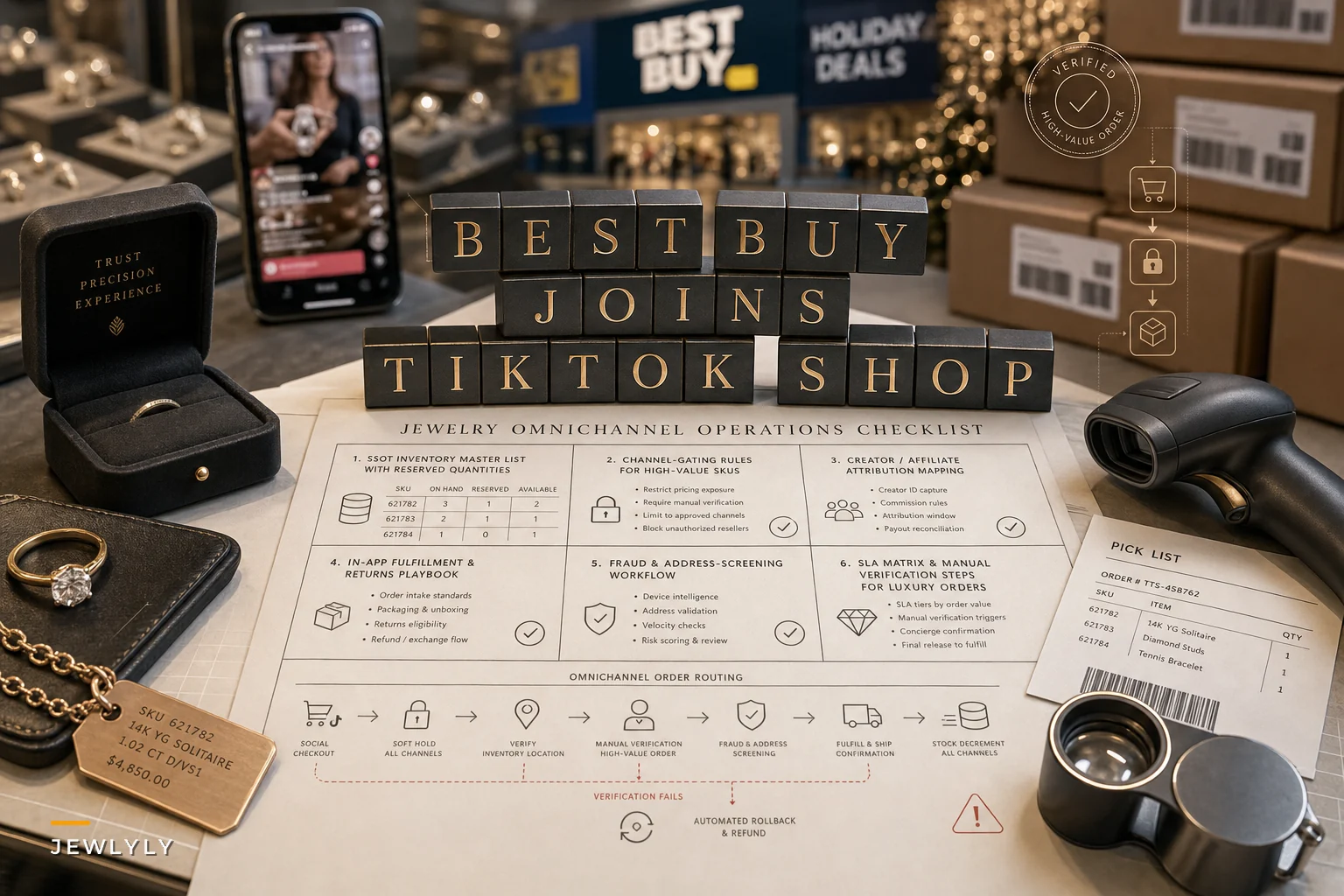

When Best Buy confirmed it's opening a TikTok Shop storefront with roughly 10,000 products and in-app checkout, most people read it as another "big retailer chases trend" headline. The Best Buy press release framed it as a discovery play — creators showing products, viewers buying without leaving the app. Retail Dive's coverage added the obvious holiday-timing angle.
But if you run a jewelry store — one location or six — the interesting part isn't Best Buy. It's what their move normalizes. When a retailer that size puts in-app checkout front and center going into Q4, it pulls buyer behavior with it. Someone who watched a creator show off a pendant used to screenshot it, maybe visit your site a day or two later. Now the expectation is: tap, buy, done. For a category where a single order can be $1,800 or $12,000, that compressed path creates problems you simply don't have with a $40 phone case.
This article isn't about whether you should be on TikTok Shop. It's about what breaks operationally the moment social-driven impulse buying collides with high-value, often one-of-a-kind inventory — and how to prepare before the demand actually shows up.
The core tension: impulse-speed demand against slow-moving, unique stock
Electronics are the easy case for social commerce. Thousands of identical units. If a creator video goes sideways and sells 400 of something overnight, inventory depth usually absorbs it.
Jewelry doesn't work that way. A meaningful chunk of what you sell is either single-quantity or close to it. That estate piece, that custom-finished band, that specific diamond with a cert attached — there's one. When discovery and checkout happen in the same three-second window inside an app you don't fully control, the thing most likely to fail is the assumption that keeps everything else honest: that your stock count is accurate right now.
What tends to happen across retailers who add a fast social channel without preparing is a pretty predictable sequence. A piece gets featured. It sells in-app. It also sold in-store ninety minutes earlier, but the sync hadn't caught up. Now you've got a customer who watched a creator, paid instantly, got a confirmation email — and you have nothing to ship. That's not a minor refund situation. That's a chargeback risk plus a trust hit on a channel where reputation spreads fast.
This is exactly the failure mode that a proper omnichannel architecture that prevents double-sells is built to stop, and adding a social checkout layer makes it non-negotiable rather than nice-to-have.
Where social orders actually differ from your normal online orders
It's tempting to treat a TikTok Shop order like any other ecommerce order and route it through the same pipe. That's where most of the operational mess starts. The differences are subtle but they compound.
Never miss a sale or shipment again.
Jewlyly helps you manage orders, track inventory, and engage customers seamlessly.
- Real-time inventory tracking
- Automated customer notifications
- Sales and order analytics
No credit card required
| Dimension | Your normal web order | Social / in-app order |
|---|---|---|
| Buyer intent | Researched, often warmed up | Impulse, creator-influenced |
| Time from interest to purchase | Hours to days | Seconds to minutes |
| Attribution | Clear channel | Tied to a specific creator/affiliate |
| Return likelihood | Moderate | Higher (emotional purchase, sizing guesses) |
| Fraud/chargeback exposure | Lower | Higher on impulse high-ticket |
| Trust signals buyer saw | Your full product page | A short video, maybe no cert visible |
That last row is the sneaky one. On your own product page you control what the buyer sees — certification, appraisal notes, metal stamp, return policy. In a creator video, the buyer might commit $4,000 having seen fifteen seconds of good lighting and a confident caption. The gap between "what they think they bought" and "what actually arrives" tends to be wider, which is what drives both returns and disputes.
The real underlying problem: your inventory has to tell the truth faster than people can buy
Everything downstream — fulfillment, returns, attribution, fraud — depends on one thing. Can your systems reflect that an item is gone fast enough that a second channel can't sell it again?
For most independent jewelers, the honest answer is "not in real time." The POS knows one thing, the website feed updates on a schedule, and now you're adding a third surface that assumes instant availability. In practice, this usually breaks when a piece lives in a case at one location, is listed online, and gets featured by a creator the same weekend. Three places think they can sell it.
A workable response isn't complicated. It's a single source of truth where stock status is authoritative and every channel reads from it, plus temporary holds that fire the instant a checkout starts — not after it completes. If you already handle this for your web store and in-store POS, you're most of the way there. Social just adds a faster, less forgiving buyer on top.
A realistic order-routing flow worth setting up before the season
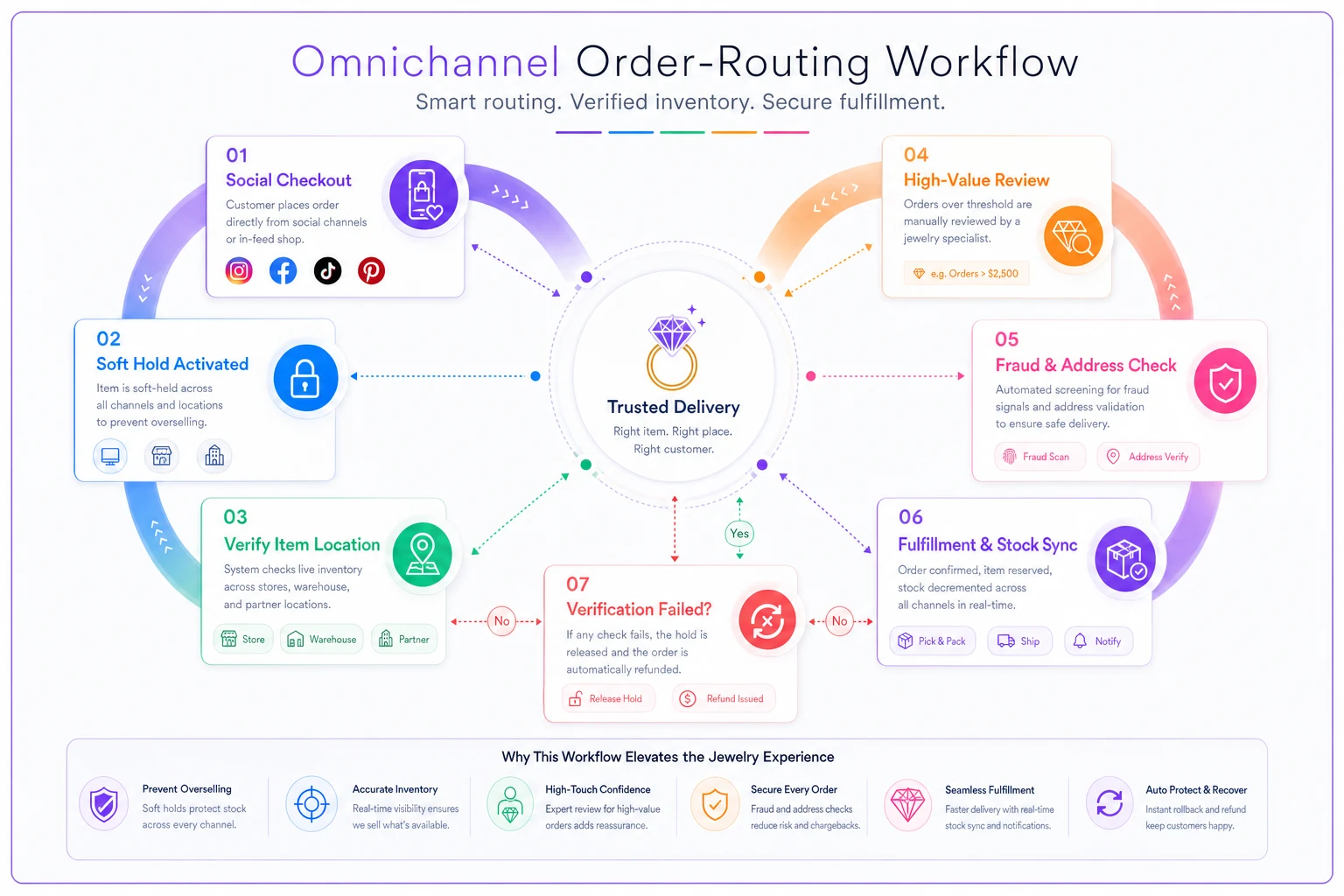
A simple flow visualization helps teams implement the hold/verify/fulfill steps.
-
Checkout initiates on TikTok Shop → system places an immediate soft hold on that SKU across all channels.
-
Hold verified against physical location — which store or safe actually has it? Route the fulfillment task there.
-
High-value threshold check — orders above a set dollar amount (say $2,500) flag for a quick manual verification step before a shipping label gets generated.
-
Fraud/address screen runs, especially for first-time buyers and rush-shipping requests.
-
Fulfillment confirmed → stock decrements everywhere simultaneously; hold converts to a sale.
-
If verification fails or item is actually unavailable → automated graceful cancel with immediate refund, before the chargeback clock starts.
The point of the manual step at #3 isn't to slow everything down. It's that impulse buyers of expensive things are exactly the population you want a human glancing at before a $9k ring leaves the building.
A pre-season checklist for social-channel readiness
Use this to find the gaps before a viral video does it for you:
-
Single source of truth confirmed — one system owns stock status; the social channel reads from it, not from a stale export.
-
Soft holds on checkout start, not checkout completion, to kill double-sells on unique items.
-
High-value verification threshold defined and staffed during the hours creator content tends to spike (evenings, weekends).
-
Return policy written specifically for social orders — sizing, resizing window, what counts as "as described" for an item seen first in a video.
-
Creator/affiliate attribution mapped so you can actually tell which content drove which sale and what it cost you in commission.
-
Trust signals embedded in listings — cert images, appraisal references, metal stamps — because the video won't carry them.
-
Fraud rules tuned for impulse behavior — new buyer + high ticket + expedited shipping should raise a flag, not auto-ship.
-
Local assortment reviewed — if a creator can drive demand to a specific piece, which location holds it, and can you fulfill or transfer fast?
-
Pickup/appointment flow decided — can a social buyer choose in-store pickup, and does your appointment system know about that order?
Staff a verifier during peak creator hours to handle manual checks quickly without blocking all fulfillment.
Pickup/appointment flow decided — can a social buyer choose in-store pickup, and does your appointment system know about that order?
A short real scenario
A two-location independent jeweler decided to test creator content ahead of the holidays — nothing huge, a few partnerships with local creators showcasing in-stock pieces. Before they tightened anything up, roughly 1 in 6 social orders hit some kind of snag: an item already sold in-store, a sizing mismatch, a buyer disputing because the piece "looked different" than the clip.
The fixes weren't dramatic. They moved stock status to a single authoritative source so both the website and the social listings read the same count, added an immediate hold at checkout start, and set a manual verification touch on anything over about $2,500. They also started dropping cert and appraisal images directly into every social listing.
After a few weeks, the snag rate on social orders dropped to something closer to 1 in 20, and the "looked different" disputes mostly dried up once buyers saw the documentation upfront. Not a revenue miracle — just far fewer avoidable messes during the busiest stretch of the year, which matters a lot when you're short-staffed in December.
When jumping on social commerce actually makes sense — and when it doesn't
It makes sense when you have reliable real-time inventory, enough depth or fast enough fulfillment to handle a demand spike on a featured item, and someone available to watch high-value orders during peak content hours. It also makes sense if a solid chunk of your assortment is repeatable — stud earrings, popular stacking bands, branded pieces — where depth gives you a cushion.
It's a bad idea when your inventory sync still runs on a schedule and you can't trust the count, or when nearly everything you sell is one-of-a-kind with no backup. Featuring a single estate piece to a large audience is a recipe for ten disappointed buyers and one sale. In that case, use social for discovery that drives people into an appointment or a conversation — not instant checkout.
Who should probably hold off entirely: any shop where a double-sell or a shipping miss on a $5k order would genuinely damage the business or the owner's capacity to function. Get the single source of truth and the hold logic solid first. The channel will still be there.
The takeaway for the holiday run-up
Best Buy's move is a signal, not a mandate. What it really tells high-value retailers is that buyers are getting comfortable committing serious money inside social apps, fast, often on emotion. For jewelry, where stock is thin and documentation matters, the speed of the channel is the risk — and the only reliable defense is inventory that tells the truth faster than someone can tap "buy."
Sort that out before you chase the content. The stores that handle social commerce well in Q4 won't be the ones with the best videos. They'll be the ones whose back-end quietly never oversells, never ships the wrong thing, and never leaves a buyer wondering why the ring looks nothing like the clip.
Sort that out before you chase the content. The stores that handle social commerce well in Q4 won't be the ones with the best videos. They'll be the ones whose back-end quietly never oversells, never ships the wrong thing, and never leaves a buyer wondering why the ring looks nothing like the clip.
Ready to elevate your jewelry store operations?
Join 500+ jewelers using Jewlyly to increase efficiency, reduce errors, and grow revenue.